

Rugby
Mastering Support Running and Angles: The 3-Phase Attack Drill
Develop your team's ability to run intelligent support lines, break the gain line, and recycle quick ball with this comprehensive 3-phase attacking drill.

What you need
4-6 Rugby balls, 10-15 Cones, Pinnies/Bibs
1. Overview
Effective support running is the lifeblood of a dynamic rugby attack. This drill focuses on developing the critical skills needed to maintain continuity, manipulate defenses, and break the gain line. By emphasizing flat support lines, deep arcs, and sharp inside-to-outside angles, players will learn how to read the ball carrier, anticipate the pass, and exploit gaps in the defensive line. This drill is ideal for integrating your backline (10, 12, 13, 11, 14) and loose forwards (7, 8) into a cohesive attacking unit.
2. Setup
Equipment Needed:
- 4-6 Rugby balls
- 10-15 Cones (for marking the grid and starting positions)
- Pinnies/Bibs (for defenders)
Pitch Setup:
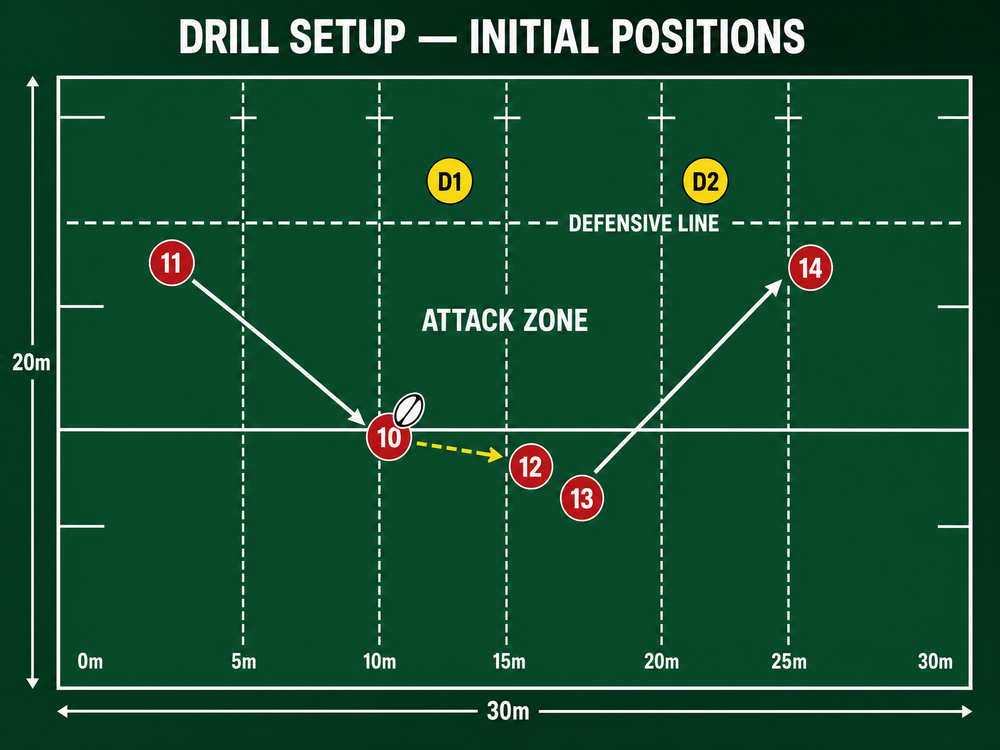
- Mark out a 30m x 20m attacking grid for the initial phases.
- Extend the grid to 40m x 22m for the progression phase.
- Clearly mark the 'Gain Line' across the middle of the grid.
Player Positions:
- Attackers: Fly-half (10), Inside Centre (12), Outside Centre (13), Left Wing (11), Right Wing (14).
- Defenders: 2-3 defenders (D1, D2, D3) starting 8m ahead of the attacking line.

3. Step-by-Step Instructions
- Initial Alignment: The fly-half (10) starts with the ball. The inside centre (12) positions 3m to the right and 1m deep. The outside centre (13) is wider and deeper. The wings (11, 14) hold width.
- The Trigger: On the coach's whistle, the 10 attacks the defensive line (D1), drawing the defender before passing to the 12.
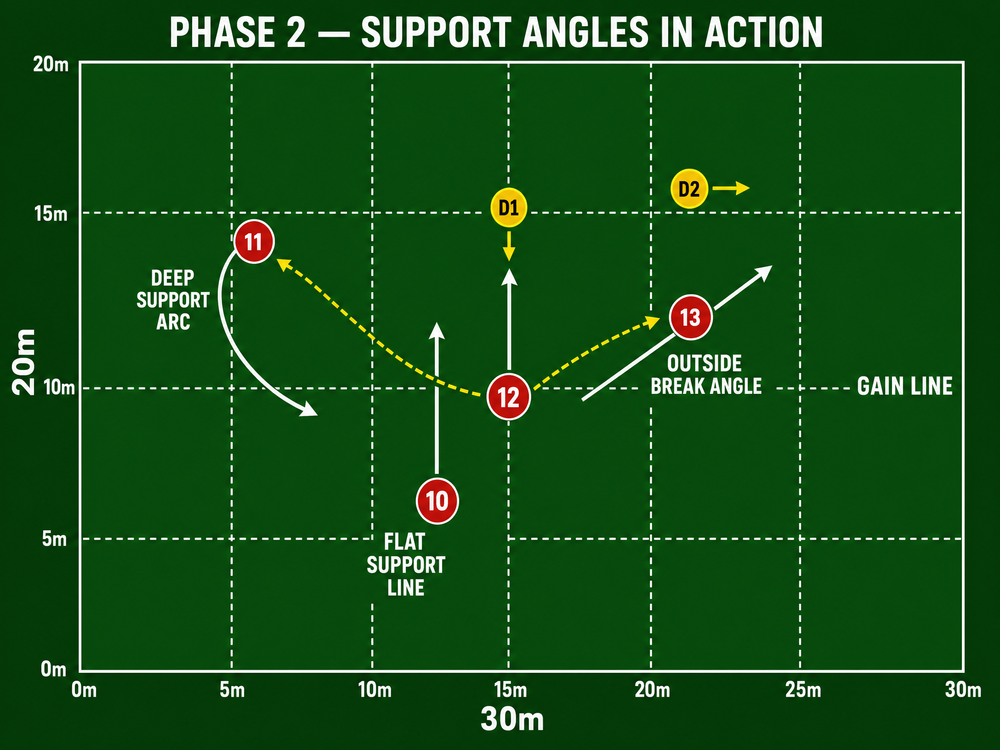
- Executing Angles: As the 12 receives the ball, the support runners must react immediately. The 10 wraps around to run a flat support line behind the 12. The 13 cuts a sharp inside-to-outside angle to target the gap between D1 and D2.
- The Decision: The 12 must read the defense. If D2 drifts out, the 12 hits the 13 on the short angle. If D2 bites in, the 12 throws a wider pass to the 14 or the wrapping 10.
- Completion: The sequence ends when a clean break is made or a simulated tackle occurs past the gain line.
4. Key Coaching Points
- Timing is Everything: Support runners must time their runs to arrive at the ball carrier exactly as the pass is made, not before. Arriving too early kills the space.
- Communicate Early and Loud: Support runners must call for the ball, indicating their position (e.g., "Flat!", "Short!", "Wide!").
- Square Shoulders: The ball carrier (12) must keep their shoulders square to the try line to commit the defender before passing.
- Depth is Crucial: Starting too flat limits options. Attackers must start deep enough to accelerate onto the ball at pace.
- Run Hard Lines: The decoy or support lines must be run with 100% commitment to force the defense to make a decision.
5. Common Mistakes
- Drifting Sideways: Attackers running across the pitch instead of straightening the line, allowing the defense to drift easily.
- Overrunning the Ball Carrier: Support runners getting ahead of the ball carrier, taking themselves out of the play.
- Passing Before Committing: The ball carrier passing too early, allowing the defender to slide off and tackle the receiver.
- Silent Running: Lack of communication from support players, forcing the ball carrier to guess their locations.
6. Variations & Progressions
Progression 1: Second Phase & Recycled Ball
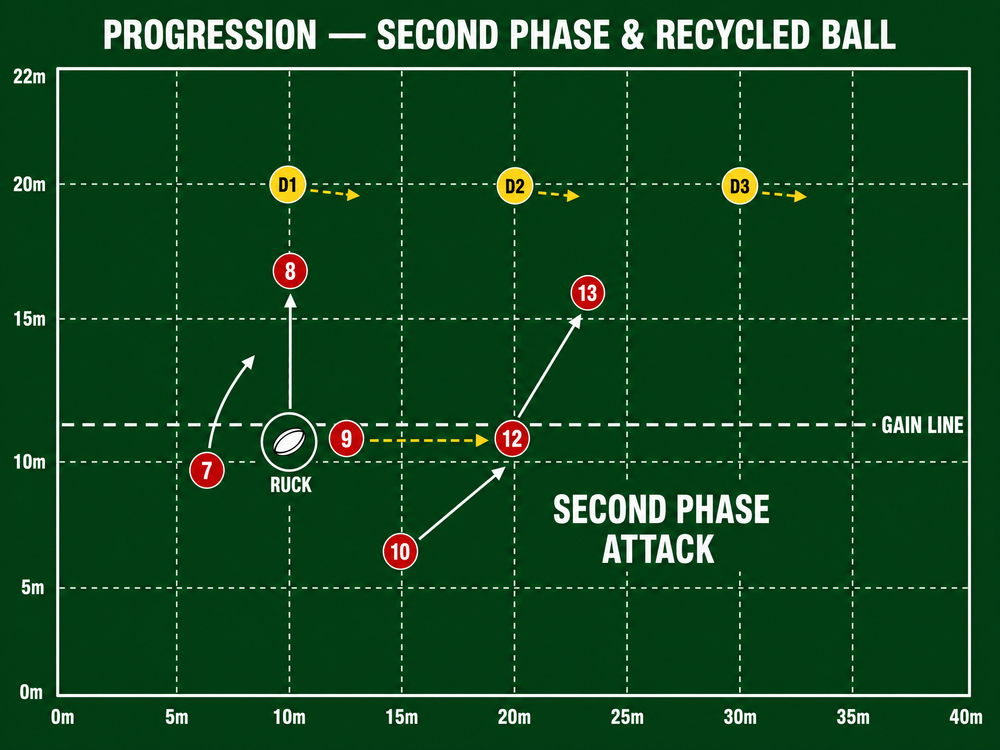
Introduce a ruck scenario. After the initial break, the ball carrier goes to ground. The scrum-half (9) arrives to clear the ball. The forwards (7, 8) and remaining backs must quickly realign to run new support angles off the 9 or the next receiver (12).
Variation 1: Unstructured Play
Instead of a set starting formation, have the attackers jog randomly in a designated area. On the whistle, the coach throws the ball to a random player, and the attacking line must instantly organize and execute support lines against a live defense.
7. Age Adaptations
- Under 10s: Focus purely on running straight and passing backward. Use only one defender to build confidence. Emphasize calling the receiver's name.
- Under 14s: Introduce the concept of the 'flat' and 'deep' support options. Begin focusing on the timing of the run.
- Under 16s & Open: Run the full drill at match intensity. Demand precise angles, rapid realignment for multi-phase play, and complex decision-making under pressure.
