

Cricket
T20 Innings Acceleration Blueprint: Maximizing Run Rate Through Phased Aggression
A complete tactical framework to help your batting unit seamlessly transition from consolidation to maximum acceleration in the crucial middle and death overs of a T20 match.

What you need
2-3 sets of stumps, 24 high-quality practice balls, Batting gear, Fielding cones/markers, Whiteboard/clipboard
1. Overview
In modern T20 cricket, the ability to systematically accelerate an innings is the difference between a par score and a match-winning total. The T20 Innings Acceleration Blueprint provides coaches with a structured framework to train batsmen in the art of shifting gears.
This set play focuses on moving from the consolidation phase (overs 7-12) into the acceleration phase (overs 13-16) and finally the death overs blitz (overs 17-20). By dividing the innings into distinct zones and assigning specific roles, coaches can eliminate panic and replace it with calculated, high-percentage power hitting. This resource is designed to help your top and middle-order batters understand when to rotate strike, when to target specific boundaries, and how to manipulate field placements to maximize scoring opportunities.
2. Setup
To effectively run this set play in a training environment, you must replicate match conditions as closely as possible.
Pitch and Field Dimensions
- Standard 22-yard pitch on an oval ground.
- Mark a 30-yard inner circle using cones or markers.
- Set boundary ropes at 65-70 meters depending on the age group and skill level.
Equipment Needed
- 2-3 sets of stumps.
- Minimum of 24 high-quality practice balls (white or pink).
- Batting gear for all participating players.
- Cones to mark specific target zones on the field (V-Zone, Square Zone, Rotation Zone).
- A whiteboard or clipboard for displaying the target score and required run rate.
Player Roles
- Anchor (Positions 1-3): Focuses on strike rotation and batting deep into the innings.
- Aggressor/Finisher (Positions 4-7): Tasked with boundary hitting and clearing the ropes in the final overs.
- Bowlers (4-6): Instructed to bowl specific phases (powerplay, middle overs, death).
- Fielders (11): Placed according to the specific phase being simulated.
3. Step-by-Step Instructions
Run this simulation in three distinct blocks, mimicking the flow of a T20 innings.
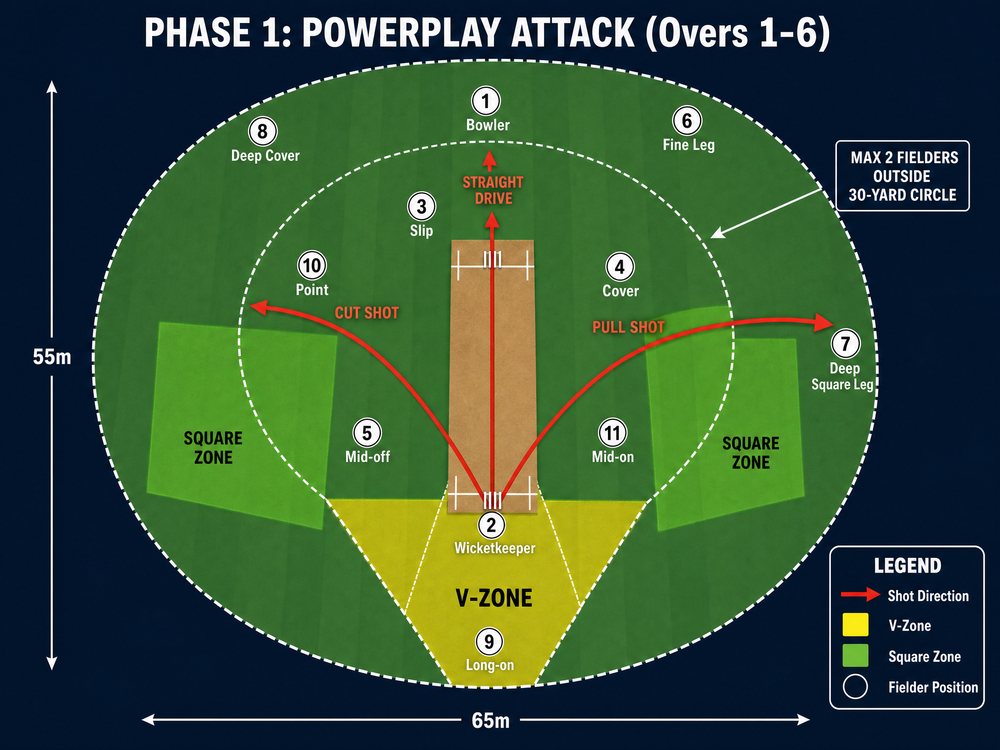
Phase 1: Powerplay Attack (Overs 1-6)

- Set the Field: Place only two fielders outside the 30-yard circle (e.g., Deep Square Leg and Deep Cover). Keep the rest inside the ring to save singles.
- Batting Objective: The opening pair must exploit the fielding restrictions. Instruct them to target the 'V-Zone' (straight down the ground) and the 'Square Zone' (cut and pull shots).
- Execution: Bowlers should bowl hard lengths. Batters must look to hit over the in-fielders rather than running hard between the wickets.
- Target: Aim for a run rate of 8-9 runs per over during this phase.
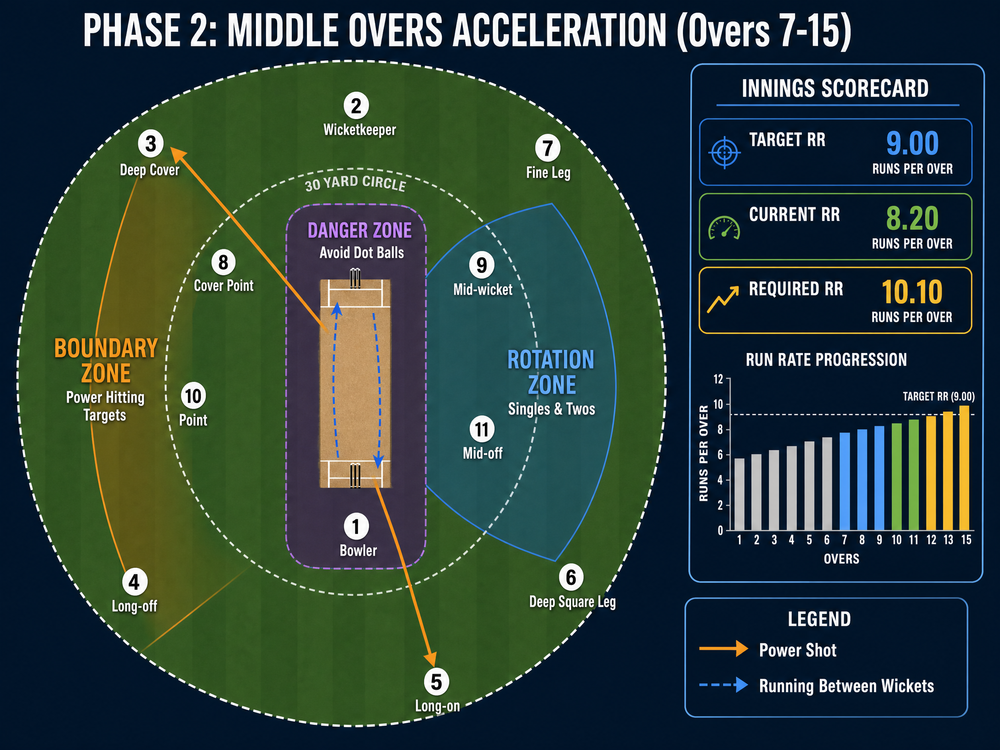
Phase 2: Middle Overs Consolidation & Acceleration (Overs 7-15)
- Set the Field: Push five fielders out to the boundary (e.g., Long-on, Long-off, Deep Mid-wicket, Deep Cover, Deep Square Leg).
- Batting Objective: Transition from boundary hitting to aggressive strike rotation. The focus shifts to the 'Rotation Zone'.
- Execution: Batters must look for singles off the first two balls of the over by hitting into gaps (e.g., to mid-wicket or cover point). Once the strike is rotated, the set batter looks for a boundary in the 'Boundary Zone' off a loose delivery.
- Target: Maintain a run rate of 7-8 runs per over without losing more than one wicket.
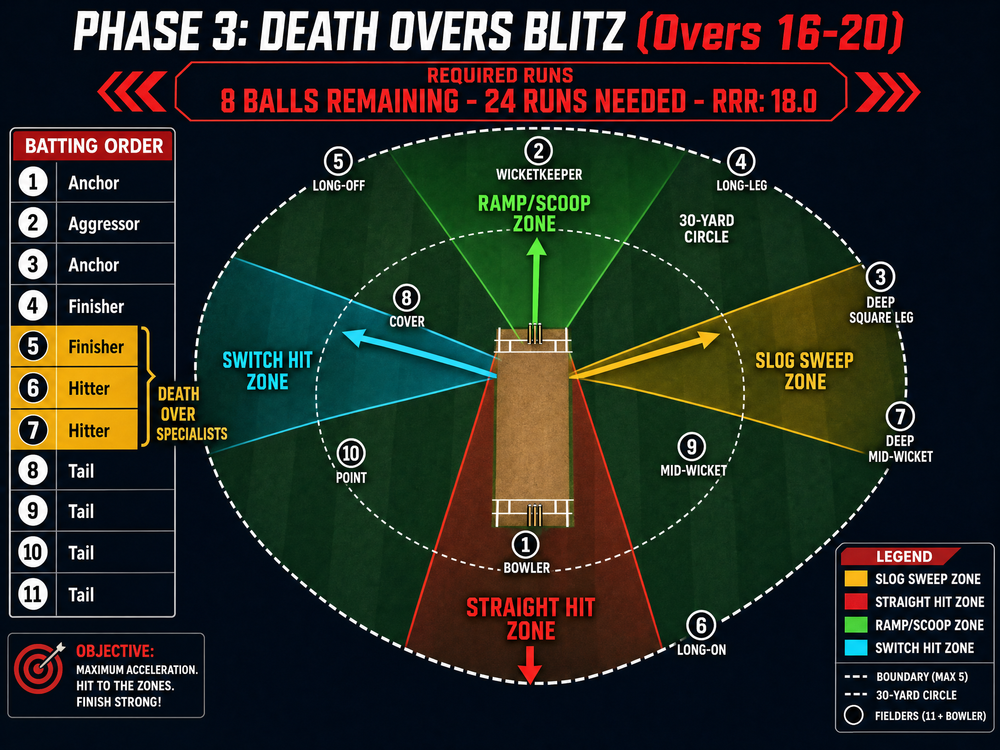
Phase 3: Death Overs Blitz (Overs 16-20)
- Set the Field: Maintain five fielders on the boundary, but adjust based on the bowler's plan (e.g., bring fine leg up and push third man back for wide yorkers).
- Batting Objective: Maximum acceleration. The 'Death Over Specialists' (batting at 5, 6, and 7) must target the 'Power Hitting Target Zones' (Slog Sweep, Straight Hit, Ramp/Scoop, Switch Hit).
- Execution: Bowlers execute yorkers, slower balls, and wide lines. Batters must use the depth of the crease, pre-meditate shots based on the field, and look to clear the boundary at least twice an over.
- Target: Aim for 10-12+ runs per over.
4. Key Coaching Points
- Intent Over Technique: In the acceleration phase, positive intent and bat speed are more critical than perfect defensive technique.
- Accessing the Crease: Teach batters to use the depth of the crease (moving back) or stepping out to turn yorkers into half-volleys or full tosses.
- Targeting Matchups: Instruct batters to identify the weakest bowler or the bowler bowling into the wind and target them for maximum runs.
- Running Hard: Even in the death overs, turning ones into twos puts immense pressure on boundary riders and forces fielding errors.
- 360-Degree Scoring: Encourage batters to develop shots behind the wicket (ramps, scoops) to counter defensive wide bowling.
5. Common Mistakes
- Pre-meditating Too Early: Batters deciding on a shot before the ball is released, leading to dismissals if the bowler changes pace or line.
- Swinging Across the Line: Trying to hit straight balls to the leg side, resulting in bowled or LBW dismissals. Encourage hitting straight in the V.
- Ignoring Strike Rotation: Focusing solely on boundaries in the middle overs, leading to dot ball pressure and eventual panic.
- Poor Communication: Lack of calling between wickets, resulting in run-outs during crucial acceleration phases.
6. Variations & Progressions
- The Chokehold Scenario: Start the simulation at Over 12 with the team 3 wickets down and the run rate climbing. This forces the middle order to rebuild while simultaneously accelerating.
- Target Practice: Place specific point-scoring zones on the boundary (e.g., 10 points for hitting over long-on). Reward batters for hitting specific target areas rather than just generic boundaries.
- Restricted Scoring Areas: To develop 360-degree play, ban scoring in the V-zone for two overs, forcing batters to use sweeps, reverse sweeps, and cuts.
7. Age Adaptations
- Under 10 / Under 12: Focus purely on running between the wickets and hitting the ball straight. Use softer balls and shorter boundaries. Do not introduce complex 360-degree shots.
- Under 14 / Under 16: Introduce the concept of targeting specific fielders and gaps. Begin teaching the slog sweep and using the crease to manipulate length.
- Open / Senior: Full implementation of the blueprint, including advanced analytics (matchups), 360-degree shot execution, and high-pressure death bowling scenarios.
