

Netball
Wing Attack Feeding Patterns & Circle Edge Drives
Master the art of the Wing Attack position by developing explosive leads, decisive circle edge drives, and precision feeding into the shooting circle.
What you need
1 Netball, 4 Cones, Bibs (WA, C, GA, GS)
Overview
The Wing Attack (WA) is the primary playmaker in the attacking third, responsible for linking the midcourt to the shooters. This comprehensive drill focuses on developing the WA's ability to execute explosive leads, secure the ball on the circle edge, and deliver precision feeds to the Goal Shooter (GS) or Goal Attack (GA). By mastering these feeding patterns, your attacking unit will become more dynamic, unpredictable, and effective at penetrating the shooting circle.
This drill is designed to simulate match intensity, challenging the WA to read the play, time their drives perfectly, and execute high-quality passes under pressure. It is ideal for intermediate to advanced teams looking to refine their attacking connections.
Setup
To run this drill effectively, you will need a standard netball court (30.5m x 15.25m) and the following equipment:
- 1 Netball
- 4 Cones (optional, for marking starting positions if players need visual cues)
- Bibs for WA, C, GA, and GS (defenders can be added later)
Player Positions:
- Centre (C): Starts with the ball in the centre third, near the transverse line.
- Wing Attack (WA): Starts in the attacking third, positioned near the left wing boundary.
- Goal Attack (GA): Starts inside the attacking third, positioned on the right side.
- Goal Shooter (GS): Starts inside the shooting circle (4.9m radius).
Step-by-Step Instructions
Phase 1: The Initial Lead and Receive
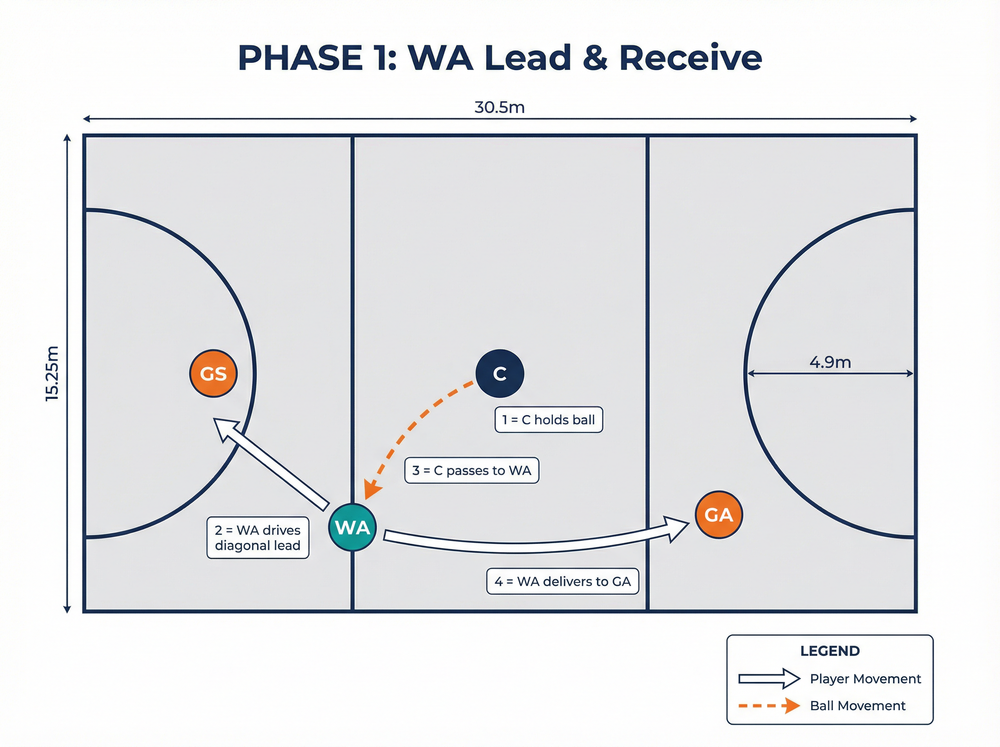
- Starting Position: The C holds the ball just outside the attacking third. The WA is positioned wide on the left wing.
- The Drive: The WA executes a sharp, diagonal drive forward toward the top of the shooting circle. The movement must be explosive, aiming to lose an imaginary (or real) Wing Defence.
- The Pass: As the WA hits the top of their drive, the C delivers a crisp, chest-height pass into the space ahead of the WA.
- The Catch: The WA receives the ball cleanly on the move, ideally landing with balanced footwork near the circle edge.
- The Delivery: Immediately upon landing, the WA turns and delivers a quick pass to the GA, who has made a supporting drive.
Phase 2: Double Lead and Circle Feed
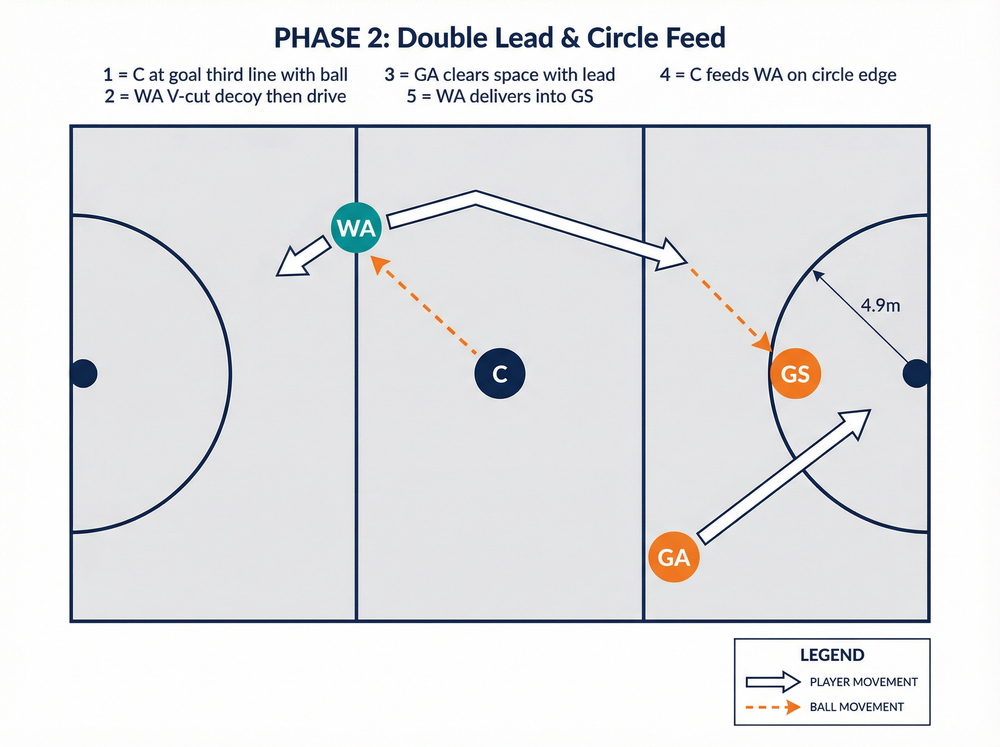
- The Decoy: This phase introduces a more complex movement. The WA starts by making a sharp V-cut—a short, explosive movement away from the goal to draw the defender out of position.
- The Strong Drive: Immediately after the decoy cut, the WA drives hard diagonally toward the edge of the shooting circle.
- Clearing Space: Simultaneously, the GA makes a lead from the right side toward the centre of the goal third, drawing their defender away and opening up space for the WA.
- The Feed: The C passes the ball to the WA, who catches it securely right on the circle edge.
- The Final Delivery: The WA quickly spots the GS holding position under the post and delivers a precision pass (e.g., a lob or a bounce pass) into the shooting circle.
Key Coaching Points
- Explosive First Step: The WA must use a powerful first step to initiate their drive. A slow or predictable lead makes it easy for the defender to intercept.
- Strong Angles: Encourage the WA to run strong, sharp angles rather than curved, looping runs. Sharp angles are harder to defend and create clearer passing lanes.
- Vision and Awareness: Before receiving the ball, the WA should already be scanning the circle to locate the shooters. This allows for a rapid, seamless feed upon catching.
- Balanced Landing: The WA must land with strong, balanced footwork on the circle edge. Being off-balance leads to inaccurate passes or footwork penalties.
- Pass Selection: The WA needs to choose the right type of pass (chest, bounce, or lob) based on the GS's position and the defensive pressure.
Common Mistakes
- Running Too Early: The WA drives before the C is ready to pass, resulting in the WA running out of space and ending up flat on the transverse line.
- Drifting Off the Circle Edge: The WA catches the ball too far away from the shooting circle, making the feed into the shooters much more difficult and easily intercepted.
- Tunnel Vision: The WA only looks at one shooter and ignores the other option, making the attack predictable.
- Weak Decoy Moves: The initial V-cut in Phase 2 is performed half-heartedly, failing to move the defender and create genuine space for the second drive.
Variations & Progressions
- Add Defenders: Introduce a Wing Defence (WD) to mark the WA, and a Goal Defence (GD) to pressure the GA. This forces the WA to work harder for the ball and make decisions under pressure.
- Time Limits: Implement a 3-second rule for the WA to release the ball into the circle, increasing the intensity and simulating match conditions.
- Alternative Starting Positions: Have the WA start from different areas of the court (e.g., centre third) to practice varied leads and angles.
Age Adaptations
- Under 10s: Focus primarily on Phase 1. Ensure the WA is running straight, strong leads and catching the ball cleanly before turning to look for the pass. Use cones to guide their running paths.
- Under 14s: Introduce the Phase 2 V-cuts and decoy movements. Begin adding passive defenders to encourage spatial awareness and decision-making.
- Open/Advanced: Run the full drill with active defenders on all players. Focus on high-speed execution, split-second decision making, and advanced passing techniques (e.g., no-look passes or rapid give-and-gos).
