

Rugby
Wide Overlap Strike: Lineout to Edge Finish
A devastating attacking set play designed to manipulate the defensive line off a 4-man lineout, creating a decisive 3v1 overlap for your wingers to exploit.
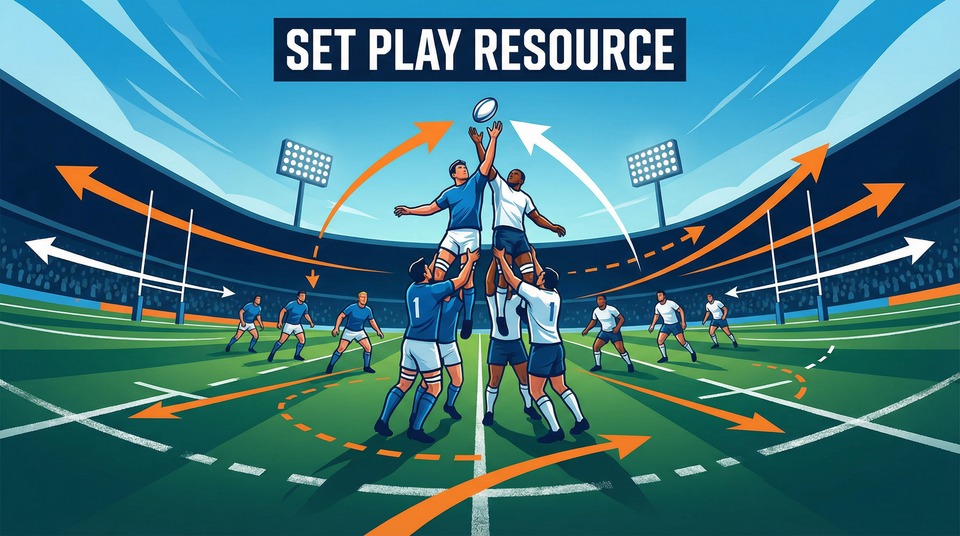
What you need
Rugby balls, Cones for marking zones, Bibs for defensive team
1. Overview
This set play is engineered to stretch the defensive line horizontally and create a numerical mismatch on the far edge. Executed off a 4-man lineout, the move relies on a decoy pod to freeze the inside defenders, rapid ball movement through the midfield, and a perfectly timed inside support run from the fullback to create a 3v1 scenario in the wide channel. It is highly effective when the opposition defends with a narrow lineout and fails to fold quickly.
2. Setup

- Pitch Location: Attacking half, ideally between the 22m and halfway lines, with the lineout set on the touchline.
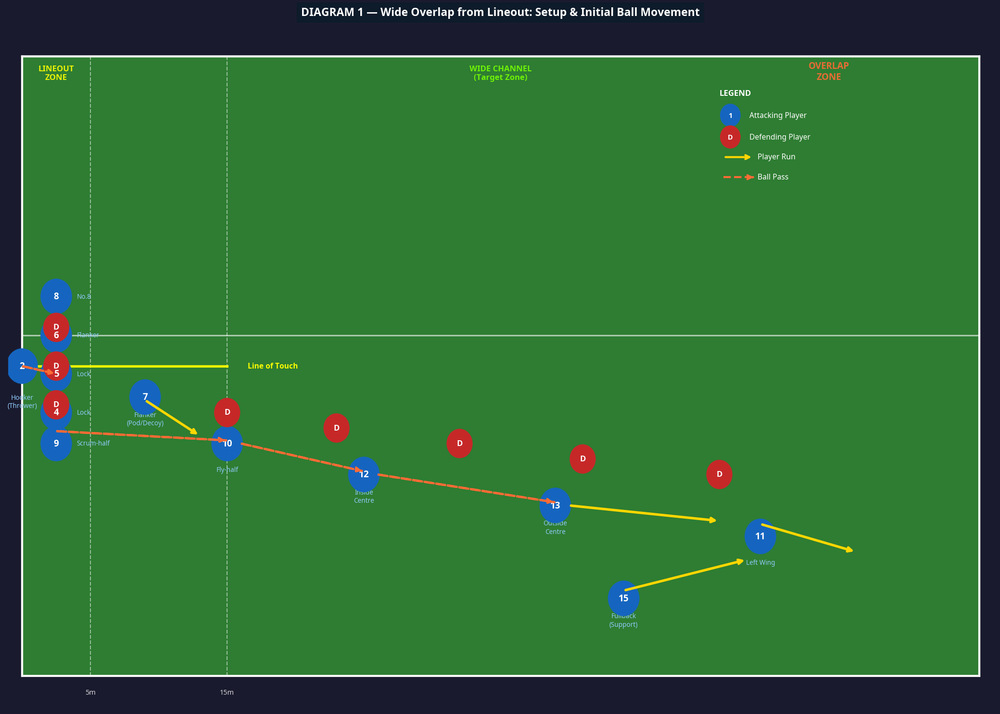
- Personnel: 4-man lineout (Hooker throwing, two Jumpers, one Lifter/Support). A dedicated decoy pod (typically the #7 Flanker) positioned 10m infield.
- Backline Alignment: Flat and deep. The Fly-half (#10) stands 10m from the lineout, Inside Centre (#12) at 20m, Outside Centre (#13) at 35m, and Left Wing (#11) hugging the far touchline. The Fullback (#15) holds a deep central position ready to inject pace.
3. Step-by-Step Instructions


- The Throw: The Hooker (#2) delivers a fast, flat throw to the middle jumper (#5) at the 4-man lineout.
- The Decoy: As the ball is won, the Flanker (#7) runs a hard, aggressive line directly at the inside shoulder of the defending Fly-half, drawing the attention of the first two defenders.
- Initial Distribution: The Scrum-half (#9) clears the ball swiftly to the Fly-half (#10), who immediately fires a flat, wide pass to the Inside Centre (#12), bypassing the decoy runner.
- Fixing the Defence: The Inside Centre (#12) carries the ball forcefully towards the gain line, fixing their opposite number before offloading to the Outside Centre (#13).
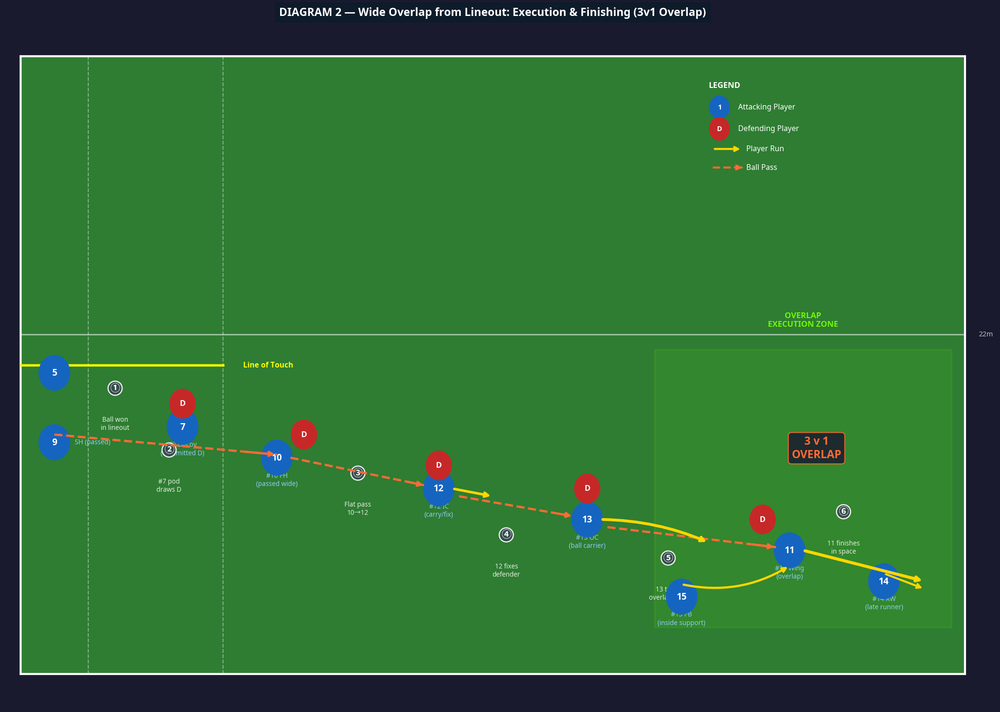
- Creating the Overlap: The Outside Centre (#13) runs an outward-angled line, forcing the last defender to make a decision. The Fullback (#15) injects pace on an inside support line, while the Left Wing (#11) holds their width.
- The Execution: With the final defender isolated, the Outside Centre (#13) executes the crucial pass to the Left Wing (#11) in space, who accelerates down the touchline to finish the play.
4. Key Coaching Points
- Decoy Conviction: The Flanker (#7) must genuinely look like they are receiving the ball. Their line and vocal call are critical to freezing the inside defence.
- Pass Speed: The transition from #9 to #10 to #12 must be seamless and rapid. Any hesitation allows the defence to drift and cover the wide channel.
- Squaring Up: The Inside Centre (#12) must run 'square' to the defensive line before passing. Drifting sideways will crowd the outside backs and close down the space.
- Fullback Timing: The Fullback (#15) must delay their entry until the ball reaches the #13. Arriving too early congests the channel; arriving too late neutralises the 3v1 advantage.
5. Common Mistakes

- Slow Lineout Delivery: A slow or contested lineout gives the defence time to set and fold, nullifying the play's intent.
- Drifting Midfield: If the #10 or #12 run laterally instead of attacking the gain line, they push the defence across and kill the overlap space.
- Forcing the Pass: If the final defender reads the play and commits to the winger early, the #13 must be prepared to step inside or use the Fullback (#15) on the support line rather than forcing a low-percentage pass.
6. Variations & Progressions
- Inside Ball Option: If the defence begins to anticipate the wide pass and drifts early, the #10 can slip a short pass to the #7 decoy runner crashing through the resulting gap.
- Miss Pass Finish: Instead of the #13 passing to the #11, the #12 can execute a long miss pass directly to the #11, bypassing the #13 entirely to catch a blitzing defence off guard.
7. Age Adaptations
- Under 12s: Focus purely on the catch-and-pass mechanics and the concept of drawing a defender before passing. Simplify the lineout to a basic uncontested throw.
- Under 14s/16s: Introduce the decoy runner and emphasize the importance of running square. Begin working on the timing of the Fullback's entry into the line.
- Open/Senior: Execute at full game speed with live defensive reads. Incorporate the variations based on how the opposition defensive system reacts.
