Basketball Drills
Football Pre Season Training Plan for Youth Teams
Build a winning football pre season training plan for youth teams. Discover phased drills, load management, and recovery tips to prepare players for success.
The cones are out, the footballs are pumped, and players arrive carrying very different versions of their summer. One looks ready to sprint, another needs time to rebuild confidence, and a third may be returning from illness or a niggle they haven't mentioned yet. A good football pre-season training plan doesn't treat those players as identical. It gives the whole squad a shared direction while allowing each player to progress safely.
Pre-season should develop more than fitness. It should restore movement quality, reconnect players with the ball, build team habits, and create an honest communication loop between coaches, players, and parents. The aim is simple: arrive at the first competitive fixture sharp, confident, and healthy, not exhausted before the season has started.
Structuring Your Four Week Pre Season Block
A player may return eager to impress yet struggle with basic football movements after time away. Start by restoring rhythm, not by testing limits. Players need to reconnect with the ball, teammates, and decision-making before demanding conditioning begins. In the UK, BBC Sport describes a pre-season block as typically about four weeks, while coaching guidance recommends at least three weeks of rest before pre-season starts so players return refreshed rather than carrying accumulated fatigue (BBC Sport's pre-season guidance).
Give each week a clear purpose
Treat the block like a staircase. Each step raises the demand while giving coaches room to adjust for players who start at different levels.
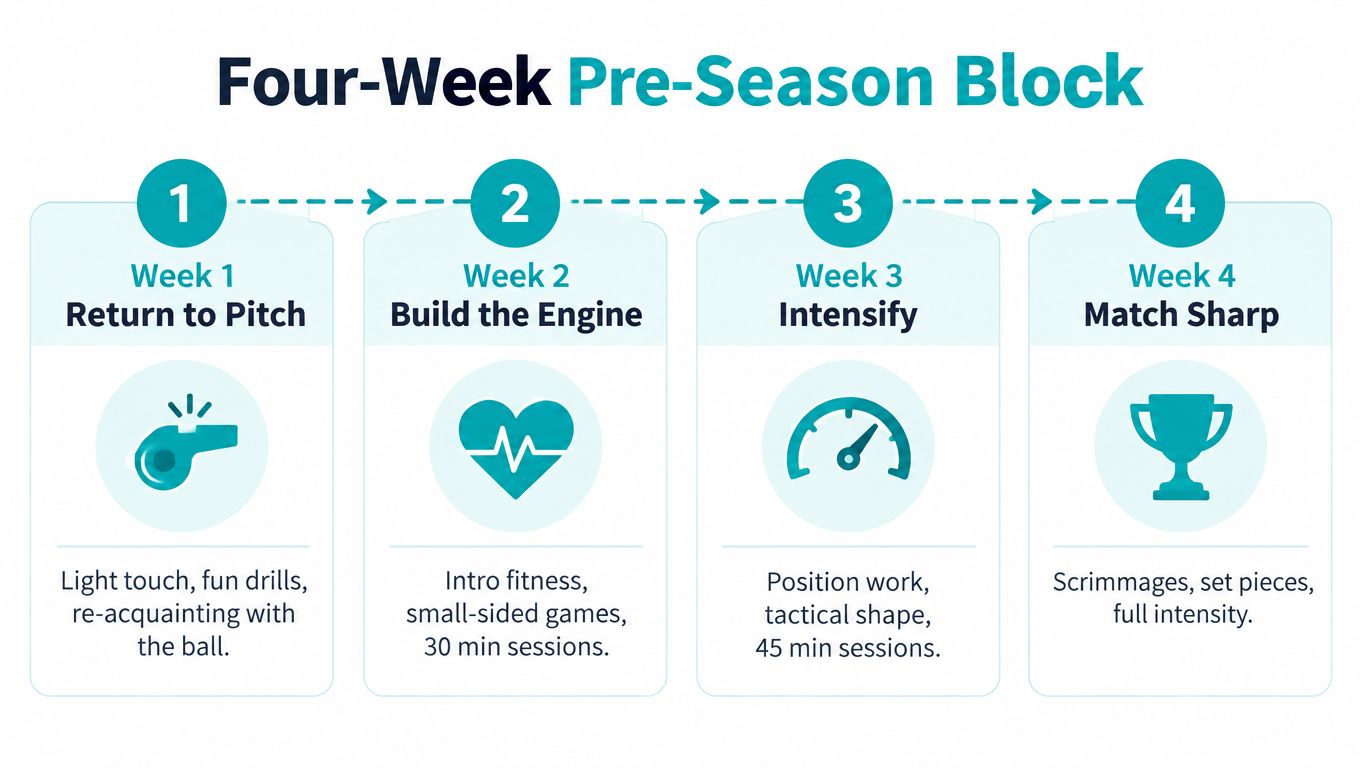
- Week 1, return and reconnect: Use low-intensity, high-volume reactivation through ball work, mobility, passing patterns, and enjoyable larger-sided games.
- Week 2, build capacity: Add purposeful fitness while keeping the ball central. Increase work gradually instead of turning every exercise into a test.
- Week 3, add intensity: Introduce sharper speed exposures, positional tasks, tactical shape, and more demanding small-sided play.
- Week 4, prepare to compete: Use controlled match situations, set pieces, and realistic game scenarios. Players should feel quick and organised, not flat.
The final four weeks of a UK plan should prioritise speed training and interval-based aerobic conditioning. Earlier work should progress from reactivation towards higher-intensity, lower-volume sessions. Set one or two objectives for each session, such as improving support angles or repeating accelerations with sound technique. Clear aims help players understand why the work matters (pre-season football training guide).
As running volume increases, check practical comfort as well as physical response. Players needing extra foot support can browse football-specific insoles from Insoles.com, then discuss fit and suitability with a parent, coach, or qualified professional. Coaches should record readiness notes and share relevant changes with families, creating a communication loop before a small concern becomes a missed session.
The Science of Progressive Load Management
A player may feel enthusiastic on the first day and still lack the physical readiness for repeated sprinting, sharp deceleration, and contact. Muscles, tendons, joints, and the nervous system adapt at different speeds. Progressive loading gives those systems time to respond, so the coach can build resilience without turning early enthusiasm into avoidable absence.
Research on English Premier League pre-season loading found that player work was commonly organised across six one-week microcycles. In a study of 30 players, overall daily training load changed little from week to week, yet the first mesocycle covered 1,304 metres more per day than the sixth, with a 95% confidence interval of 434 to 2,174 metres, showing how elite clubs can build early volume before tapering towards match readiness (Premier League training-load study).
Translate elite principles to youth football
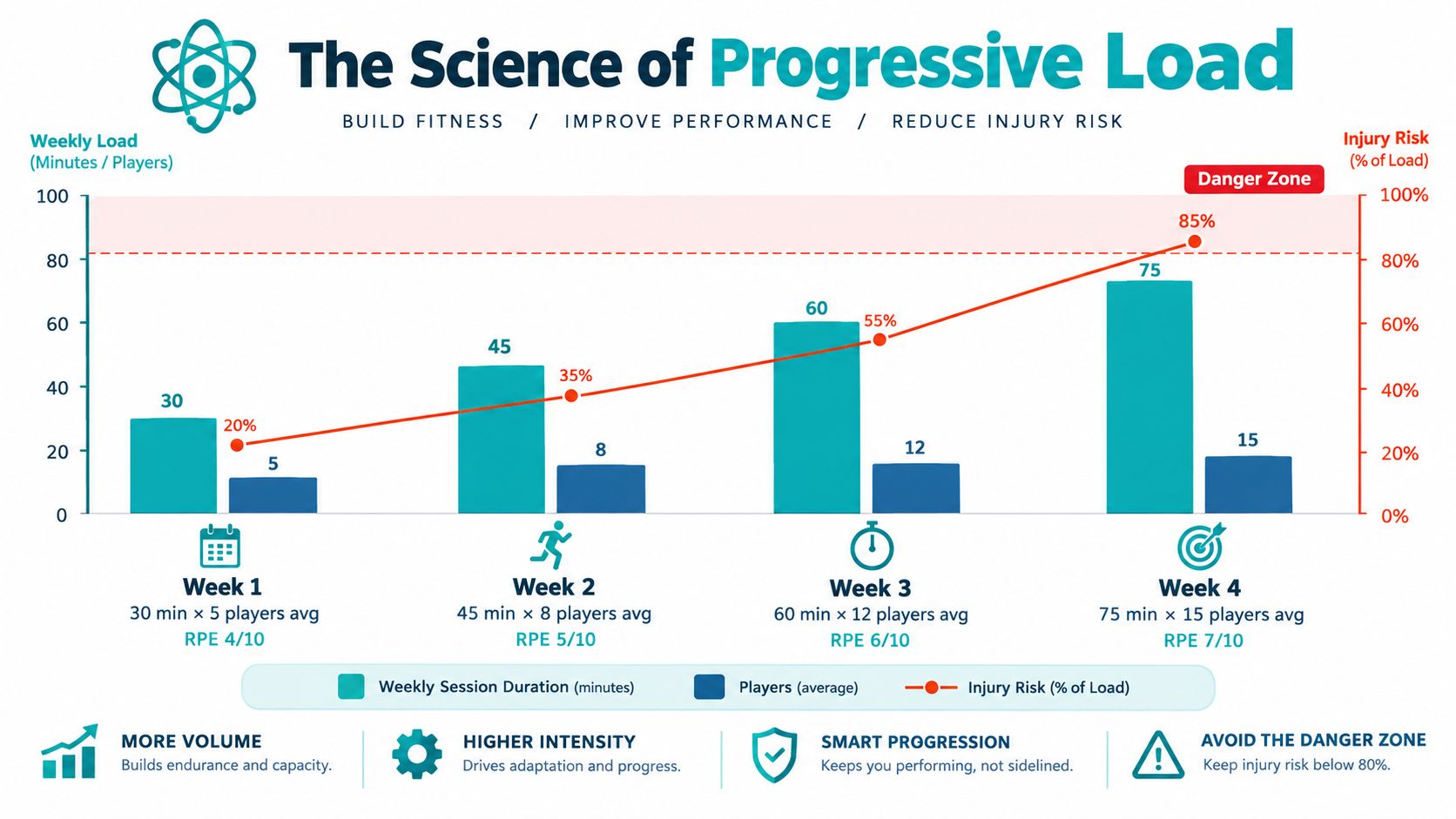
Youth coaches shouldn't copy an elite loading schedule. They should copy the principle of planned progression. Track a few useful signals, such as session duration, perceived exertion, sprint exposure, and how players respond the following day. A simple player rating after training can reveal that two athletes completing the same drill experienced very different demands.
The FA Medical Research Programme recorded 17% of all injuries across two seasons during pre-season, with an average absence of 22.3 days per injury (FA injury benchmark). That makes the opening weeks a poor time for punishment runs or surprise fitness tests. Experienced UK coaching guidance recommends progressive overload of about 10 to 20% per week in key load measures, while keeping the acute-to-chronic workload ratio around 0.8 to 1.3. Ratios above 1.5 are associated with sharply higher injury risk, so a sudden spike deserves attention rather than praise.
Practical rule: Increase one meaningful demand at a time. If the session becomes faster, don't also make it longer, more crowded, and more competitive without a clear reason.
A player who reports unusual soreness, poor movement, or declining concentration may need reduced volume while staying involved. Use a technical role, smaller work interval, or controlled recovery activity instead of removing the player from the group completely. For coaches building strength and endurance into the wider plan, this strength and endurance training resource offers a useful framework for connecting physical preparation with football actions.
Weekly Session Templates and Progressive Drills
A player arriving for the first session should recognise the game before facing demanding conditioning. Begin with larger-sided football, where shared movement and frequent touches distribute the work. Then reduce the space, group size, and duration of each bout as players become ready for sharper efforts. The FA grassroots progression example follows this principle, moving from two 10-minute blocks with three minutes of rest in Week 1 to two 12-minute blocks with the same recovery in Week 2. The change is modest by design. Coaches are building capacity rather than testing maximum intensity immediately.
A practical four-week progression
| Week | Format & Space | Conditioning Focus |
|---|---|---|
| Week 1 | 6v6 or 7v7 in a large area | Reintroduce movement, passing, scanning, and gentle changes of pace |
| Week 2 | Larger-sided games with slightly longer blocks | Build aerobic capacity through continuous ball-led activity |
| Week 3 | 4v4 in a smaller area after the previous larger-sided work | Develop repeated accelerations, decelerations, reactions, and quick decisions |
| Week 4 | Controlled matches, set pieces, and position-specific scenarios | Rehearse match intensity while managing total exposure |
The weekly format acts like a set of adjustable gears. England Football Learning advises starting with a large group in a large area during the opening weeks, then progressing towards smaller groups and spaces. After two weeks of 6v6 or 7v7, its guidance describes 4v4 as suitable for Week 3, with short explanations followed by ample practice (England Football Learning youth pre-season guidance).
Begin every session with a structured injury-prevention warm-up. WakeMed describes a 20-minute FIFA warm-up programme combining strength, plyometrics, and balance work, and reports that it can reduce injuries by up to 50% when completed before training (WakeMed FIFA warm-up information). Keep the work active and football-specific: controlled running, balance challenges, landing mechanics, changes of direction, and short accelerations prepare players for the first game.
Make the ball the teacher
In Week 1, coach spacing, support angles, and scanning rather than chasing fatigue. Week 2 can add transitions and changes of direction. Week 3 introduces competitive 4v4 games with clear recovery between bouts. Week 4 applies those habits to set pieces, positional tasks, and match scenarios, while coaches monitor each player's exposure.
Use the football basic drills collection to extend the progression without turning sessions into fitness circuits. Record who needs more recovery, where technique breaks down under pressure, and which decisions improve. These observations create a useful communication loop for coaches, players, and parents, especially when readiness differs across the squad. Share clear examples through the club's usual tools so the next session can be adjusted with context rather than guesswork.
Managing Mixed Readiness and Parent Communication
Two players can attend the same session and receive completely different physical stress. One may have trained consistently during the break, while another is returning after illness, growth-related discomfort, or a long period away from organised football. Equal opportunity doesn't require equal loading. It requires every player to receive an appropriate route into the work.
Use a shared session design with flexible demands. A player rebuilding fitness might complete fewer high-speed repetitions, start in a larger-sided game, or take a coaching observation role between bouts. A ready player might receive additional speed exposure or a more demanding positional constraint. Neither option should feel like a punishment or a public ranking.
Build the communication triangle
Parents and guardians need clear expectations before the first session. UK club policies can require parent or carer presence for younger players, written consent when older players self-register, and attendance at scheduled sessions. These details matter because a coach can't manage load safely if the player's attendance, health, or transport arrangements remain uncertain (UK club policy example).
Ask families to report illness, injury, medication changes, and significant breaks from training before the player arrives. Coaches should also explain what information they need, who receives it, and when a player should be assessed by a qualified healthcare professional. Clear reporting protects trust. It doesn't label a player as fragile.

A central club tool can help by placing RSVPs, attendance, fee management, notifications, and coach messages in one visible place. Use the guide to communicating with parents to establish a routine, then keep messages brief: what the session involves, what players should bring, and how families should report a concern.
Essential Recovery and Hydration Protocols
Recovery isn't an optional extra added after the football work. It determines whether a player can adapt to the work and return ready for the next challenge. Coaches should make recovery expectations as clear as the passing pattern or defensive shape.
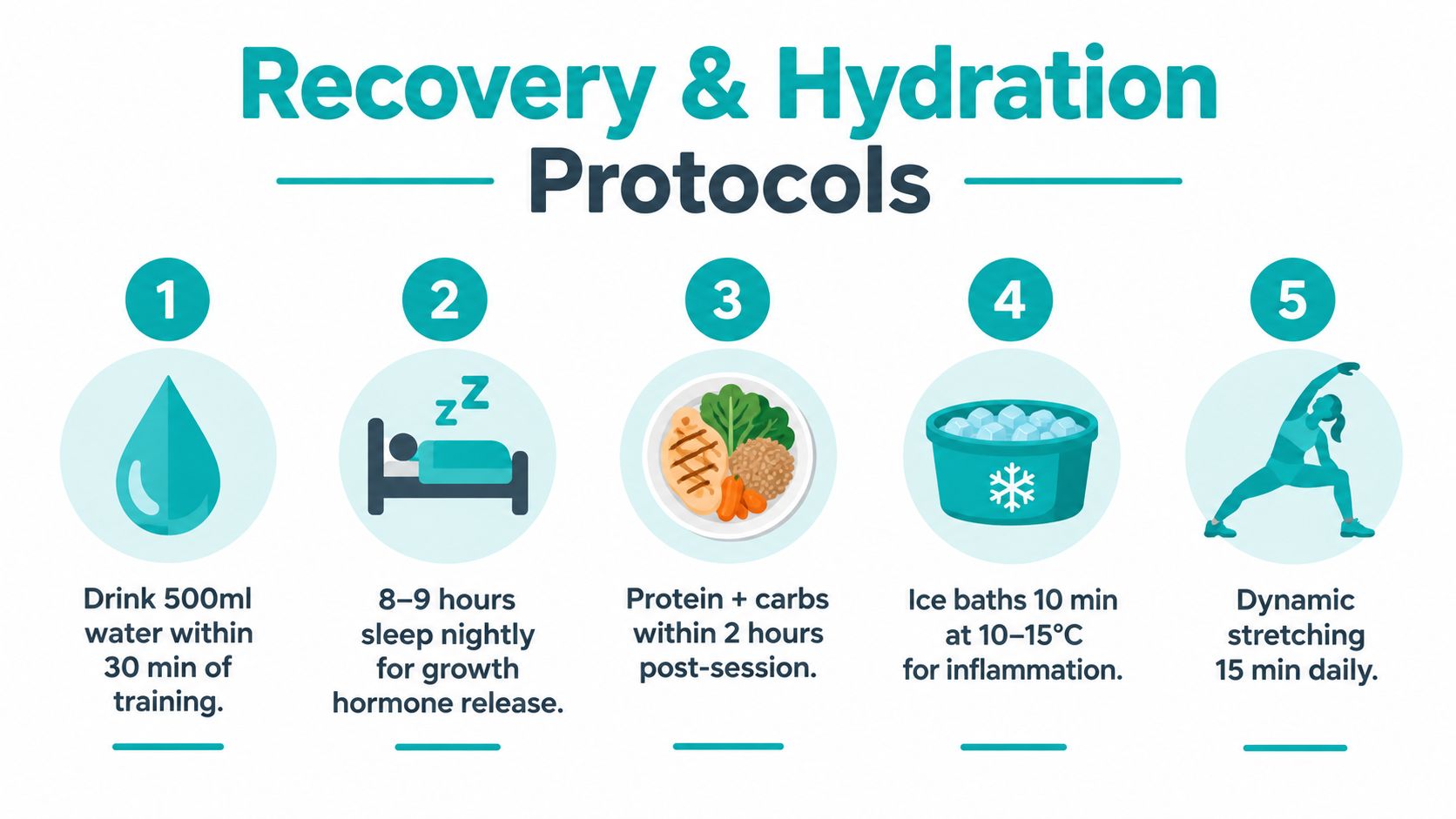
UKSCA nutrition guidance says youth athletes should begin exercise euhydrated, and recommends sipping 5 to 7 ml per kilogram of body mass during the four hours before exercise. It also advises consuming 1.5 litres for every kilogram of body mass lost during exercise afterwards (UKSCA youth nutrition guidance). Parents can help by preparing drinks before the player leaves home and checking that the player replaces fluids after hot sessions.
Use simple post-session habits
Players should eat a balanced meal or snack containing carbohydrate and protein after training, then prioritise regular sleep and a calm evening routine. Coaches can monitor internal load through player feedback, mood, soreness, and perceived exertion, while external load includes the work completed, such as minutes, accelerations, and high-speed actions. The point isn't to burden young athletes with paperwork. It's to spot patterns early.
Plan a deload week before fixtures begin if the squad has accumulated demanding work. Reduce unnecessary volume while preserving speed, technical quality, and tactical confidence. Families looking for practical ideas can also review these Peak Performance post workout tips, then adapt any routine to the player's age, health, and professional advice.
A player who feels pain, dizziness, unusual fatigue, or continuing illness should tell an adult and stop rather than trying to earn selection through discomfort. Good recovery builds a culture in which honesty is a strength.
Unifying Your Club for a Seamless Season
A thoughtful plan can fail through small administrative gaps. A player misses a schedule update, a guardian doesn't know whether attendance is expected, or a coach can't see who completed the previous session. Those problems don't stay off the pitch. They change who arrives, how the session is organised, and whether the coach can manage exposure responsibly.
Club administrators need one dependable place to create teams, assign coaches, schedule training and matches, manage events, and collect payments through integrated Stripe billing. Guardians benefit from a responsive app that brings together RSVPs, attendance, fees, notifications, progress updates, and direct coach communication. Players need clear goals and visible progress so pre-season feels like development rather than a series of disconnected demands.
Connect planning with evidence
Coaches can use a dedicated iOS app to plan sessions with drill cards, take attendance, message teams, track performance, and capture statistics with Apple Watch support. That information helps the coach compare the planned session with the session players completed. It also makes it easier to identify a player who has missed work, returned late, or needs a conversation before the next increase.
Players can stay engaged through performance tracking, XP, badges, leaderboards, and practice streaks. Used carefully, those features reward consistency and learning rather than just celebrating who runs hardest. A young goalkeeper might earn recognition for communication, while a midfielder receives feedback for scanning and supporting teammates.
Vanta Sports brings these club, coach, guardian, and player functions together through scheduling, analytics and reporting, and automated fixture imports. The platform doesn't replace judgement on the touchline. It gives the people making those decisions better access to attendance, communication, planning, and development information, so a progressive football pre season training plan has a better chance of being delivered consistently.
Vanta Sports connects club administration, coach session planning, guardian communication, attendance, payments, player development, and performance tracking in one system. Visit Vanta Sports to organise your pre-season around clearer communication and more consistent player development.
Tags