Youth Development
How to Manage Attendance for Youth Sports Clubs
Learn how to manage attendance for youth sports clubs with simple, supportive steps on policies, tracking, reporting, and automation that actually work.

Tuesday night at the sideline always looks simple until you open the register. One coach is calling names over the fence, one parent is texting about traffic, and two players who were reliable last month have started to drift in and out. That's usually the moment clubs realise how to manage attendance is not about chasing names on a sheet, it's about spotting patterns early, understanding the reason behind the miss, and getting players back into a routine that feels safe and worth keeping.
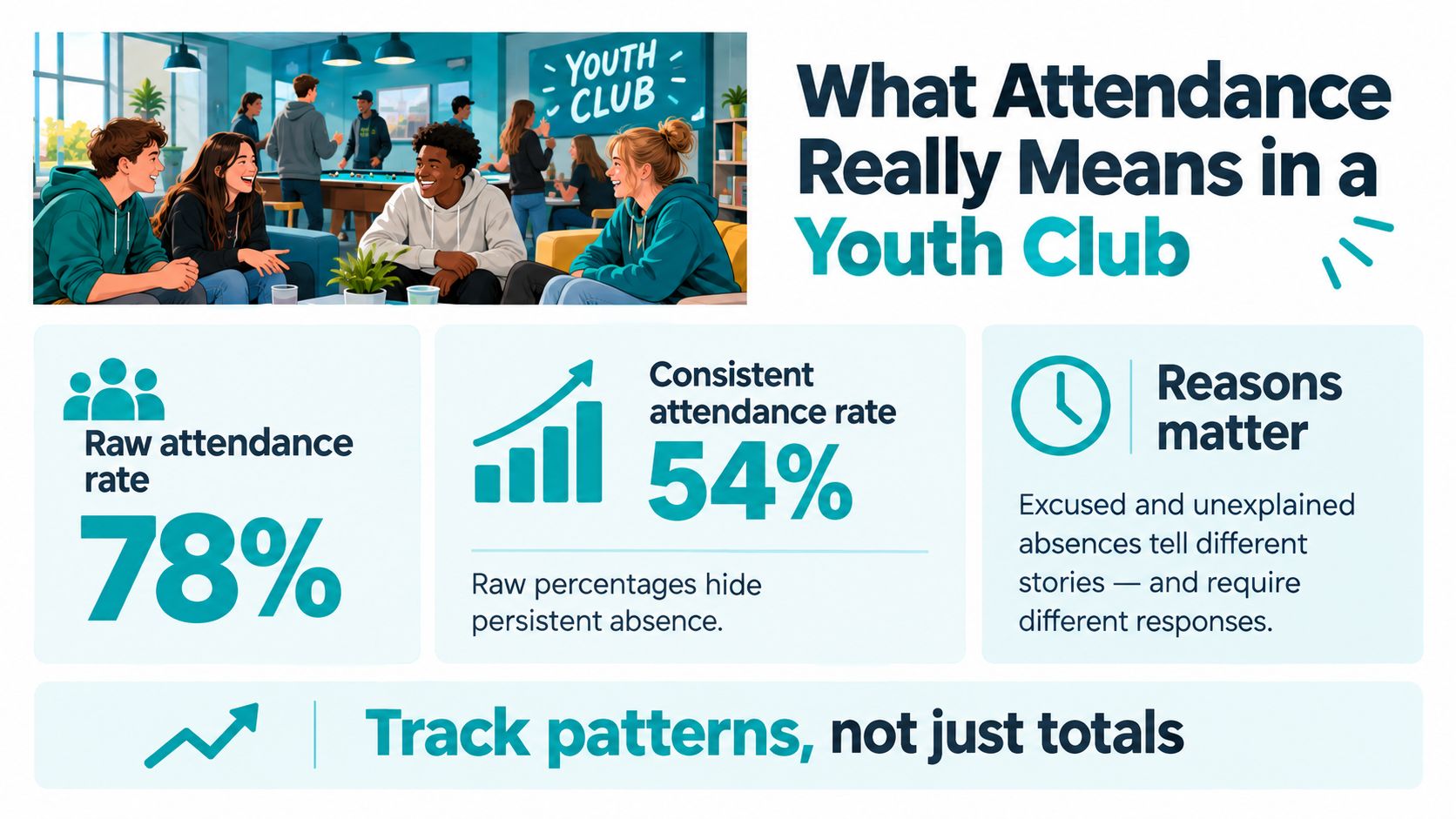
England's Department for Education recorded an overall school absence rate of 6.78% in 2024/25, meaning pupils attended approximately 93.22% of possible sessions, while 18.14% of pupils were persistently absent, defined as missing at least 10% of possible sessions (Education absence data). That's the kind of gap a youth club can't afford to ignore.
Track patterns, not just totals.
A paper register tells you who turned up. A managed attendance system tells you who's slipping, why they're slipping, and whether your response is helping. That shift matters because a missed session isn't always disengagement. Sometimes it's illness, transport, a fixture clash, a family pressure, or a player who needs a gentler return.
If you want to stop losing players, start treating attendance as part of welfare and re-engagement. A useful first read is this guide on attendance management compliance, because the best clubs don't just record attendance, they act on it.
What Attendance Really Means in a Youth Club
A Tuesday evening can still look “fine” on paper while a club is slowly leaking players. The squad is there, the cones are out, and the register gets ticked, but one defender has gone from every week to every other week, and nobody has noticed because the sheet still has plenty of green marks. That's why raw presence isn't the same as attendance management.
The useful unit is the attendance rate, not the name on the list. A club needs to know how often each player is available across training, matches, and events, then compare that over time. If a player keeps missing the same slot, the issue may be travel, school pressure, confidence, or something else entirely. The register alone won't tell you that.
A welfare-first mindset changes the conversation. Instead of asking, “Who's absent?”, the coaching team asks, “Who's drifting, and what's in the way?” That keeps families from feeling judged and makes it more likely they'll reply openly. It also stops a club from mistaking short-term disruption for lack of commitment.
The shift that changes everything
A missed session is data, not just a no-show.
That's the real difference between taking the register and managing attendance. The first records the moment. The second interprets the pattern, checks the reason, and guides a response. Clubs that get this right usually find players are easier to retain because families feel noticed for the right reasons.
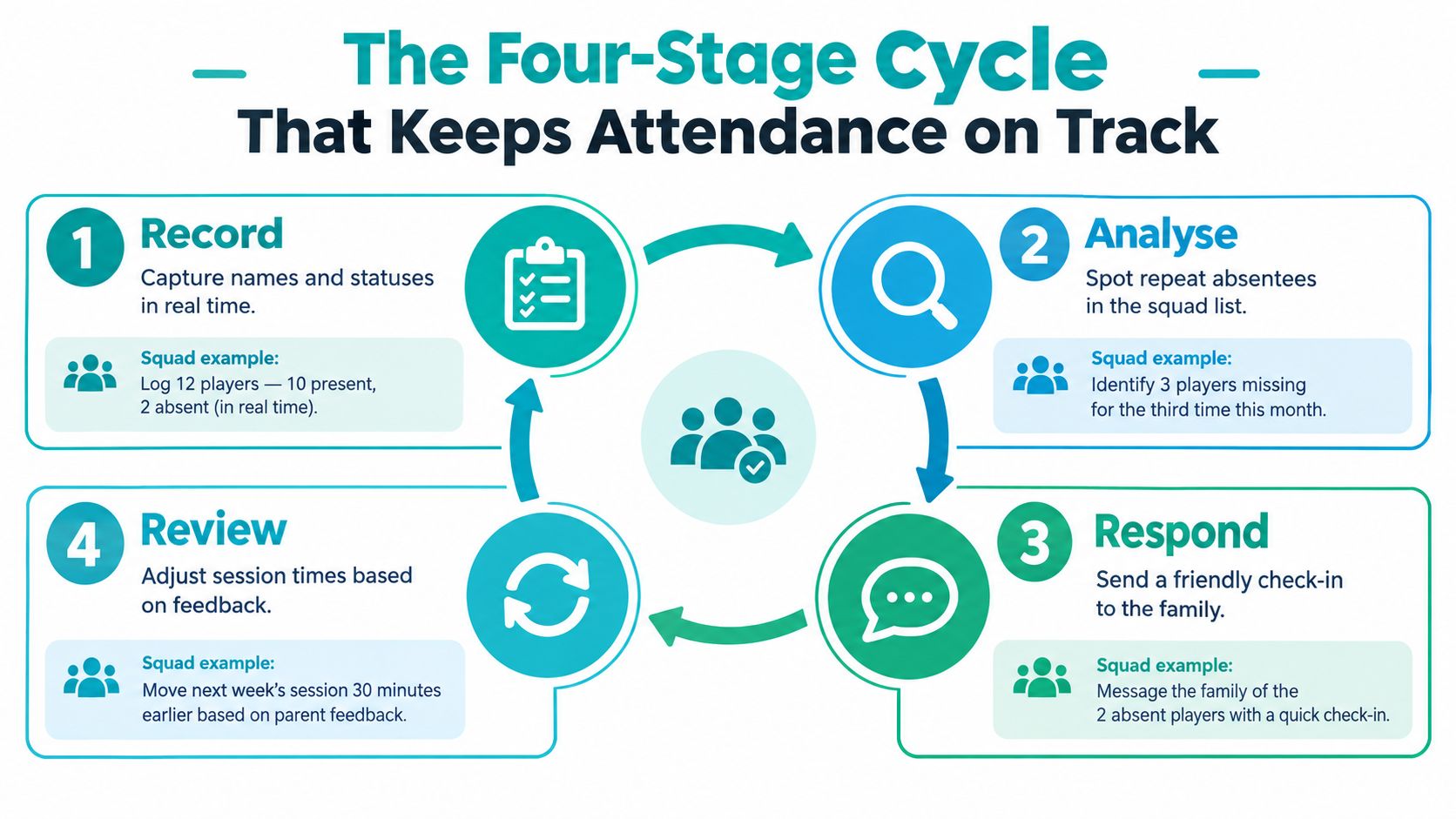
The Four-Stage Cycle That Keeps Attendance on Track
The cleanest way to run attendance is to keep the same rhythm every week. The UK guidance is simple enough to teach to a volunteer in one conversation: record, analyse, respond, review (Department for Education guidance). That structure works because it keeps the club from skipping straight from a missed session to a generic reminder.
Record at the point of activity
Mark attendance while the session is happening, not later that night. Use consistent statuses such as present, late, excused, and absent so every coach is speaking the same language. If assistant coaches are helping, they should use the same roster and the same labels.
Analyse by pattern, not gut feel
Look at the register at least weekly. Check it by player, session type, age group, and reason code. A player who misses Tuesday technical work but never Saturday fixtures is telling you something different from a player missing both.
Respond when a threshold is crossed
Don't wait for a full collapse. Use a graduated response, starting with a simple check-in and moving to a guardian conversation if the pattern continues. A club can even use a practical trigger, such as two unexplained absences in four sessions, before escalating to a coach or welfare lead.
Review what changed
Attendance action only works if you can see the effect. Keep an audit trail of the trigger, the action taken, how quickly you acted, and whether the player's pattern improved. That trail matters because reminders alone are often not enough.
For clubs that want a simpler onboarding path, this guide on ways to improve attendance helps turn the cycle into a routine people actually follow.
Setting Up Your Attendance Policy Before the First Session
A good attendance policy should read like a practical agreement, not a warning notice. Parents need to know what the club counts as late, what happens when a player misses repeatedly, and how they should explain a absence without feeling awkward. Coaches also need the same clarity so they aren't inventing their own rules on the touchline.
The policy should start with plain statuses and reason codes. If one coach marks a player as late and another calls the same thing partial attendance, your data becomes messy fast. Keep the list short enough to remember, and make sure it covers the most common reasons a young player misses a session.
Age matters too. Sport England reports that 57% of children in school Years 7–11, roughly ages 11–16, took part in a team sport at least once in the previous week, compared with 40% of children in Years 1–2, roughly ages 5–7 (Sport England age data). Younger players usually need more parental support and simpler reminders. Older players can take more responsibility for replying to selections and fixtures.
A policy that families will actually read
- Set clear statuses: Use the same labels every time, so attendance data can be compared across coaches and squads.
- Add reason codes: Separate illness, travel, family issues, and unknown absence so support stays proportionate.
- Define lateness: Decide when a player becomes late and apply it consistently.
- Match expectations to age: Don't demand the same attendance pattern from an under-8 as from an older squad.
- Confirm it with guardians: Ask parents to acknowledge the policy before the season starts, then revisit it when routines change.
If you want a practical reference point, the attendance management best practices guide from LeaveWizard is a useful reminder that policy only works when people understand it.
Taking and Recording Attendance on the Day
On the day, the job is simple. Mark people in real time, note who's late, and capture the reason before the details get forgotten. The biggest mistake I've seen is coaches promising themselves they'll update the register later, then trying to reconstruct a whole session from memory on Sunday night.
A phone-friendly register works well because it follows the coach from warm-up to cool-down. Paper backups still help when a pitch has no signal or a volunteer's battery is low. If a guardian messages that a player can't come, log the reason straight away, then add the coach note if there's a useful detail, like injury, mood, transport trouble, or a half-session only.
During the week beginning 1 December 2025, absence was 6.35% in state-funded primary schools, 9.65% in secondary schools, and 14.72% in special schools, which is exactly why clubs should separate scheduled absence, late arrival, partial attendance, coach cancellation and unnotified absence rather than using a single present/absent column (CSJ absence tracker).
Small habits that keep the register honest
- Use one live roster: Shared links stop assistant coaches working from old versions.
- Capture late arrivals separately: Late is not the same as absent.
- Add the reason immediately: The longer you wait, the weaker the data gets.
- Keep session notes together: Attendance, injury, and availability belong in one entry, not three places.
- Check the weekly export: A quick download shows who's drifting before the gap becomes a habit.
For clubs using a connected setup, the register should sit close to the session plan, not buried in another tab. A platform like Vanta Sports can keep check-in alongside drill cards and coach notes, which makes the process feel like part of coaching rather than extra admin. If your kit bag keeps swallowing shin pads and socks, this shin guard missing help resource is a surprisingly practical reminder that organisation saves time everywhere.
For a deeper look at keeping records tidy, this internal guide on sports attendance records is worth keeping handy.
Reading Attendance Reports Like a Coach, Not an Auditor
The best weekly report tells a story. It shows which players are present, which sessions are slipping, and where the pattern is attached to an age group, a reason code, or a venue change. Sport England's Active Lives Children and Young People Survey uses responses from around 120,000 children and young people each year, which is a good reminder that consistent recording matters if you want a benchmark you can trust (Active Lives data).
What you're looking for is change. A player who usually turns up but has started missing one specific night deserves attention. So does a whole squad that dips after a school term change, a coach swap, or a new training location. Those are coaching questions, not spreadsheet questions.
| Weekly Attendance Read-Out | What to Look For | Typical Action |
|---|---|---|
| Player view | One player's pattern is slipping | Send a personal check-in |
| Session view | A specific night has lower turnout | Review timing, venue, or workload |
| Age-group view | Younger or older groups miss differently | Adjust expectations and reminders |
| Reason code view | The same barrier keeps appearing | Offer targeted support |
The right question to ask
Don't ask, “How do we get everyone to 100%?” Ask, “What is stopping this family from staying involved?” A guardian message that names the recent pattern, asks for the reason, and offers one clear remedy usually does more than a generic reminder. That keeps the conversation practical instead of defensive.
A short report shared with coaches and welfare leads should be enough. Respect matters here, so don't turn attendance into a public ranking. A club's job is to notice the dip, not shame the player.
Responding to Absence With Support, Not Pressure
A good response feels human. First missed session, send a friendly nudge. If the pattern repeats, share the player's recent attendance history with the guardian and ask what's getting in the way. If it continues, bring in the coach or welfare lead and look for a proper support plan.
That order works because parent communication and engagement are where attendance improvement often starts. A UK review of 61 randomised controlled trials found that parent engagement and better communication produced consistently positive attendance effects, and a one-to-one counselling study found the odds of persistent absence fell by 18.5% even when overall attendance changed only marginally (King's College London summary).
A warm sequence that coaches can actually use
- First absence: Send a same-day note that checks in.
- Second unexplained miss: Refer to the recent attendance pattern and ask for a reason category.
- Ongoing pattern: Escalate to a welfare conversation, not a warning.
- Follow-up window: Recheck the next four to six sessions and see whether the player is back in rhythm.
The message should offer a route back. Transport coordination, schedule clarity, welfare support, or a catch-up plan all feel more useful than a reminder that says nothing new. That's the difference between pressure and re-engagement.
Clubs often think they need a harsher system. In practice, they usually need a better conversation, recorded properly and followed up on time.
Automating the Routine so Coaches Can Coach
The biggest win in attendance management is removing the little tasks that eat evenings. If the club is still copying names from a spreadsheet into a group chat, or waiting for someone to remember the register on the drive home, the system is doing too much work for the wrong people. A connected setup should make the routine lighter, not louder.
One useful source of context is the children's activity picture. In 2024/25 Active Lives data, 49.1% of children in England were classed as active, while 28.4% were less active, meaning clubs should treat repeated non-attendance as a welfare and inclusion signal and offer practical solutions such as transport coordination, equipment support or a gradual return to training (Sport England activity levels). That makes automation a support tool, not just an admin tool.
A connected platform can unify rosters, RSVPs, drill cards, and attendance so coaches aren't juggling four systems on a Tuesday night. Vanta Sports is one example that brings registers, attendance history, session planning, and guardian communication into one place, which is useful when you want the data to live where coaching happens. If you already use email reminders for events, the send reminders with Mail Merge for Gmail guide is a handy reference for keeping messages timely and personal.
Automations worth turning on first
- Same-day absence notifications so families hear from the club while the session is still fresh.
- Guardian reason-code replies so the club isn't guessing at the cause.
- Recurring session imports so new weeks don't require manual rebuilding.
- Private alerts for repeated absence so welfare leads see patterns early.
- Central audit notes so coaches can show what was flagged, when, and why.
What to keep manual
Not everything should be automated. A coach should still decide how to phrase a welfare conversation, when to step in with a phone call, and whether a player needs a softer return after injury or stress. Automation should flag the pattern, not replace judgment.
A simple 30-day rollout keeps change manageable. In week one, set statuses and reason codes. In week two, run the new register alongside the old one. In week three, review the first report and tighten any messy labels. In week four, share a coach-friendly summary with guardians and welfare leads.
If you want a deeper look at the tech side, this guide on attendance tracking app shows how the routine can sit inside one workflow.
Quick answers coaches usually ask once the system is live
- Per session or per minute? Per session is clearer for youth clubs, as long as late and partial attendance are recorded separately.
- What about dual-registered players? Track attendance in each programme they're expected to attend, then compare like for like.
- How do we stay fair? Use the same statuses and reason codes across recreational and academy pathways, but allow different expectations for age and accessibility.
The goal isn't perfection. The goal is a system that helps a player return, stay connected, and feel wanted.
If you're ready to make attendance easier to manage and kinder to families, visit Vanta Sports and see how a connected club workflow can bring registers, coaching, RSVPs, and welfare notes into one place. It's a practical way to turn attendance data into re-engagement, not just admin.
Tags