

Youth Development
Sports Team Schedule That Actually Works: Build It Right
Build a sports team schedule that holds up all season. Learn formats, best practices, and how Vanta Sports keeps clubs, coaches, and families in sync.

Sunday evening is when a youth club's tidy weekend can become Monday morning's headache. A coach is checking whether the pitch is still available, a parent is asking about the revised kick-off time, two players haven't confirmed attendance, and the club secretary is trying to remember which message contains the latest venue change. Meanwhile, the next training session still needs a coach, equipment, and enough adults present.
A reliable sports team schedule brings those moving parts together. It connects matches, training, venues, people, travel, supervision, attendance, and communication in one working system. The aim isn't to fill every available slot. It's to create a season that children can enjoy, families can manage, and coaches can deliver safely.
What a Sports Team Schedule Really Is
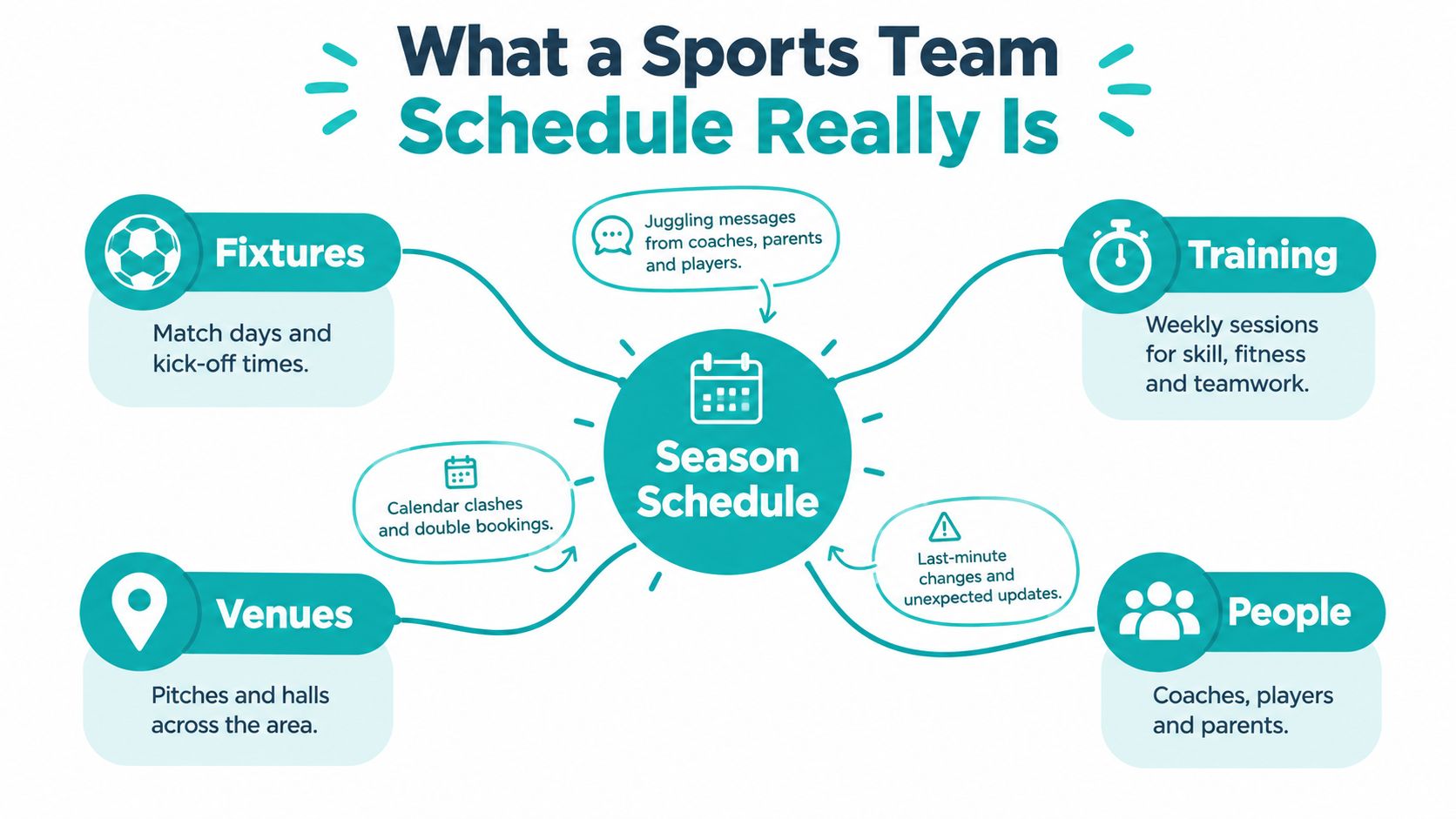
A shared spreadsheet can look perfectly organised until something changes. One Sunday evening, a youth coach may have a league fixture in one column, a pitch swap in a text message, a parent poll in a WhatsApp group, and a coach absence written on a scrap of paper. Everyone has some information, but nobody has the same picture.
A sports team schedule is the club's operational hub, not just a list of opponents and dates. It should bring together training sessions, league fixtures, cup matches, tournaments, social events, venues, coaches, players, guardians, officials, availability, and relevant costs. When one part changes, the people affected should know what changed and what they need to do next.
Each fixture is an operational event
Historical English fixture calendars show the level of structure that a mature competition can require. They preserve dates, results, venues, attendances, goal scorers, and line-ups, demonstrating that every fixture has a wider operational story than its kick-off time. A match involves a location, participants, officials, attendance, and an outcome, as shown in the archived English fixture calendar.
That same principle works for a youth club, even when the scale is smaller. A training session needs a time, venue, coach, squad, attendance record, and communication trail. A tournament may also need travel notes, arrival instructions, player availability, and supervision planning.
Plan forward, learn backwards
The useful schedule works in both directions. Before an event, it helps administrators allocate a venue, confirm staff, collect RSVPs, and notify families. Afterwards, it helps the club review attendance, compare planned and completed sessions, and identify recurring clashes or difficult travel patterns.
Think of it as a living record. The schedule tells a family where to be next Saturday, while the history tells the club which arrangements worked last season. That combination gives new volunteers a much firmer starting point than a blank calendar.
The Four Schedule Formats Every Club Should Know
Not every club needs the same starting structure. A development squad with regular training needs a different framework from a team travelling through a cup competition, although most organisations eventually combine several formats.
Weekly schedules
A weekly schedule repeats a dependable rhythm. For example, a squad might train on one evening, play a match at the weekend, and leave space for optional practice or recovery. This format suits new teams and development groups because families quickly learn the routine.
The limitation is that a weekly template can hide disruption. School events, venue closures, tournaments, and postponed fixtures still need to be added clearly rather than squeezed into an informal message.
Seasonal calendars
A seasonal calendar starts with the league or competition programme and adds training blocks, holidays, club events, and review points. It gives administrators a broad view of busy periods and helps coaches plan development rather than reacting to each weekend in isolation.
This is often the right foundation for clubs with several teams, because coordinators can see where pitches, halls, and coaches may compete for the same resources.
Tournament schedules
A tournament schedule concentrates on a particular event or run of fixtures. It needs more practical detail than a normal match listing, including arrival windows, changing arrangements, travel, supervision, player availability, and contingency communication.
The same model works for showcase days, festival sport, and holiday programmes. Families need a clear timetable, but coaches also need a reliable operational plan.
Hybrid schedules
Most established clubs need a hybrid schedule. It combines the season calendar with recurring training, one-off events, tournaments, travel notes, and live changes. This format lets the club keep a stable weekly rhythm without pretending that the season will remain unchanged.
| Format | Best For | Revision Cadence | Primary Audience |
|---|---|---|---|
| Weekly | Development squads and regular training | Frequent, as changes arise | Coaches and families |
| Seasonal | League teams and multi-team clubs | At planning reviews and fixture changes | Administrators and coaches |
| Tournament | Cup runs, festivals, and showcase events | Before and during each event | Coaches, players, and guardians |
| Hybrid | Clubs combining all activity types | Ongoing | The whole club |
Start with the format that reflects your current reality, then let it grow. A club exploring local competition can also use a practical resource to join a league near you, while keeping its internal schedule flexible enough for training and family commitments.
Anatomy of a Schedule That Holds All Season
A schedule survives change when its information is stored in useful fields rather than buried in free-text notes. A fixture should be connected to the team, venue, coach, player group, RSVP status, and communication history. That structure lets an administrator answer a parent's question without searching through several conversations.
Vanta Sports can serve as the worked example here. Its club dashboard brings teams, coaches, training, matches, events, attendance, RSVPs, notifications, and payments into a connected workflow, while coaches and guardians access the information relevant to them.
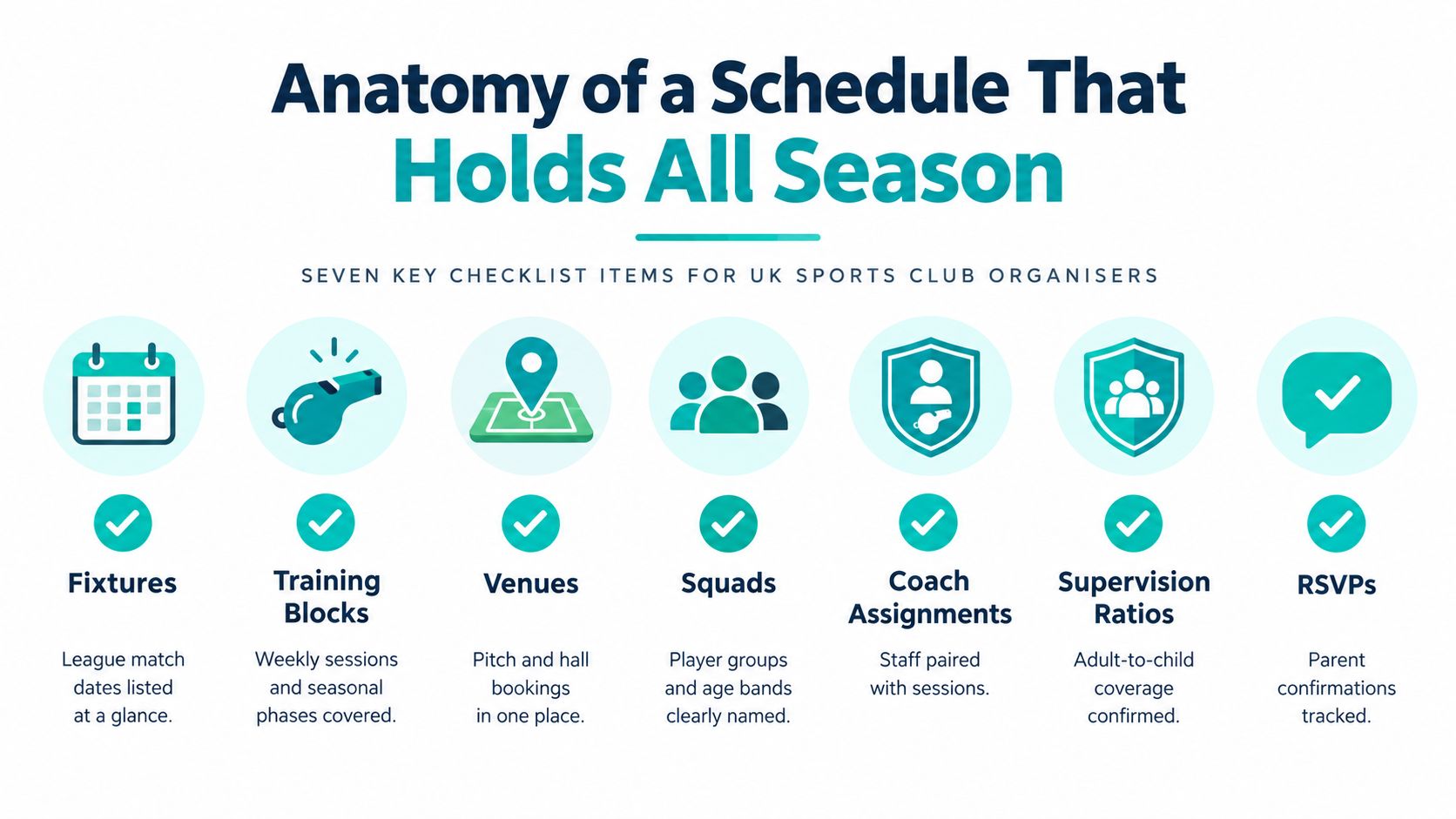
The fields that do the real work
- Fixtures: Record the opponent, date, kick-off time, venue, officials, status, and any competition details.
- Training blocks: Store recurring sessions alongside seasonal phases, planned activities, and coach availability.
- Venues: Include the pitch or hall, confirmed booking, usable time, blackout periods, and any access instructions.
- Squads: Connect each event to the correct age band, team, player list, and expected attendance.
- Coach assignments: Name the responsible coach and supporting adults before the event is published.
- Supervision ratios: Make staffing visible so organisers can check coverage before a session or trip.
- RSVPs: Track parent confirmations, absences, late responses, and changes that affect selection or planning.
The value appears when these fields connect. A guardian confirms attendance in the app, a coach sees the response, and the administrator can review participation later. A venue change can trigger a notification instead of relying on one volunteer to repeat the message manually.
A published date also shouldn't be treated as permanent. A SportRxiv study of 1,900 English football matches across five seasons found that 41.4% of fixtures were played on a different date from the date originally published, which is why a schedule needs change history and notifications as well as the original fixture. The findings are available in the SportRxiv fixture scheduling study.
For a practical starting point, compare these fields with the event schedule template, then remove anything your club doesn't need. A shorter, accurate schedule is more useful than an impressive form nobody keeps up to date.
Scheduling Smarts Beyond the Calendar
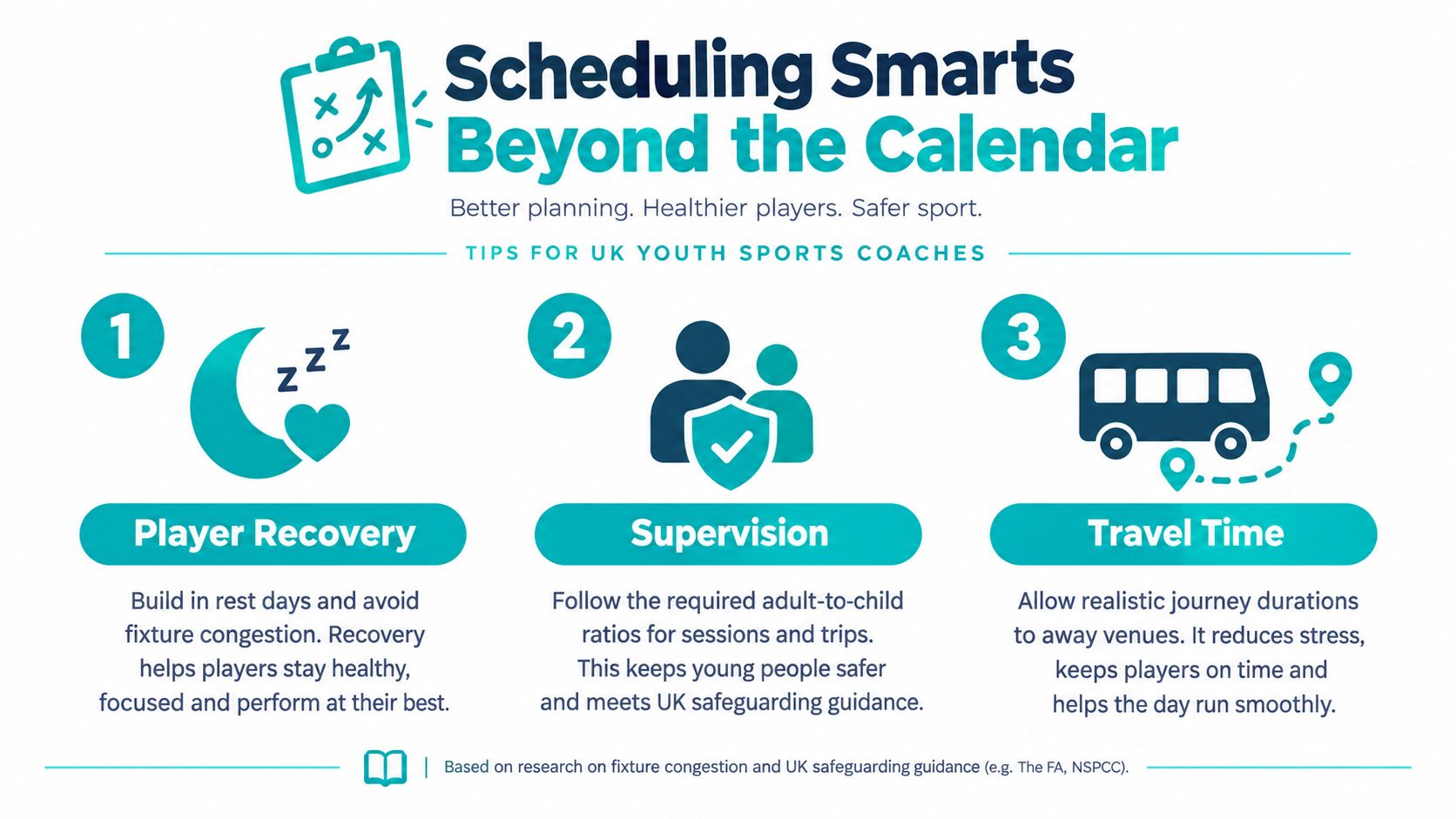
More fixtures don't automatically create a better season. A packed calendar can make development harder when players have little time to recover, coaches struggle to staff sessions, and families can't reach distant venues reliably.
Recovery comes before density
A UK systematic review defined fixture congestion as at least two matches separated by 4 days or less. It found that 5 of 8 included studies reported higher match-injury incidence during congested periods, as documented in the systematic review of fixture congestion in professional men's soccer.
Youth clubs shouldn't treat every week as interchangeable. Build a rolling view of the gap between matches for each team, and ask the coach to review any period that leaves limited recovery time. The review also points towards practical responses involving training periodisation, workload monitoring, and attendance data.
Practical rule: If the schedule looks full but the players look tired, protect recovery before adding another fixture.
Supervision is a scheduling field
A session isn't ready just because a pitch and coach are available. UK Athletics recommends one suitable volunteer to eight children aged 8 to 12, with at least one UK Athletics-licensed coach present. For young people aged 13 to 18, its guidance recommends one suitable volunteer to 10 children, again with at least one licensed coach, and it recommends that two suitable volunteers attend every session involving children. These figures appear in the UK Athletics supervision guidance.
That means a group of 24 children aged 8 to 12 needs at least three supervising adults, including a licensed coach. Put the expected player count and adult assignments beside the event, not in a separate safeguarding folder that nobody checks during scheduling.
Travel determines participation
Travel deserves the same attention as the kick-off time. UK community-sport evidence found that 53% of group leaders reported young people's inability to travel to activities had recently limited or stopped participation, while 52% of parents said there weren't enough local sports clubs in their area. The figures are reported in written evidence on community sport and transport barriers.
Record realistic journey times, public transport dependencies, lift-sharing options, parking information, and likely pinch points. A schedule that reduces participation friction may serve the club better than one that maximises venue use. Calendar coordination can help administrators keep those changes visible, as shown in this guide to calendar synchronization.
Building Your Schedule in Vanta Sports
Begin with the club's structure rather than individual events. Create the organisation, add teams and age groups, assign coaches, and make sure each administrator has the right access. This prevents a common problem, where a volunteer publishes a match without knowing which coach or squad owns it.

Build the season in layers
- Add the competition fixtures. Import or sync league information where available, then check dates, opponents, venues, and kick-off times against the competition's latest communication.
- Create recurring training. Add normal sessions first, then edit holiday periods, venue closures, tournaments, and special development blocks.
- Assign people and places. Attach the correct coach, squad, venue, and expected player group to every event.
- Add the practical notes. Include arrival guidance, travel information, kit requirements, parking details, and any relevant contingency plan.
- Publish for confirmation. Let guardians respond to invitations and keep unresolved attendance visible to the coach.
- Update from one admin view. When a fixture changes, revise the event centrally so the new information reaches coaches and guardians through notifications.
A team scheduling app is most useful when it connects planning with what happens afterwards. Attendance responses can inform selection and session preparation, while payment records and notifications remain attached to the wider club workflow rather than scattered across separate tools.
Give families enough context to act. “Away match, Saturday” isn't enough for a parent arranging transport. A useful event says where to go, when to arrive, who to contact, and whether the child's attendance is confirmed.
The following video offers another way to understand the platform workflow:
Finish each update with a quick check. Is the venue confirmed? Is the coach assigned? Are enough adults available? Have guardians received the change? That short routine turns publishing into a dependable club habit.
A Season in the Life of a Unified Schedule
At the start of the season, a youth football club moved away from a shared spreadsheet that only one administrator fully understood. The coordinator created each team, assigned coaches, added league fixtures, and built recurring training sessions in Vanta Sports. Guardians could see the same schedule, respond to invitations, and receive updates without searching through old messages.
Autumn brought the first test. A venue became unavailable, so the administrator changed the fixture location and sent the updated information through the connected system. The coach saw the new arrival details, guardians could revise their responses, and the player list gave the team a clearer view of who still needed transport.
Later, a postponed match created a crowded week. Instead of treating the new date as an isolated change, the coach checked the surrounding training sessions and recovery space. A coach swap was recorded, the safeguarding coverage was reviewed, and a parent chasing a late RSVP received an answer based on the current event record.
The winter cup run added travel notes and extra match-day information. Players could follow their progress through performance updates, XP, badges, leaderboards, and practice streaks, while coaches retained attendance and session records. The calendar became useful to children as well as adults.
The club also used its schedule to encourage activity beyond match day. Sport England's 2024–25 Active Lives data found that 49% of children met the 60-minutes-per-day activity guideline, up from 43% in 2017–18, as reported in its children's activity update. A weekly plan can therefore include warm-ups, skill blocks, optional practice, and active travel, rather than assuming one organised event carries the whole week.
By the end-of-season awards, the club had more than a calendar. It had a record of participation, changes, communications, and development. Families could also connect the schedule with their own calendars using guidance on adding a sports team schedule to Google Calendar.
Habits of Schedulers Who Get the Best from Their Season
Great scheduling isn't a one-off administration project. It's a set of small habits that make the club easier to trust.
The weekly rhythm
- Check changes before the weekend: Confirm venues, kick-off times, coach assignments, and travel notes.
- Review unanswered RSVPs: Contact families early enough to solve transport or availability problems.
- Count adults as well as players: Check supervision coverage before publishing each session.
- Protect recovery space: Look at the surrounding fixtures before accepting a replacement date.
- Close the loop: Record attendance and important changes after the event, while the details are fresh.
The monthly view
Once a month, look across all teams rather than focusing on one squad. Identify repeated venue clashes, difficult travel patterns, low-response sessions, and periods where coaches carry too much responsibility. Then make one practical adjustment, such as moving a training block, sharing transport information earlier, or assigning another qualified adult.
Parents also have a role. Respond promptly, read change notifications, and tell the coach when travel or timing creates a genuine barrier. Players can build ownership by checking their events, preparing kit in advance, and treating practice as part of the season rather than an optional extra.
A schedule earns confidence when it stays current. Keep the information simple, make responsibility visible, and use each completed event to improve the next one.
Vanta Sports brings teams, coaches, guardians, and players into one connected sports management platform, with scheduling, RSVPs, notifications, attendance, payments, and development tools working together. Visit Vanta Sports to explore a calmer way to build and manage a sports team schedule that supports the whole club.
Tags