Youth Development
Stripe Payment App for Youth Sports: Build It in 2026
Build a Stripe payment app for your youth sports club in 2026. Step-by-step guide covering SDK selection, secure flows, testing, and deployment.
Saturday morning arrives with a familiar admin headache. A parent asks which payment link covers the new term, another says a bank transfer still hasn't been matched, and a coach wants to know whether a player's fees are up to date before training starts. Meanwhile, the club's spreadsheet contains several colours, notes and half-confirmed payments.
A well-designed Stripe payment app can turn that scramble into a clear routine. Families get one dependable place to pay, clubs can automate recurring collections, and administrators can see what needs attention without chasing every guardian individually. The important point is that payment technology should support the sporting experience, not create another job for volunteers.
Why Youth Sports Clubs Need a Stripe Payment App
Youth clubs rarely struggle because parents don't want to pay. They struggle because the payment process is scattered. Term fees may sit in a spreadsheet, match registrations arrive through separate links, and recurring squad subscriptions depend on reminders being sent at the right moment. That creates avoidable questions for guardians and repetitive reconciliation work for administrators.
The wider UK market has already moved towards more flexible digital payments. Stripe says UK consumers and businesses made 48.8 billion payments in 2024, while more than 94% of eligible in-store transactions were contactless in that year. It also reports that 57% of UK adults were registered for mobile wallets in 2024, compared with 42% in 2023, which helps explain why families expect payment journeys to work smoothly on a phone. These figures come from Stripe's UK payments guide.
The operational case for one connected system
A club payment app needs to connect the payer, the player, the team and the fee. A guardian should be able to see whether a charge is for membership, a term, a tournament or equipment. The administrator should be able to assign fees in bulk, identify unpaid balances and reconcile collections without switching between unrelated tools.
Stripe's UK footprint shows how established the infrastructure has become. Stripe says it began serving the UK in 2012, and reports that online commerce grew from 10.5% of retail sales in 2013 to 26.6% in the later period it describes as “today”. Its UK retrospective also says businesses process nearly 1 billion transactions a year through Stripe, while 90 UK towns and cities process over £100 million annually on the platform, three times as many as before the pandemic. The source is Stripe's UK internet business retrospective.
For clubs assessing their options, a browse Stripe integration resource can help compare the surrounding tools and connection patterns. It's also useful to review the Stripe payment gateway guide before deciding whether to build a standalone app or connect Stripe to an existing club management platform.
The practical win isn't just accepting cards. It's predictable cash flow and fewer interruptions. Parents receive a clear request, the club records the result automatically, and coaches spend less time answering payment questions instead of preparing players for the next session.
Choosing the Right SDKs and Tools for Your Club
Start with the club's operating model, not the programming language. A club with an administrator dashboard and a guardian mobile app has different requirements from a small organisation that only needs a hosted payment page. Both can use Stripe, but building a custom experience adds responsibility for customer records, permissions, error handling and support.
Match the tools to the platform
| Club requirement | Sensible Stripe approach | Trade-off |
|---|---|---|
| Browser-based guardian checkout | Stripe Checkout or Elements | Faster to launch, with less control over the surrounding experience |
| Custom web payment form | Stripe Elements with a server-side SDK | More flexibility, but more development and testing |
| Native iOS or Android app | Stripe's mobile SDKs or Payment Sheet | A polished mobile flow, with platform-specific release work |
| Recurring term or membership fees | Stripe Billing and Subscriptions | Automates invoices and renewals, but needs careful exception handling |
| Saving a payment method for later | Setup Intents | Useful for future charges, provided consent and communication are clear |
On the server, choose the SDK that fits the existing stack. A Node.js library makes sense for a JavaScript or TypeScript backend, while Python is a natural fit for a Python service. The choice matters less than keeping all secret-key operations on the server and making the payment layer an explicit part of your club data model.
On the client, Stripe Elements suits a web dashboard or responsive parent portal. A native mobile SDK is more appropriate when guardians already manage attendance, messages and invoices inside an iOS or Android app. Don't force a native build just because the club has an app. A secure, mobile-friendly hosted checkout can be the better operational choice if the team has limited engineering capacity.

Design the data flow before the payment screen
A successful payment must update more than Stripe. It should connect to the guardian account, player profile, team, fee record and reporting view. Define those relationships before development begins. Otherwise, the club may collect money successfully but still need manual work to decide which child's account has been settled.
Product teams that are documenting these decisions can use practical integration guides for product teams as a reference for mapping ownership, dependencies and edge cases. The same discipline helps a volunteer-led club avoid a fragile setup.
Use Setup Intents when a guardian authorises a card for future term charges, and use Subscriptions when the club wants Stripe to manage a recurring schedule. For a one-off tournament fee, a straightforward PaymentIntent may be enough. The right choice depends on whether the club needs a future payment relationship, not on which product sounds most advanced.
Implementing Secure Client and Server Payment Flows
Keep the payment journey split into two responsibilities. The client collects payment details and handles customer interaction. The server decides what the customer should pay, creates the payment object and records the result. That separation protects the club and makes the system easier to audit.
A practical flow for a term fee
- The guardian selects the player and the fee in the club app. The server retrieves the authoritative amount rather than trusting a value sent by the phone or browser.
- The server creates a PaymentIntent with the amount and currency, then returns the client secret to the client.
- Stripe Elements, Checkout or a mobile payment component collects the payment details. Card data should go directly through Stripe's secure interface, not through your own database.
- The client confirms the PaymentIntent. If additional authentication is required, Stripe can guide the guardian through 3D Secure, often called 3DS.
- The server waits for the relevant webhook before marking the fee as paid. The screen result is useful feedback for the guardian, but the webhook should drive the durable record.
This approach works for a one-off season fee and can be adapted for monthly deductions. For recurring billing, create the Stripe Customer, attach the permitted payment method and store the Stripe identifiers against the guardian account. Keep your own database focused on club relationships and payment status, rather than copying sensitive card information.
Security rule: Never place a Stripe secret key in the mobile app, browser code or a downloadable configuration file.
The server endpoints should also be deliberately narrow. One endpoint can create a payment request, another can create or update a payment method setup, and a webhook endpoint can process status changes. Use idempotency so a repeated tap or network retry doesn't create duplicate charges. Store event identifiers and make webhook handlers safe to run more than once.
For mobile teams, PCI compliance for mobile apps provides useful context on keeping sensitive payment data away from the app's own infrastructure. A practical companion is the Stripe payment integration guide, particularly when connecting payments to player records and club workflows.
Don't treat authentication as an edge case. A payment may require action, fail after an issuer decision or remain incomplete while the guardian leaves the app. Your interface should explain what happened in plain language and give the parent a clear next step, while the server preserves the actual payment state.
Testing Payments and Handling Webhooks Reliably
Test mode should imitate the situations that create work for a club administrator, not just the happy path. Run successful payments, issuer declines, authentication challenges, duplicate button taps, abandoned checkouts and interrupted network requests. A club's system isn't ready because one test card produced a green tick.
Test the complete operational chain
Use Stripe's test environment to confirm that:
- Successful payments create the correct fee record, update the player's balance and appear in reconciliation.
- Declined payments produce a useful message for the guardian without marking the fee as settled.
- Authentication flows return the guardian to the right screen after 3DS or another required action.
- Recurring events update subscriptions, invoices and notifications as expected.
- Repeated events don't duplicate a payment, message or attendance permission.
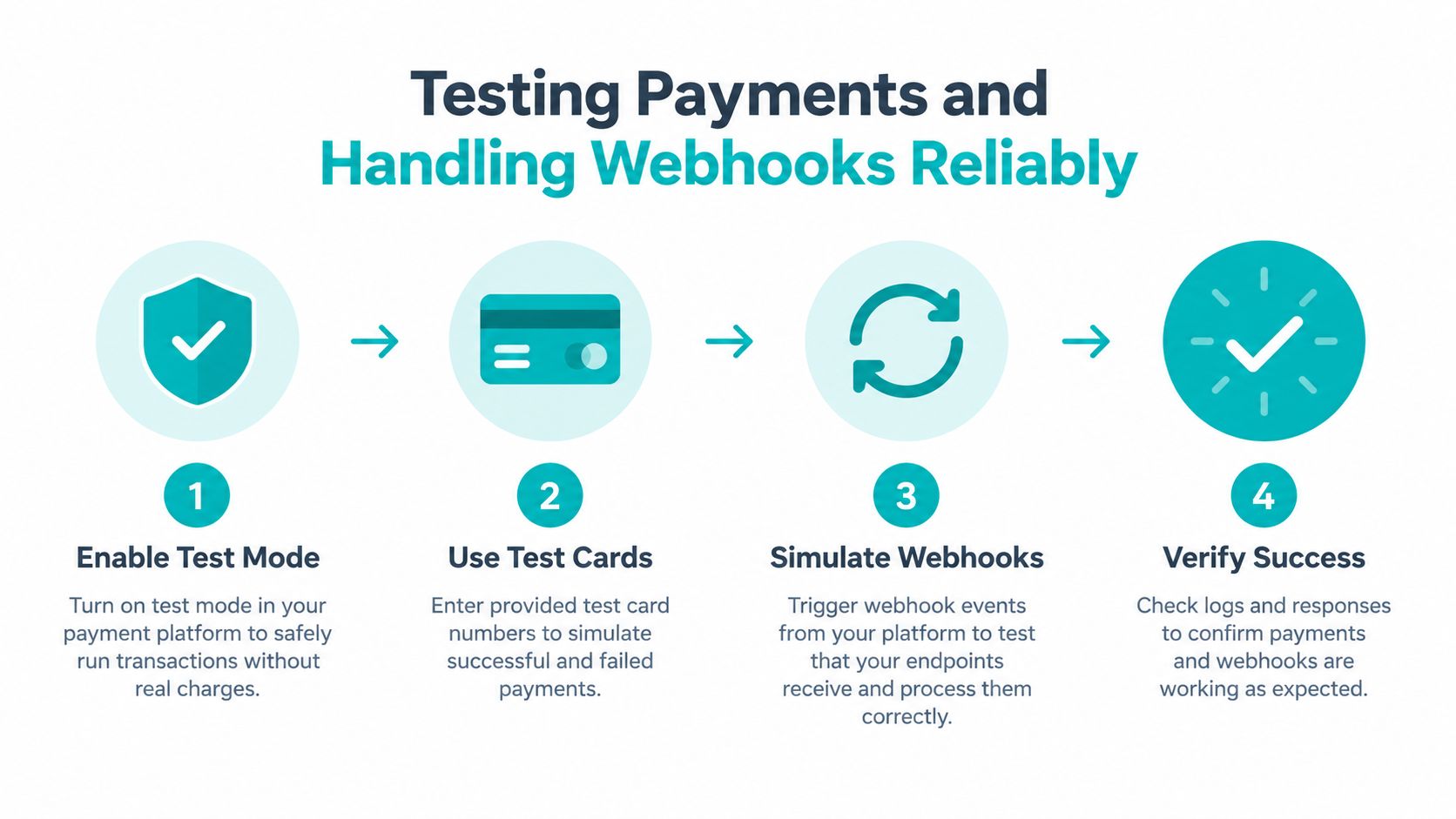
Webhooks are the bridge between Stripe and the club's operational records. Configure an endpoint that verifies the webhook signature, rejects untrusted requests and records the event before processing its business effect. Then handle the events the club needs, such as payment_intent.succeeded for completed payments and invoice.payment_failed for recurring collection problems.
Build recovery into the first release
Stripe defines payment success rate as the share of submitted attempts that are ultimately authorised, including 3DS authentication, Stripe or Radar blocks and card-network authentication. Authorisation rate is narrower, covering only attempts that reach the card networks. For a UK club, track both metrics separately and segment results by card country. Domestic card-country payments usually outperform cross-border payments, so a single overall figure can hide the true source of failure. These distinctions are documented in Stripe's card decline guidance.
When a payment fails, inspect the decline code on the PaymentIntent or attempted charge, look for integration patterns and then review fraud rules and recovery logic. Stripe groups failures into issuer declines, blocked payments and invalid API calls, and recommends Smart Retries and customer update flows for recurring card billing because cards expire, are lost or replaced. The recommended troubleshooting sequence appears in Stripe's UK failed-payment guidance.
A useful recovery workflow sends a calm notification, provides an update-payment route and gives administrators a queue of unresolved cases. Connect those actions to automated payment processing, so the system handles normal exceptions while staff focus on the few cases that need a conversation.
Deploying Your Payment App for Live Club Operations
Going live is an operational change, not just a key-swap exercise. A club needs confidence that a real payment will reach the correct guardian record, trigger the right receipt, appear in the administrator view and reconcile with the eventual payout.

Before inviting families, separate test and live credentials, configure production webhook endpoints and confirm that access permissions match the people who manage fees. Create a small internal launch checklist. It should cover fee descriptions, refund handling, notification wording, administrator access and the support route for a guardian who can't complete payment.
Monitor the numbers that drive decisions
Stripe's UK pricing page lists standard UK card payments at 1.5% + 20p per transaction, while premium UK cards are 2.8% + 20p. Those rates give a club a straightforward starting point for modelling registration and term-fee collection, although the club should review the current pricing and its own payment mix before publishing fee policies. See Stripe's UK pricing for the stated rates.
Recurring billing introduces another layer. Stripe's UK pricing information describes a pay-as-you-go Billing fee of 0.7% of billing volume, or £450 per month up to £70,000 in monthly recurring revenue under the stated option. A club collecting monthly squad fees should compare that cost with the volunteer hours saved and the value of more consistent collections. The pricing structure is summarised in this UK Stripe pricing comparison.
Show administrators payment success and decline reasons in a simple dashboard. Alert them when recurring invoices fail, but avoid sending an alert for every transient event. Reconciliation reports should identify the player, guardian, fee, payment status and Stripe reference, allowing the treasurer to match records without reading raw transaction data.
A production launch also needs a feedback loop. Ask administrators which cases still require manual intervention, give guardians a clear help route, and review payment-method performance by fee type. This is how the app grows from a checkout screen into dependable club infrastructure.
A short visual guide can reinforce the difference between a payment confirmation and a complete operational record:
Tips for Maximising Payment Success in Youth Sports
Payment success improves when the club matches the payment method to the reason for payment. A card can suit a one-off registration or last-minute match fee. A recurring term charge may be easier to manage through card-on-file or Direct Debit, particularly when the amount and collection date are agreed in advance.
The UK mix is broader than cards alone. Stripe's UK guidance includes Bacs Direct Debit and recurring bank-funded flows, while recent UK payments data says digital wallets represent about 40% of e-commerce value and are forecast to reach 50% by 2030. The same source places BNPL at about 8% of e-commerce value in 2025, and mobile-wallet registration remains above half of UK adults. These figures are reported in Worldpay's UK shopper payments insight.
Use a deliberate payment-method mix
- Term fees: Offer a recurring route, with clear collection dates and an easy way to update an expired card.
- One-off charges: Keep the checkout quick, with wallet support where it fits the guardian's device.
- Delayed collection: Consider bank-funded options when the club needs a planned collection rather than an immediate card authorisation.
- Exceptions: Let administrators record an agreed alternative arrangement without losing the original fee history.
Cash flow depends on more than whether a payment button works. Stripe's UK documentation states that Bacs Direct Debit has a default £10,000 per-transaction limit and a weekly £10,000 limit for new users. Stripe also says its UK financial account can receive Faster Payments and CHAPS, with Faster Payments typically arriving quickly but sometimes delayed. Clubs should use those details when designing payout expectations, not promise families that every collection becomes available at the same moment.
Communicate before the charge. Tell parents what the fee covers, when it will be taken, how receipts work and whom to contact if circumstances change. Send reminders that are helpful rather than threatening, and give guardians a direct update-payment path when a card expires or is replaced.
Finally, connect payment status to participation without using it as a surprise barrier for players. Administrators can flag unresolved accounts privately, coaches can receive only the information they need, and families can resolve issues without a public conversation. A platform such as Vanta Sports can connect Stripe billing with club membership, one-off charges and match fees, while giving administrators a single view of assigned fees and paid status. For clubs looking to bring those workflows together, automated payment reminders can help shape a clearer communication routine.
Vanta Sports connects Stripe payment collection with club operations, including memberships, one-off charges, match fees and a single view of who has paid. Visit Vanta Sports to see how your club can give guardians a clearer payment experience while reducing the admin burden around term fees and recurring billing.
Tags