Basketball Drills
Tackling Drill Football: Coach's Safety Guide
Master tackling drill football with safe, step-by-step progressions for youth players. Build confidence and technique through game-realistic coaching drills.
A young player can explain every tackling cue in training, then arrive late, stand tall and stab at the ball when the match speeds up. The coach sees the same mistake repeat, the parent wonders why the practice hasn't transferred, and the player starts to believe tackling is about courage or strength rather than timing and control.
Effective tackling drill football has to bridge that gap. Players need technical detail, but they also need realistic decisions, repeated opposition and a safe progression that builds confidence. The aim isn't to produce the hardest challenge. It's to help young players recognise the moment, arrive balanced, win the ball cleanly and recover quickly when the first attempt doesn't succeed.
Why Tackling Drills Often Fail in Matches
Every coach has seen the mismatch. In a quiet technical exercise, a player bends the knees, watches the ball and places the non-kicking foot correctly. On match day, an opponent changes direction, the player rushes forward and the carefully rehearsed technique disappears.
The problem usually starts with the design of the practice. A player who tackles a stationary ball, or works without an opponent, can learn the shape of a tackle without learning when to use it. Match play adds speed, deception, scanning, pressure and consequences. Those decisions cannot be transferred from a drill that removes them.

Knowledge needs pressure
A Leeds Beckett University study of youth tackle technique found that players' awareness of safe, effective mechanics didn't translate into better technique execution in training. That finding matters for grassroots coaches because it challenges the assumption that a clear explanation creates a reliable habit.
A player can repeat “stay low” perfectly and still rise during a duel. They can know to watch the ball and still commit before the attacker exposes it. Coaching language has value, but it must be attached to action.
England Football Learning's tackling resources frame tackling as a teachable skill developed through repeated, game-realistic practice. Their guidance recommends small-sided games, 2v1s, tag games and 1v1 duels, with opposition and realistic scenarios that train timing rather than isolated contact. The platform also uses the STEP framework, adjusting space, task, equipment and players to shape the difficulty of the practice.
Practical rule: If the attacker has no meaningful choice, the defender isn't learning to tackle. They're learning to follow instructions.
Build every practice around a decision. The defender might delay, show the attacker away from danger, wait for a heavy touch or commit to win the ball. Use match observations and football match statistics to identify the defensive problem you're trying to solve, then design the duel around that problem.
A strong drill doesn't make tackling look perfect. It makes the player solve the right problem often enough that the correct response becomes available under pressure.
The Block Tackle Technique Breakdown
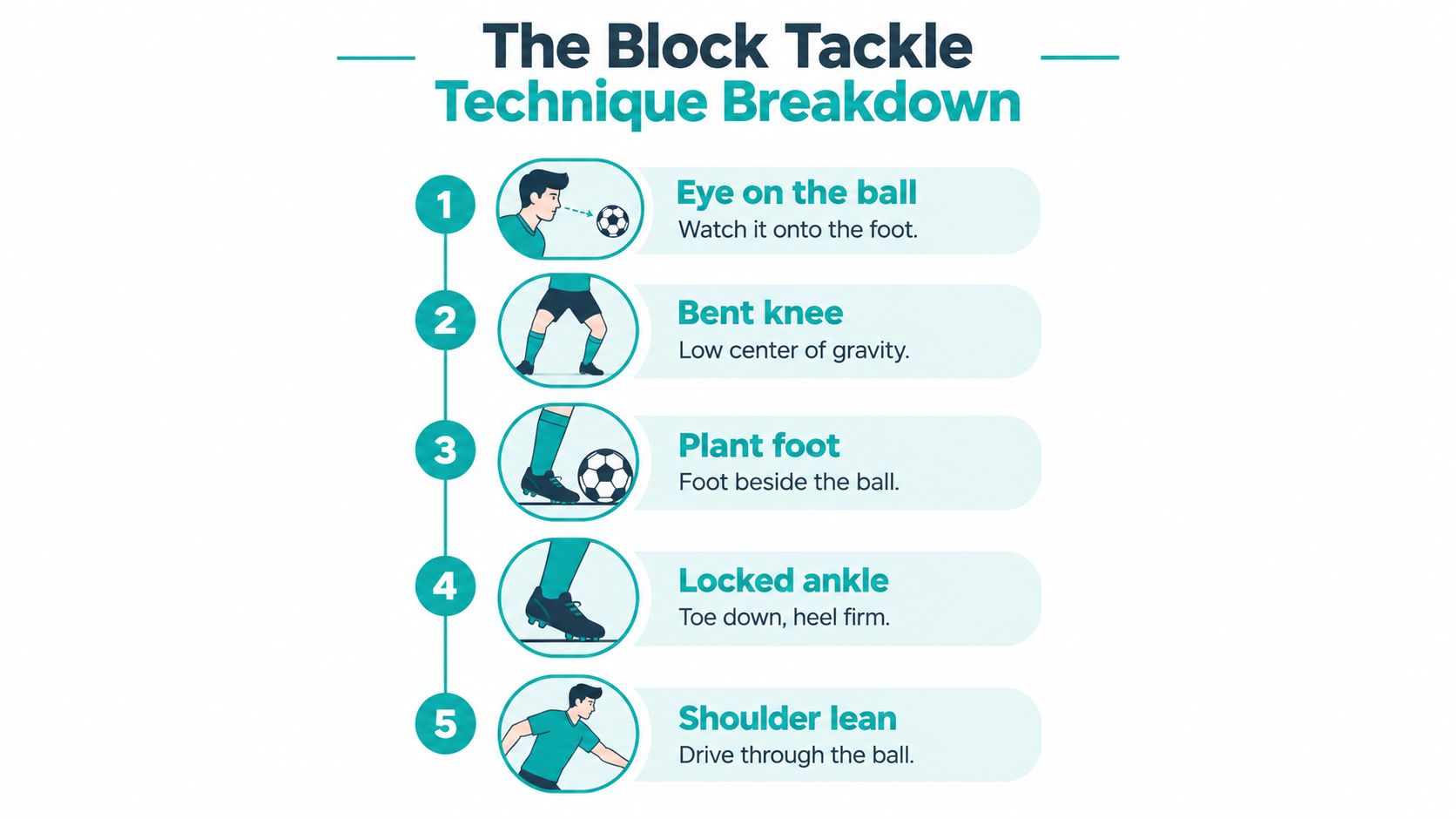
Before adding competitive scoring or live decisions, give players a dependable technical reference. The block tackle works when the defender arrives under control, stays connected to the ground and drives through the ball rather than swinging at it.
The UK youth football block-tackle guidance identifies consistent cues: approach at roughly 2-3 feet, keep the knees bent with weight on the balls of the feet, lock the tackling ankle, place the non-kicking foot alongside the ball and make contact through the ball's centre with the head and upper body over it.
Five cues that hold up at speed
Watch the ball onto the foot. The eyes should track the ball, not the attacker's upper body. Players still need peripheral awareness of the runner, but staring at the chest can make them react to a feint instead of the ball's movement.
Stay low and mobile. Bent knees and weight over the balls of the feet let the defender adjust. A straight-legged player has fewer options and often reaches from too far away. Low doesn't mean folded over. The chest should remain controlled so the player can recover if the tackle doesn't win possession.
Plant beside the ball. The non-kicking foot provides balance and directs the body through the challenge. If it lands behind or too far to the side, the player loses stability and often reaches with the tackling foot.
Lock the ankle. The tackling foot needs a firm contact surface. A loose ankle absorbs force and creates a mis-hit, while a locked ankle gives the player a cleaner chance of striking through the centre of the ball.
Keep the head and upper body over it. The body should lean into the action without diving. Shoulders square, a low centre of gravity and a firm plant foot help the player drive through the ball and remain ready for the next phase.
Practise the cues first at a controlled pace. A partner can roll or gently push the ball into the defender's path, but the exercise should quickly become a moving action. A useful companion resource is this tackle height and body-position drill, which reinforces the importance of approaching under control rather than collapsing into contact.
Watch for two faults immediately: the player stands upright, or the player swings before the plant foot is set. Correct the body shape, reset the distance and repeat. Strength won't rescue poor alignment.
Progression Drills for Every Skill Level
A good session can move from reading space to competing for a target, then into a duel where the player must choose whether to press, delay or tackle. Three England Football practices provide a useful progression because each one keeps the defender connected to an attacking problem.

Start with the diamond duel
Set four cones in a diamond. England Football's small-sided session places attackers and defenders roughly 20 yards apart, with the attacker trying to reach a side cone for one point or the far cone for three points. Add the ball as the progression so the defender must read the attacker's angle, speed and touch before choosing to engage. The full practice is described in the England Football diamond duel session.
The scoring creates a useful defensive decision. If the attacker is travelling towards a side cone, the defender may be able to press and win the ball. If the attacker has a clear route to the far cone, delaying and protecting space may be smarter than lunging.
Coach the defender to close distance under control, slow the attacker and stay balanced. If a tackle isn't available, the player should delay rather than force contact. For younger players, begin without a ball or reduce the distance between the opponents. For more experienced players, add a recovery defender or allow the attacker to start with a varied first touch.
Move into the challenging grid
The 1v1 challenging grid uses a square split into four equal boxes, with a safe zone down the middle. Two teams of four work with two servers. Attackers score by moving the ball into the safe zone, while defenders score by winning possession and returning it to the server. Players rotate after each point, so everyone experiences attacking, defending and serving.
This format creates more repetitions without turning the session into a queue. The safe zone gives attackers a clear target and defenders a reason to protect space rather than chase blindly. Ask players what changed before the successful tackle: Was the touch loose? Did the attacker slow down? Did the defender force play towards help?
For coaches planning broader learning outcomes, these actionable school drill objectives offer a useful way to connect movement, awareness and decision-making rather than treating each skill in isolation.
Finish with tag and tackle
The tag-and-tackle practice makes bravery and confidence explicit objectives. That matters because hesitation is often psychological. Some players have the mechanics but pull out when the attacker approaches, while others rush because they're trying to prove they aren't afraid.
Start with a tag, then allow a controlled tackle when the defender is in a good position. Praise the decision to delay as much as the successful ball win. A player who stays composed, protects the goal and waits for the right moment is developing a match skill, even when the attacker eventually escapes.
Use the progression below to keep the session purposeful:
- Reading: Can the defender identify the attacker's route?
- Approach: Can the defender close space without overcommitting?
- Decision: Can the player press, delay or tackle?
- Recovery: Can the defender react if the first challenge doesn't win possession?
Avoiding the Most Common Coaching Mistakes
Poor tackling sessions usually fail for predictable reasons. The coach may have good intentions, but the exercise rewards the wrong behaviour, removes the decision or introduces contact before players can control their bodies.
Mistake one, removing the opponent
A player can rehearse a block tackle against a passive ball and look tidy. That rehearsal doesn't teach the defender how to read a touch, manage approach speed or recognise when the ball is genuinely available. The England Football guidance on coaching tackling identifies opposition, repetition and realistic scenarios as central to improving timing.
Replace long lines and static demonstrations with short, repeated 1v1 actions. The attacker should have a clear objective and enough freedom to make the defender think. Start with predictable movement if necessary, but remove that predictability as soon as the player can manage the body shape.
Mistake two, accepting an upright defender
Watch the first two steps of the approach. If the defender's knees straighten, the weight shifts to the heels or the chest rises, the player has lost the position needed to change direction. An upright stance also encourages reaching, which places the foot too far from the body and makes recovery difficult.
Use a simple freeze command. Call “hold” as the defender closes, then check the knees, feet, chest and distance. Restart the action if the player has arrived too tall or too quickly. This takes less time than allowing a bad habit to run through a full practice.
The best tackle starts before contact. It starts with the defender arriving at a distance where balance is still possible.
Mistake three, treating bravery as force
Bravery isn't the same as aggression. A player who throws themselves into every challenge may look committed, but they're often giving the attacker an easy route around them. A confident defender can stay patient, protect space and tackle decisively when the ball moves away from the attacker's control.
The Leeds Beckett finding on knowledge and execution reinforces the point. Explanation alone doesn't create performance. Players need repeated opposition, sensible challenge and feedback that identifies the decision as well as the technique.
Keep the coaching language short during live practice. Use one cue such as “slow down”, “show outside” or “wait for the touch”. Between repetitions, give one correction and let the player try again. Coaches looking to improve session organisation can also use these training-session planning ideas to keep repetitions high without allowing quality to fall.
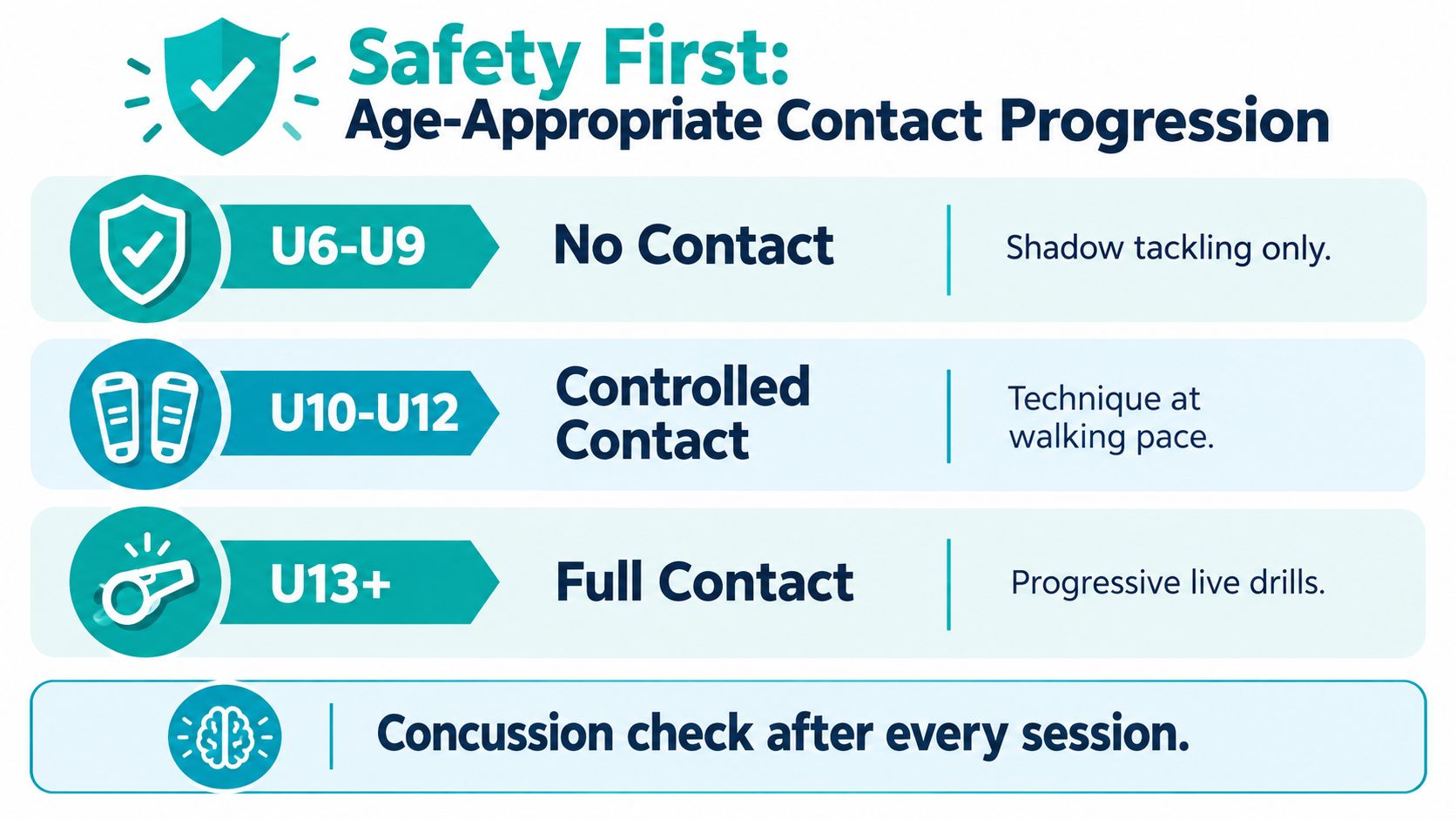
Safety First and Age-Appropriate Contact Progression
Tackling belongs in youth football, but contact must be planned rather than hidden inside a competitive game. The FA's concussion guidance and safeguarding rules state that normal training can include tackling when it takes place in a controlled, open environment with clear consent and appropriate explanation. The same guidance also rejects concealed physical contact, while current coaching resources emphasise heads-up and shoulder-contact methods.
Build contact in layers
Begin with movement and shadowing. The defender mirrors the attacker, matches the angle and practises slowing down without making contact. This phase teaches scanning, footwork and body control while allowing the coach to see whether players understand the defensive objective.
Introduce ball pressure next. The attacker can expose the ball or make a controlled touch, and the defender places a foot across the path without driving through the opponent. Keep the purpose on winning possession, not making a memorable collision.
Controlled contact comes after the player can manage approach speed and body position. Use clear boundaries, explain exactly where contact is allowed and give every player permission to stop if they feel uncomfortable. Players should know what will happen before the practice starts, not discover the contact rules during a challenge.
A practical progression looks like this:
- Shadow work: Match movement, angle and distance with no contact.
- Ball contact: Challenge the ball at a controlled pace while both players stay upright.
- Shoulder contact: Use heads-up positioning and controlled shoulder-to-shoulder actions where appropriate.
- Live decisions: Add realistic pressure only when players can maintain balance and follow the agreed safety rules.
The FA concussion and safeguarding guidance should sit within the club's wider process, not in a folder that coaches never open. Know who is responsible for responding to a suspected concussion, record concerns and follow the relevant return-to-play procedure. A guide to safer sports events can also help clubs review spaces, supervision and event-level risk before a session begins.
Give players a voice
Consent isn't a one-time question. Check that players understand the exercise and are willing to take part. A player who is worried about contact may need a less intense role, a demonstration with a coach or a gradual return to the activity.
Parents also need clear communication. Explain that the session develops controlled defensive technique, not toughness through heavy collisions. For a broader view of youth athlete development, clubs should consider confidence, physical readiness, learning needs and enjoyment alongside technical progress.
Stop the activity if a player loses control, the environment becomes crowded or the intensity rises beyond the agreed level. Safe repetition gives young players the confidence to compete well. Unmanaged contact teaches them to fear the moment or to copy reckless behaviour.
Building Your Season-Long Tackling Programme
A tackling programme should solve the problem you're seeing, then raise the difficulty only when players show control. A simple four-week cycle can give coaches a clear route without locking every age group into the same intensity.
Week one, establish the body shape
Use shadow approaches, controlled block-tackle movements and slow ball contacts. Watch the plant foot, ankle, knee bend and head position. Keep the feedback narrow. One strong correction repeated consistently is more useful than a speech covering every part of the tackle.
Week two, add the attacker's choices
Use the diamond duel with varied routes and a clear scoring target. The defender now has to decide whether to close, delay or tackle. Keep the environment safe and reduce the space if players are arriving out of control.
Week three, increase repetition under pressure
Use the challenging grid and rotate roles so players defend, attack and serve. Track simple observations such as controlled approaches, successful delays, clean ball wins and recoveries after missed challenges. Don't record success as tackles alone. A defender who forces a poor pass or protects the dangerous route has contributed to the outcome.
Week four, connect the skill to match play
Use tag-and-tackle actions before adding the tackle into a small-sided game. Set one defensive focus, such as delaying until support arrives or recovering after the first challenge. Review the next match for that specific behaviour, then adjust the following cycle based on player performance.
Keep contact intensity appropriate to the group, and build rest and explanation into the session. Coaches seeking wider guidance on top performance tips for athletes should still return to the central principle here: performance improves when players can repeat the right action with quality, purpose and confidence.
Vanta Sports helps clubs organise training, matches, attendance, communication and player development in one connected system, while coaches can use drill cards and performance tracking to keep tackling work visible across the season. Visit Vanta Sports to see how your club can turn well-designed tackling practice into a clearer, better-managed development pathway.
Tags