

Basketball
Mastering the 1-3-1 Zone Offense: Overload and Attack
Learn how to systematically dismantle zone defenses using the 1-3-1 offensive formation, focusing on quick ball reversals, high-low action, and corner overloads.
What you need
Basketballs, Half-court with FIBA markings, Cones (optional, for spacing markers)
1. Overview
The 1-3-1 zone offense is a highly effective tactical formation designed to attack traditional even-front zone defenses, particularly the 2-3 zone. By placing players in the gaps of the zone, the offense creates immediate numerical advantages (overloads) and forces defenders into difficult decision-making situations.
This set play aims to shift the defense horizontally, creating passing lanes for high-low post entries, open perimeter shots, and driving lanes. It is best utilized when facing a disciplined 2-3 zone that is difficult to penetrate through traditional motion principles. The core philosophy is to attack the elbows, the short corners, and the high post, forcing the bottom defenders of the zone to commit and thereby exposing the baseline or the opposite wing.
2. Setup
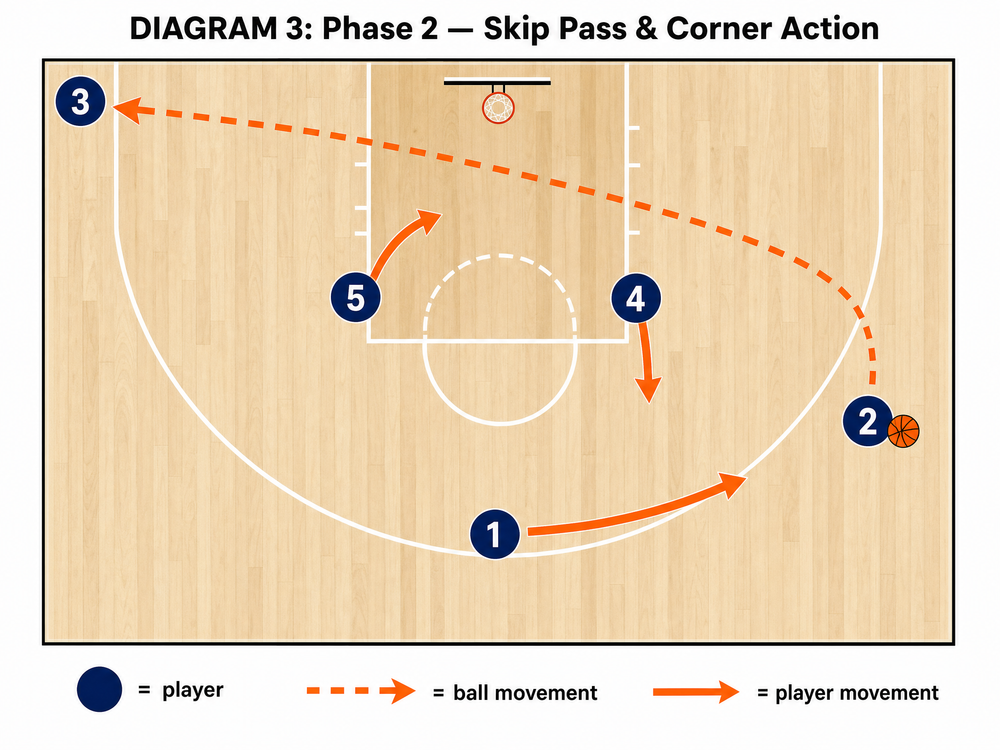
Court Dimensions: Standard FIBA half-court (28m x 15m)
Initial Alignment:
- 1 (Point Guard): Positioned at the top of the key, slightly beyond the three-point arc (6.75m).
- 2 (Shooting Guard): Positioned on the right wing, extended from the free-throw line, beyond the arc.
- 3 (Small Forward): Positioned on the left wing, mirroring the 2-guard.
- 4 (Power Forward): Positioned at the high post/free-throw line area, specifically favoring the strong-side elbow.
- 5 (Center): Positioned at the low post/short corner area on the strong side.
3. Step-by-Step Instructions
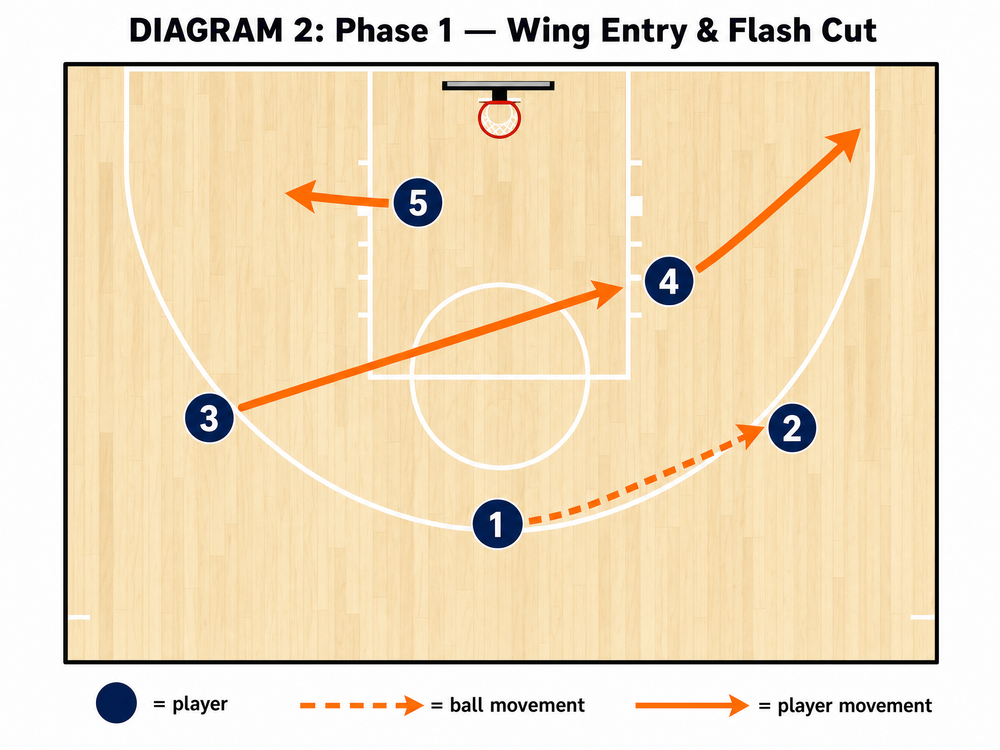
Phase 1: Wing Entry and Flash Cut
- The Entry Pass: Player 1 initiates the offense by dribbling slightly to one side to commit the top defenders, then makes a crisp pass to Player 2 on the right wing.
- The Flash Cut: As the ball is in the air to Player 2, Player 3 immediately makes a hard, diagonal flash cut from the left wing toward the high post/elbow area on the strong side.
- Post Sliding: Simultaneously, Player 5 slides along the baseline from the right low block to the left short corner to create space and prepare for a potential high-low action.
- Spacing Adjustment: Player 4 steps out slightly toward the right corner to drag the bottom defender out of the paint.
Phase 2: Skip Pass and Corner Action
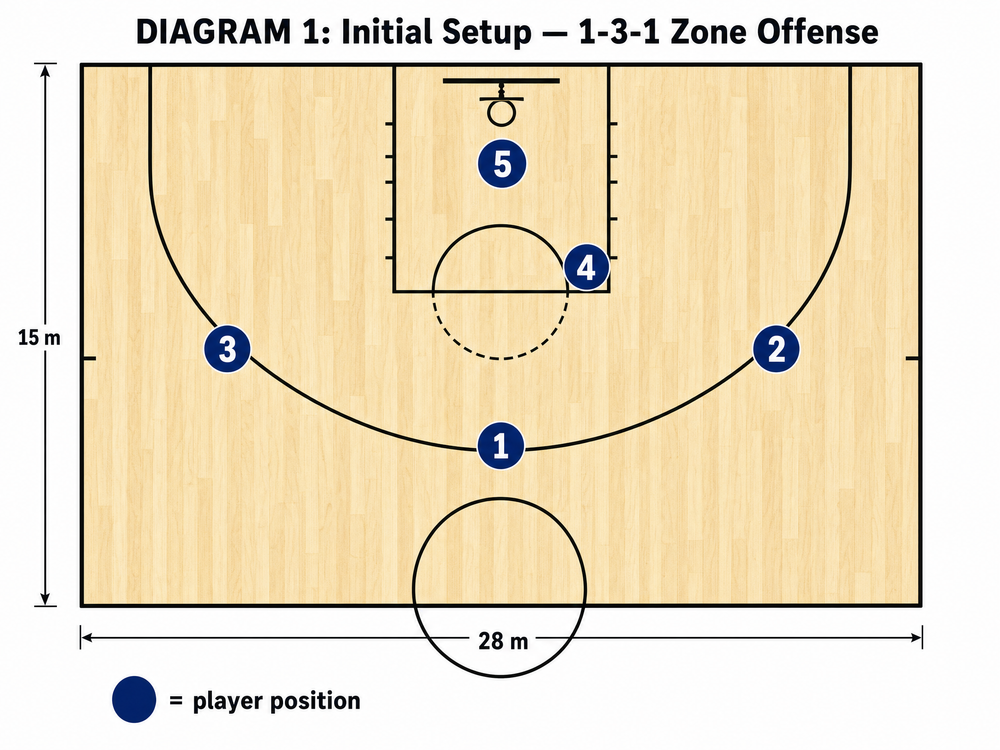
- The Skip Pass: If the defense shifts heavily to the strong side (right side) to cover the flash cut and the ball, Player 2 executes a quick, overhead skip pass directly to Player 3, who has now relocated to the left corner.
- High-Low Action: Upon catching the skip pass, Player 3 immediately looks inside. Player 5 seals the recovering defender and flashes from the left short corner up to the left block or elbow for a high-low entry.
- Perimeter Rotation: Player 1 slides over to the right wing to fill the spot vacated by Player 2, providing a safety outlet.
- Weak-Side Rebounding: Player 4 dives from the right elbow down to the right block, establishing weak-side rebounding position.
4. Key Coaching Points
- Patience and Ball Reversal: The effectiveness of this offense relies on shifting the zone. Players must be patient and execute quick ball reversals to force the defense to move.
- Attack the Gaps: Players should catch the ball in a triple-threat position and immediately look to attack the gaps in the zone, either through the pass or the dribble.
- High Post Presence: The high post (Player 4 or the flashing Player 3) is the hub of the offense. Getting the ball to the high post forces the bottom of the zone to collapse, opening up the perimeter.
- Screening the Zone: Utilize pin-down screens on the outside of the zone defenders to free up shooters on the weak side during ball reversals.
5. Common Mistakes
- Holding the Ball: Players holding the ball too long allow the zone to set and recover. Quick passing is essential.
- Standing Still: Offensive players becoming static on the perimeter makes them easy to guard. Continuous movement, cutting, and filling spots are required.
- Ignoring the High Post: Failing to look for the high post entry pass negates the primary advantage of the 1-3-1 alignment against an even-front zone.
- Poor Spacing: Players creeping too close together allow one defender to guard two offensive players. Maintain strict spacing beyond the three-point arc.
6. Variations & Progressions
- Baseline Runner: Instead of keeping Player 5 stationary, have them continuously run the baseline from short corner to short corner, following the ball to overload the strong side.
- Dribble Penetration: Allow the guards (Players 1, 2, and 3) to use dribble penetration to commit two defenders, then kick out to the open shooter.
- High Screen and Roll: Implement a high ball screen from Player 4 for Player 1 at the top of the key to initiate the offense and force the top defenders to communicate.
7. Age Adaptations
- Under 10/12: Focus heavily on the basic alignment and simple passing. Emphasize catching, pivoting, and looking inside before passing around the perimeter. Limit complex flash cuts.
- Under 14/16: Introduce the flash cuts and the concept of overloading one side of the floor. Teach players how to read the defense and decide between a skip pass or a post entry.
- Open/Advanced: Implement all phases, variations, and advanced screening actions. Demand rapid ball movement, precise timing on cuts, and high-level decision-making based on defensive rotations.
