

Basketball
The Ultimate 5-on-5 Box-Out and Rebounding Drill
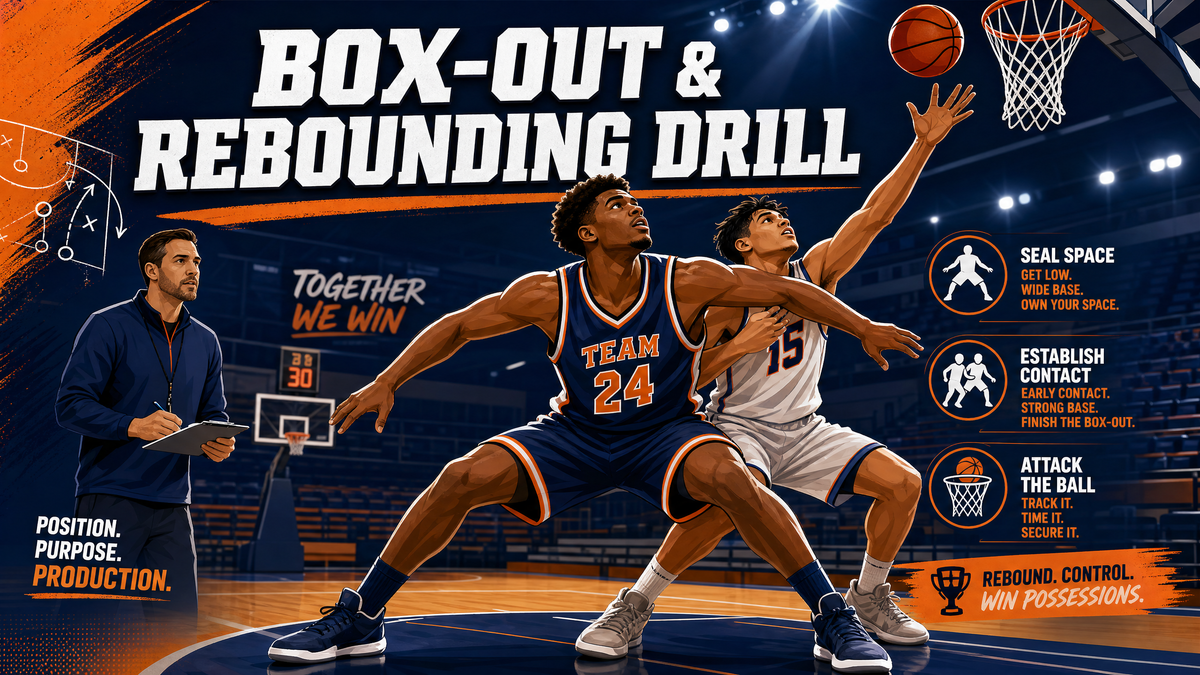
Master the fundamentals of securing possession with this competitive 5-on-5 rebounding drill that teaches players how to locate, seal, and pursue the ball.
What you need
Basketball, Whistle, Colored pinnies
Overview
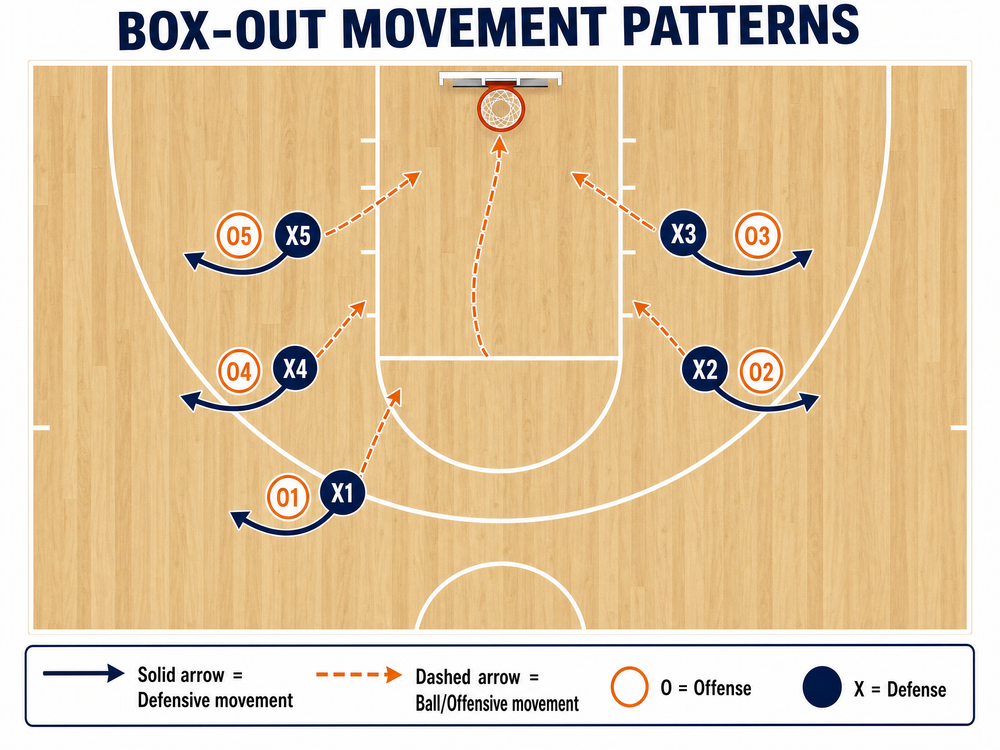
Rebounding is the great equalizer in basketball. A team that controls the glass controls the tempo, limits second-chance points, and creates transition opportunities. This 5-on-5 Box-Out and Rebounding Drill is designed to build the critical habits of locating a man, making early physical contact, establishing a wide base, and aggressively pursuing the basketball.
This drill is ideal for teaching defensive accountability. It forces players to communicate, find their assignment in space, and execute fundamental box-out technique before reacting to the flight of the ball. By running this in a live 5-on-5 half-court setting, players learn to navigate traffic and secure rebounds in game-like conditions. Use this drill at the start of practice to reinforce defensive culture, or at the end of a session as a competitive finisher.
Setup
Equipment Needed:
- 1 Basketball
- Whistle (for the coach)
- Colored pinnies (optional, but recommended to distinguish offense and defense)
Court Setup:
- Use one half of a standard FIBA court (28m x 15m full court dimensions), giving you approximately 14m x 15m of playing space.
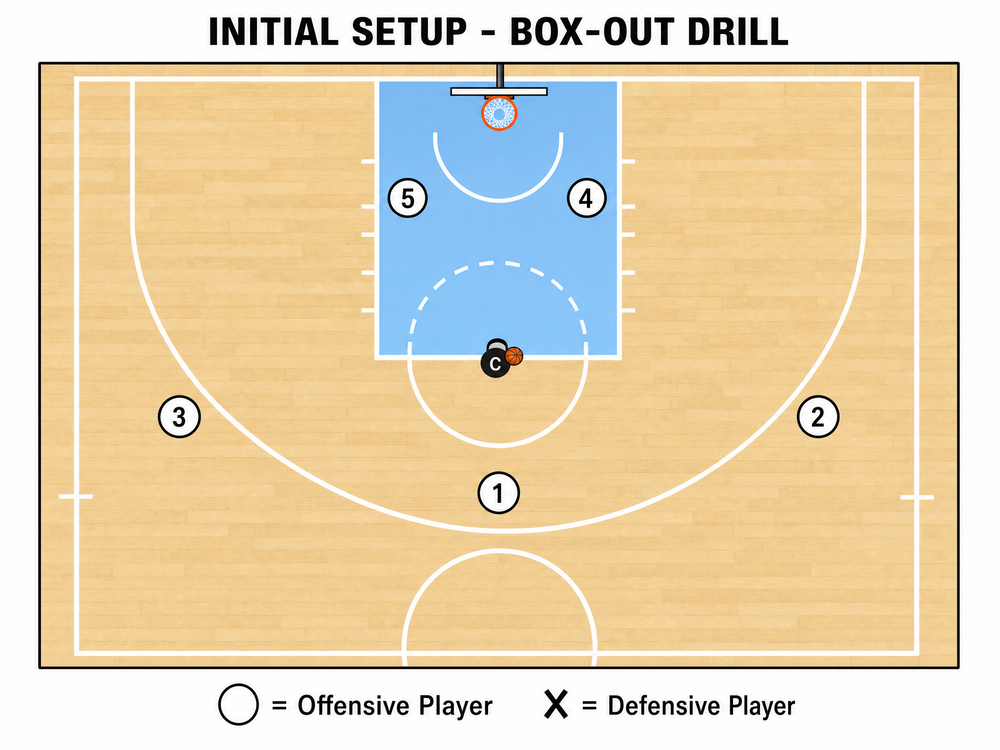
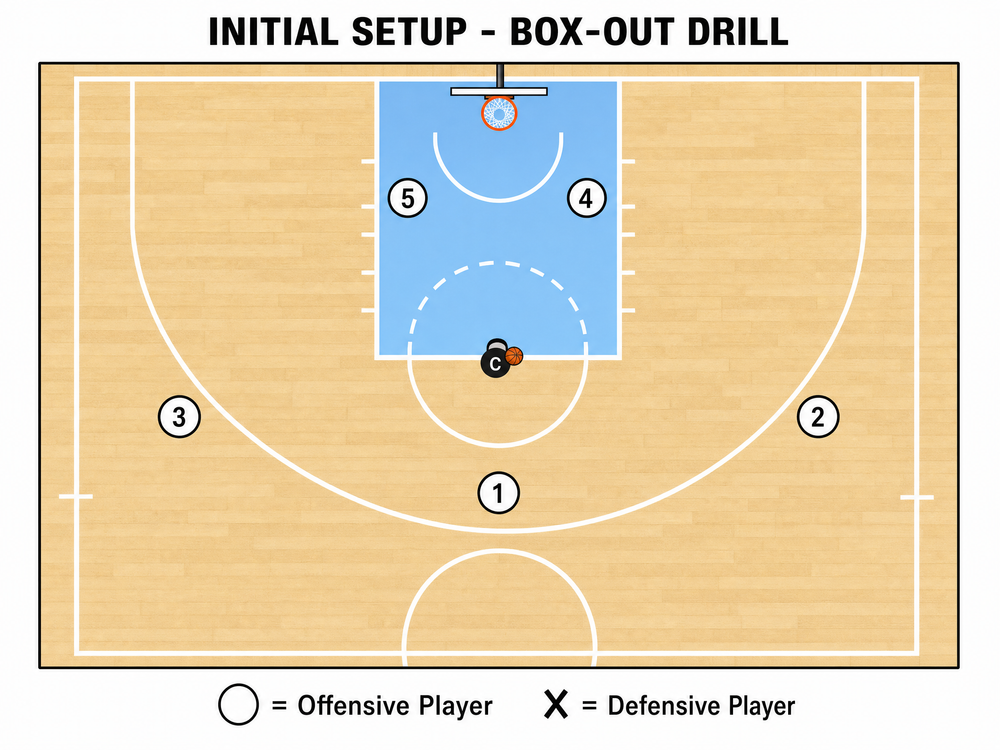
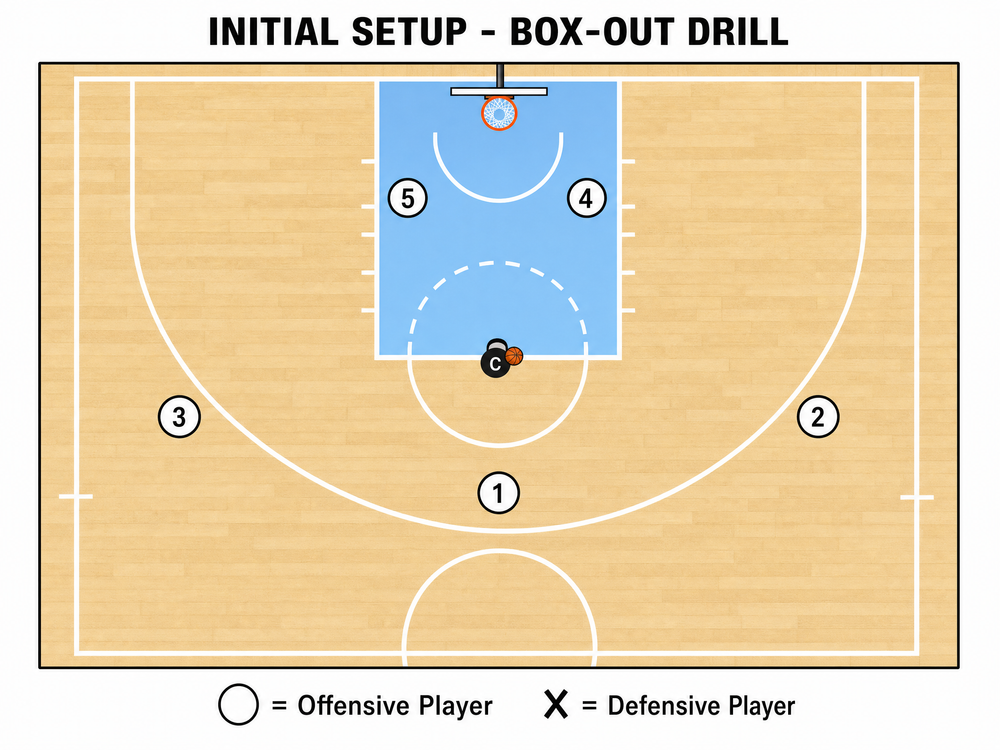
- The coach (or a designated shooter) stands near the free-throw line — 5.8m from the basket — with the basketball.
Player Positions:
- Set up 5 offensive players (O1-O5) around the perimeter and mid-post areas.
- Set up 5 defensive players (X1-X5) matched up against the offensive players, positioned slightly inside their man (between their assignment and the basket).
- Point Guard (1): Top of the key, approximately 6.75m from the basket.
- Shooting Guard (2): Right wing, level with the free-throw line extended.
- Small Forward (3): Left wing, level with the free-throw line extended.
- Power Forward (4): Right block, 1.5m from the baseline.
- Center (5): Left block, 1.5m from the baseline.
Step-by-Step Instructions
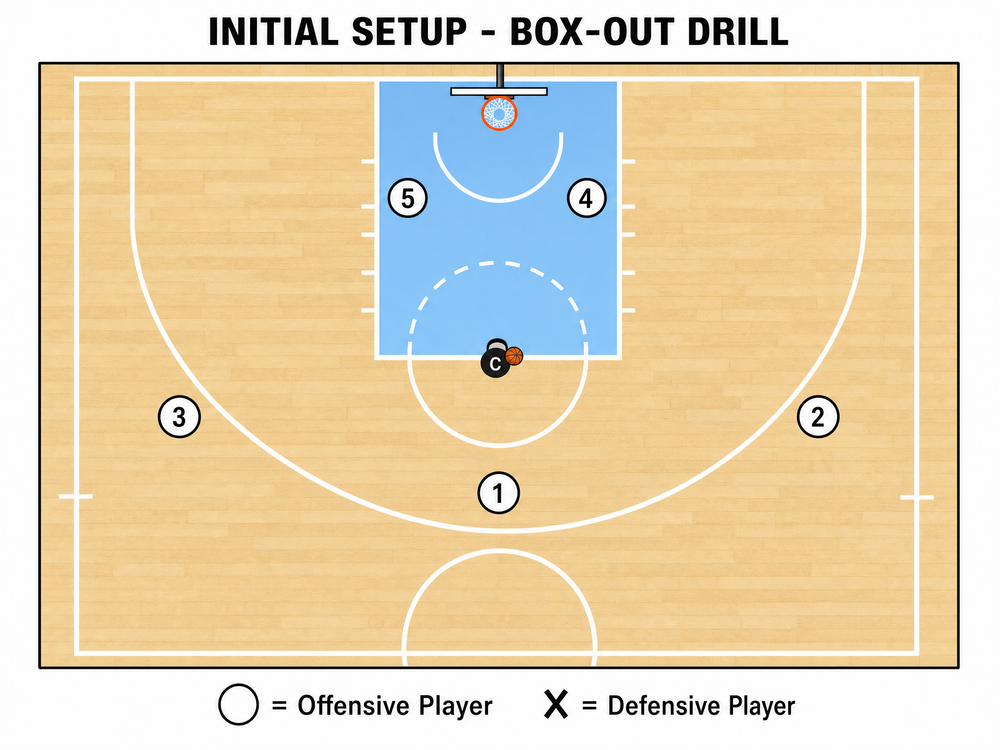
Initial Alignment: The coach stands at the free-throw line with the ball. The defense is matched up man-to-man against the offense. Every defender should be in a low defensive stance, using "pistols" — one hand pointing to their man, one hand pointing to the ball.
The Shot: The coach shoots the ball toward the basket. The shot can be a deliberate miss off the rim or backboard to create a contested rebounding opportunity. Vary the angle and trajectory to simulate different game situations.
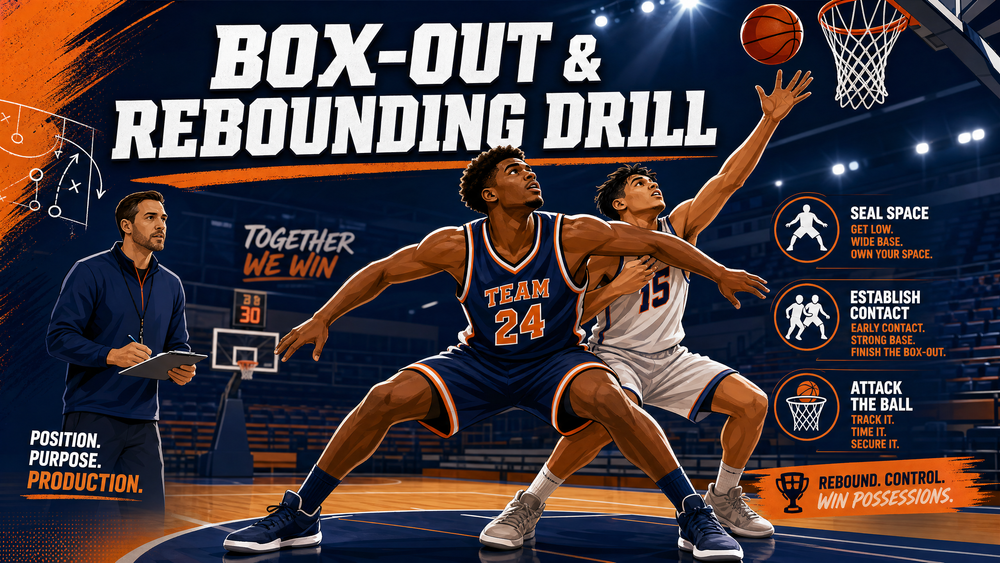
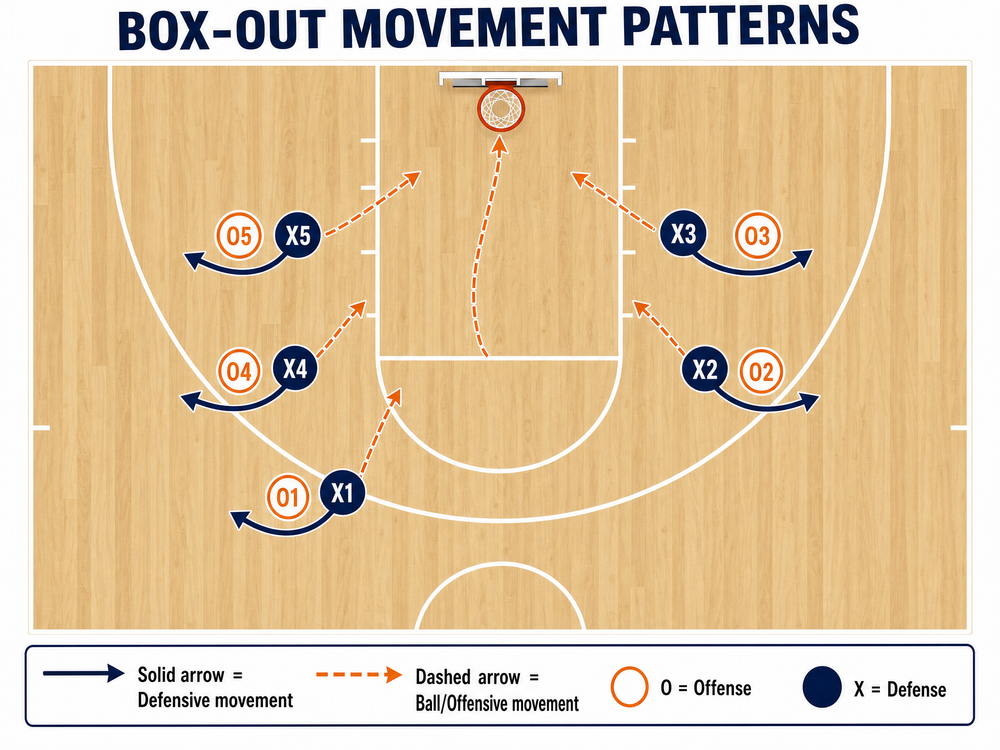
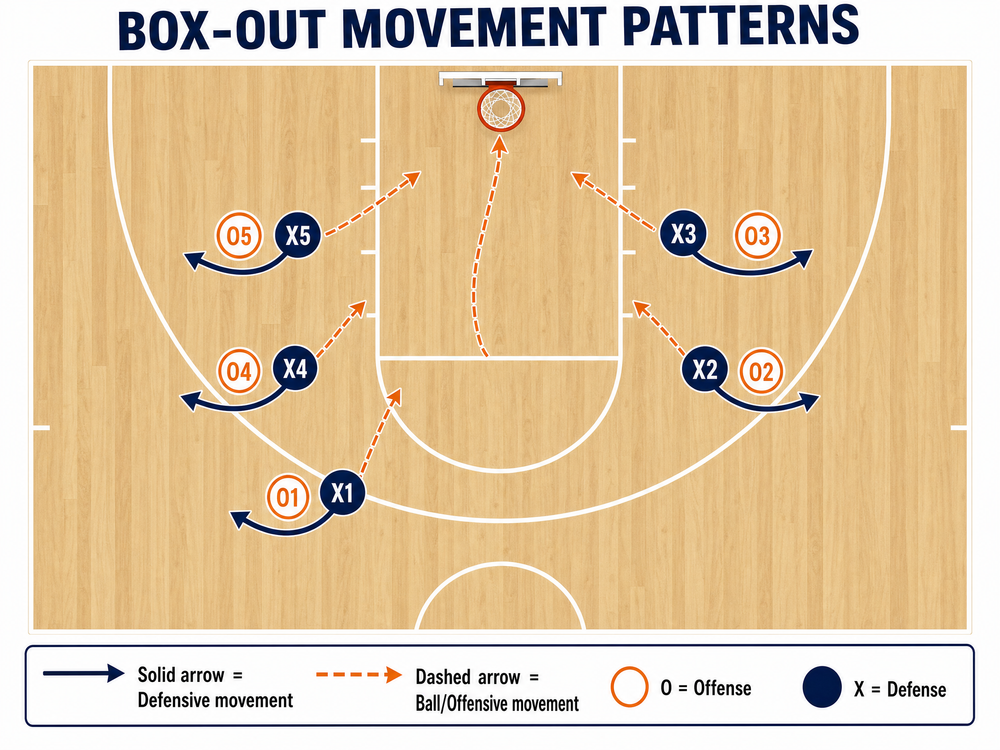
Locate and Contact: The instant the ball leaves the coach's hands, every defensive player must immediately locate their assigned offensive player. Within one step, they must move toward their man and make physical contact — using their forearm, shoulder, or chest — to feel where the offensive player is moving.
The Pivot and Seal: After making contact, the defender executes a reverse pivot (drop step) or front pivot to put their back or hips squarely into the offensive player's thighs and midsection. The defender must drop their hips to lower their center of gravity, establish a wide base with feet shoulder-width apart, and keep their arms up and out to occupy maximum space.
Hold the Seal for 2 Counts: Players must maintain the box-out position for a full two counts — long enough to prevent the offensive player from getting a clean path to the ball. This is the discipline point most players skip.
Pursuit: Once the box-out is established and the offensive player's forward momentum is stopped, the defender releases the seal and aggressively pursues the basketball. Players should attack the ball at its highest point, snatching it with two hands.
The Outcome:
- If the defense secures the rebound, they must immediately pivot to the outside (away from the baseline) and throw a crisp outlet pass to a designated outlet player or the coach at the half-court line.
- If the offense secures the offensive rebound, the drill immediately becomes "live" and the offense attempts to score. The defense must recover and contest.
Reset and Rotate: After each repetition, rotate offense to defense and bring in a new offensive group. Run 3 sets of 5 repetitions per group, then rotate all players.
Key Coaching Points
Hit First, Then Find the Ball: The single most important habit to build. Players must initiate contact on their man before turning to watch the shot. Remind them: "Find the body, then find the ball."
Wide Base and Low Hips: A tall, narrow stance is easily pushed under the basket or around. Players must drop their center of gravity, bend their knees, and maintain a wide, strong base. Cue: "Get low and grow wide."
Use Your Back, Not Your Arms: Trying to hold off the offensive player with hands or arms leads to fouls and weak positioning. The power comes from the hips and back. Players should feel the offensive player's pressure against their back, not their hands.
Two-Handed Rebounds: Encourage players to snatch the ball with two hands and bring it aggressively to chin height with elbows flared out ("chin it") to protect it from strip attempts in traffic.
Communicate on the Shot: Defenders should call out "Shot!" the moment the ball is released. This triggers the whole team to execute their box-out assignments simultaneously and builds collective defensive awareness.
Complete the Play with the Outlet: The rebound is not complete until the outlet pass is made. A sloppy outlet pass after a hard-earned defensive rebound is a wasted possession. Demand a strong, two-handed chest or overhead outlet pass every time.
Common Mistakes
Ball Watching: Players stare at the shot trajectory and forget to find their man, allowing the offense a free path to the basket. Correct this immediately by stopping the drill and requiring the offending player to call out their man's number before the next rep.
Arm Reaching: Using hands or arms to push the offensive player instead of using hips and back. This is both ineffective and a foul risk. Cue: "Back to belly, hips to thighs."
Standing Up After Contact: Players make initial contact but then pop up out of their stance, losing their leverage and getting pushed under the backboard. Reinforce: "Stay low through the whole box-out."
Releasing Too Early: Defenders feel the contact, then immediately spin to look for the ball before the offensive player is truly sealed. The offensive player slips by for an easy put-back. Enforce the two-count rule strictly.
Weak Outlet Passes: Securing the rebound but turning it over with a lazy, one-handed, or telegraphed outlet pass. The drill must include a quality outlet pass to be considered a complete repetition.
Variations & Progressions
Advantage/Disadvantage: Give the offensive players a 1-second head start after the shot to simulate a defensive lapse. This forces the defense to recover, locate, and box out on the move — a much more realistic game scenario.
No-Jump Rebounding: Require all players to secure the rebound without leaving their feet. This variation strips away athleticism as a crutch and forces players to perfect their positioning and box-out technique. Any player who jumps must repeat the rep.
Transition Transition: If the defense secures the rebound, require them to immediately execute a full-court fast break to the opposite end and finish at the rim within 8 seconds. This adds a conditioning element and reinforces the connection between defensive rebounding and offensive transition.
Age Adaptations
Under 10s: Remove the competitive element entirely. Focus purely on the mechanics of the pivot and seal. Have players pair up and practice the footwork of the box-out on the coach's whistle, without a live shot. Emphasize the wide base and the feeling of using their back. Keep sessions to 5 minutes maximum.
Under 12s: Introduce a live shot but use a lighter, smaller ball (size 5). Focus on the "locate and contact" step. Praise any player who successfully finds their man before the ball comes off the rim, regardless of whether they secure the rebound.
Under 14s: Introduce the concept of "hit first" and begin enforcing the two-count box-out rule. Emphasize two-handed rebounding and incorporate the outlet pass as a mandatory conclusion to every successful defensive rebound.
Under 16s & Open: Run the drill completely live with full physicality. Emphasize high-point rebounding, quality outlet passes, and the transition element. Add the Advantage/Disadvantage variation to replicate in-game pressure. Track statistics: count how many defensive rebounds versus offensive rebounds are secured per set to create competitive accountability.
