BLOB ‘Fist’: Box Cross-Screen Layup for a Baseline Inbound
Install a dependable baseline inbound that creates a rapid rim finish, a screen-and-slip counter, and a disciplined safety outlet.
Equipment Needed
BLOB “Fist”: Box Cross-Screen Layup for a Baseline Inbound
Overview
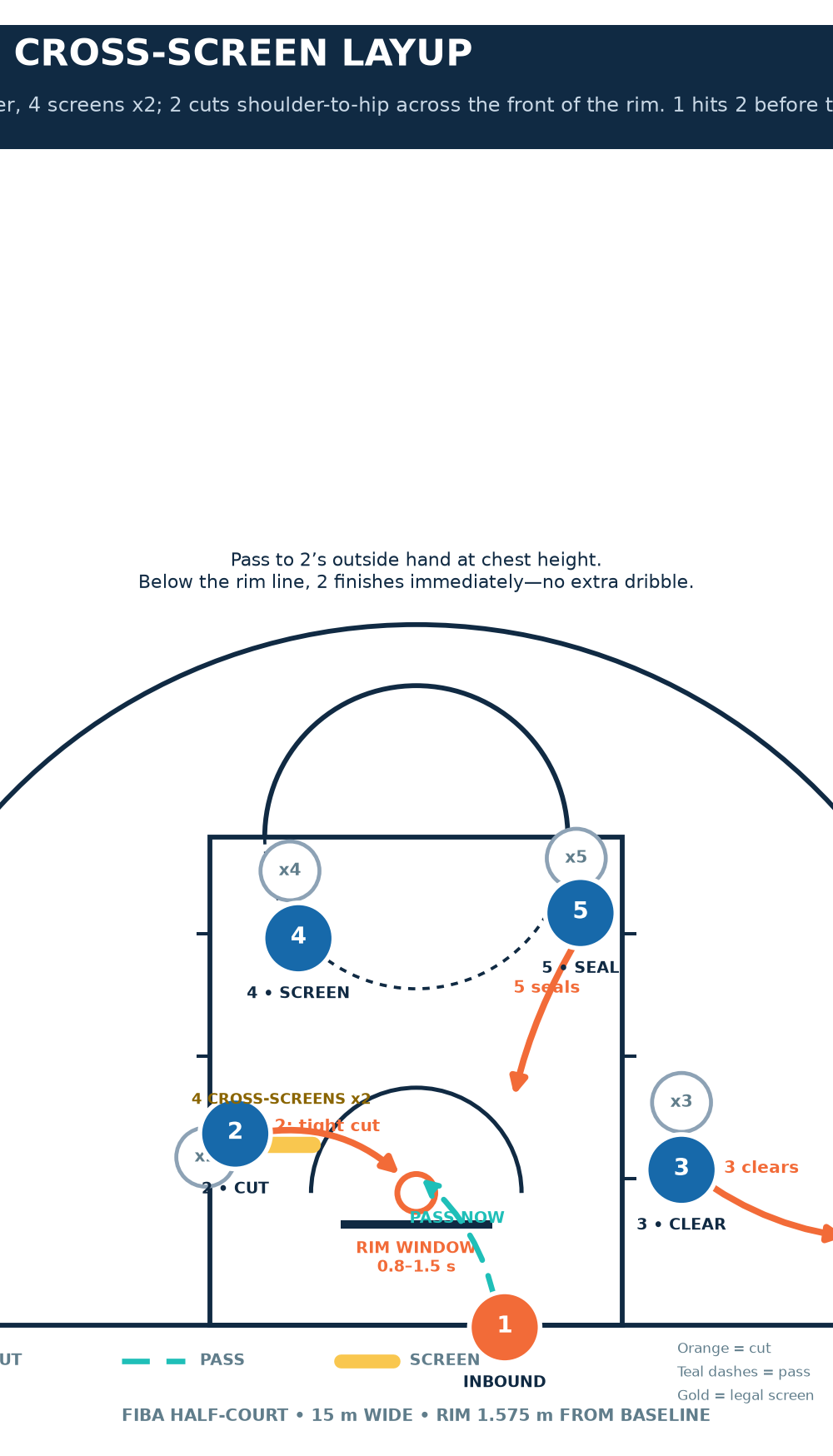
BLOB “Fist” is a compact baseline-out-of-bounds play designed to create a layup before the defence can organise its help. It is a reliable call after a timeout, after a dead ball on the baseline, or whenever you need one decisive rim attempt rather than a long possession. The primary action is simple: 4 cross-screens for 2, 2 cuts shoulder-to-hip across the front of the rim, and 1 delivers the pass immediately. The play also contains a built-in screen-and-slip counter for 5 when the defence jumps the cutter.
Use the full 28 m × 15 m FIBA court as your reference, but teach this play in the 5.8 m deep lane area first. The critical time constraint is the inbounder’s five-second release window, so your players must recognise the first scoring window by roughly 1.5 seconds and flow straight to the counter if it is taken away.[1] This is an intermediate set: the movements are teachable for developing teams, while the reads make it useful at older ages and open level.
Setup
| Element | Coach’s setup instruction |
|---|---|
| Personnel | Put your most accurate passer at 1 (inbounder) and best contact finisher at 2. Use 4 as the primary screener, 5 as the secondary screener/slip option, and 3 as the clear-out and safety outlet. |
| Starting alignment | Form a tight box: 2 on the left low block, 3 on the right low block, 4 at the left elbow, and 5 at the right elbow. Keep feet about 0.5–0.8 m outside the lane-line corridor so the lane stays readable. |
| Inbound spot | 1 stands out of bounds under the basket, about 0.5 m to the ball-side of the backboard support. The official must hand 1 the ball only after the four cutters are set. |
| Court reference | The painted lane is the working area; use the rim line and the 4.9 m lane width as visual anchors. Keep 3’s clearing route outside the paint and toward the short corner. |
| Equipment | One game ball, two colour bibs for the defence, four flat cones to mark the box, and a whistle. Add a manager or assistant as the official during timed reps. |
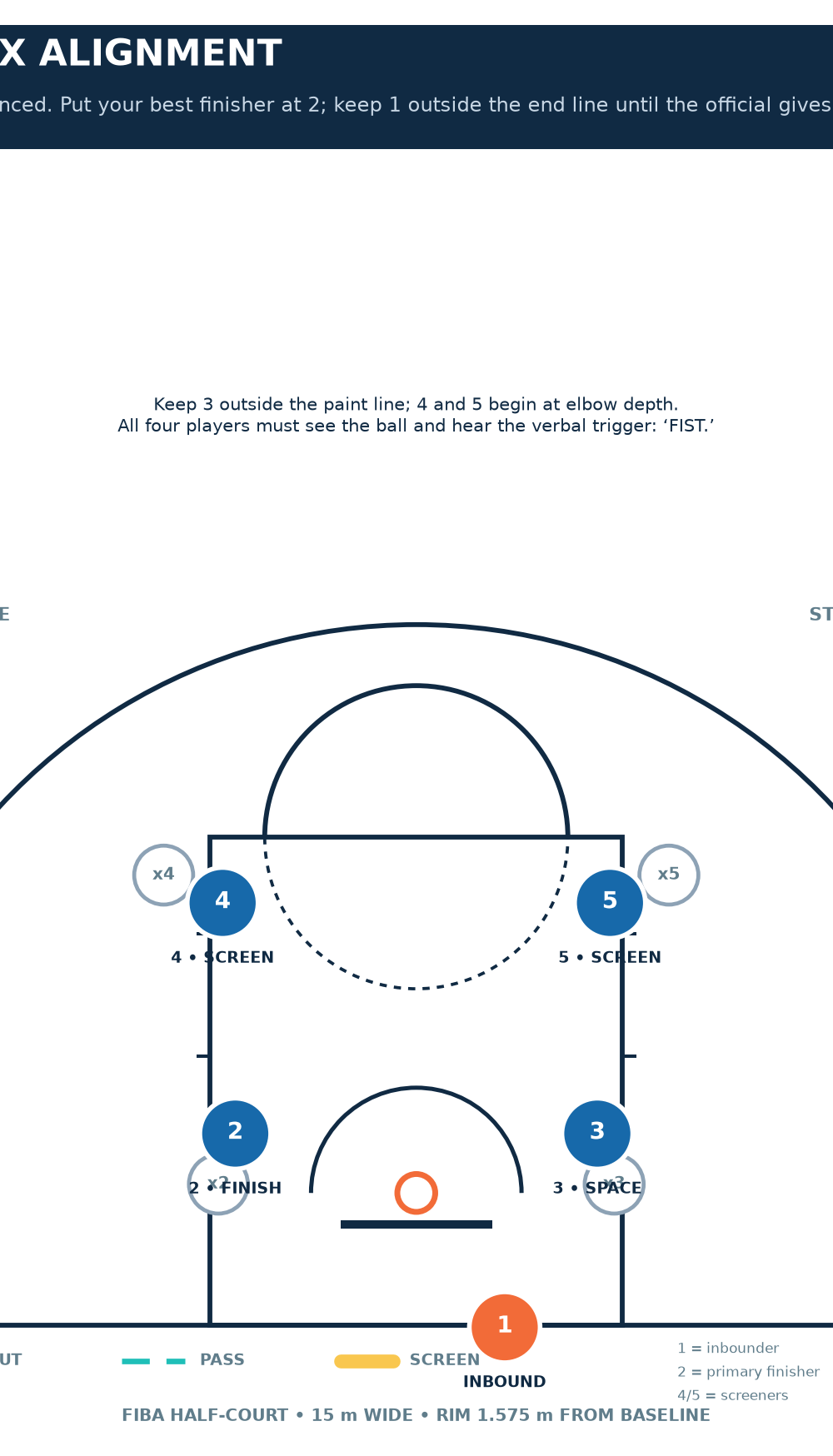
Before the ball is live, name the call “Fist.” Your cue is that every player can see 1 and hear the call. Demand stillness in the set. If the offence drifts before the ball is administered, the screen angles change and the defence has already won the possession.
Step-by-Step Instructions
Set the box and identify the primary finisher. Place 2 on the left low block with a staggered stance, inside foot nearest the lane. Place 3 opposite on the right low block. Put 4 and 5 at elbow depth, facing the inbounder. Tell 2: “Show your numbers, then hide your hips.” The defender must believe 2 is staying low before the cut begins.
Administer the ball and trigger the action. As soon as 1 receives the ball, 4 sprint-steps down to set a legal cross-screen on x2. 4’s chest faces the sideline, feet set before contact, with arms tight to the body. At the same instant, 3 clears to the right short corner, at least 1 m outside the lane line, taking x3 away from the rim.
Run the primary cut. 2 waits until 4’s feet are set, then cuts hard across 4’s hip and the front of the ring. The cut must pass within roughly 0.5 m of the rim line. Coach 2 to arrive on balance with both hands visible and the outside hand high as a target. A slow, rounded route invites a switch; a tight cut creates separation.
Make the first pass on time. 1 pivots to a two-hand chest-pass base and passes to 2’s outside shoulder between 0.8 and 1.5 seconds after the ball is released to play. Do not lob the primary pass unless the defender is underneath. 2 catches and finishes immediately: inside-hand layup if protected by the rim, outside-hand finish if the defender trails. No extra dribble is the standard.
Protect the second chance. While 2 cuts, 5 steps toward the lane as if to screen x3, then seals x5 on the far side of the rim. 4 opens after screening and presents two hands at the free-throw line as the safety pass. If the direct finish is unavailable, 1 must find 4 before the five-second count forces a turnover.
Key Coaching Points
| Coaching focus | What to teach and demand |
|---|---|
| Screen legality | “Arrive early, be still, absorb.” 4 must establish position before x2 arrives. Do not teach a moving screen simply because the play begins quickly. |
| Cut detail | 2 wins with the shoulder-to-hip path, not a wide sprint. The cutter’s eyes find the ball only after clearing the screener’s hip. |
| Pass window | 1 should see the target before receiving the ball and release on the first clean angle. A pass delivered late turns a layup into a crowded catch. |
| Rim balance | 5 must seal without standing under the basket. Teach a wide base, hands high, and a pivot to the ball after contact. |
| Spacing | 3’s clear-out is real. If 3 drifts into the lane or watches the ball, x3 becomes a help defender and kills the finish. |
| Communication | Use a single verbal trigger—“Fist”—and one hand signal. Players should know primary, counter, and safety before they break the huddle. |
Common Mistakes to Correct
Mistake 1: 4 chases x2 instead of screening a space. Stop the rep and put a cone on the exact screening spot, about one body width above 2’s original defender. Require 4 to beat the defender to the cone and be balanced before contact.
Mistake 2: 2 leaves before the screen is set. This creates an illegal moving screen or lets x2 slide under. Use a “screen—cut” verbal rhythm in walkthroughs, then remove the call once timing becomes automatic.
Mistake 3: 1 watches the cut too long. Give the inbounder a 1.5-second shot-clock cue in practice. If the ball has not left 1’s hands on the first window, 1 must immediately read 5’s slip, then 4’s safety pass.
Mistake 4: 3 is a spectator. Put a live defender on 3 and award the defence a point if x3 tags 2 in the restricted area. Your spacer will then understand that the clear-out is part of the score.
Variations & Progressions
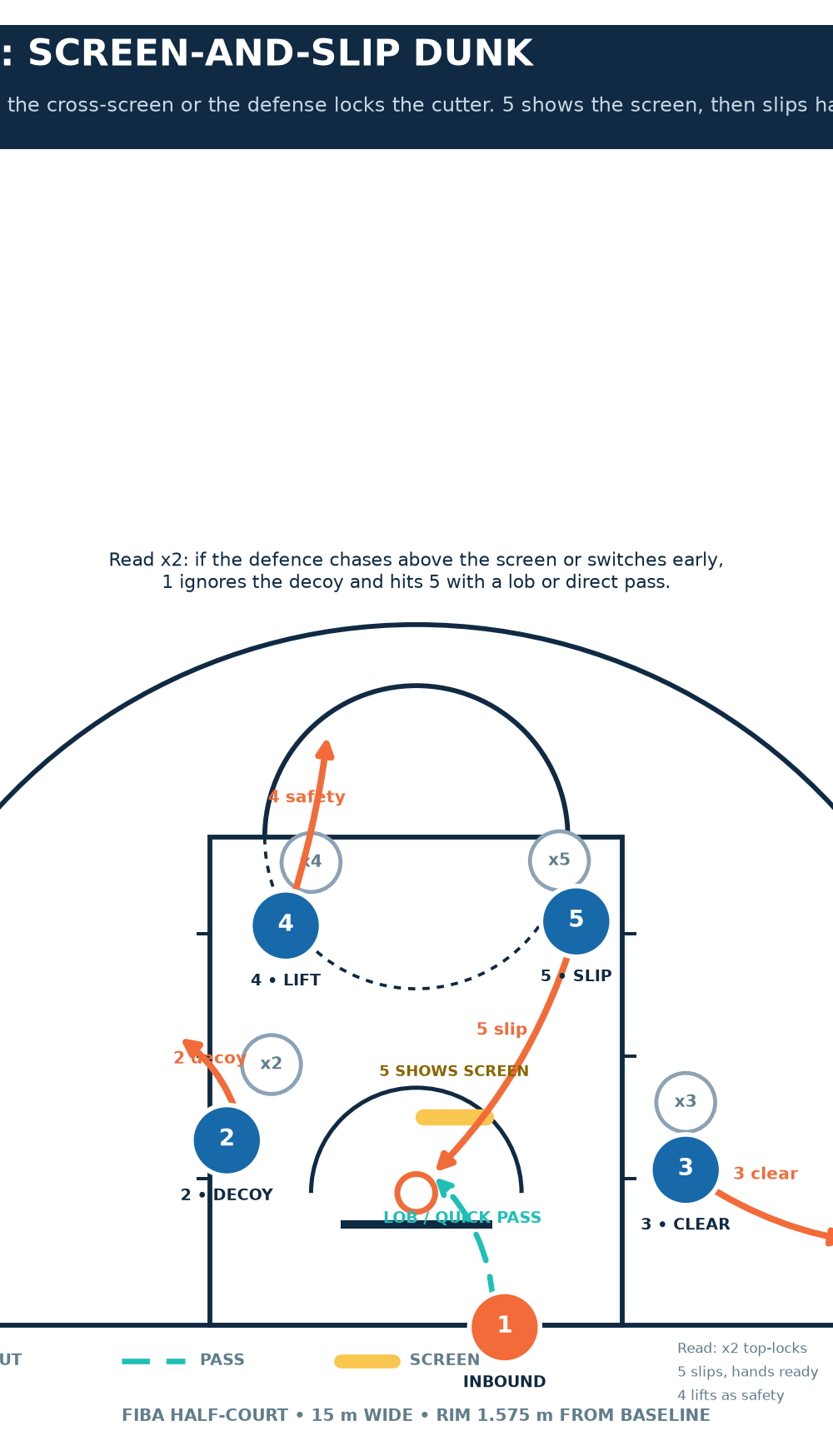
Variation 1 — Screen-and-slip counter. Call “Fist Slip” when x2 top-locks, shoots above the screen, or the defence switches before 2 cuts. 2 becomes the decoy, moving up the lane line. 5 shows the second screen, then slips directly to the front of the rim. 1 delivers a direct pass or soft lob to 5’s high hands.
Variation 2 — Safety-to-three. Against packed paint help, have 4 open to the free-throw line and reverse the ball to 3 in the short corner. 3 either shoots the catch-and-shoot three, attacks the close-out, or feeds 5 on the seal. This makes the play usable when you need a quality shot rather than only a layup.
Progression — Add decision pressure. Begin 5-on-0 with the ball administered by a coach. Progress to 5-on-5 guided defence: x2 trails, then top-locks, then switches. Finish with live 5-on-5 and a five-second visible count. Award the offence two points for a rim score, one point for a clean safety pass, and zero for a five-second violation or offensive foul.
Age Adaptations
For Under-10, remove the screen contact. Have 4 stand as a stationary landmark and allow 2 to run around it; use a bounce pass and a wider target area. For Under-12, introduce a legal stationary screen but retain guided defenders and let 1 use 3–4 seconds to pass. For Under-14 and Under-16, teach the slip read, the safety outlet, and weak-side help. At open level, rehearse opponent-specific coverage: switching, zoning the lane, top-locking the cutter, and denying 1’s vision.
Build this into a 25-minute segment: 5 minutes of walking alignment, 6 minutes of 5-on-0 timing, 7 minutes of guided defence, and 7 minutes of live competitive reps. End every rep with a finish, an outlet, or a dead-ball correction—never with players jogging back before the decision has been completed.
References
[1]: FIBA, Official Basketball Rules 2024, court dimensions and Article 17 throw-in procedure