Baseline Inbound ‘Rim Seal’: Box-Cross SLOB for a Quick Finish
Teach a reliable baseline inbound that creates a layup first, a deep-corner counter second, and a safe outlet when the defense takes away the rim.
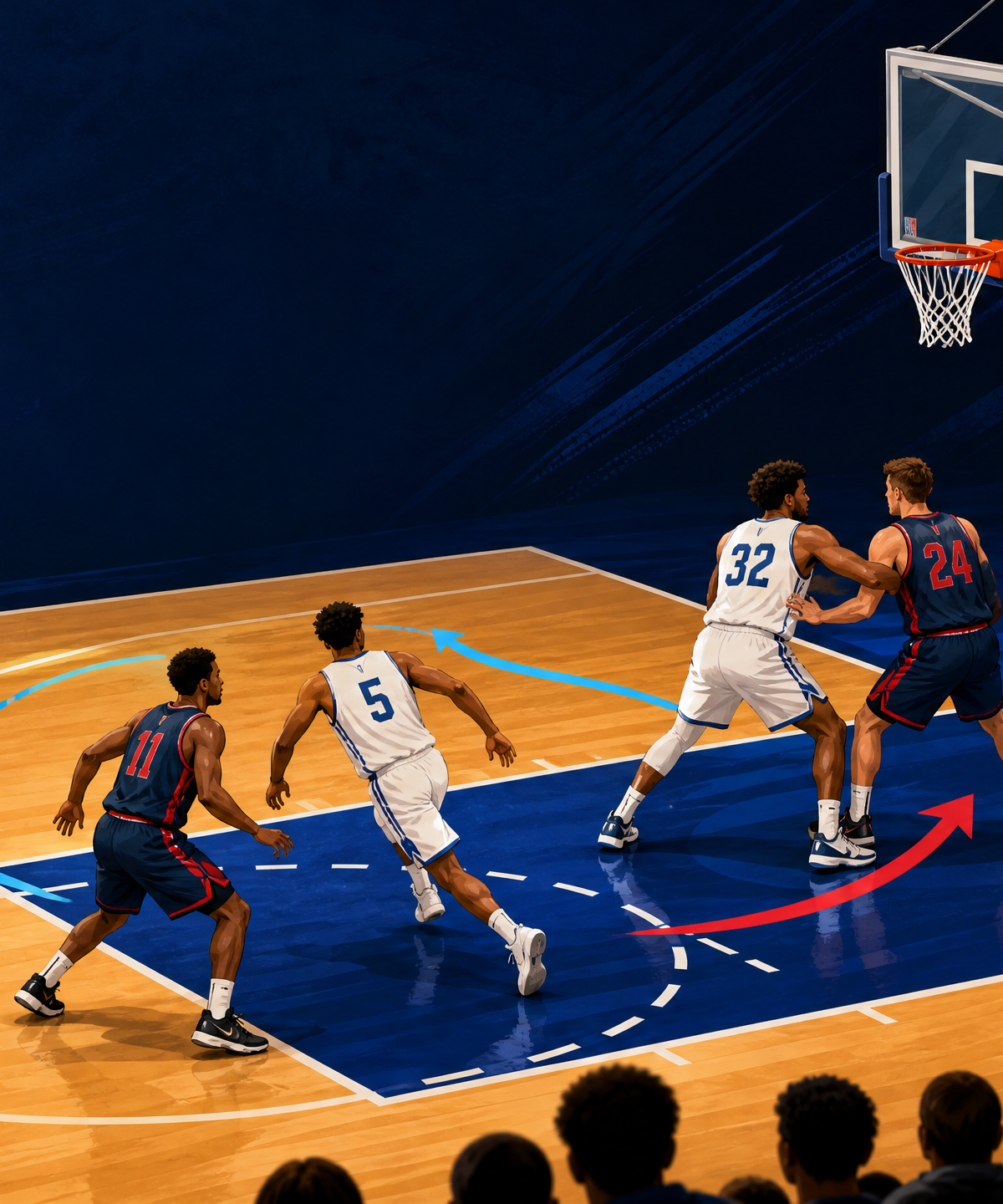
Equipment Needed
Overview
Rim Seal is a baseline out-of-bounds (BLOB/SLOB) play designed to manufacture a paint touch in the first two seconds after the ball is released. It starts from a compact box alignment: 4 cross-cuts, 5 creates a legal seal at the rim, and 3 flares to the deep corner if the paint is crowded or the defense switches.
Use it after a dead ball under your own basket, especially after a timeout, when the defense is in man-to-man coverage, or when you want to put a strong finisher at the rim. It is also useful late in a quarter because the inbounder has three clean options: layup, corner catch, or safety outlet. The diagrams use the FIBA court geometry requested for this resource: a 28 m × 15 m full court, with the action organized in the 14 m frontcourt half. 1
Setup
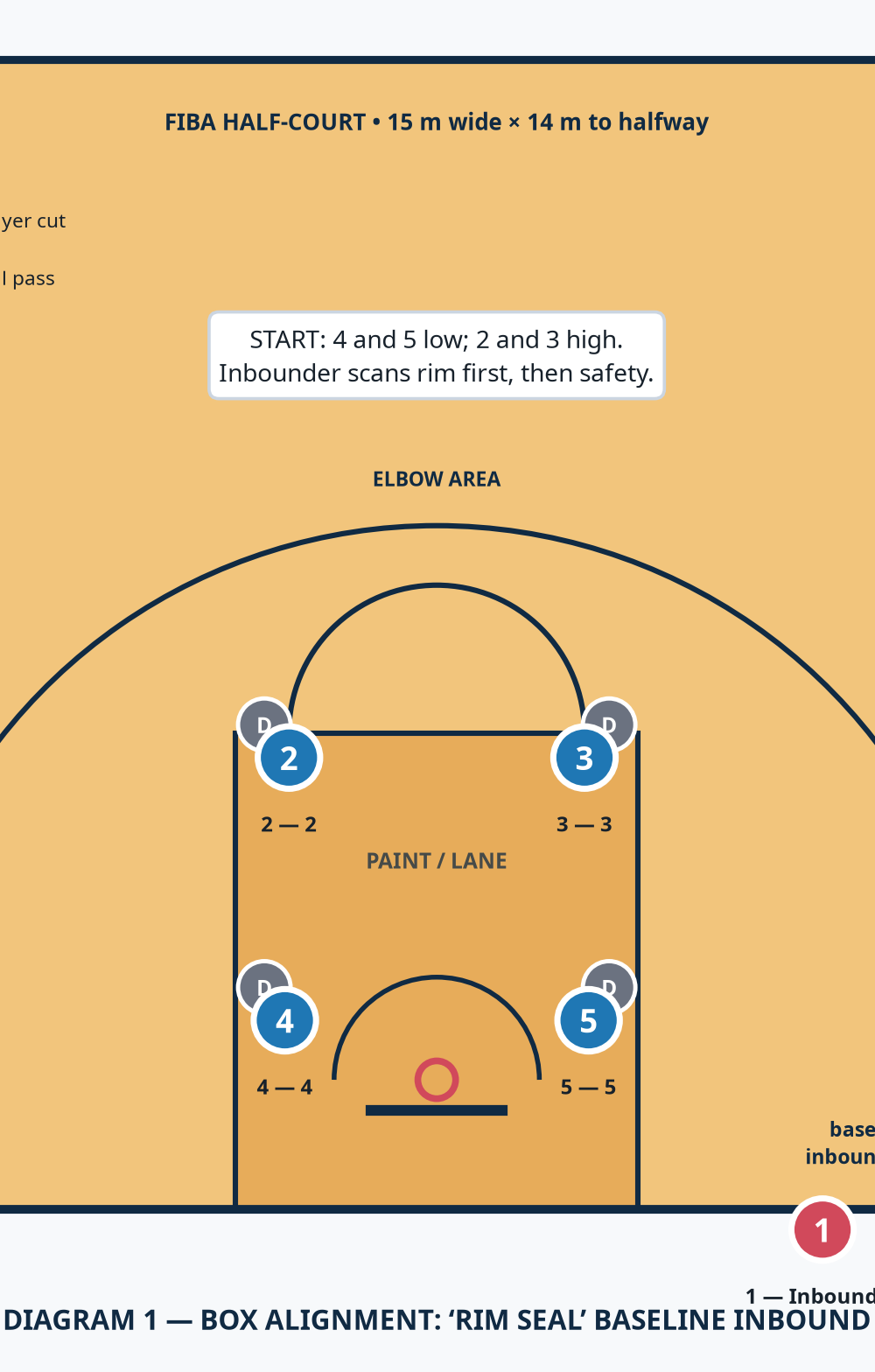
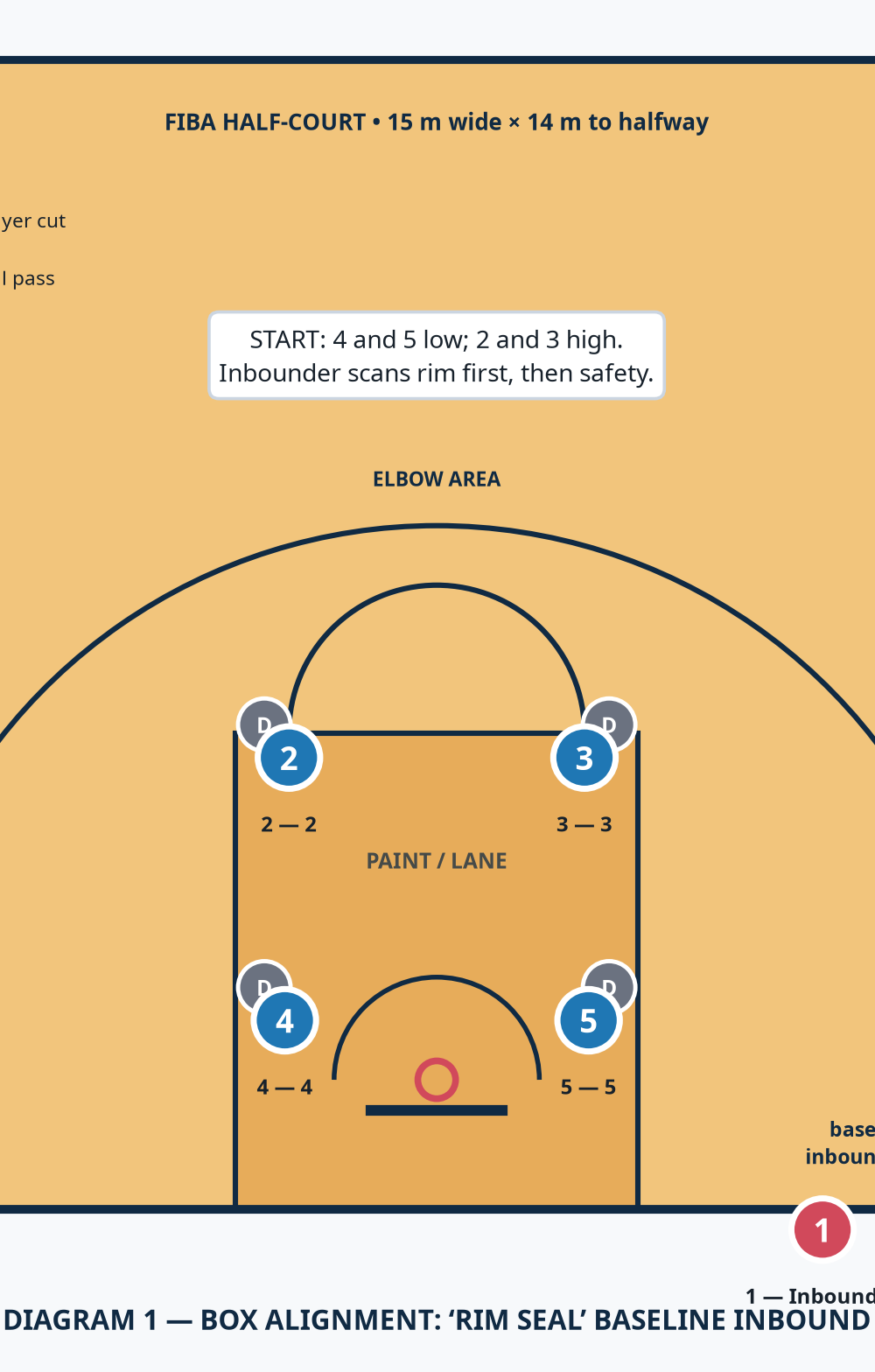
Run this as a five-on-five baseline inbound with one ball. Position the inbounder, 1 (point guard), outside the baseline about 1.0 m to the right of the basket support, or on the ball-side side selected by the referee. Align 4 (power forward) on the left low block and 5 (center) on the right low block, both roughly 0.8–1.0 m outside the lane line. Place 2 (shooting guard) at the left elbow area and 3 (small forward) at the right elbow area. Keep the high players just above the low players so the initial box is tight without placing teammates on top of one another.
| Role | Starting position | First responsibility |
|---|---|---|
| 1 — Point Guard | Out of bounds, baseline right | Read rim, then corner, then safety |
| 2 — Shooting Guard | Left elbow | Clear hard to the left corner |
| 3 — Small Forward | Right elbow | Lift as safety, then flare on the counter |
| 4 — Power Forward | Left low block | Cross-cut and finish at the front of the rim |
| 5 — Center | Right low block | Create contact, seal, and rebound |
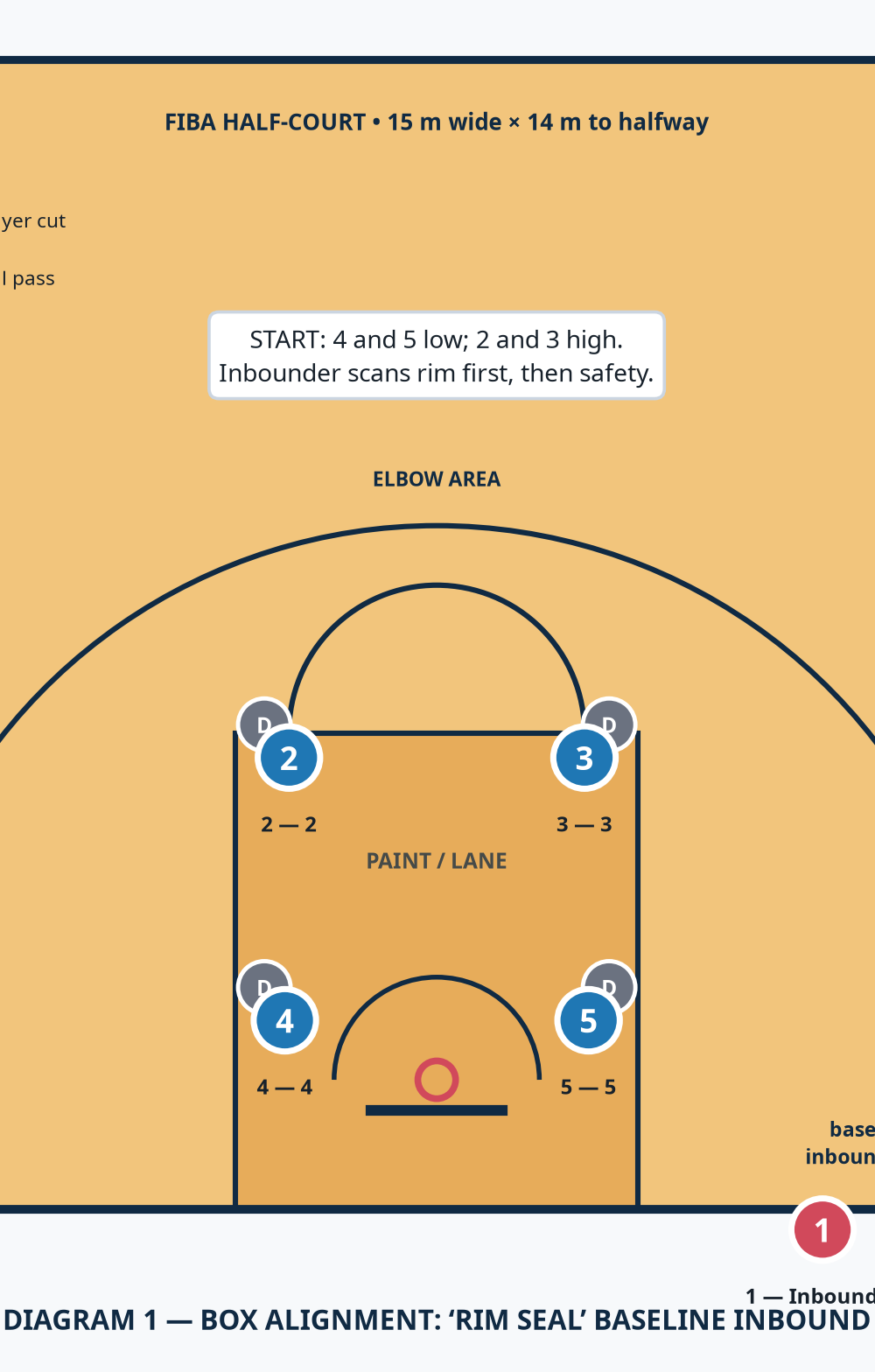
For teaching, use cones at each starting spot and in the corners. Rehearse first with no defense, then on-ball defenders, then a live five-player defense.
Step-by-Step Instructions
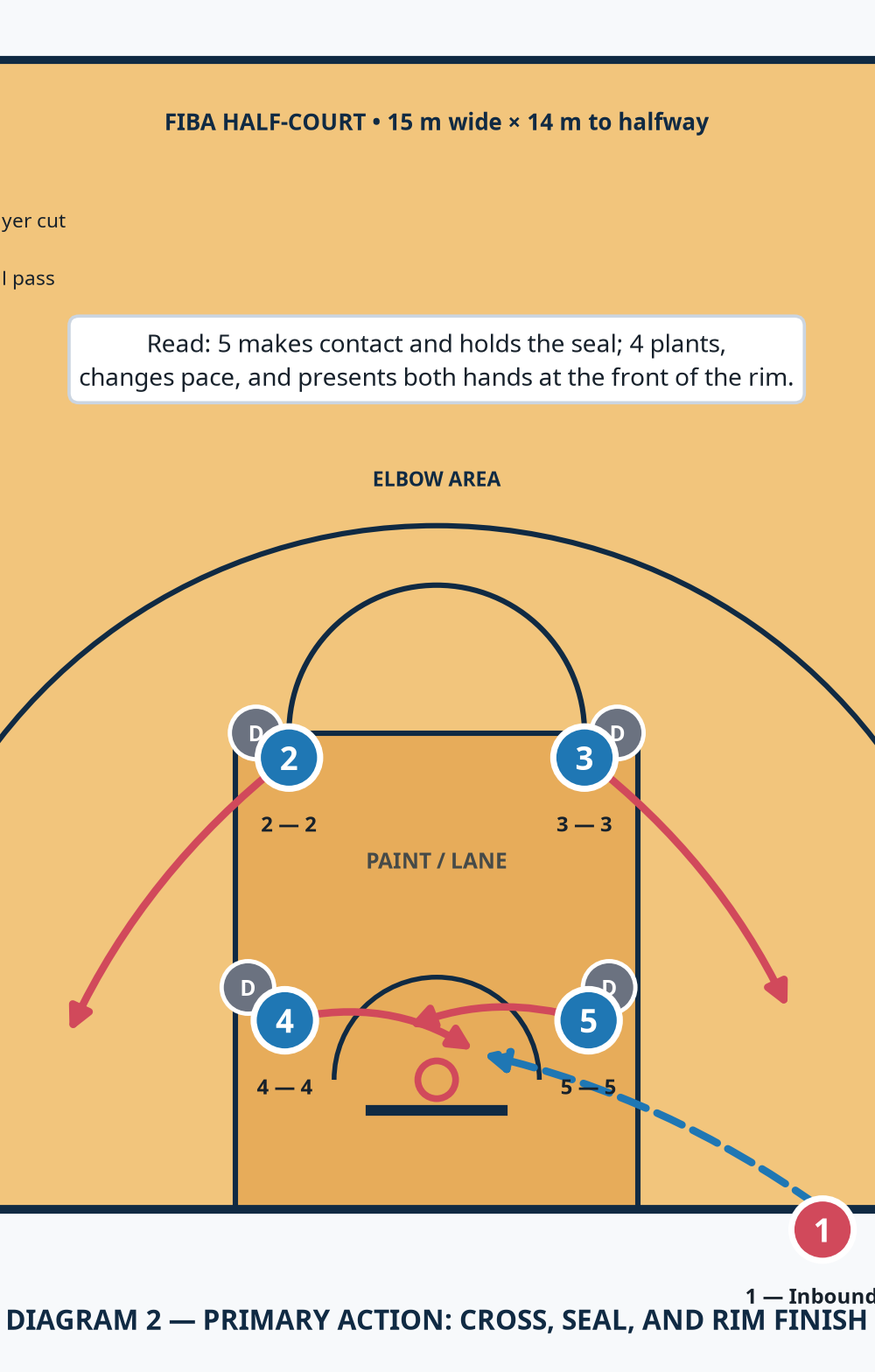
1. Set the clock and call the trigger
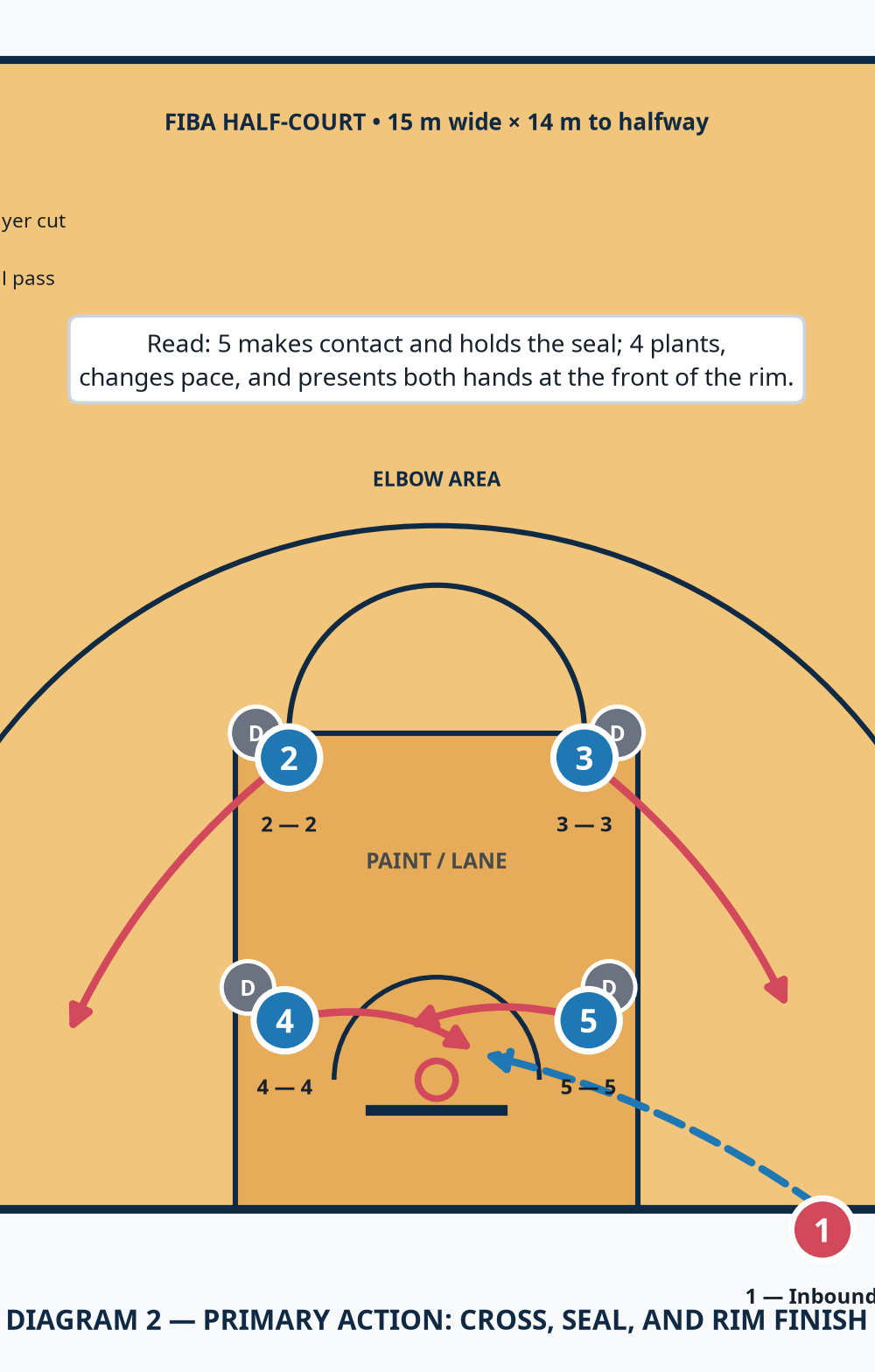
When 1 receives the ball, call “Seal.” The four on-court players hold their spots until the trigger. Then 5 steps into the lane, gets chest-square contact, and holds a stationary seal—never a moving shove.
2. Create the primary rim window
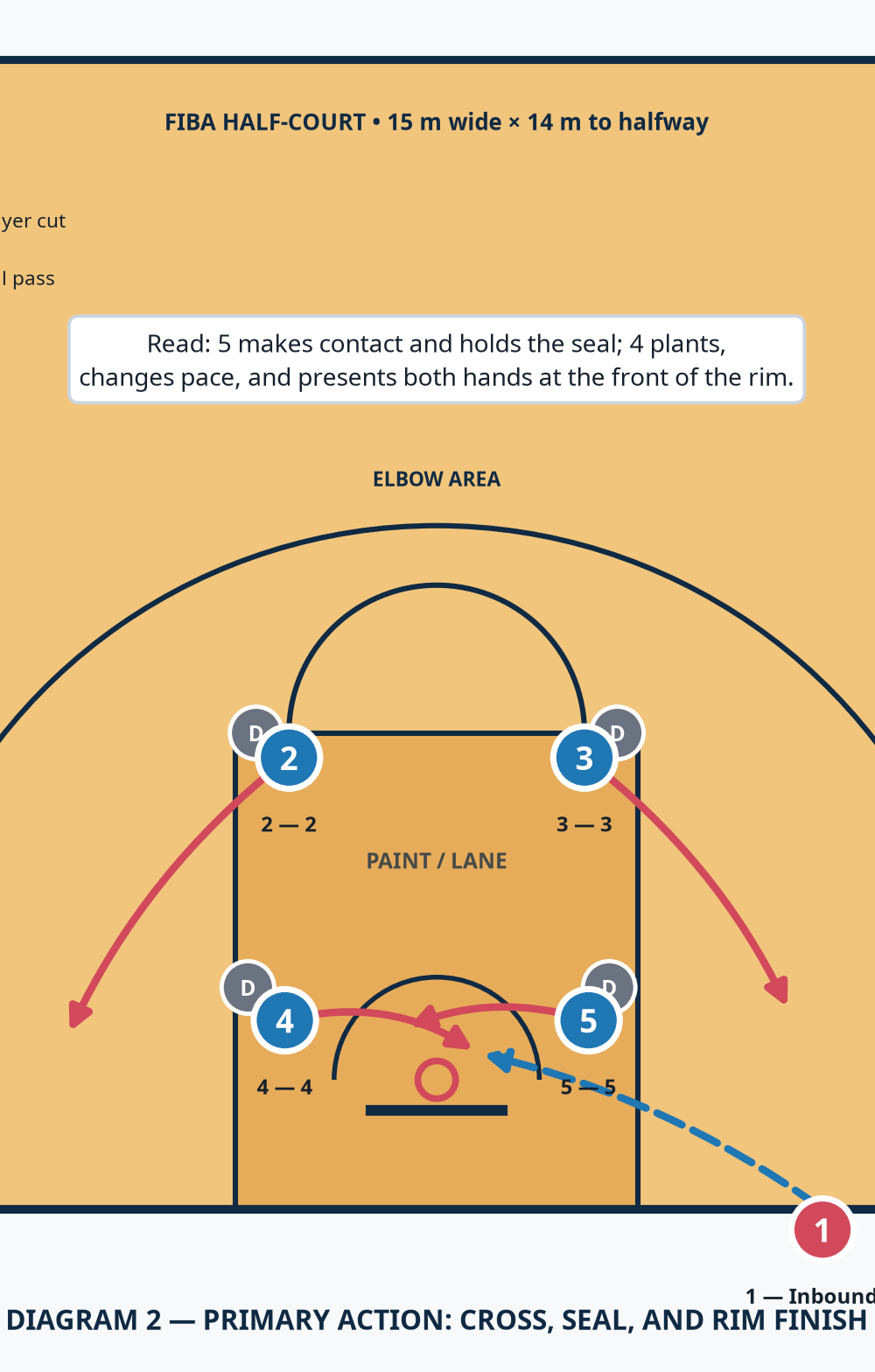
As 5 seals, 4 takes a short jab toward the baseline to sell a corner cut, then plants the outside foot and crosses hard in front of 5’s body. The target is the front of the rim, not the far block. 4 should arrive about 0.6–1.0 m in front of the cylinder with both hands visible and a low, wide finishing base. The change of pace is vital: a casual jog lets the defender slide under the seal.
At the same time, 2 empties to the left corner and 3 lifts to the right wing as safety. Those cuts widen help and clean 1’s passing lane.
3. Deliver the first read
1 scans rim first. If 4 wins the front of the rim, 1 throws a firm chest pass to 4’s outside hand, away from the trailing defender. Aim for a catch below shoulder height so 4 can step directly into a power layup. The pass must leave 1’s hands by roughly the two-second mark. Make it a rule in practice: no lob unless 4 has clear vertical separation; a straight, on-time pass is the high-percentage pass.
4 finishes on two feet whenever possible. 5 pursues the rebound; 2 and 3 balance the perimeter; 1 steps in only after the pass to protect against the outlet.
4. Progress to the counter
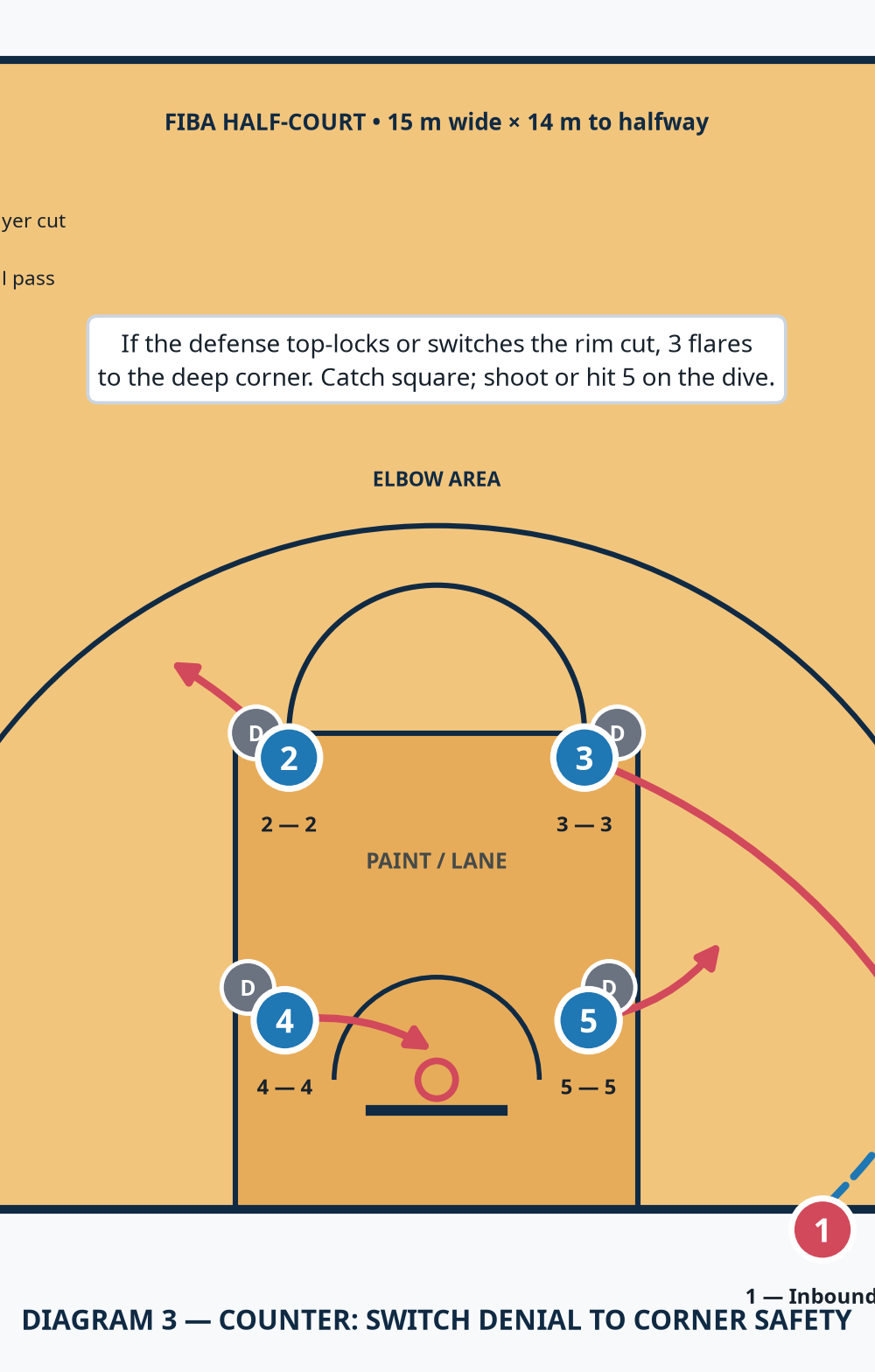
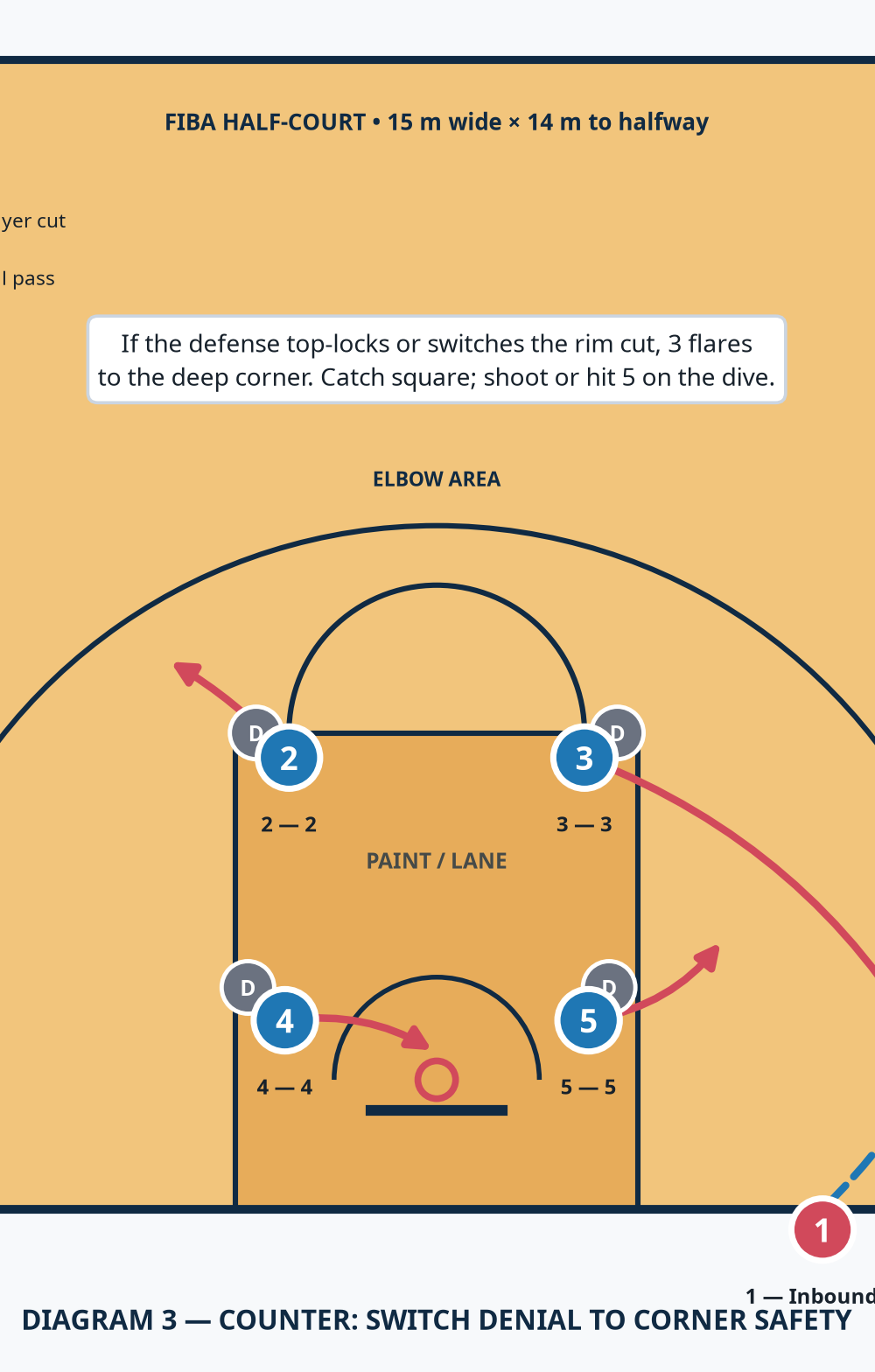
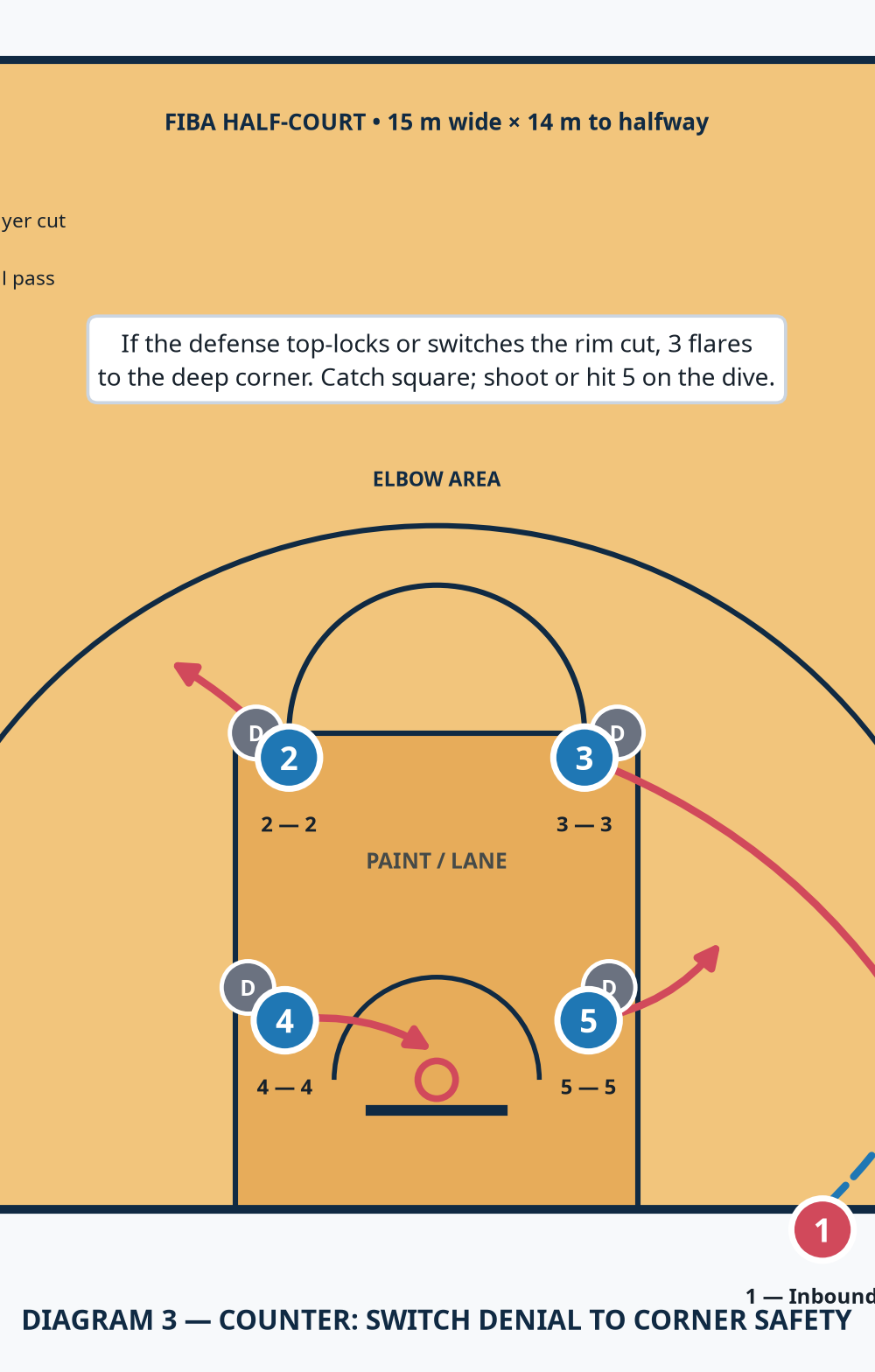
If the defense switches, top-locks 4, or places a second defender at the rim, do not force the layup. 3 changes the lift into a sharp flare to the right deep corner, ending just inside the sideline and behind the three-point line. 5 re-screens upward to occupy the low defender. 1 delivers the dashed-line pass to 3. 3 catches square: shoot if the closeout is late, drive baseline if the defender flies by, or feed 5 diving through the middle if the low defender commits.
5. Install the safety rule
If neither the rim nor corner is available, 1 passes to 3 on the right wing or calls a timeout if permitted and necessary. The safety rule is non-negotiable. A 40% look in the paint is only valuable if it does not become a live-ball turnover under your own basket.
Key Coaching Points
| Teaching point | What you should demand |
|---|---|
| Pace change | 4 sells one direction, then explodes across the face of the defense. |
| Screen legality | 5 gets set, makes contact with the torso, and does not extend hands or hips. |
| Passing discipline | 1 reads rim, corner, safety in that order and passes on time. |
| Spacing | 2 reaches the deep corner; 3 holds the safety lane until the counter is called. |
| Finishing detail | 4 shows two hands, catches low, lands balanced, and finishes through the defender’s chest. |
| Rebound balance | 5 pursues the near-side rebound; 2 and 3 sprint back if the shot is missed. |
Coach the play in short clips. Run three reps with guided defense, stop immediately for spacing or timing errors, then run three reps live without interruption. Your language should be direct: “Cross hard. Seal still. Show hands. Rim first.”
Common Mistakes
The most common error is 4 leaving before the seal; make 4 wait for 5’s shoulder, then sprint across it. Next, correct 5’s moving screens with a wide, stationary base. Young inbounders also stare at the rim, so have 1 say “rim, corner, safety” during walk-throughs.
A shallow corner cut brings help into the paint; use a cone in the deep corner and demand a full sprint. Finally, do not let 4 fade after the catch. This action is built for a direct two-foot finish.
Variations & Progressions
Variation 1: Reverse the formation. Put 4 on the right low block, 5 on the left, and inbound from the left baseline. The same cross-cut works in mirror image and prevents the defense from sitting on a single side.
Variation 2: Slip the seal. If the defense pre-switches and parks a large defender in the paint, have 5 fake the seal, then slip directly to the rim while 4 holds position as the screen. This gives 1 a second interior target without changing the box alignment.
Progression 3: Live score-and-stop. Award the offense two points for a rim finish, one point for a clean corner catch, and minus one for a turnover or illegal screen. Start at 4 seconds on the inbound count and reduce to 3 seconds once the group consistently finds the first read. This builds the decision speed coaches need in games.
Age Adaptations
For Under-8 and Under-10, remove the counter and use a 3-on-0 version: 1 inbounds to 4 after a single stationary screen from 5. Mark the lane with cones, use a coach as the passer if needed, and praise correct spacing before demanding speed. For Under-12, teach the full five-player alignment but begin without switches; ask 1 to make only the rim-or-safety decision. For Under-14 and Under-16, add a live switching defense, a 4-second inbound count, and the deep-corner flare. With older or open-age groups, let the defense choose between switching, trapping the inbounder, or playing zone principles, then require the offense to call the appropriate counter before the referee hands over the ball.
Finish with two game-speed possessions from each side and track rim catches, corner catches, and turnovers. The standard is an on-time decision under pressure, not merely memorizing the pattern.