Flex Offense Continuity: Baseline Cut and Down-Screen Series
Install a repeatable 4-out, 1-in Flex continuity that creates a baseline layup first, an open wing jumper second, and a disciplined next-side re-entry every possession.
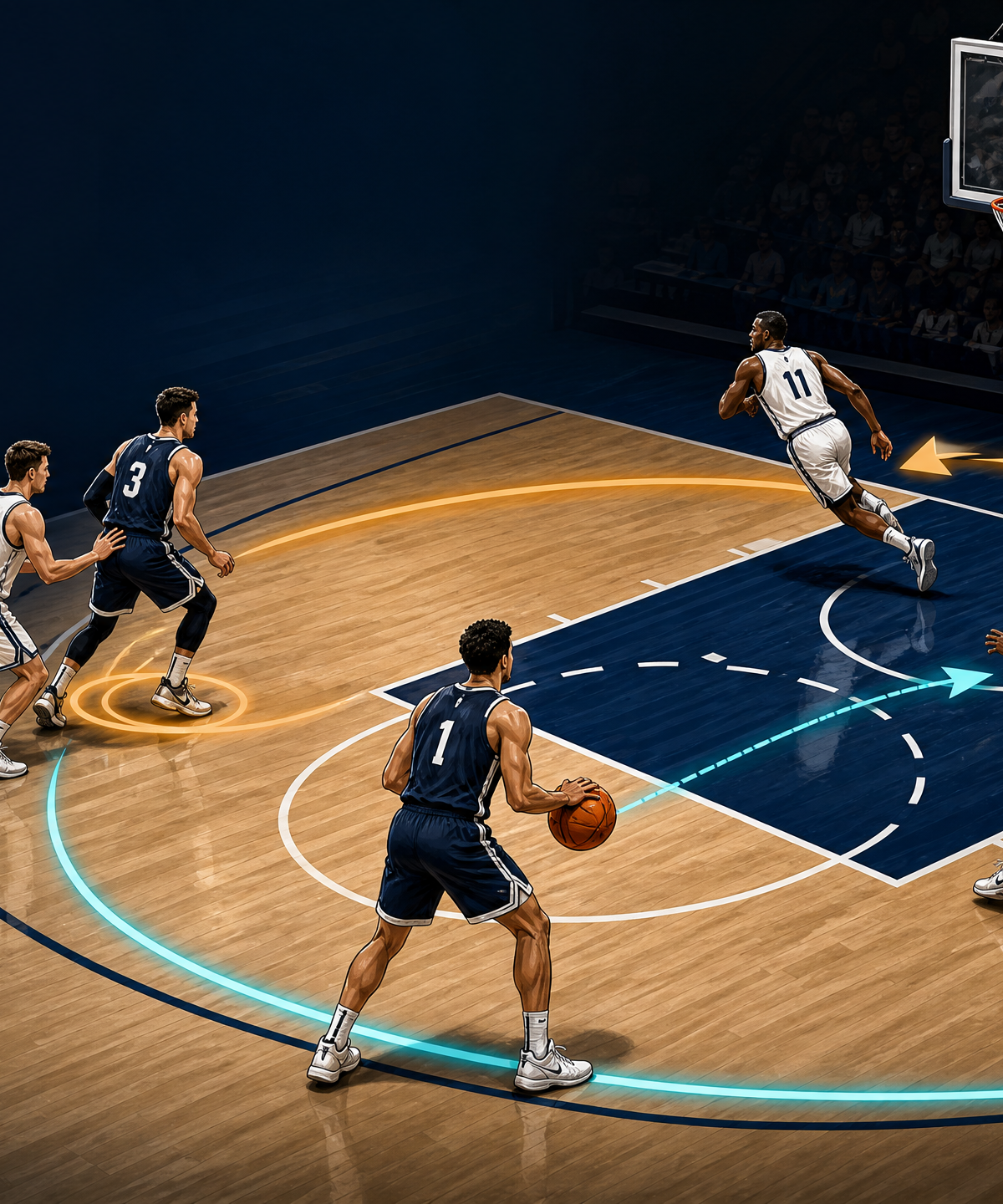
Equipment Needed
Overview
The Flex offense continuity gives your team a dependable half-court framework when you want movement without asking players to invent every possession. It is especially useful against man-to-man teams that overplay the wing, trail cutters, or lose discipline through repeated screens. The action is simple: enter to a wing, set a low Flex screen for a cross-lane cutter, then flow immediately into a down screen. That screen-the-screener sequence produces a paint touch, a catch-and-shoot wing option, or a clean re-entry on the opposite side. The traditional Flex is commonly taught as a 4-out, 1-in continuity built around the baseline Flex cut and the subsequent down screen.[2]
Use this as your organized continuity after transition has not produced an advantage, after a timeout when you need reliable spacing, or as your man-to-man package for teams that can execute with pace and physicality. Keep the goal clear: do not run the pattern for its own sake. Run it until the first player has an uncontested rim finish, a rhythm perimeter shot, or a high-value post seal.
Setup
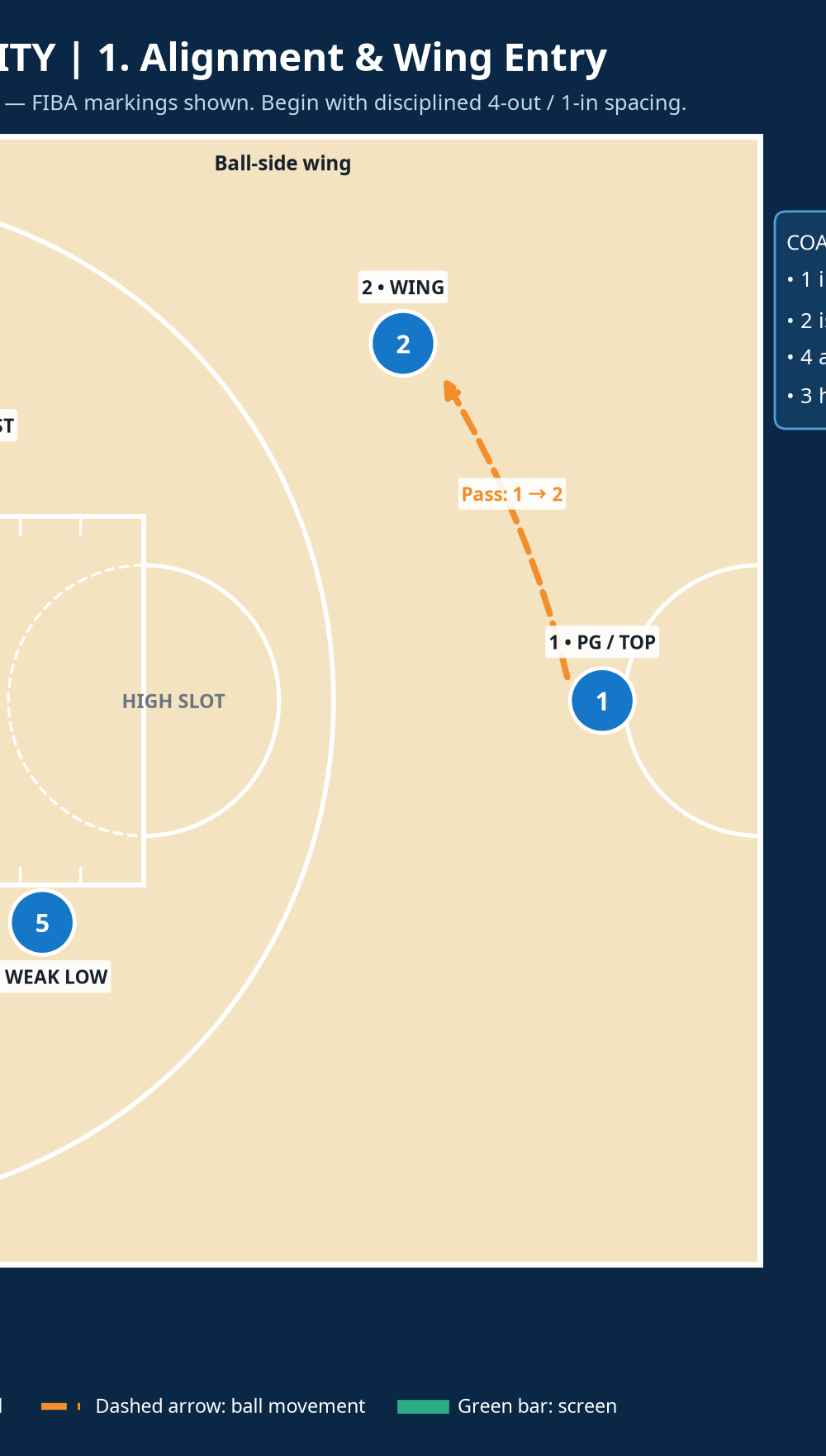
On a FIBA court, establish your teaching landmarks on the 28 m x 15 m floor and use one 14 m x 15 m half-court for the installation. The FIBA three-point line is 6.75 m from the basket centre, so make wing players catch roughly 1.5–2 m outside the arc rather than drifting into crowding distance.[1]
| Role | Starting position | Job on the entry |
|---|---|---|
| 1 — Point guard | Top, centred above the arc | Initiate the wing pass, then clear to become the down screener. |
| 2 — Wing | Ball-side wing, wide and outside the arc | Receive the entry, read the baseline cutter, then find the pop. |
| 3 — Opposite wing | Deep opposite corner | Hold the corner through the first read, then sprint-fill the top. |
| 4 — Low-post cutter | Weak-side low block or lane-line extended | Set up the defender, use the Flex screen, and finish or seal. |
| 5 — Post screener | Weak-side low block, one step above the baseline | Set the legal Flex screen, then pop tight off the down screen. |
Use one ball, 10 flat cones or floor spots, reversible jerseys, and a visible clock. For the first teaching block, work 5-on-0. Add five defenders once the offense can complete two full cycles without losing spacing.
Step-by-Step Instructions
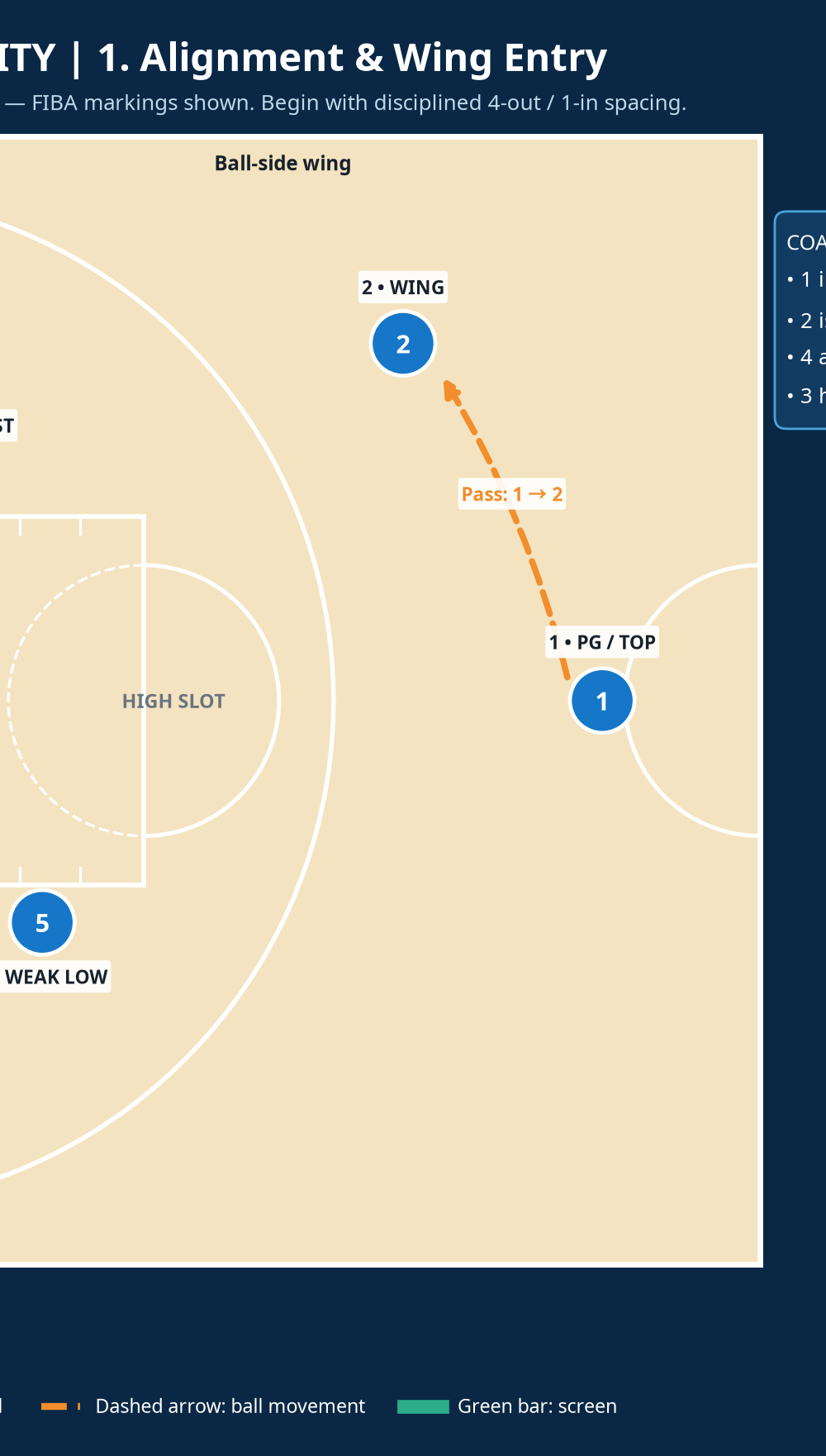
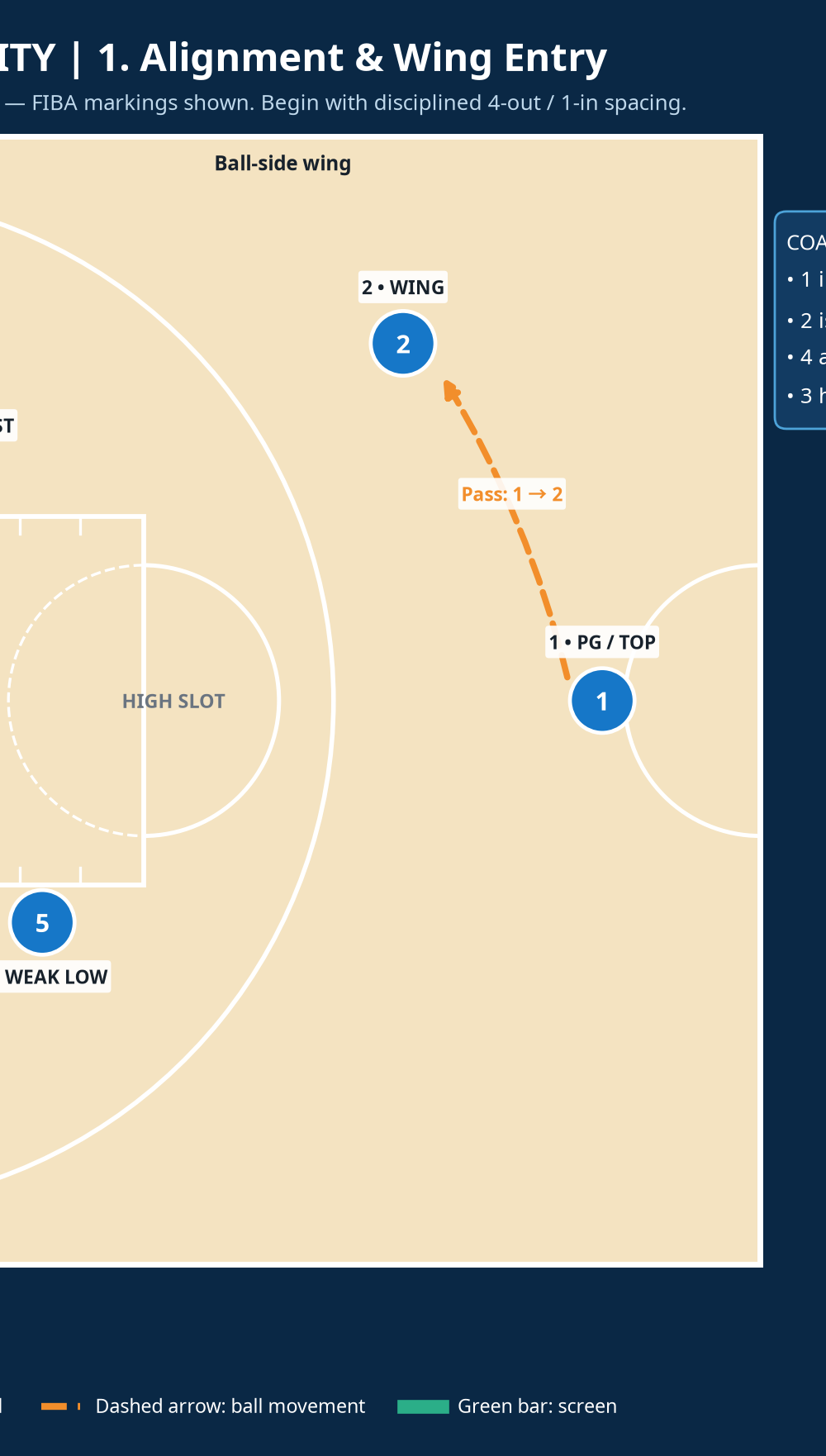
Start in your spots. Put 1 at the top, 2 on the right wing, 3 in the opposite corner, 4 at the weak-side high-low seam, and 5 low on the weak side. Demand a minimum 3–4 m gap between off-ball teammates. Tell 2 to show target hands and stay wide enough that the first defender must cover ground to help.
Make the wing entry. On the coach’s “go,” 1 passes to 2 and immediately clears toward the ball-side slot. The pass must arrive on 2’s outside hand; 2 catches in a shot-ready stance with chin over the ball. Do not let 1 stand and watch the pass. The entry is the trigger for the entire sequence.
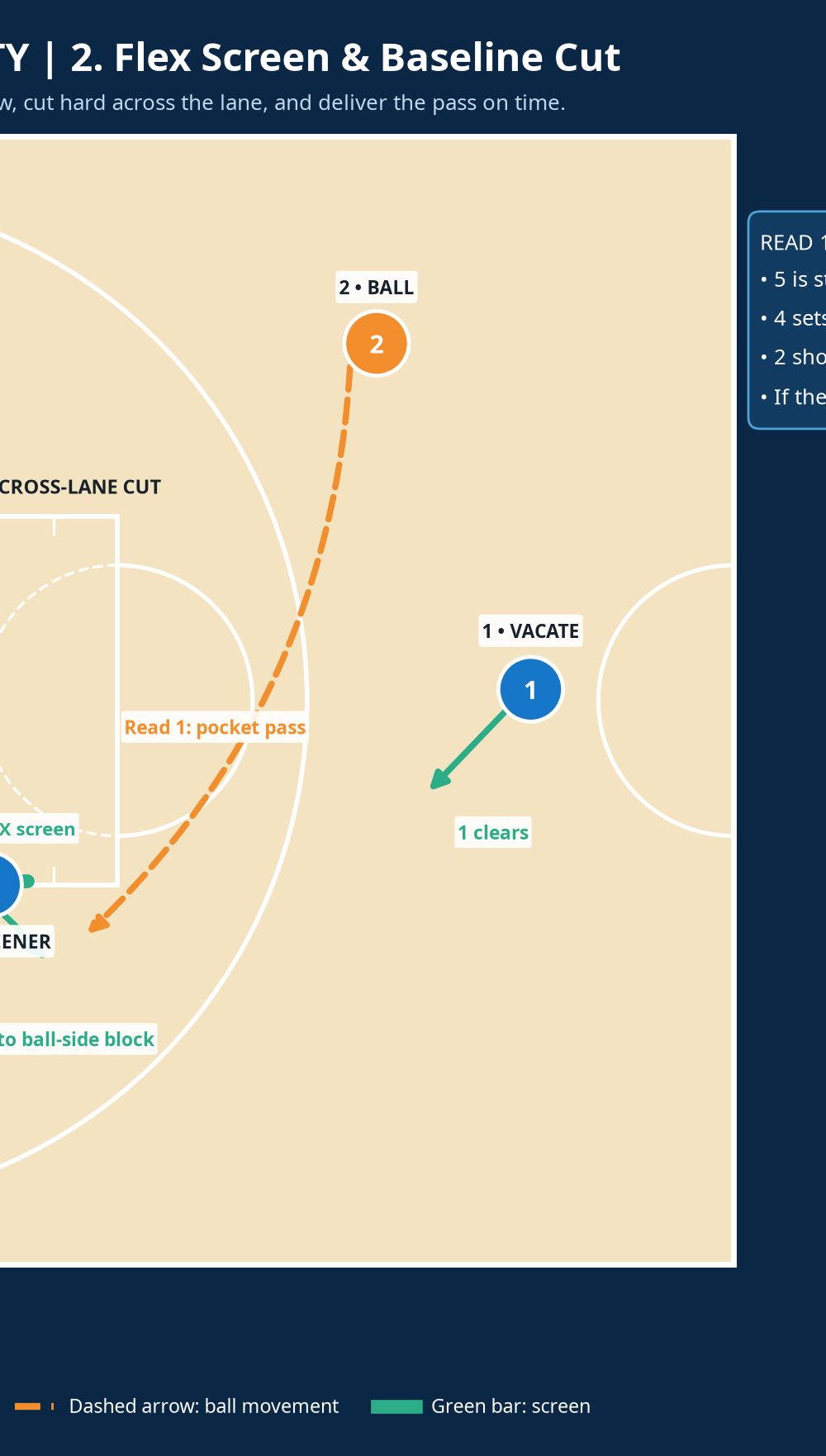
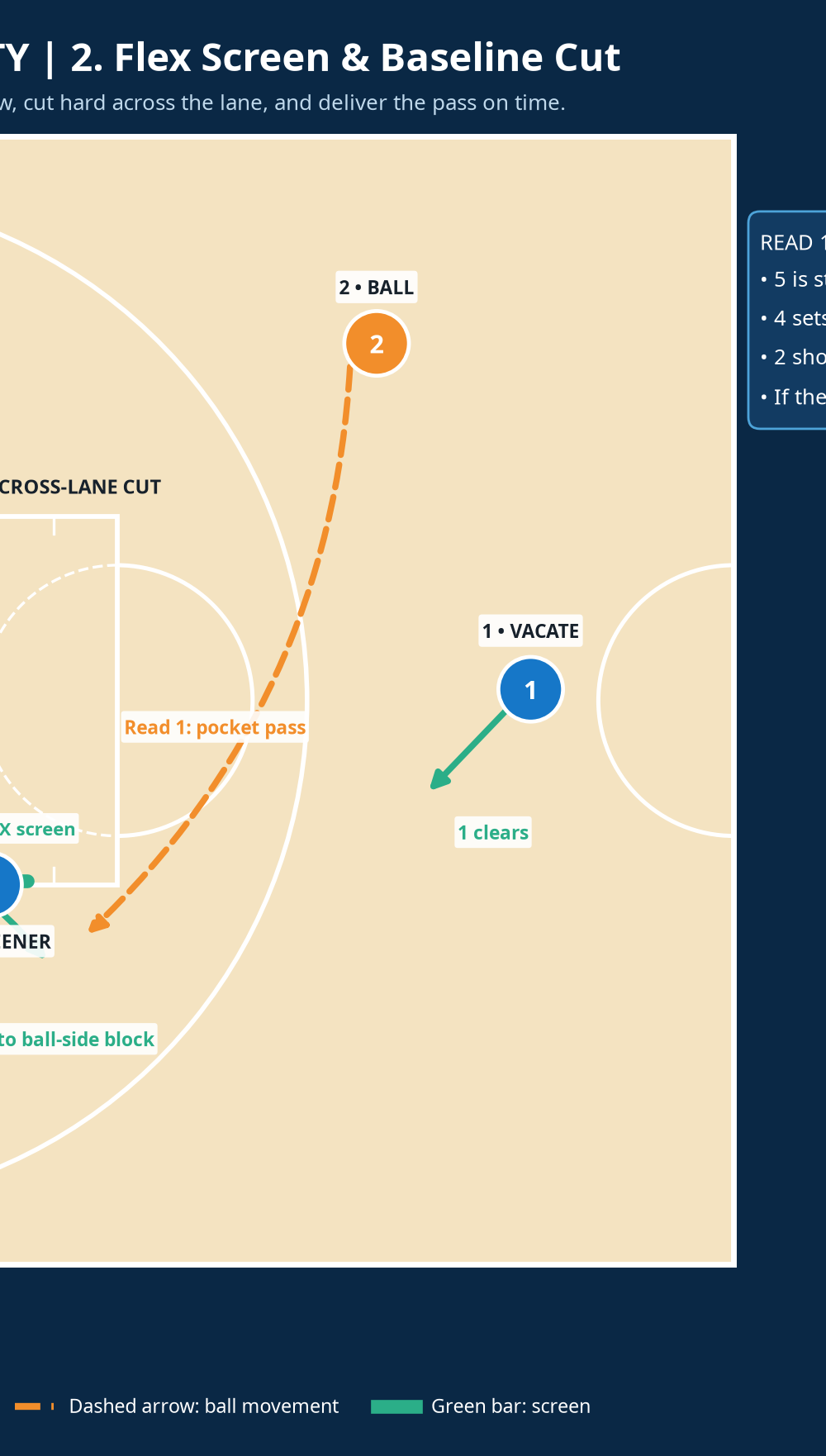
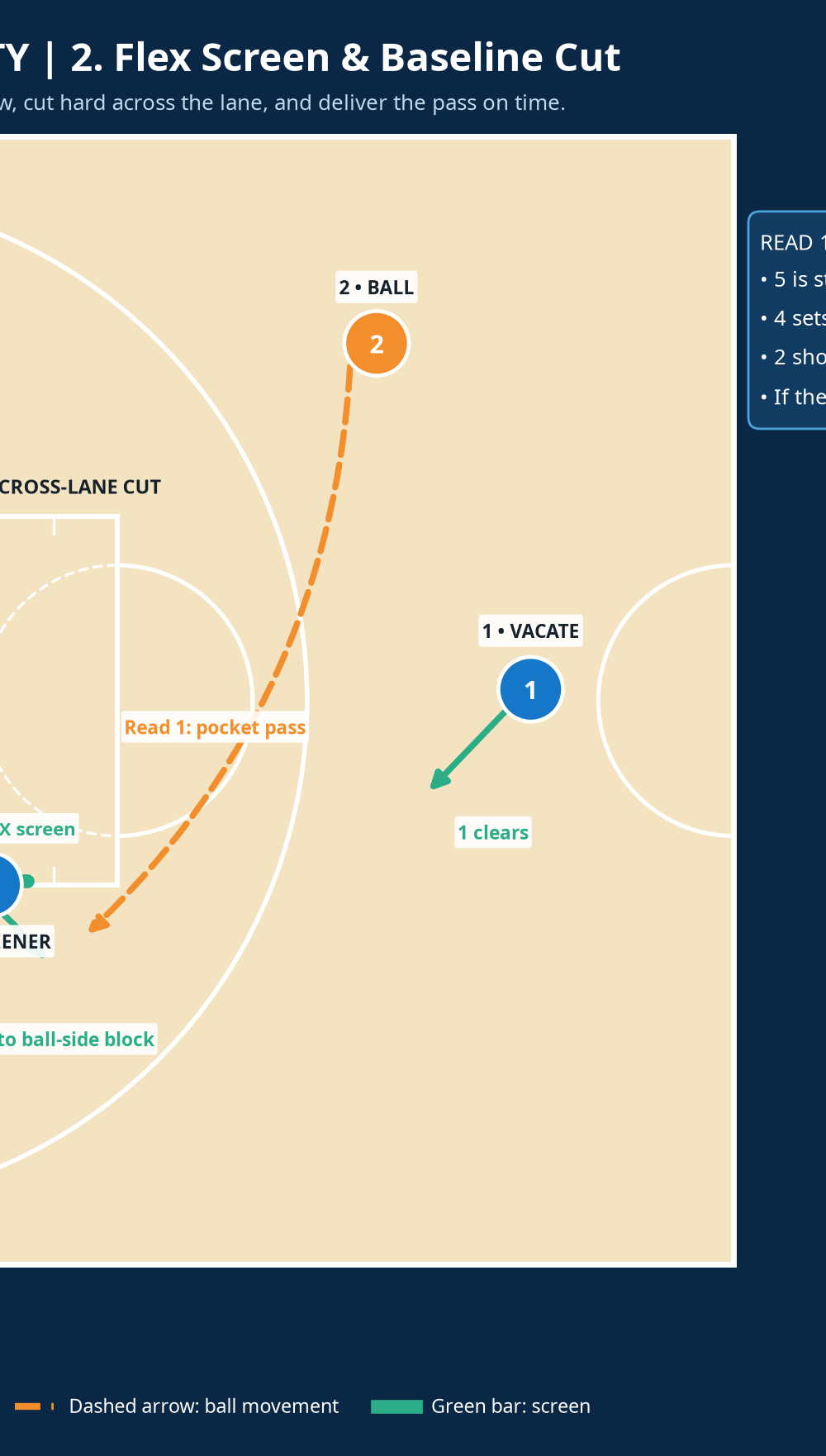
Set the Flex screen. As the ball reaches 2, 5 arrives low, gets square and stationary, and sets a legal screen on 4’s defender. 5 should be a half-step outside the lane line and approximately 1 m above the baseline, with a wide base and hands protecting the body. 4 first walks the defender up toward the elbow, then explodes shoulder-to-hip across the lane below the screen. The cut is not a loop; it is a hard, flat sprint to the ball-side block.
Read the first scoring window. 2 keeps eyes at the rim and delivers a low pocket/bounce pass to 4 as 4 gains a step. The pass belongs in the space between the cutter and the help defender, not at 4’s chest. If 4 catches, finish with the inside hand, power through contact, or immediately make the extra pass to 3 if the low help collapses. If the defender shoots the gap, 4 should reverse-cut to the open side and 2 should not force the pass.
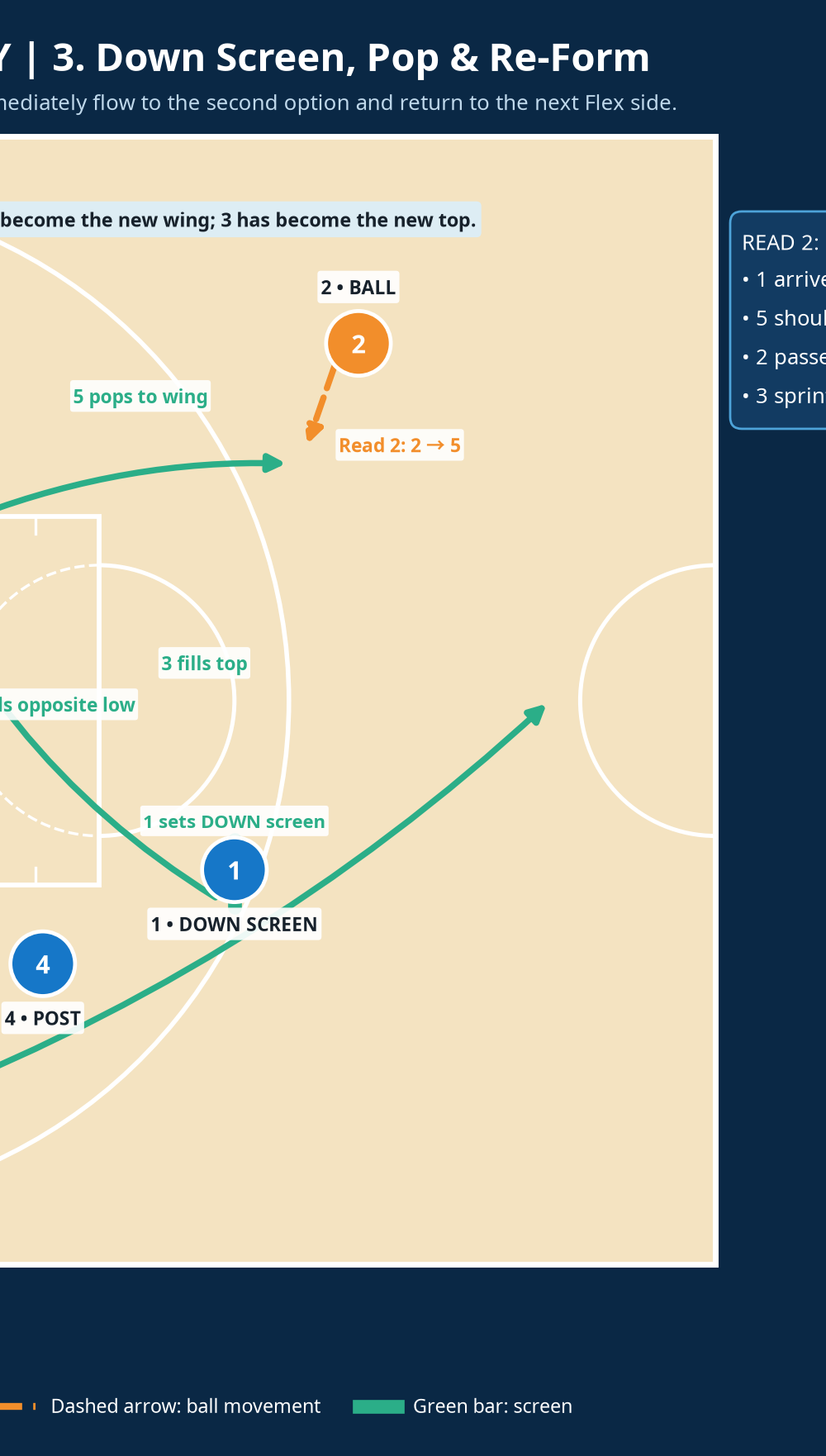
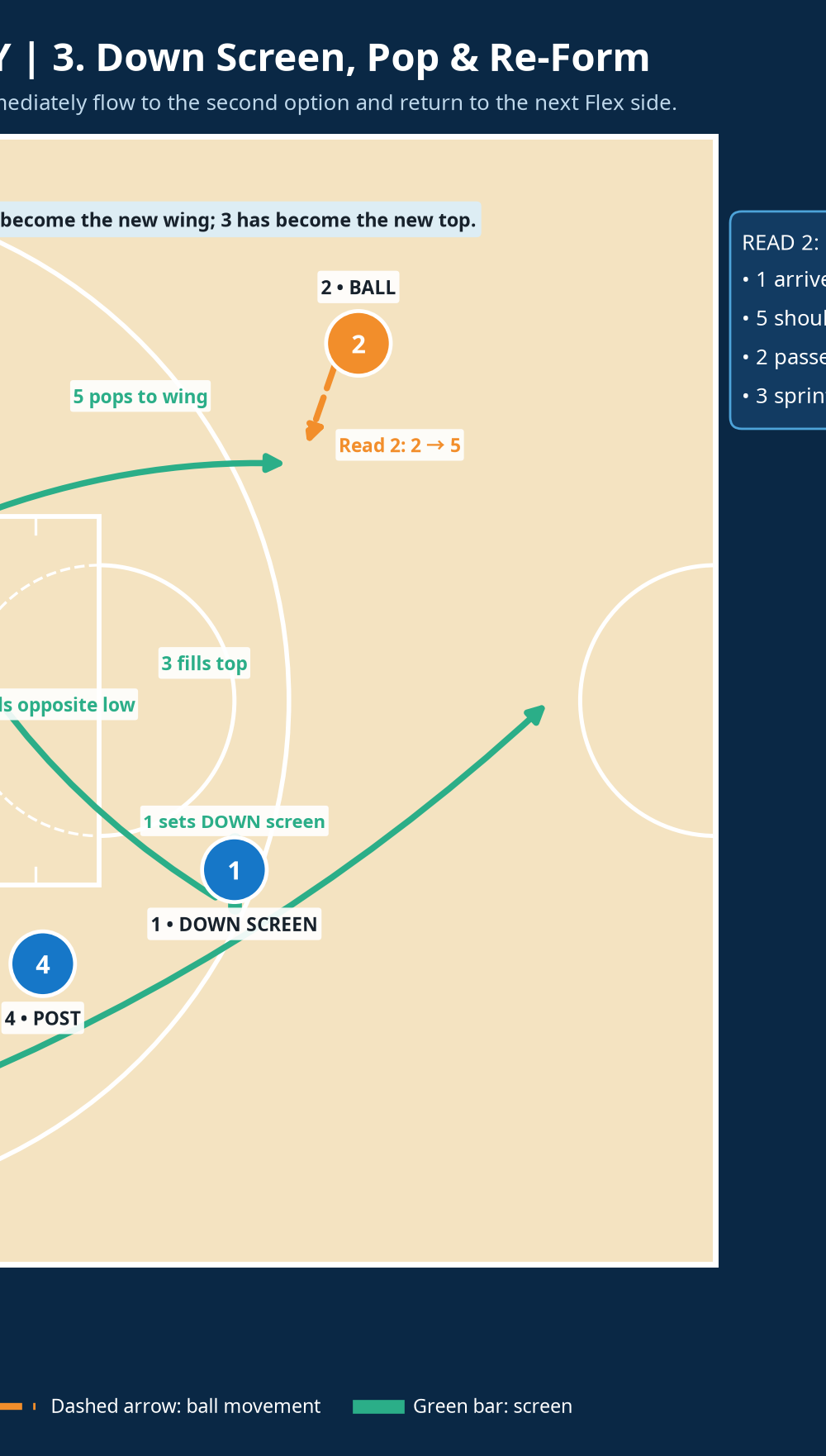
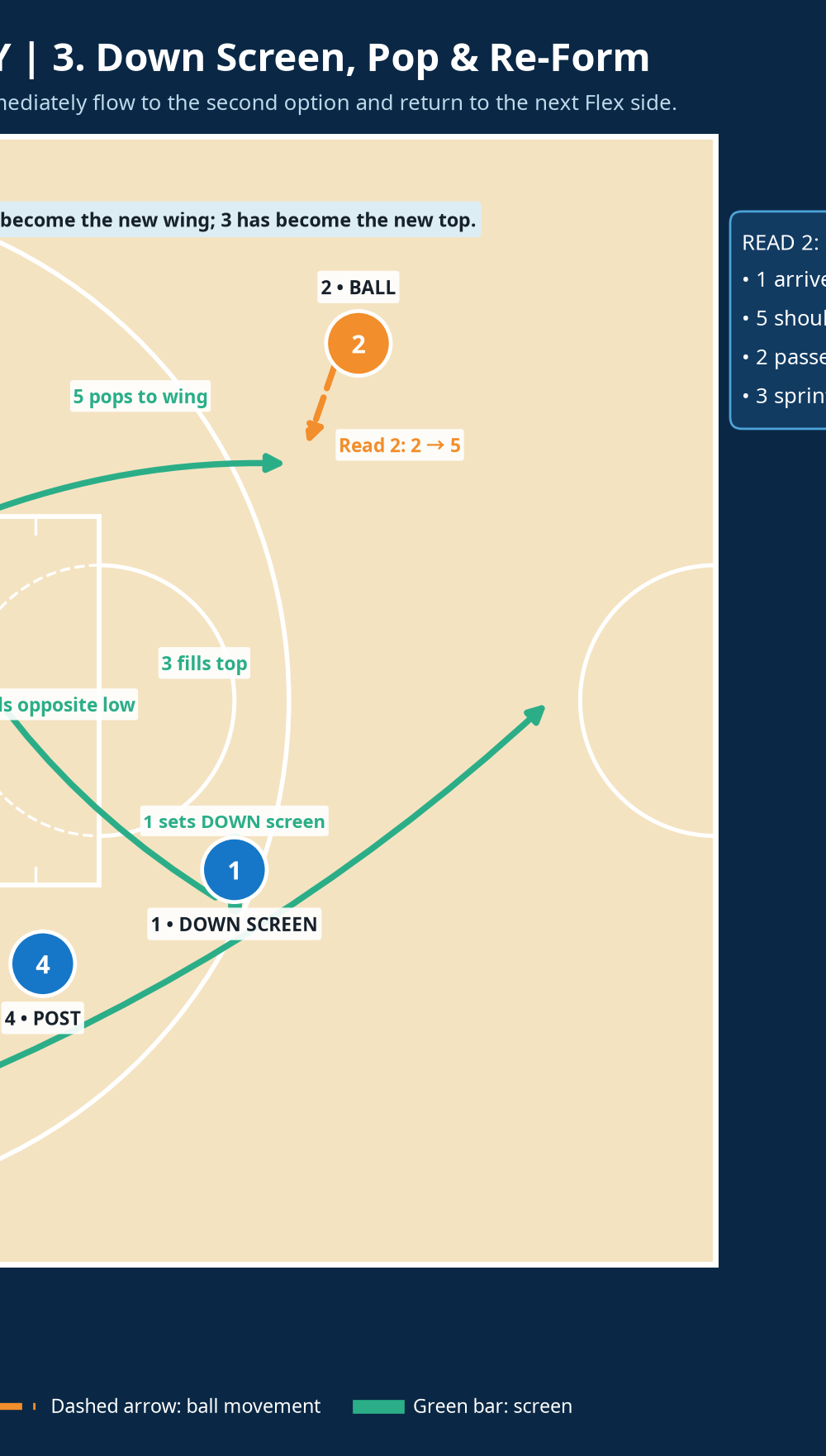
Flow directly to the down screen. When the Flex cut is covered, 1 sprints into position to set a down screen for 5. 1 must arrive before 5 moves; a late screen turns a scoring chance into a switch. 5 shoulder-checks the defender, comes tight off 1’s hip, and pops to the wing above the break. At the same moment, 3 sprint-fills from the corner to the top, keeping the outlet centred and preserving your next-side entry.
Make the second read. 2 passes to 5 only when 5 has cleared the down screen and can catch with feet prepared. This is the rhythm jumper or immediate drive. If 5 is denied, 2 reverses to 3 at the top. The reverse becomes the next wing entry, and the players have re-formed the same shape on the other side. Your continuity is alive again; do not pause to reset it.
Key Coaching Points
| Coaching emphasis | What to coach in the moment |
|---|---|
| Screen first, then move | Insist that 5 is stationary before 4 uses the Flex screen and that 1 is set before 5 uses the down screen. This protects legality and makes the action credible. |
| Win the set-up | Teach 4 to change pace: walk the defender high, plant, then sprint low. A screen is only as effective as the cutter’s set-up. |
| Cut shoulder-to-hip | The cutter should brush the screener’s hip. Leaving 0.5 m of daylight gives the defender a path over the top. |
| Pass on the advantage | 2 passes when 4’s numbers are visible and the help is late. Hold the ball too long and the baseline window disappears. |
| Keep the corner deep | 3 stays deep until the down-screen trigger. A shallow corner shrinks the baseline cut and invites help. |
| Reverse with purpose | A reversal is not a bailout. 3 must meet the pass at the top and announce the next entry immediately. |
Coach’s language: “Screen. Cut. Read. Downscreen. Re-form.” Use the same five words every rep until players can call the sequence themselves.
Common Mistakes
The first common error is a moving Flex screen. Correct it by freezing the screener at the point of contact and requiring the cutter to wait until the screen is established. The second is a rounded baseline cut. Place a cone at the low block and require 4 to run through it; the cutter must threaten the rim, not drift under the backboard.
A third error is allowing 2 to catch too narrow or too close to the sideline. Re-mark the wing spot 1.5–2 m outside the arc and coach the catch on balance. Fourth, teams often start the down screen before reading the cut. Give 2 a loud verbal count—“rim, wing, reverse”—so the baseline read remains first. Finally, if 3 jogs to the top, the next cycle has no rhythm. Grade the sprint-fill in your film and make it non-negotiable.
Variations & Progressions
Begin with a guided 5-on-0 progression. Use cones at each starting location, stop the ball after every action, and have players call the destination of the next pass before moving. Then progress to 5-on-5 with defenders in trail-only coverage: defenders may chase cutters but may not switch or help. This lets your offense feel the timing of the pocket pass before the reads become complex.
For the full decision progression, allow switches and add a simple counter. Against a switch on the Flex screen, 4 immediately seals the smaller defender at the block while 5 opens to the short corner or elbow for a high-low look. Against a hard top-lock on the down screen, 5 back-cuts to the rim while 1 pivots and becomes the safety outlet. Keep the counter to one rule per coverage; too many “if-then” calls will slow the continuity.
Age Adaptations
For Under-10, use a 4-out shell without a fixed post, shorten the court to the frontcourt lanes, and teach only pass–screen–cut. Let the coach make the scoring pass so young players can learn spacing before decision-making. For Under-12, install the baseline cut and use a two-dribble maximum after the wing catch; play 4-on-4 if five-player spacing is too crowded. For Under-14 and Under-16, run the full 4-out, 1-in version with guided defensive coverages, a 12-second shot clock, and a requirement to complete the next-side re-entry. Open-age groups can add switching counters, post seals, and weak-side flare options once the basic two-read cycle is automatic.
References
[1]: https://refereeing.fiba.basketball/en/rules/the-basketball-court — FIBA court and basket dimensions
[2]: https://www.breakthroughbasketball.com/offense/flex-offense — Breakthrough Basketball Flex Offense overview