Basketball
Drill
intermediate
under 14
Mastering the Full Court Press Break: The 4-Across Drill
Equip your team with the essential spacing, passing, and decision-making skills needed to confidently dismantle any full-court pressure defense.
Jul 5, 20264 min read15 min drill5 players
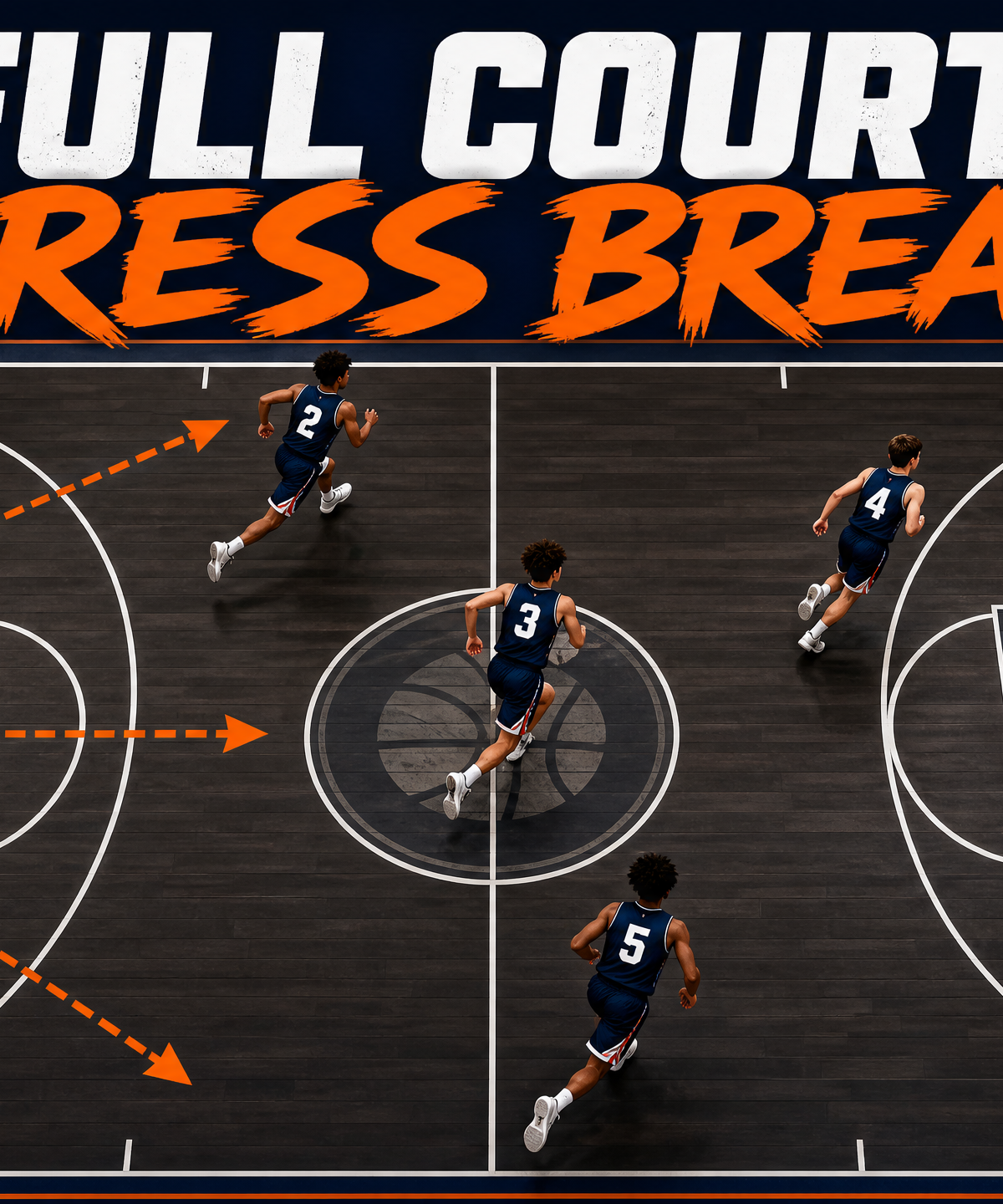
Equipment Needed
Basketballs
Colored bibs/pinnies
Whistle
Cones (optional, for marking zones)
1. Overview
The "4-Across Press Break" is a fundamental offensive strategy designed to safely and efficiently advance the basketball against aggressive full-court pressure. This drill simulates high-pressure game situations, teaching players how to maintain composure, utilize correct spacing, and exploit the defense's over-aggressiveness. It is highly effective against both man-to-man and zone presses (such as the 1-2-1-1 or 2-2-1). By establishing a reliable framework, coaches can instill confidence in their guards and bigs alike, turning defensive pressure into fast-break scoring opportunities.
2. Setup
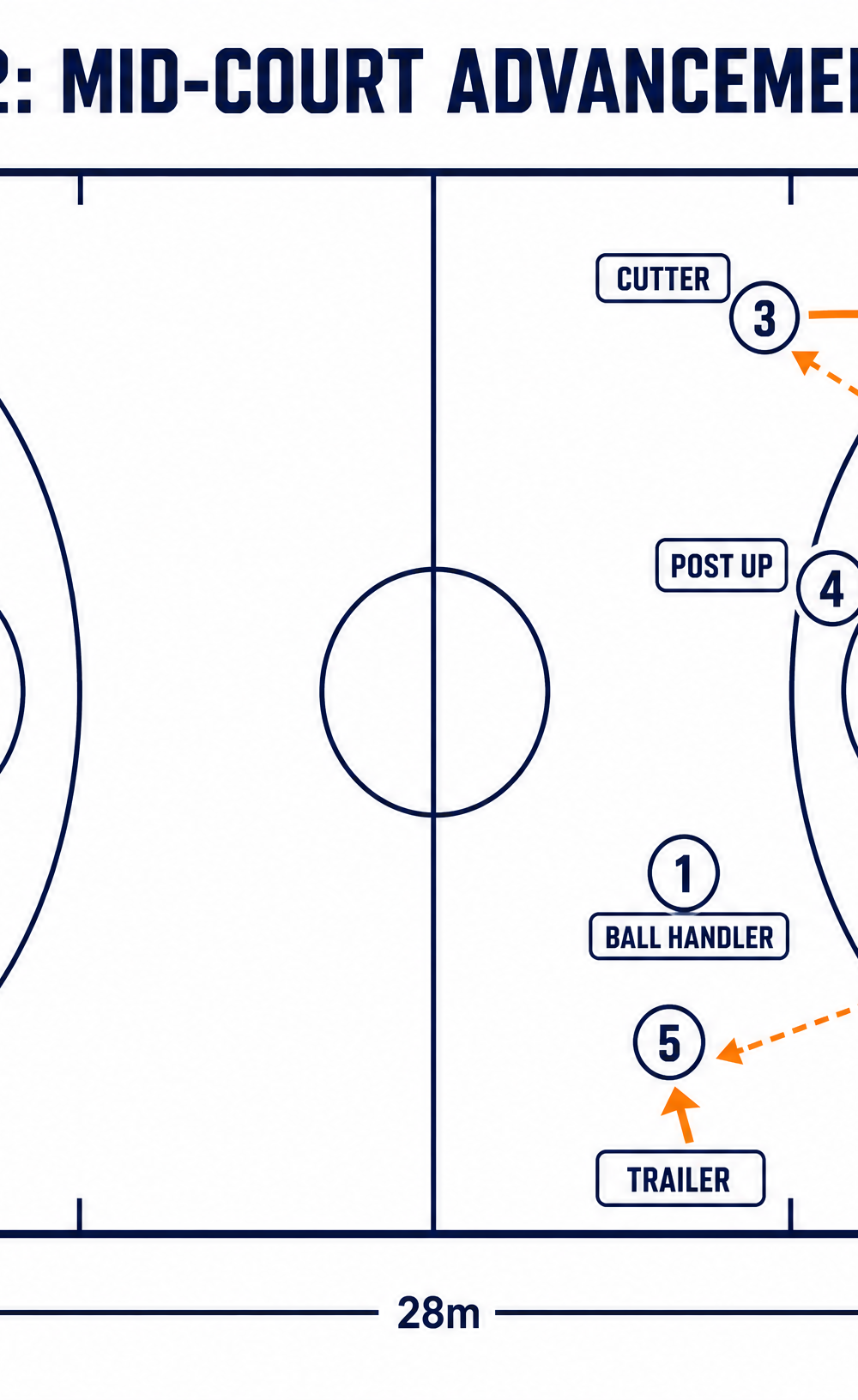
- Court: Full standard FIBA court (28m x 15m).
- Equipment: 1 basketball per group, colored bibs/pinnies (if running with defense).
- Players: 5 offensive players (can add 5 defenders for progression).
- Positions:
- 1 (Point Guard): Inbounder, positioned out of bounds under the defensive basket.
- 2 (Shooting Guard): Positioned on the left sideline, free throw line extended.
- 3 (Small Forward): Positioned on the right sideline, free throw line extended.
- 4 (Power Forward): Positioned at half court, left side.
- 5 (Centre): Positioned at half court, right side.
3. Step-by-Step Instructions
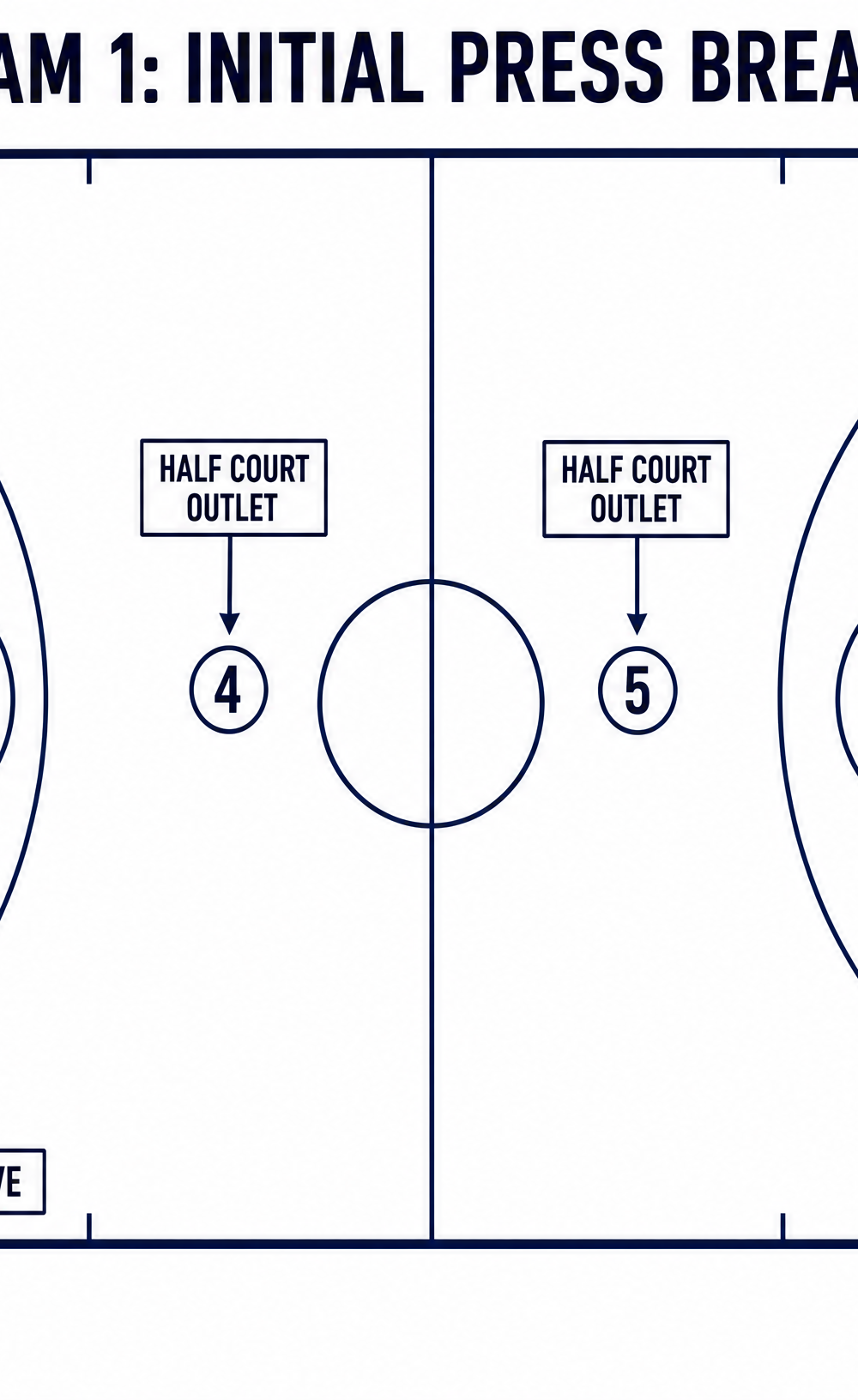
- The Setup: Players align in the 4-across formation as shown in Diagram 1. The inbounder (1) slaps the ball to signal the start of the play.
- The Initial Cuts: Players 2 and 3 make hard, V-cuts toward the baseline to get open. They must read the defense; if denied, they can cross over and switch sides.
- The Inbound Pass: Player 1 steps back to create space and makes a crisp, two-handed overhead or chest pass to the open guard (let's assume Player 2 receives it).
- Clearing the Backcourt: Immediately upon passing, Player 1 steps inbounds as a safety valve trailing the play. Player 3 sprints up the opposite sideline to stretch the defense.
- Advancing the Ball: Player 2 faces up, squares to the middle of the floor, and looks upcourt. The primary look is to advance the ball via the pass, not the dribble.
- The Half-Court Outlets: Players 4 and 5 act as release valves. If Player 2 is trapped, Player 4 flashes to the middle of the floor, while Player 5 remains deep to keep the defense honest.
- Attacking the Frontcourt: Once the ball crosses half-court (e.g., passed to Player 4 in the middle), the team transitions into an attack mindset, looking for a 3-on-2 or 2-on-1 advantage at the rim.
4. Key Coaching Points
- Meet all passes: Receivers must aggressively step toward the ball to prevent interceptions by lurking defenders.
- Pass before you dribble: The ball moves faster in the air than on the ground. Dribbling against a press often invites a trap.
- Stay out of the "Coffin Corners": Players must avoid catching the ball or dribbling into the corners of the backcourt, as these are natural trapping zones for the defense.
- Maintain spacing: Proper spacing (12-15 feet apart) stretches the defense and creates passing lanes. If players bunch up, one defender can guard two offensive players.
- Middle is golden: Flashing a player (usually the 4 or 5) to the middle of the floor against a zone press is often the key to breaking it.
5. Common Mistakes
- Panicking and rushing: Players catching the ball and immediately putting their head down to dribble without surveying the floor.
- Inbounder stepping on the line: A simple turnover that gives the ball right back to the pressing team under their basket.
- Throwing looping passes: Soft, looping passes allow the defense time to recover and intercept. Passes must be sharp and direct.
- Hiding behind defenders: Receivers failing to make eye contact with the inbounder and standing behind their defender.
6. Variations & Progressions
- Add Token Defense: Introduce 3 to 5 defenders playing at 50% intensity to allow the offense to practice their reads and passing angles without full pressure.
- Live 5v5: Run the drill live with a full-court trapping defense. Reward the defense for turnovers and the offense for crossing half-court within 5 seconds.
- Time Constraint: Put 8 seconds on the shot clock and challenge the offense to get the ball across half-court before the buzzer sounds.
7. Age Adaptations
- Under 10s: Focus primarily on the inbound pass and the initial V-cuts. Emphasize pivoting and protecting the ball rather than complex full-court reads. Use a smaller ball and shorter distances.
- Under 12s-14s: Introduce the concept of the middle flash and staying out of the corners. Begin adding token defense to simulate pressure.
- Under 16s & Open: Run live 5v5 scenarios. Focus on quick decision-making, advanced reads (e.g., recognizing specific zone press alignments), and attacking the rim immediately upon breaking the press.