The 1-2-2 Half-Court Trap: Suffocate Offenses and Force Turnovers
Learn how to execute a devastating half-court trap to disrupt the opponent's rhythm, force turnovers near the timeline, and create easy transition scoring opportunities.
Equipment Needed
1. Overview
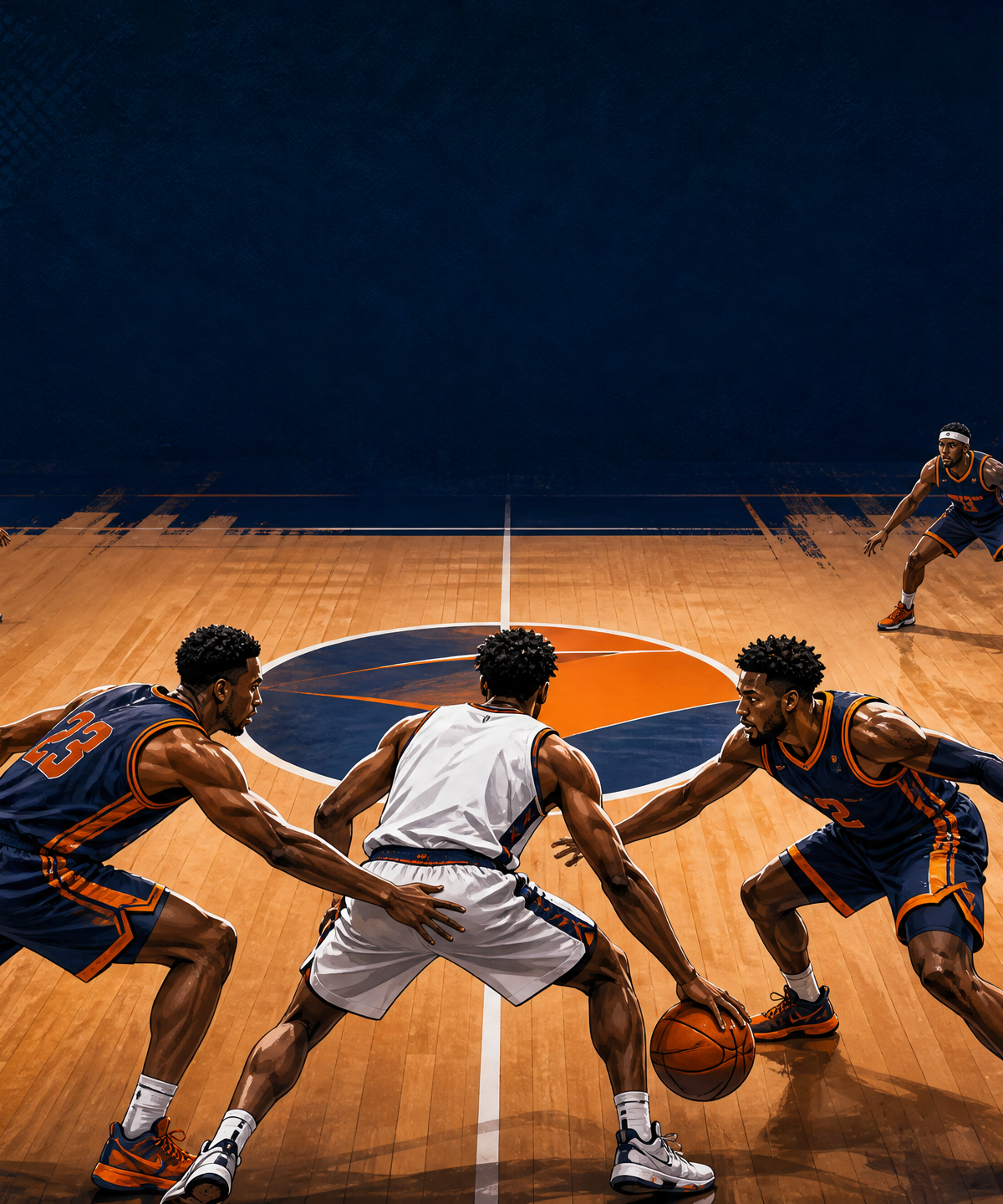
The half-court trap is an aggressive defensive strategy designed to surprise the offense as they cross the timeline. Unlike a full-court press that exerts pressure over 28 meters, the half-court trap conserves energy while maximizing disruption in the most vulnerable area of the court: the corners just past the half-court line.
By executing a trap immediately after the ball-handler crosses half-court, the defense utilizes the sideline and the half-court line as "extra defenders," effectively boxing the offensive player into a confined space where they cannot dribble backward without committing a backcourt violation. This set play is highly effective for changing the tempo of the game, forcing rushed decisions, and generating quick turnovers that lead to fast-break points.
2. Setup
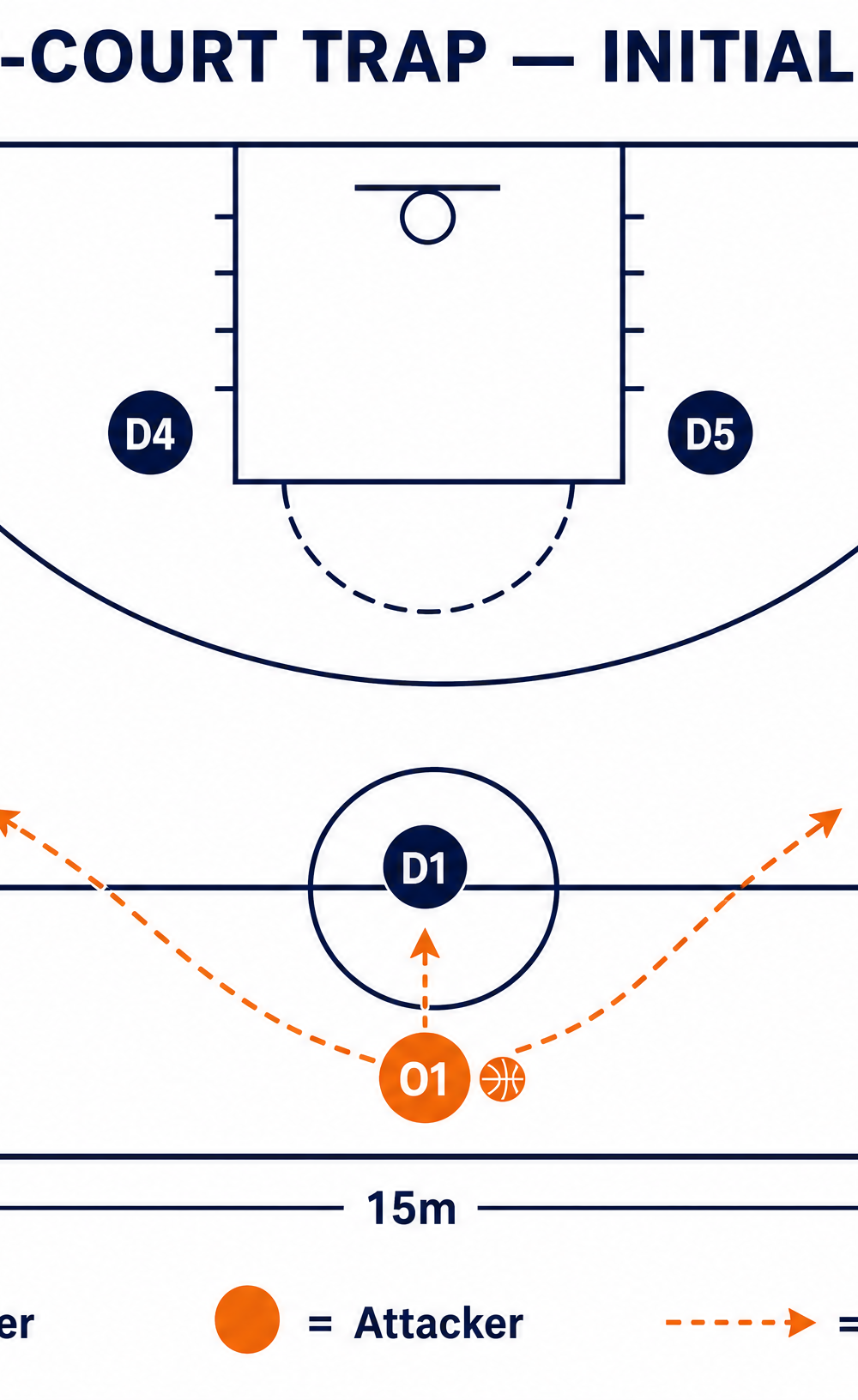
This play is typically run out of a 1-2-2 defensive alignment. It requires excellent communication, quick lateral movement, and high defensive IQ from all five players.
Court Dimensions & Positioning:
- D1 (Point): Positions at the top of the key or center circle, ready to pressure the ball-handler as they approach half-court.
- D2 & D3 (Wings): Positioned near the sidelines just below the half-court line, ready to spring the trap or deny the primary outlet pass.
- D4 & D5 (Forwards/Bigs): Positioned at the elbows or high post area, responsible for protecting the paint and intercepting long skip passes.
3. Step-by-Step Instructions
Step 1: The Invitation
As the opposing point guard (O1) brings the ball up the court, D1 applies light to moderate pressure. The goal is not to steal the ball in the backcourt, but to "steer" O1 toward one of the sidelines as they approach the half-court line. D1 should force O1 to their weaker hand if possible.
Step 2: Springing the Trap
The moment O1 crosses the half-court line and commits to a sideline, the trap is sprung. If O1 goes to the left sideline, D1 and D2 immediately converge. They must sprint to the spot, closing out under control to avoid fouling, and establish a hard double-team with their feet touching to prevent O1 from splitting the trap.
Step 3: Denying the Outlet
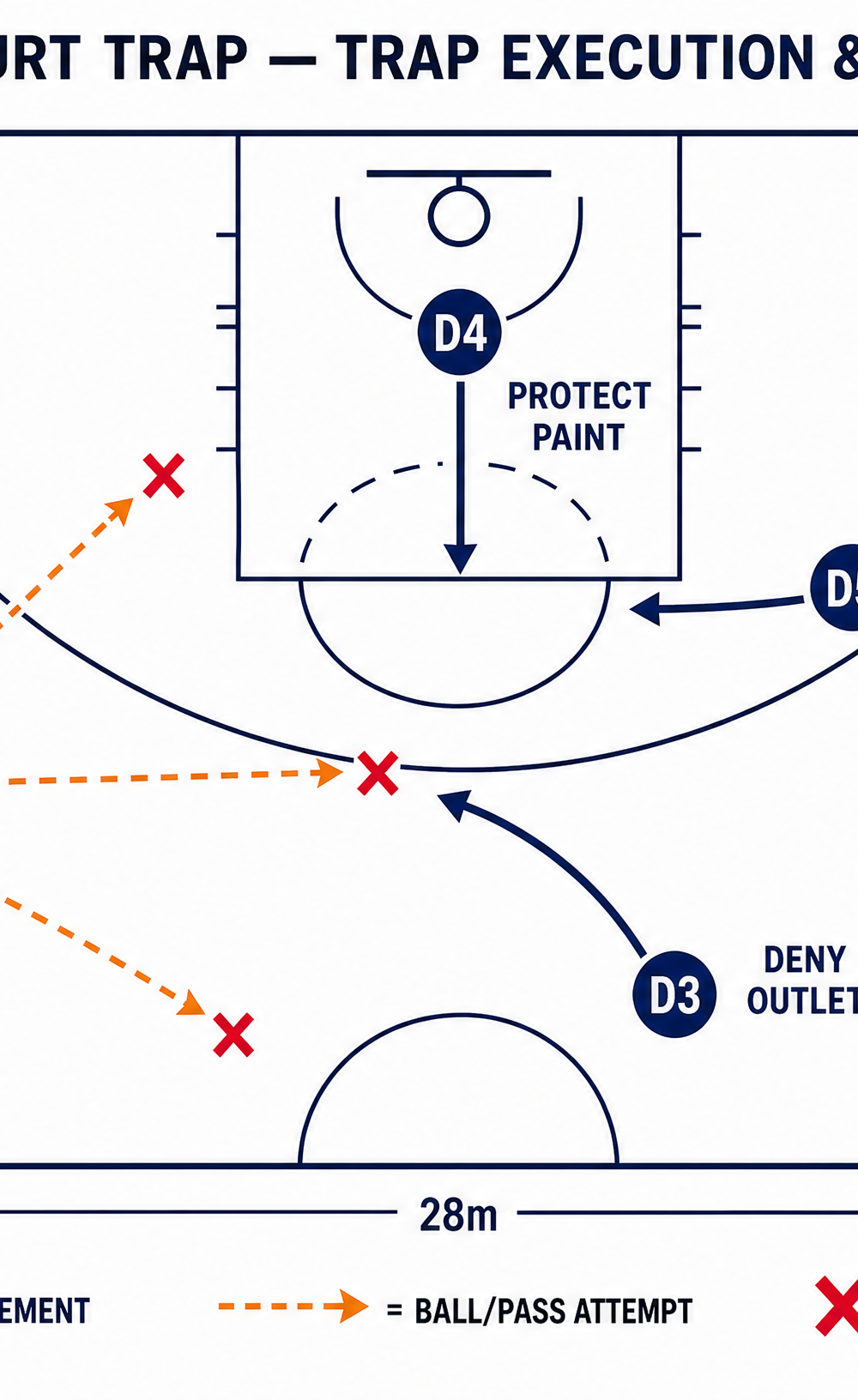
As the trap is set, the remaining defenders must rotate quickly to cut off the easiest passing lanes.
- D3 (Weak-side Wing): Sprints across the court to deny the closest lateral outlet pass or the pass back to the middle.
- D4 (Strong-side Big): Steps up to deny the pass down the sideline to the corner.
Step 4: Protecting the Basket (The Interceptor)
The final defender, D5 (Weak-side Big), drops into the paint to act as the safety. Their primary job is to protect the rim against any back-door cuts and read the ball-handler's eyes to intercept any desperate, looping skip passes thrown over the trap.
Step 5: Recovery and Transition
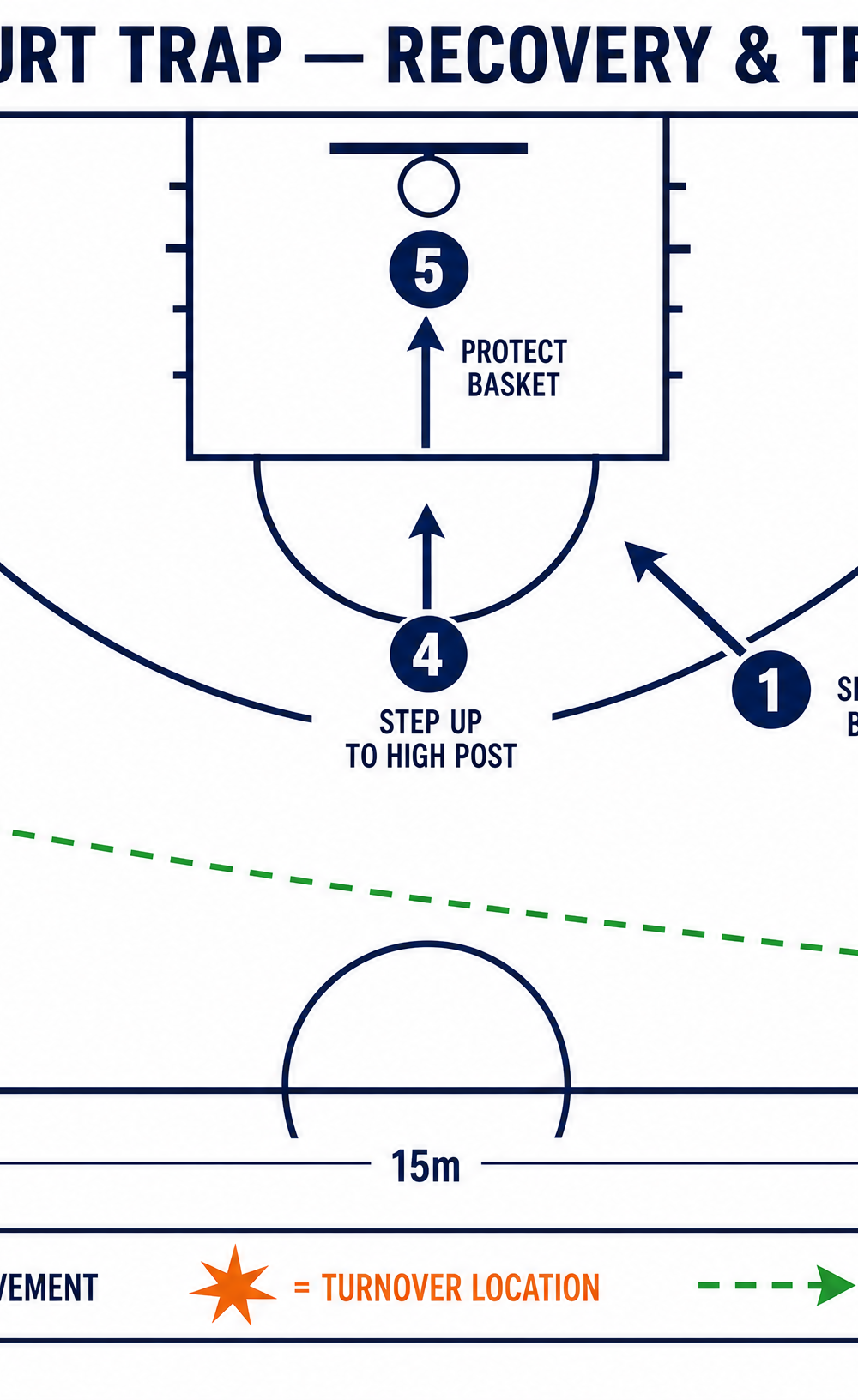
If the trap forces a turnover, all players immediately transition to offense. If the offense manages to pass out of the trap, the defense must communicate and scramble back into their base half-court defense as quickly as possible. D1 and D2 must sprint out of the trap to find their new assignments.
4. Key Coaching Points
- Use the Lines: Emphasize to your players that the sideline and the half-court line are their best teammates. The trap must happen close to these lines to be effective.
- Knees Bent, Hands High: Trappers must stay low and wide to prevent the ball-handler from dribbling through, but their hands must be high and active to trace the ball and obscure the passer's vision. Do not reach in and foul.
- Anticipate, Don't React: The interceptors (D3, D4, D5) must read the ball-handler's eyes and body language. They should be moving to intercept the pass as it is being thrown, not after.
- No Splitting: The cardinal sin of trapping is allowing the offensive player to dribble between the two defenders. Trappers must lock their feet together.
5. Common Mistakes
- Trapping Too Early: If D2 or D3 jump out before the ball crosses half-court, the ball-handler can simply retreat or pass backward safely.
- Reaching In: Trappers often get over-eager and reach in for the steal, resulting in a cheap foul that bails out the offense.
- Lazy Rotations: If the off-ball defenders (D3, D4, D5) do not sprint to their spots, the trap will easily be broken by a simple pass, leading to an open shot for the offense.
6. Variations & Progressions
- The 1-3-1 Trap: Instead of a 1-2-2, start in a 1-3-1 alignment. This puts more pressure on the middle of the floor and can confuse offenses expecting the standard 1-2-2 trap.
- Fake the Trap: Have D1 and D2 stunt toward the ball-handler as if to trap, but then immediately drop back into a standard half-court defense. This can cause the ball-handler to pick up their dribble prematurely out of panic.
7. Age Adaptations
- Under 12s: Focus heavily on the mechanics of the trap itself (feet together, hands high without fouling). Do not worry as much about the complex weak-side rotations. Teach them to simply trap and recover.
- Under 14s/16s: Introduce the concept of the "interceptor" and reading the passing lanes. Emphasize the importance of sprinting to the rotation spots.
- Open/Advanced: Run the trap out of multiple different formations (1-2-2, 1-3-1, 2-2-1) and incorporate "fake traps" to keep the offense constantly guessing.