Repeatable Free-Throw Shooting Routine: Build the “Same Every Time” Habit
A coach-ready, 20-minute free-throw routine that builds repeatable mechanics, fast feedback, and calm execution under pressure.
Equipment Needed
Repeatable Free-Throw Shooting Routine: Build the “Same Every Time” Habit
Overview
A free throw is the one shot where the player controls the pace, space, and start point. This 20-minute routine turns that advantage into a dependable team habit. It is not a contest for a lucky streak; it rehearses the same physical and mental sequence players need when tired, after contact, late in a game, or with noise around them.
Run it after dynamic warm-up, as a technical reset between intense blocks, or as the final competitive segment of practice. Players establish a personal pre-shot routine, rehearse balanced mechanics, identify miss patterns, and reset quickly. A FIBA court is 28 m × 15 m; the free-throw line’s far edge is 5.80 m from the inner edge of the endline. Use the official line whenever possible. 1
Coach’s objective: Every player can describe and reproduce a routine with the same timing, alignment, target, and follow-through.
Setup
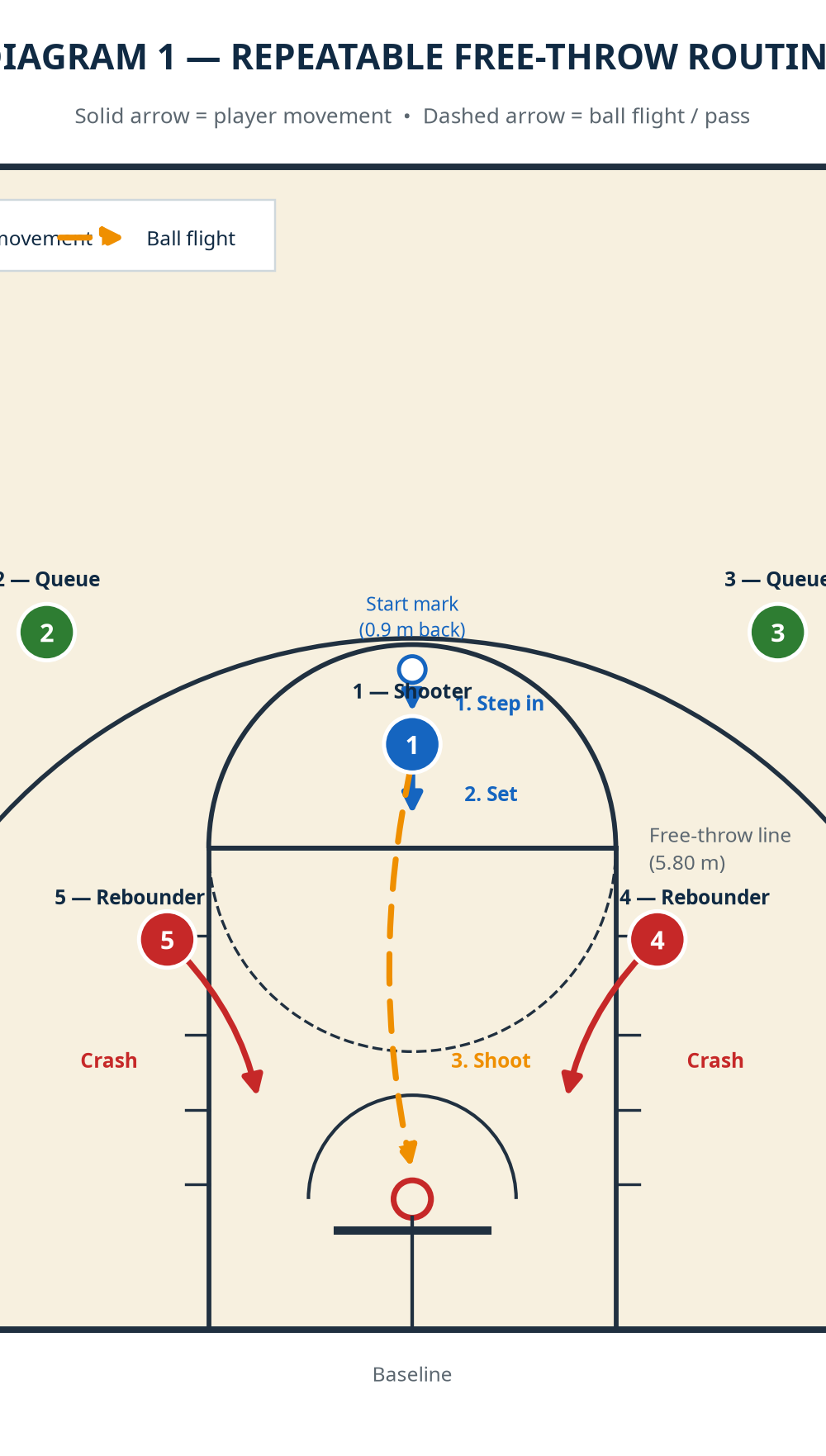
Use one basket, five players, two balls, six flat markers, a stopwatch, and a clipboard. Four to six players per hoop is ideal; larger squads use both baskets. Place one marker 0.9 m behind the middle of the free-throw line as an approach mark. It is a training cue only: every shot is still released from behind the official line.
| Area / role | Exact setup | Responsibility |
|---|---|---|
| Shooter — 1 | Centre of free-throw line | Executes the full routine and calls the result: clean, short, long, left, or right. |
| Rebounders — 5 and 4 | First legal lane spaces, opposite sides | Track release, secure the rebound, and chest-pass to the shooter. |
| Queue — 2 and 3 | Two lines, 2 m outside top corners of lane | Observe the routine, then replace the active shooter. |
| Coach | 3–4 m away at 45 degrees on shooter’s non-shooting-hand side | See feet, elbow line, ball path, and finish without entering the eyeline. |
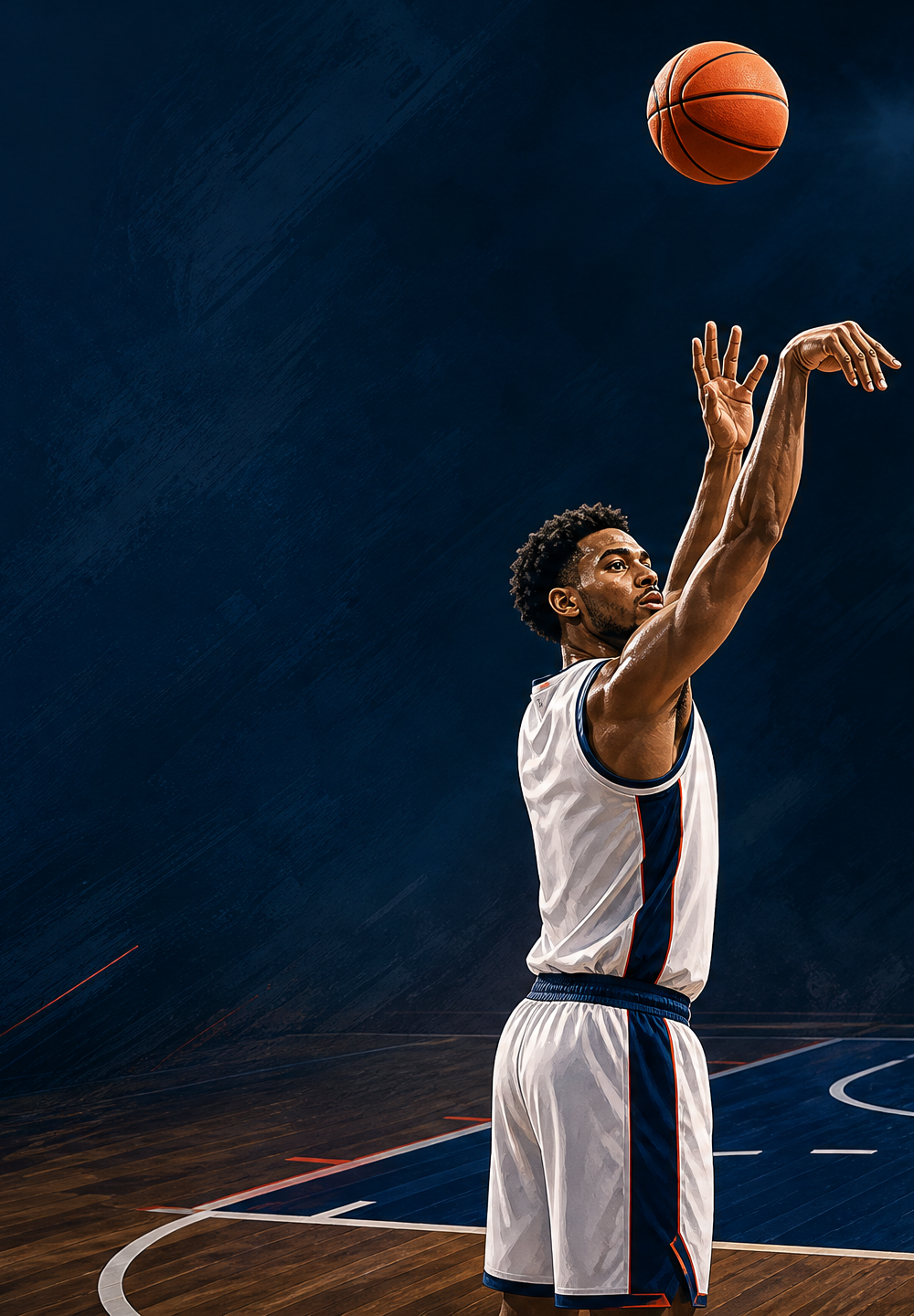
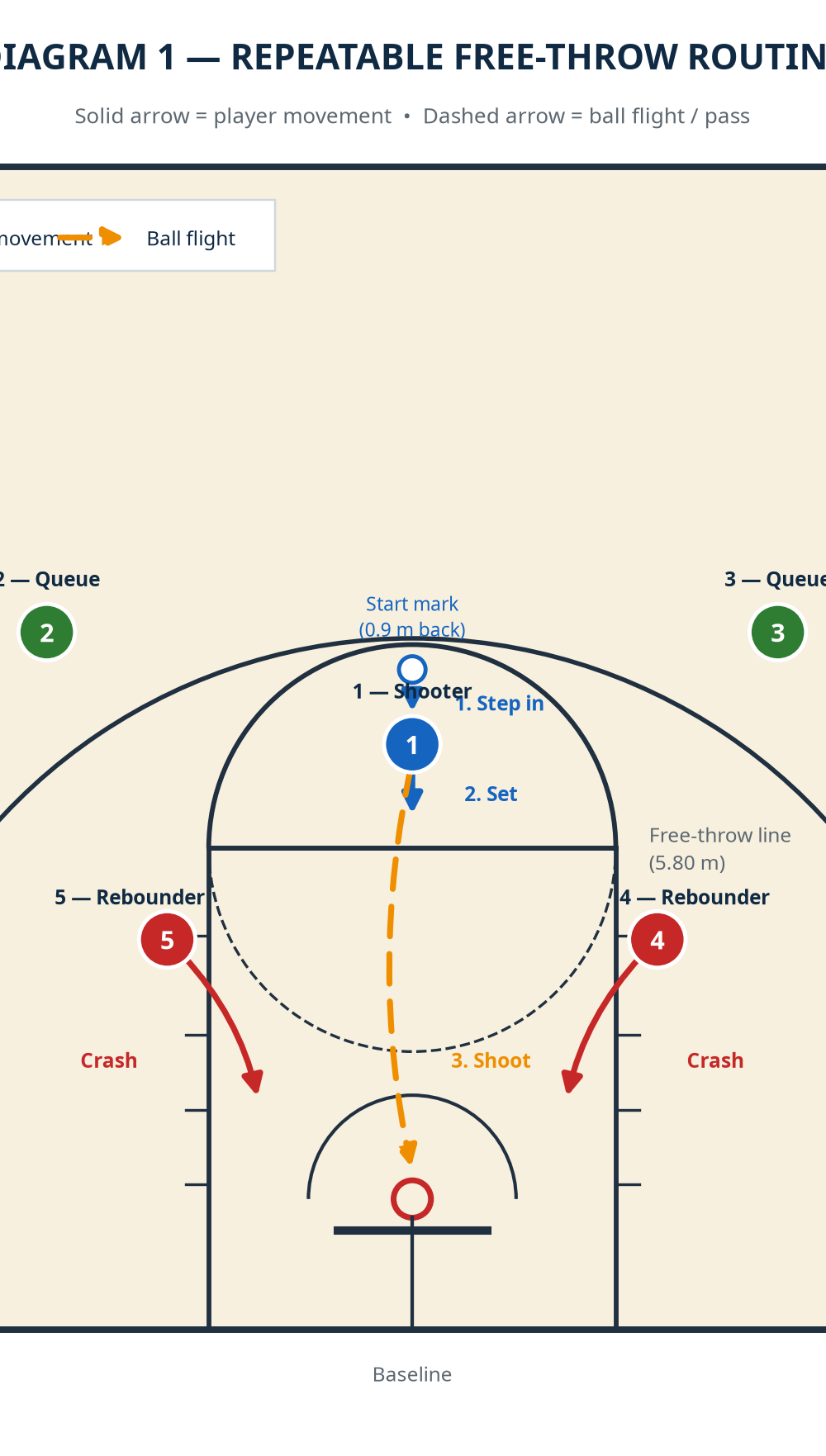
Diagram 1 is the teaching picture. Numbered circles use standard 1–5 position language: 1 shoots; 4 and 5 work the lane; 2 and 3 are next. Solid arrows show player movement and dashed arrows show ball movement. Keep players inside the 14 m half-court working space, while reminding them that the full FIBA court is 28 m × 15 m. 1
Step-by-Step Instructions
Demonstrate the standard. Show one complete rep at normal speed. The player starts at the 0.9 m marker, walks in under control, sets the shooting-side foot fractionally ahead, and finds a comfortable shoulder-width stance. Set a target of 6–8 seconds from receiving the ball to release. Consistency matters more than the exact number.
Set the body and breath. Player 1 arrives with toes and hips generally square to the rim, knees softly flexed, and weight through the mid-foot. One slow breath settles the ball in the shooting pocket. For young players, use: “quiet feet, soft knees, eyes on the back rim.” Do not give five mechanical cues at once.
Shoot a five-ball technical set. Player 1 takes five free throws. After each attempt, 4 or 5 rebounds and chest-passes the ball back. The shooter holds the finish until the ball reaches the rim, calls the result, and makes one adjustment only on the next attempt. Record makes out of five and one main miss pattern.
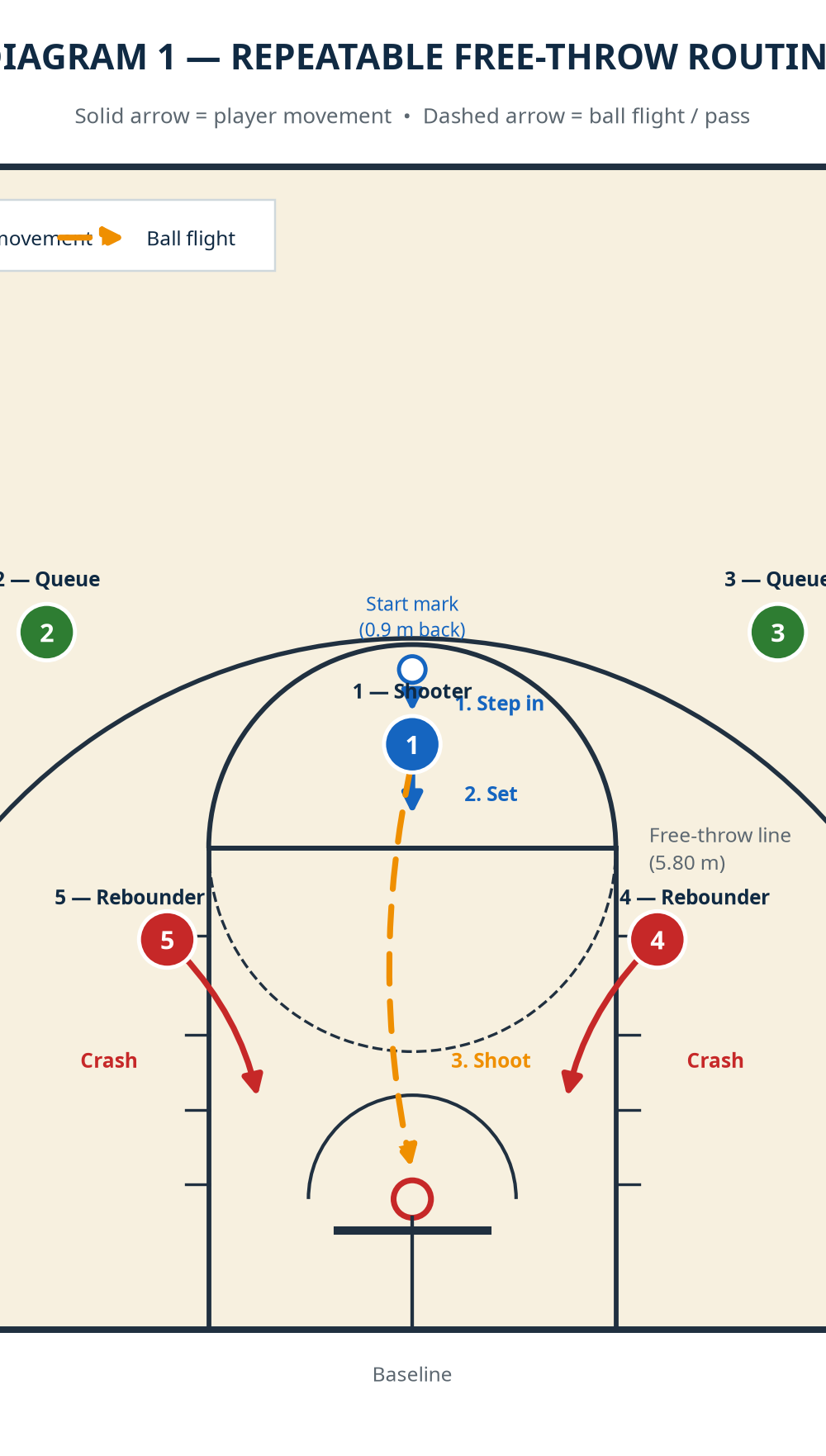
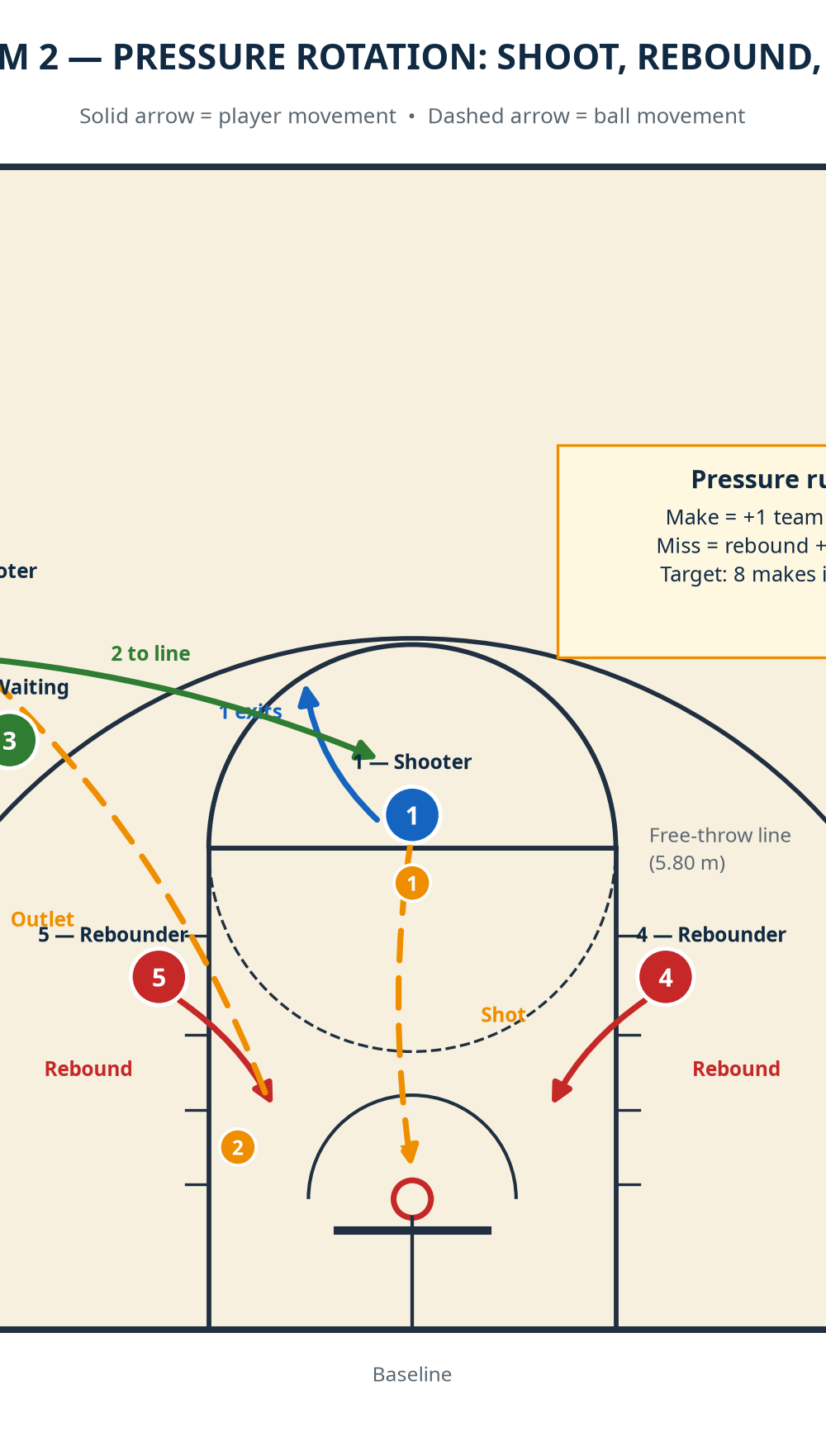
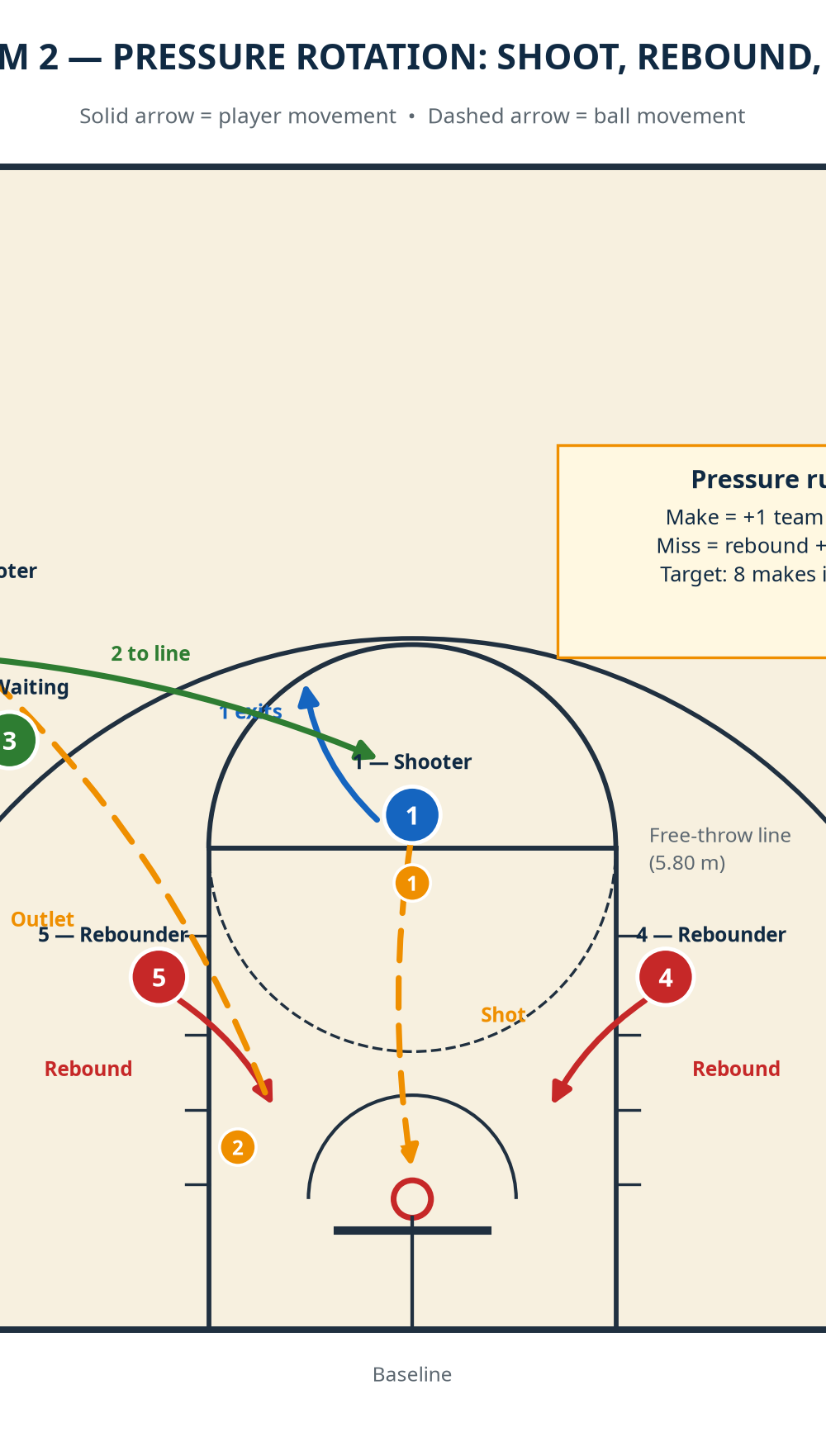
Rotate with purpose. After shot five, 1 exits on the non-shooting-hand side to the back of the queue. Players 4 and 5 remain as rebounders for the next shooter, then rotate out after two shooters. Player 2 becomes the shooter. This preserves repetition without slowing the station.
Add the pressure clock. When every player has completed one technical set, run the 60-second rotation in Diagram 2. The group target is eight makes in 60 seconds. A make earns one point; a miss requires a secure rebound and immediate outlet. Demand execution, not blame.
Finish with two game balls. Each player performs 15–20 seconds of light movement—defensive slides between two markers 3 m apart—then shoots two consecutive free throws. Chart these separately. They reveal whether the routine holds when heart rate rises.
In Diagram 2, 1 shoots, 4 and 5 rebound, and the ball is outlet-passed to 2 as 1 exits and 2 replaces the shooter. Solid arrows are player movements; dashed arrows are the shot and outlet. Fix a late pass or careless rebound before demanding more speed.
Key Coaching Points
| Teaching point | Floor-level coaching language |
|---|---|
| Routine before result | Use the identical entry, breath, visual target, and release count after a make or miss. Do not let emotion change mechanics. |
| Balance creates touch | Start in soft knees with weight centred. The shot rises from legs and core, not a late arm heave. |
| One clear target | Pick a stable rim reference—often the back of the rim—and keep the eyes there through release. |
| Straight ball path | Keep the shooting elbow under the ball; the guide hand supports but does not steer. A repeated left/right miss is a direction issue, not a “shoot harder” issue. |
| Hold the finish | Extend the arm and finish fingers through the rim line until the ball reaches the basket. This creates a diagnostic window for the coach. |
| Next-play response | Name the miss, reset breath, and repeat the routine. Be factual, not dramatic. |
Common Mistakes
Rushing after a miss is the first issue. Return the player to the agreed 6–8-second routine and one anchor word, such as “smooth.” Second, players often change two or three things after one miss. Limit feedback to one visible correction: “finish longer” for a short ball, or “quiet guide hand” for a sideways miss.
Third, watch for feet moving at release. If the player rocks forward, rehearse the stance twice before shooting again. Fourth, rebounders can steal reps by stepping early, fumbling the ball, or returning a poor pass. Their standard is: see release, secure with two hands, pivot, chest-pass to numbers. Finally, do not coach every player identically. Keep the shared sequence; let individuals own a dribble count or breath cue.
Variations & Progressions
Use a Partner Mirror variation while learning. Player 1 shoots five while player 2 stands outside the lane and observes only three items: feet set, eyes on target, held finish. Then switch. This lowers pressure and teaches players what good routine discipline looks like.
Progress to Make Two to Leave. A player needs two consecutive makes before rotating out; a miss resets the count. Cap the turn at 90 seconds to retain flow.
For advanced groups, add fatigue and consequence. After a 12 m down-and-back, the player shoots two. A 2/2 banks one team point; a 0/2 sends the player through the next rebound-outlet rotation before shooting again. The objective is stable mechanics under fatigue, not conditioning volume.
Age Adaptations
| Age group | Coach adjustment | Success measure |
|---|---|---|
| Under 8–Under 10 | Use a child-appropriate line 2–3 m from the basket, a lighter ball if available, and only stance, target, and “freeze your hand.” | 3 of 5 shots with a held finish. |
| Under 12–Under 14 | Use the official line when strength allows; otherwise step forward but preserve the routine. Use three-ball sets and a 45-second team clock. | 60% routine compliance before percentage. |
| Under 16–Open | Use the official line, five-ball technical sets, game-ball pairs after movement, and directional-miss charting. | Make percentage plus a clear miss trend and adjustment. |
Coach’s Close
End by asking every player for one routine sentence: “I step in, breathe, see the back rim, and finish.” This checks ownership and gives athletes a script when score, crowd, or fatigue rises. For maximum transfer, use legal rebound places along the restricted area, which FIBA specifically reserves for players during free throws. 1