Box Rip: Under-the-Basket Inbound for a Clean Rim Finish
Teach a simple box-set baseline inbound that creates a high-percentage layup first, then flows immediately to a safe corner outlet and inside counter.
Equipment Needed
Overview
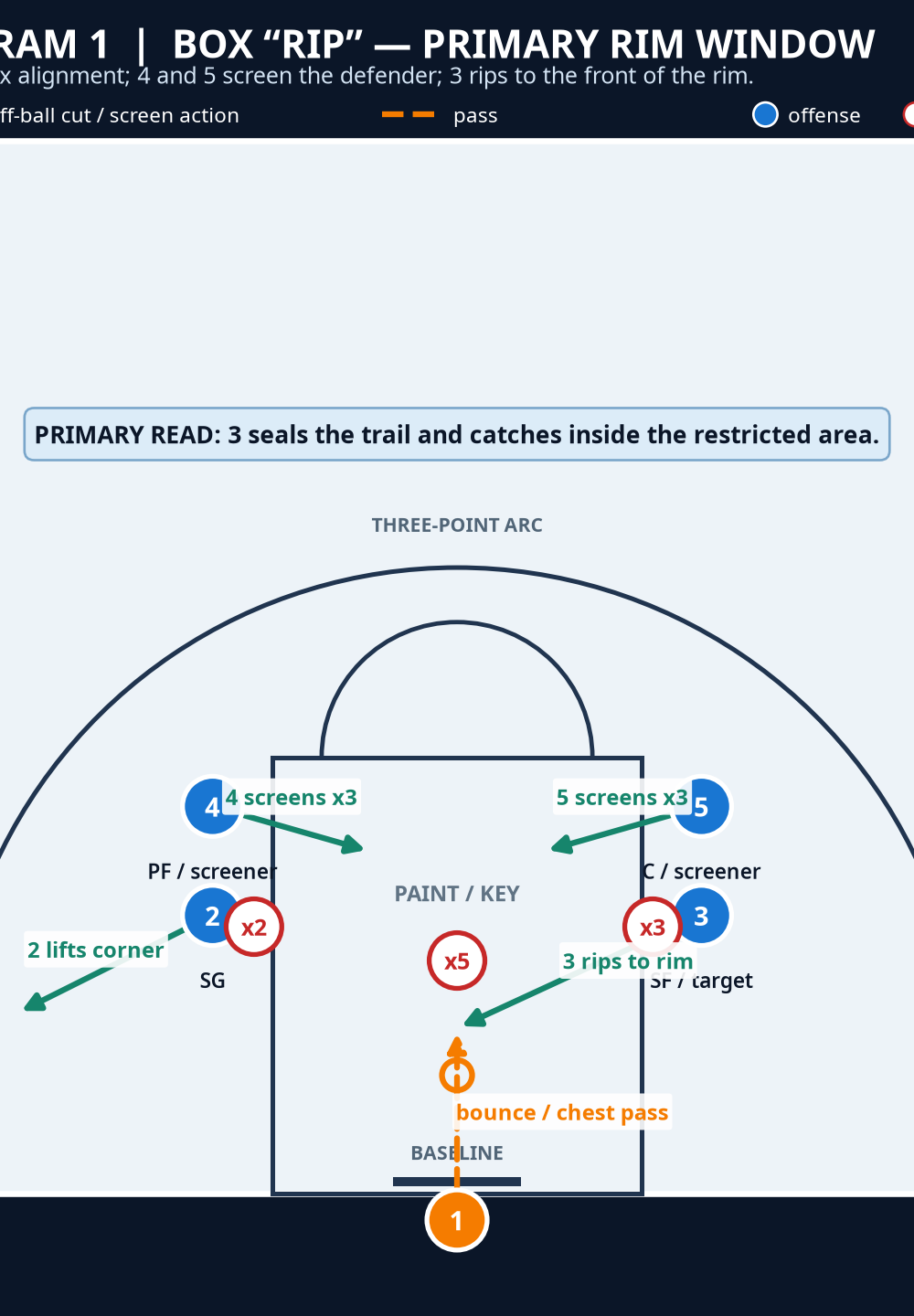
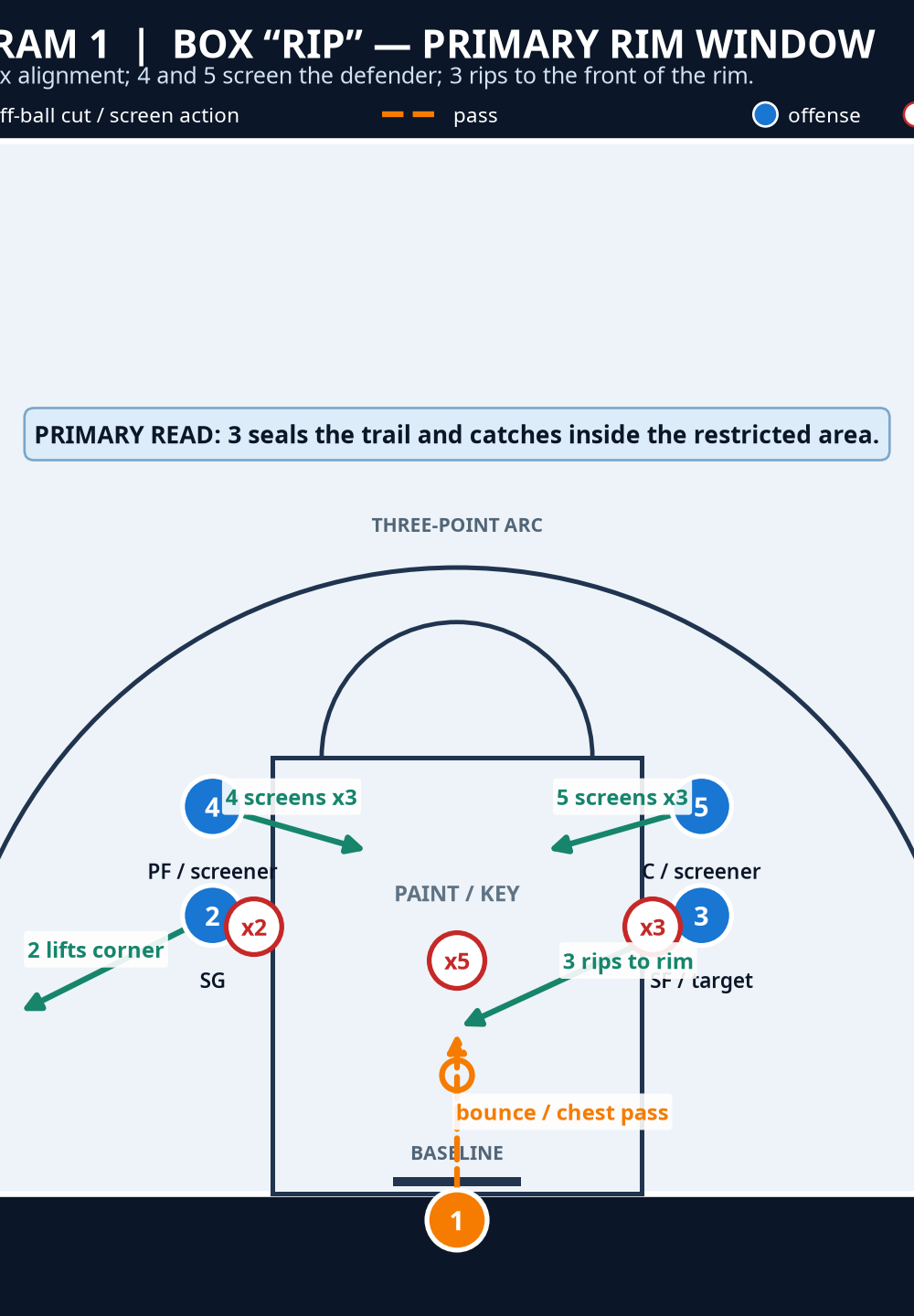
Box Rip is a baseline out-of-bounds (BLOB) play built for a fast, clean look at the front of the rim. It is a dependable set when the ball is being inbounded under your offensive basket after a dead ball, particularly when the defense is in pressure man-to-man coverage. The play begins in a compact four-player box, uses two physical legal screens to free the small forward (3), and gives the point guard (1) a clear three-read sequence: rim, corner safety, then opposite-block slip.
On a FIBA court, organize the action in the 15 m-wide end of the 28 m × 15 m playing floor. Keep the initial box inside the lane area and make the first decision quickly; the inbounder has only five seconds to release the ball. 1
Coaching intent: Put your best finisher at 3, your most composed passer at 1, and your strongest screen-and-seal players at 4 and 5. The set is designed to create an advantage, not to force a pass that is not there.
Setup
| Item | Coach setup |
|---|---|
| Court area | Use one offensive half court, with the basket, lane, baseline, short corners and three-point arc visible. |
| Players | Five offensive players; add five defenders once the timing is clean. Player 1 is the inbounder. |
| Alignment | Place 2 and 3 on the low-block line, about 1 m outside each lane line. Place 4 and 5 directly behind them, about 1.5 m higher, forming a tight box. |
| Spacing landmarks | Keep 2's safety outlet in the ball-side short corner, roughly 1 m inside the sideline and 2 m above the baseline. Keep 1 outside the baseline, centered under the rim. |
| Equipment | One ball, cones or flat markers for the four box spots and short-corner outlet, practice pinnies, whistle, and a stopwatch. |
Call the set "Box Rip". The word rip tells 3 to plant, attack the screen shoulder-to-shoulder, and cut hard toward the front of the rim. Use a verbal cue such as "Box Rip—Go!" when the referee hands 1 the ball.
Step-by-Step Instructions
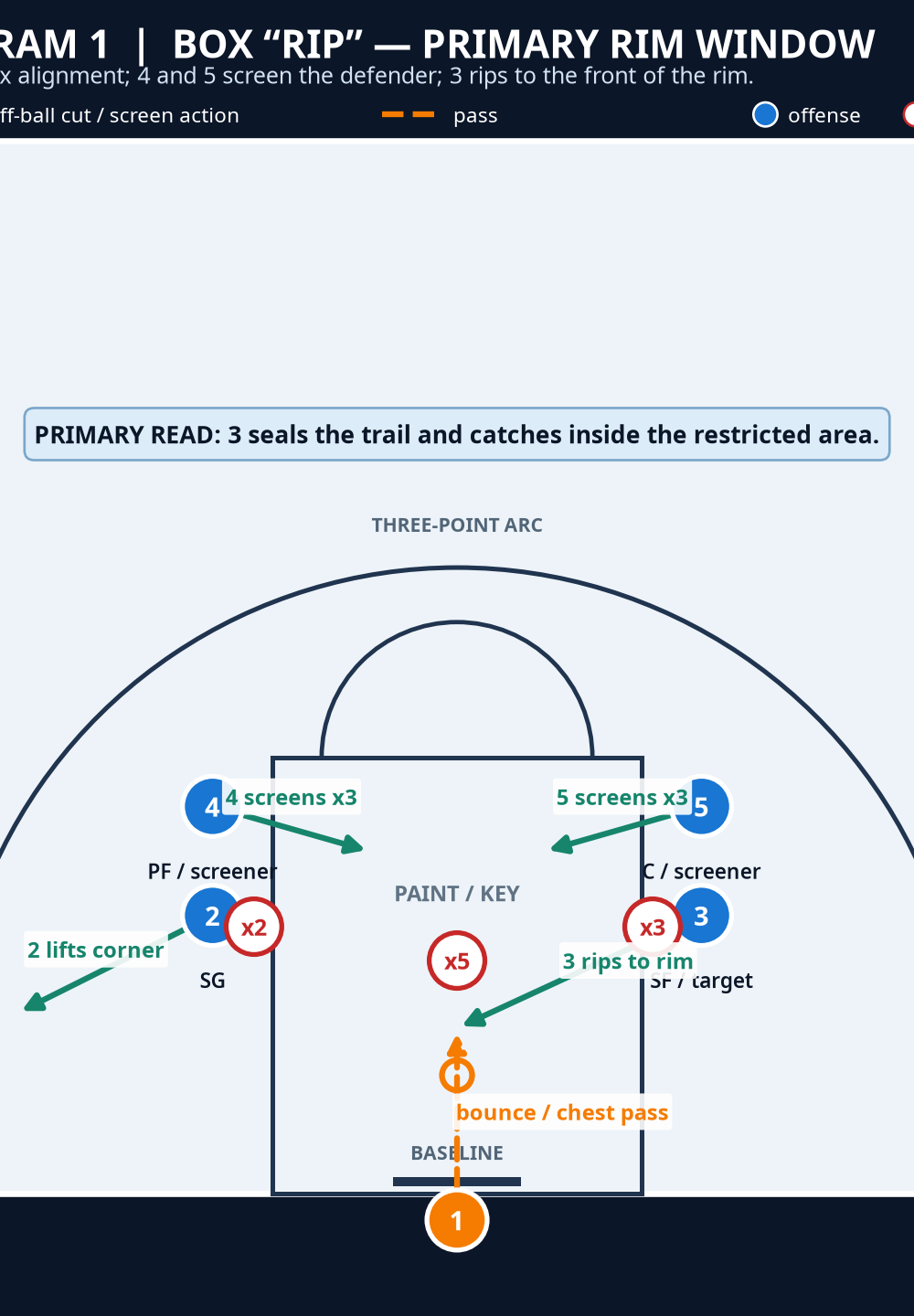
Set the box before the ball is live. Put 2 on the left low-block line and 3 on the right low-block line, facing the baseline. Put 4 behind 2 and 5 behind 3. Have 1 stand outside the baseline at the middle of the basket, in a balanced passing stance. The box should be compact enough to create traffic, but every player needs a clear pivoting lane.
Sell the static alignment. On 1's verbal cue, 4 and 5 step diagonally toward the middle of the paint and establish wide, stationary legal screening positions. Their chests face the baseline, feet are set before contact, and hands stay tight to the body. They are screening 3's defender, not chasing the defender.
Run the primary cut. As 4 and 5 arrive, 3 takes one hard step away from the basket to create separation, plants the outside foot, then rips tightly between the two screens. 3's target is the front of the rim, inside the restricted area. 3 shows both hands early, catches with two feet if possible, and finishes immediately through contact.
Create the safety outlet. Simultaneously, 2 lifts to the ball-side short corner. This movement must be game-speed but controlled: 2 is not drifting to the sideline or disappearing behind the backboard. 2 stays visible to 1 and opens both shoulders to the court.
Make the inbounder's first read. Player 1 reads 3 first. If 3 wins the shoulder battle and has a direct passing lane, 1 throws a firm chest pass or bounce pass to the target hand. Do not lob into a crowded lane. If x3 is top-side or has a hand in the passing lane, 1 immediately moves eyes to 2.
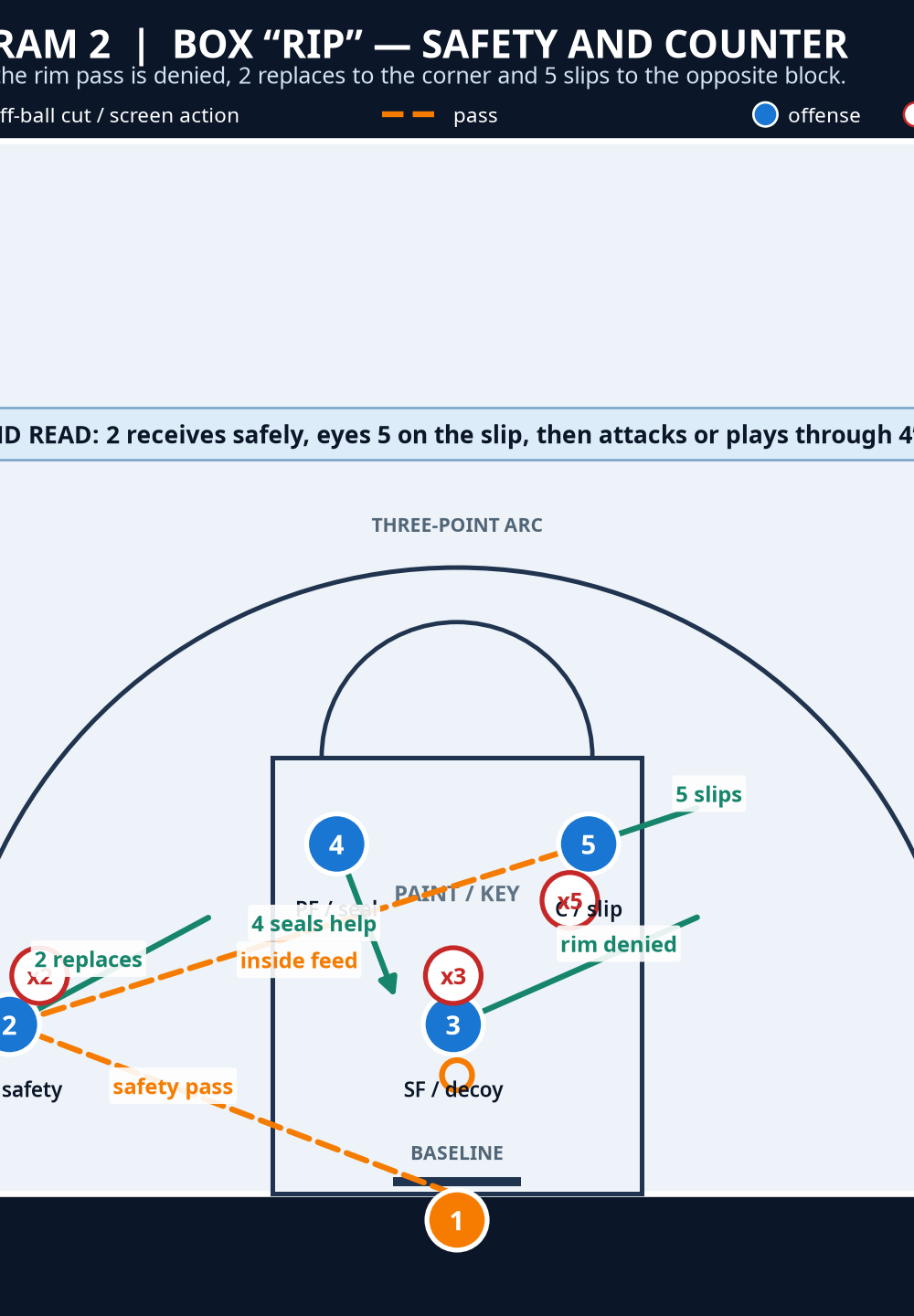
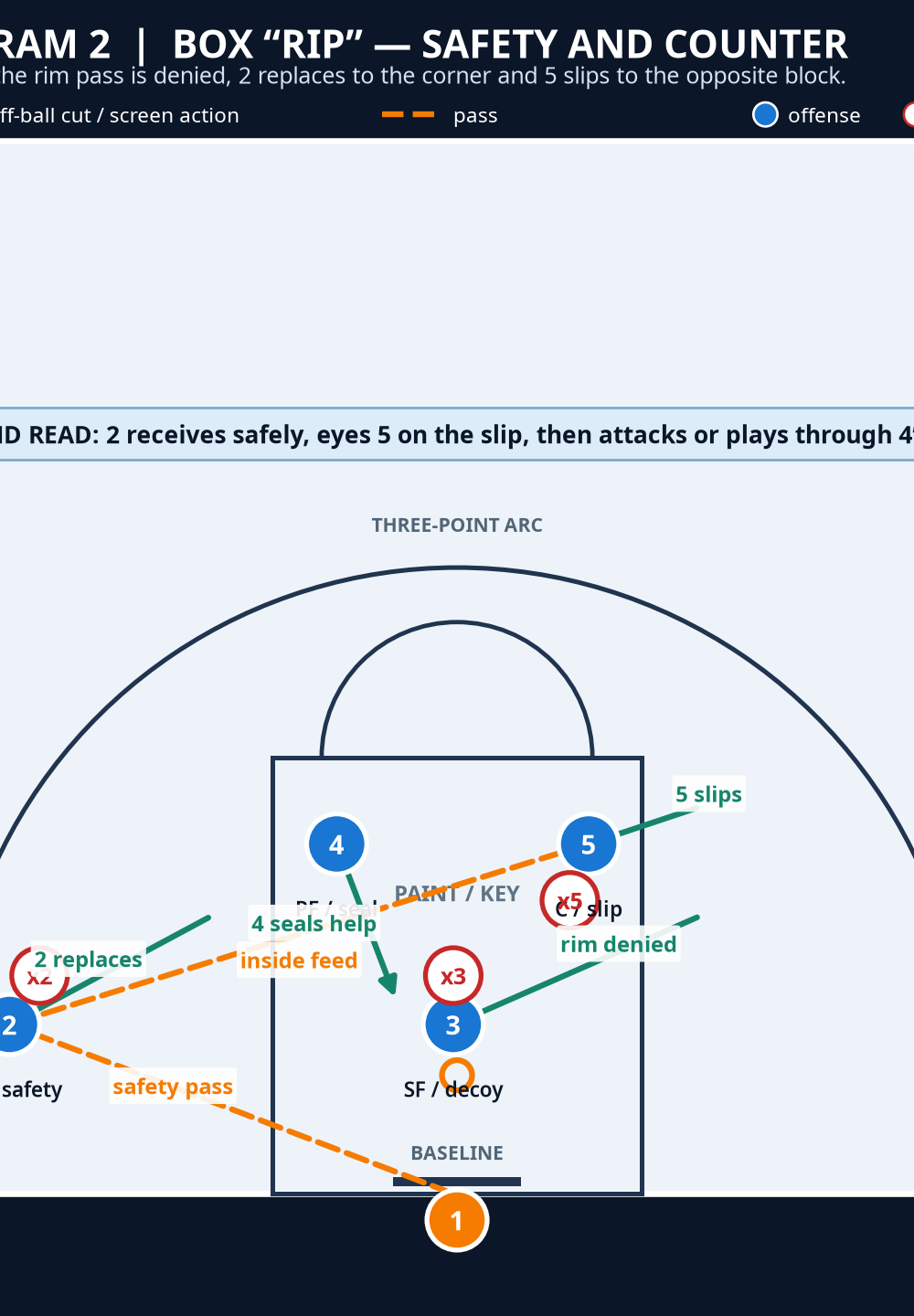
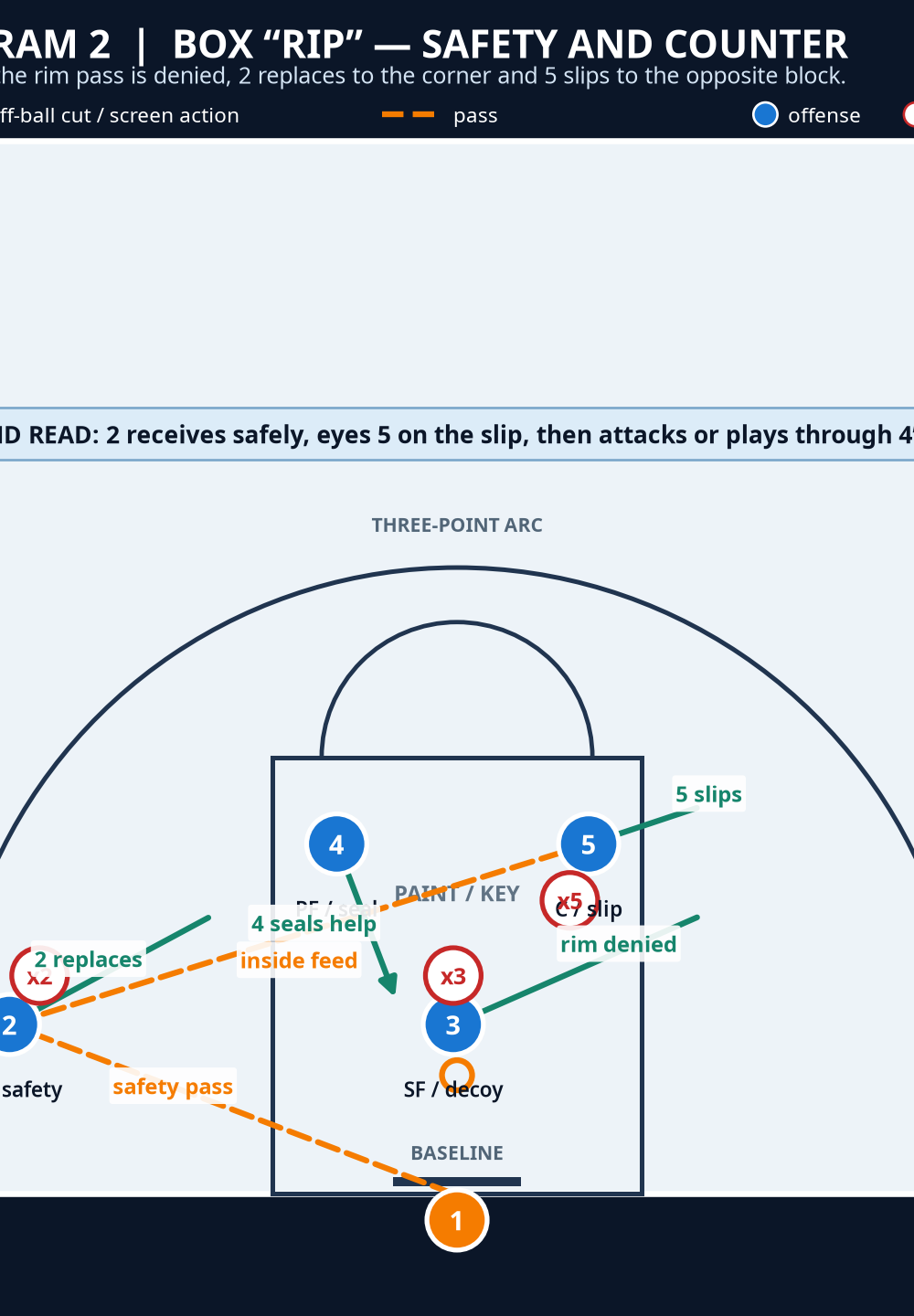
Use the counter without panic. If the rim pass is denied, 1 hits 2 in the short corner. As the ball travels, 5 slips off the screen to the opposite block and 4 seals the help defender in the middle of the lane. Player 2 catches on a jump stop, scans 5 for the inside feed, and attacks the baseline or plays through 4's seal if the post is covered.
Finish with floor balance. Once 2 has the ball, 1 steps inbounds and fills behind the ball as the emergency outlet. The weak-side player exits toward the wing after the initial action. This gives your group an organized second phase rather than five players trapped under the basket.
Key Coaching Points
| Teaching point | What the coach should demand |
|---|---|
| Screen legality | 4 and 5 arrive early, stop their feet, keep hands in, and screen the defender's path rather than leaning or holding. |
| Cut quality | 3 first moves away from the basket, then changes pace and shoulder angle to get hip-to-hip with the screen. A flat, slow cut will not create a window. |
| Inbounder poise | 1 uses a strong pivot, sees the whole paint, and works rim → safety → counter. No predetermined lob. |
| Passing window | Pass to the side away from the defender's top hand. A bounce pass is best when the defender trails; a chest pass is best when 3 has daylight. |
| Outlet discipline | 2 stays in the short-corner window and is ready before the ball is released. The outlet is a safety valve, not an afterthought. |
| Finish mentality | 3 catches ready to score: chin the ball, use the rim for protection, and finish before the help defense can load up. |
Coach the sequence in short bursts. Start with walk-through reps, progress to five live seconds for the inbounder, and score the group on quality of read rather than only made baskets. A successful rep is one in which every player arrives on time and 1 chooses the open option.
Common Mistakes
The most common error is spacing the box too wide. When 4 and 5 are more than a step apart, x3 can split the screens and recover to the rim. Pull the box back together and rehearse the screen angles without defenders. A second problem is screeners moving on contact. Correct it by teaching "arrive, wide base, freeze" before 3 begins the rip.
Another mistake is 3 cutting before the screens are set. The timing cue is not the referee handing over the ball; it is 4 and 5 arriving in their screen positions. Finally, coaches must eliminate the automatic lob. If 3 is covered, 1 must use 2 immediately. A risky rim pass creates a turnover in the most congested area of the floor.
Variations & Progressions
Variation 1 — Corner three. If opponents over-help from the ball-side corner, have 2 lift beyond the arc instead of stopping in the short corner. The first read remains 3; the second read becomes a catch-and-shoot three for 2. Use this only with a reliable perimeter shooter and enough space from the sideline.
Variation 2 — Slip-and-seal. Against teams that switch the two screens, have 5 slip immediately to the opposite block while 4 holds the middle seal. This creates a quick high-low style option for 2 after the safety catch.
Progression — Add live constraints. Begin 5-on-0, then place one defender on 3, then add defenders on 2 and 5. Finish with 5-on-5 and a five-second inbound count. Award the defense a point for a deflection or five-second violation; award the offense two points for a rim catch and one point for a clean safety outlet.
Age Adaptations
For Under-8 and Under-10, use only 1, 3 and 2: 3 cuts directly to the rim after one coach-held screen marker, while 2 becomes the obvious short-corner safety. Remove live defenders until players can identify the basket and passing lane. For Under-12 and Under-14, introduce 4 and 5 as stationary screeners and practice the rim-to-safety read against token defense. Keep the language simple: "screen, rip, corner."
For Under-16 and open-age teams, add switching defenders, a weak-side tag, and a scout-specific counter. Demand legal screen angles, a precise five-second clock, and a second action after the safety catch. At this level, track whether 1 identifies the best read by 2.5 seconds; that decision speed is what makes the set useful in competition.
Practice Script
Run three minutes of footwork-only box alignment, four minutes of 5-on-0 timing, six minutes with a live defender on 3, six minutes with the safety outlet defended, then six minutes of competitive 5-on-5 BLOB possessions. End each rep by asking 1: "What was your first open read, and why?" That question turns a drawn play into basketball decision-making.