Mastering the Centre Pass: 3 Essential Variations to Break the Line
Equip your team with three highly effective centre pass strategies to confidently break through any defensive setup and secure first-phase possession.

Equipment Needed
1. Overview
The centre pass is the most critical set piece in netball. A team that can consistently convert their centre passes into goals dictates the pace and pressure of the game. However, relying on a single, predictable movement pattern allows the opposition defence to easily anticipate and intercept the ball. This comprehensive drill introduces three distinct centre pass variations designed to break the defensive line, create space, and ensure safe delivery of the ball into the attacking third.
By mastering these variations, your Wing Attack (WA), Goal Attack (GA), and Goal Shooter (GS) will learn how to coordinate their movements, use decoys effectively, and exploit gaps in the defensive setup. This drill is suitable for intermediate to advanced teams looking to elevate their tactical gameplay.
2. Setup
To run this drill effectively, you will need a full netball court (30.5m x 15.25m) and the following setup:
- Players Required: Minimum of 7 players (C, WA, GA, GS for the attacking team; WD, GD, GK for the defending team). Additional players can rotate in.
- Equipment: 1 netball, bibs for both attacking and defending teams.
- Starting Positions:
- Centre (C): Standing entirely within the centre circle (0.9m radius).
- Wing Attack (WA): Positioned in the centre third, typically starting near the transverse line or sideline depending on the variation.
- Goal Attack (GA): Positioned in the goal third, near the transverse line.
- Goal Shooter (GS): Positioned inside the goal circle or deep within the goal third.
- Defenders (WD, GD, GK): Marking their respective attacking opponents tightly.
3. Step-by-Step Instructions
Variation A: The Standard Split
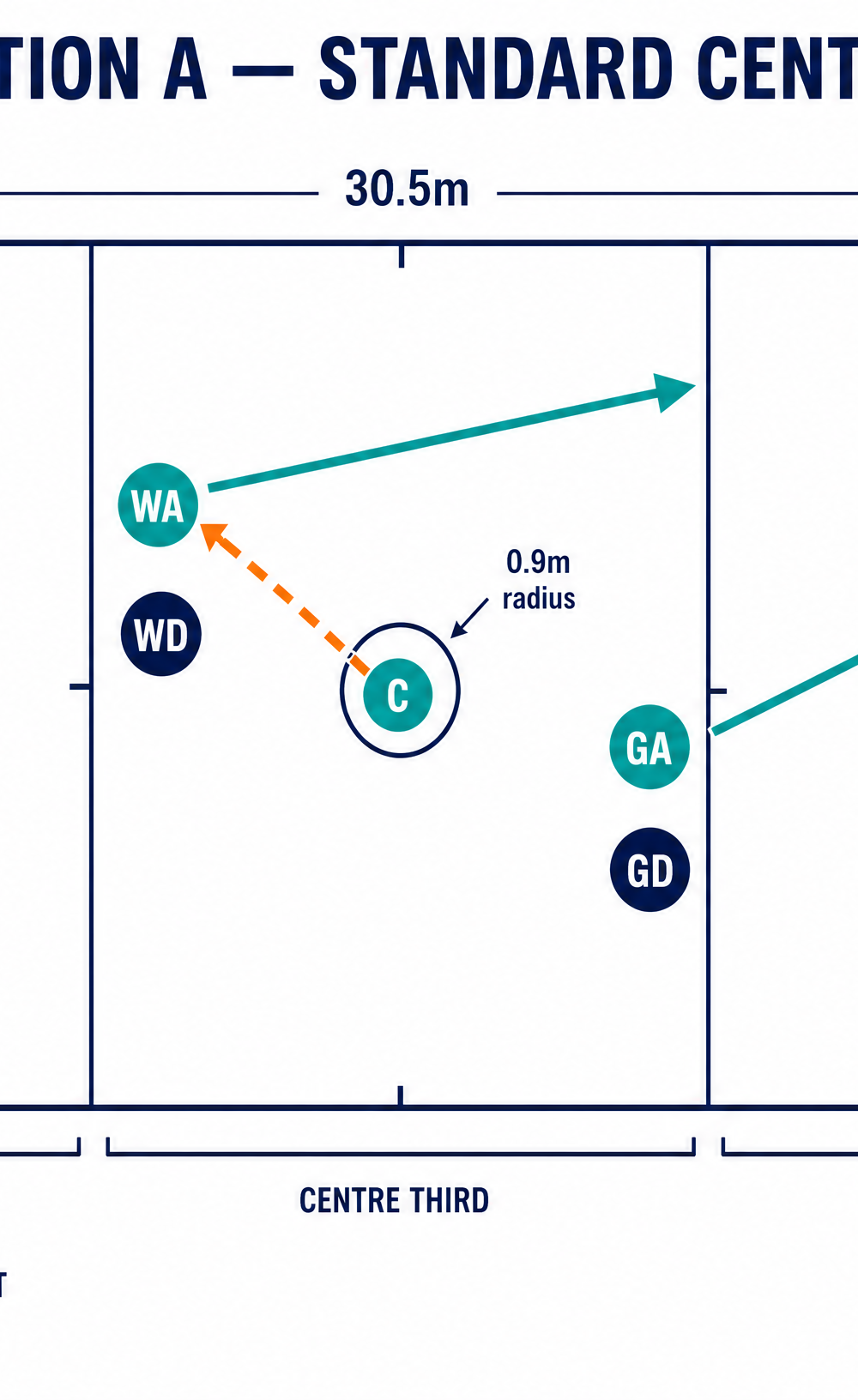
This is the foundational centre pass, relying on speed and timing to hit the first option.

- The Setup: The C stands in the centre circle with the ball. WA and GA position themselves on the transverse line, roughly shoulder-width apart.
- The Whistle: On the umpire's whistle, the C steps forward to execute the pass.
- The Movement: The WA drives hard and straight forward into the centre third, aiming for the top of the goal third. Simultaneously, the GA cuts sharply diagonally towards the goal circle.
- The Pass: The C reads the movement and delivers a fast, flat pass to the WA (the primary option) as they hit the top of the goal third.
- The Follow-up: If the WA is heavily defended, the C looks to the GA as the secondary option.
Variation B: The Double-Cut (Decoy)
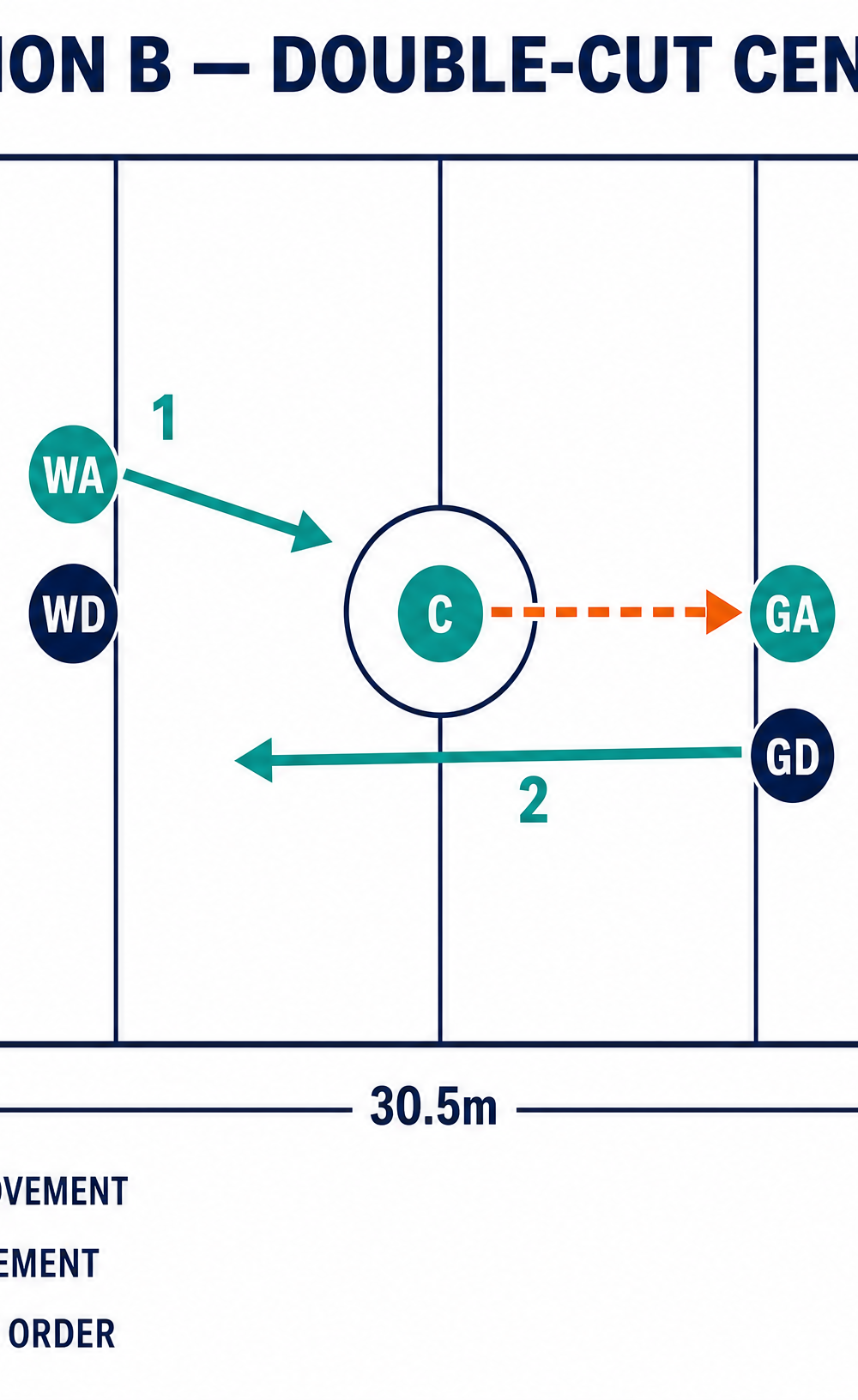
This variation uses a decoy run to pull defenders out of position, creating a clear channel for the secondary attacker.
- The Setup: The C is in the centre circle. WA starts wide on the left side of the centre third. GA starts on the right side near the transverse line.
- The First Cut (Decoy): On the whistle, the WA cuts sharply and aggressively towards the middle of the court. The goal is to draw the WD with them, vacating the space on the left side.
- The Second Cut: Immediately after the WA's movement, the GA drives hard into the space just vacated by the WA.
- The Pass: The C ignores the initial decoy run by the WA and delivers a strong pass into the space for the GA to run onto.
- The Follow-up: The WA must quickly re-offer if the GA is covered.
Variation C: The Long-Ball Direct (GS Lead)
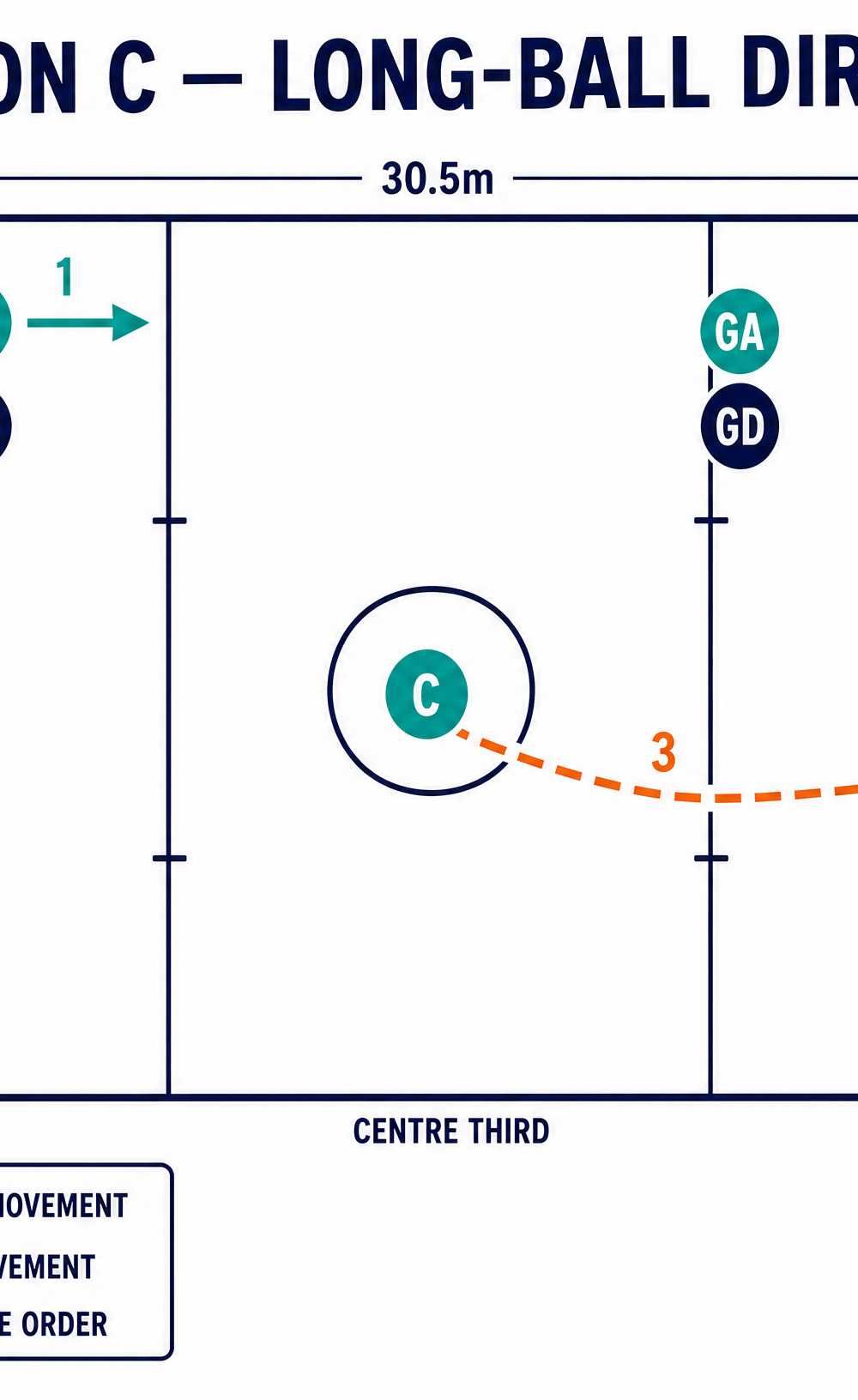
This aggressive variation aims to bypass the midcourt entirely, delivering the ball directly to the Goal Shooter.
- The Setup: The C is in the centre circle. WA starts wide on the left. GA is at the transverse line on the right. The GS starts deep in the goal circle.
- The Decoy Runs: On the whistle, the WA and GA make short, sharp decoy runs to draw their defenders (WD and GD) away from the centre channel.
- The Strong Lead: Simultaneously, the GS makes a powerful, explosive lead drive straight up the middle of the court, aiming for the top of the goal third (near the transverse line).
- The Pass: The C identifies the GS's lead and delivers a long, high, and accurate lob pass over the top of the defenders directly to the GS.
- The Follow-up: The WA and GA must immediately drive towards the goal circle to support the GS and prepare for the next phase of play.
4. Key Coaching Points
- Timing is Everything: The attackers must time their movements perfectly. Moving before the whistle results in a penalty; moving too late allows the defence to set up.
- Strong First Step: Encourage players to push off powerfully on their first step to gain immediate separation from their defender.
- Eye Contact: The Centre must maintain strong eye contact with the intended receiver to ensure they are ready for the pass.
- Decoy Commitment: Decoy runs must be executed at 100% effort to successfully draw the defenders away from the intended target space.
- Pass Accuracy: The Centre must deliver the ball accurately to the space the attacker is running into, not where they are currently standing.
5. Common Mistakes
- Telegraphing the Pass: The Centre staring down the intended receiver, allowing the defence to anticipate the pass and intercept.
- Weak Decoy Runs: Attackers jogging through their decoy runs, failing to pull the defenders out of position.
- Crowding the Space: Both the WA and GA driving into the same area, making it easy for a single defender to cover both options.
- Passing Behind the Player: The Centre passing the ball behind the running attacker, forcing them to slow down and allowing the defence to recover.
6. Variations & Progressions
- Add Defensive Pressure: Start with passive defence (shadowing only) and gradually increase to full, contested defence.
- Time Limit: Challenge the attacking team to score within a specific timeframe (e.g., 10 seconds) after the centre pass to simulate match pressure.
- Restricted Vision: Have the Centre start facing backwards and only turn on the whistle, forcing them to quickly scan and identify the best option.
7. Age Adaptations
- Under 10s / Under 12s: Focus heavily on Variation A (The Standard Split). Ensure players understand the basic timing and the importance of a strong first step. Keep the passes shorter and flatter.
- Under 14s / Under 16s: Introduce Variation B (The Double-Cut). Emphasize the importance of convincing decoy runs and spatial awareness. Introduce passive defence to build confidence.
- Open / Advanced: Practice all three variations under full defensive pressure. Focus on rapid decision-making by the Centre and the ability of the attackers to seamlessly switch variations if the primary option is shut down.