

Cricket
Short-Pitch Survival & Attack: Pull and Hook Shot Drill
A progressive, coach-led batting drill that develops safe, decisive footwork and scoring options against short-pitched bowling.
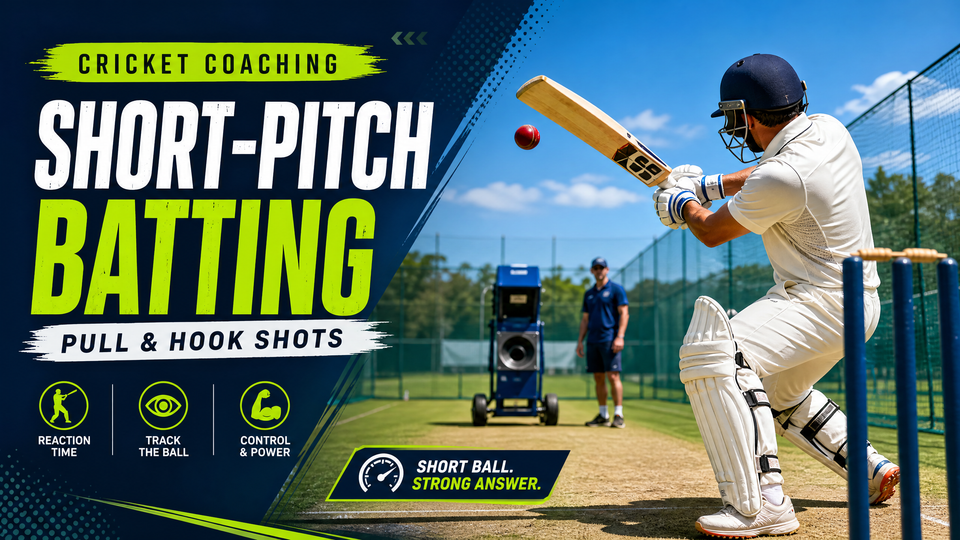
What you need
15-20 cricket balls or soft training balls, bowling machine or side-arm thrower, full batting protective equipment, stumps, cones or flat markers, 22-yard net or pitch
1. Overview
The Short-Pitch Survival & Attack Drill builds a batter’s confidence, reaction time, and technique against short-pitched bowling. Many players allow the short ball to dictate their movement, which leads to panic, poor shot selection, and dismissals from top edges or fended strokes. This drill gives the coach a safe progression for teaching two key responses: evasion when the ball is above the batter’s control zone, and an assertive pull or hook when it is there to be scored from.
Run this as a 45-minute middle-to-late net block once batters are warm and fully protected. It is particularly useful before fixtures on lively pitches, against quick attacks, or whenever a player is being tied down by hostile short bowling. The desired outcome is not reckless aggression. The player should finish the drill able to recognise length early, get into a balanced back-foot position, and make a calm, percentage-based decision.
2. Setup
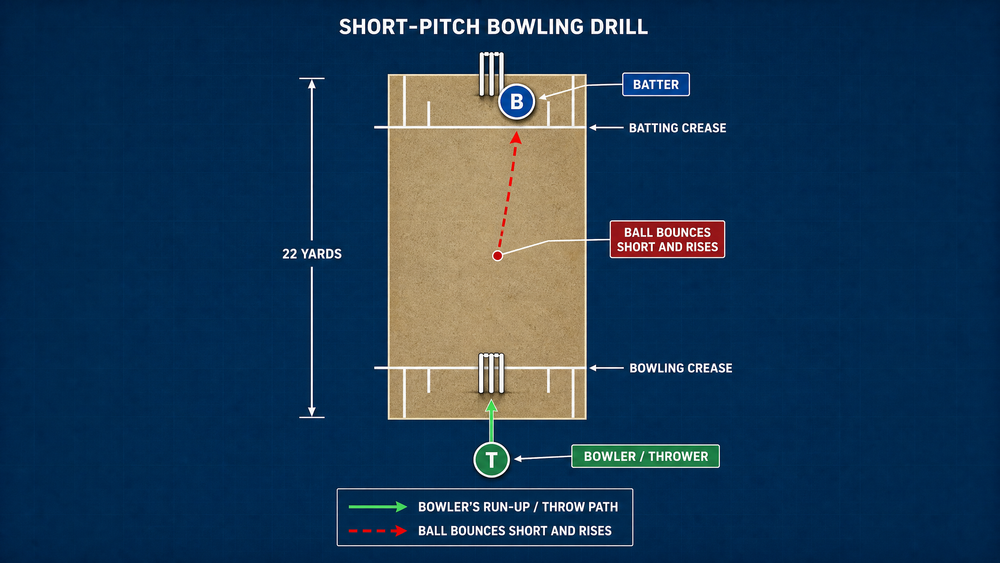
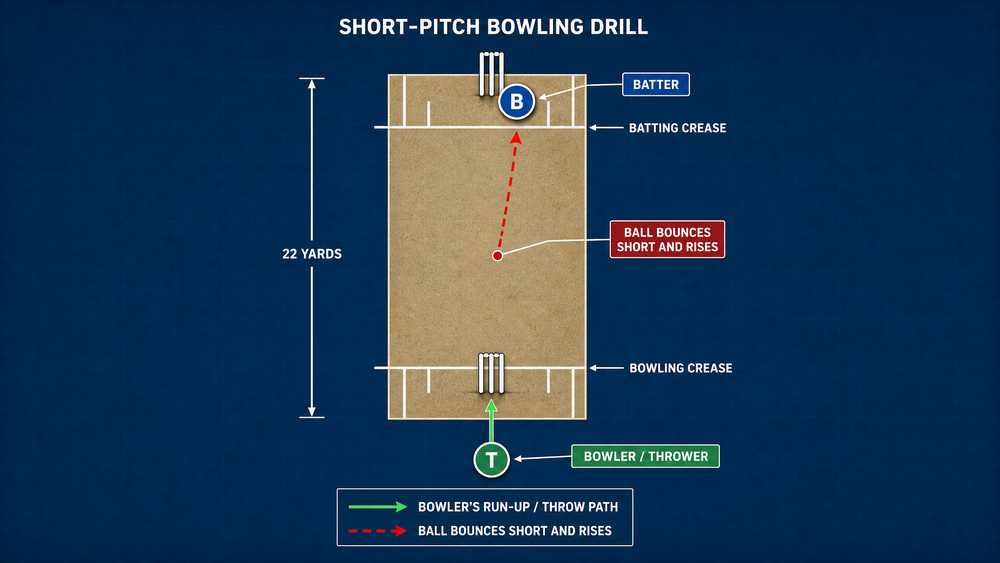
Use a full 22-yard pitch where possible, or mark a 22-yard lane within a net. Require every batter to wear a correctly fitted helmet with grille, pads, gloves, abdominal guard, and appropriate arm and chest protection. Have 15–20 cricket balls ready; older training balls are sensible for early repetitions. A bowling machine gives the best repeatability, but a skilled side-arm feeder or overarm thrower works well.
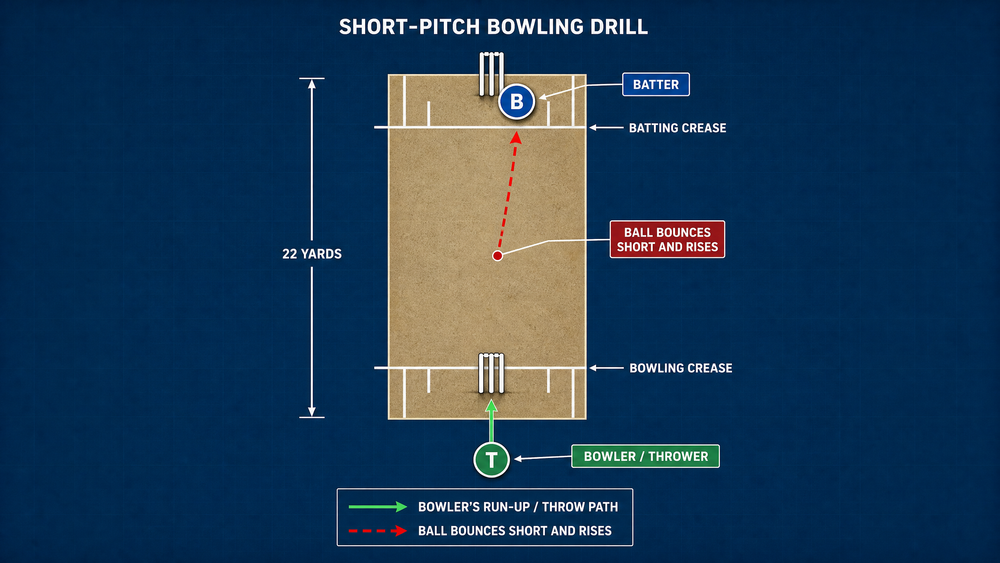
Place the feeder at 18–20 yards for the main phase. This shortens the decision window without asking a coach to bowl at unsafe match pace. Mark a 2–3 metre target channel in the back half of the pitch, approximately 6–8 yards from the batter’s stumps, where the feeder is aiming to land a controllable short ball. Set a cone target 12–18 metres square on the leg side, then bring fielders into the exercise as players become more competent.
Player Positions
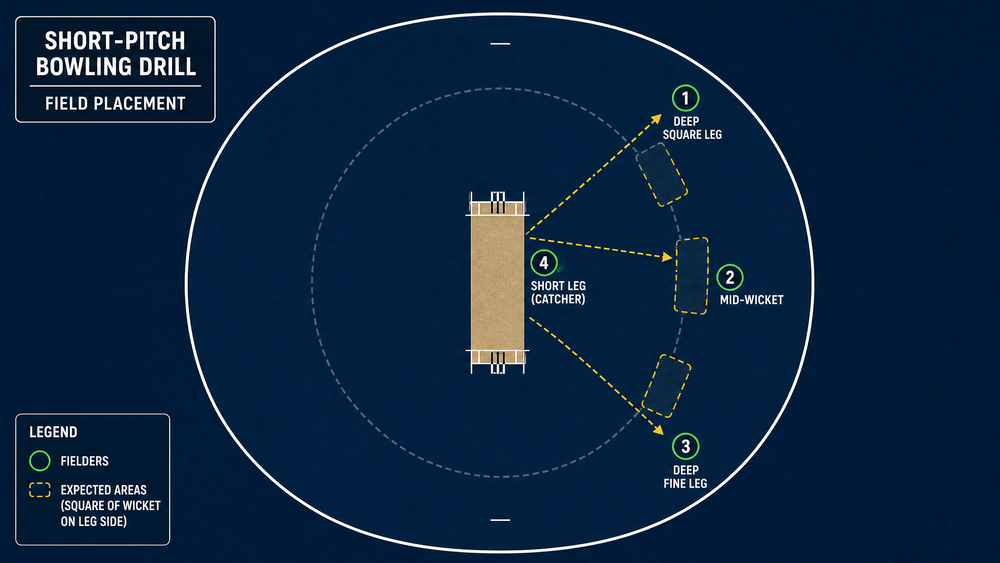
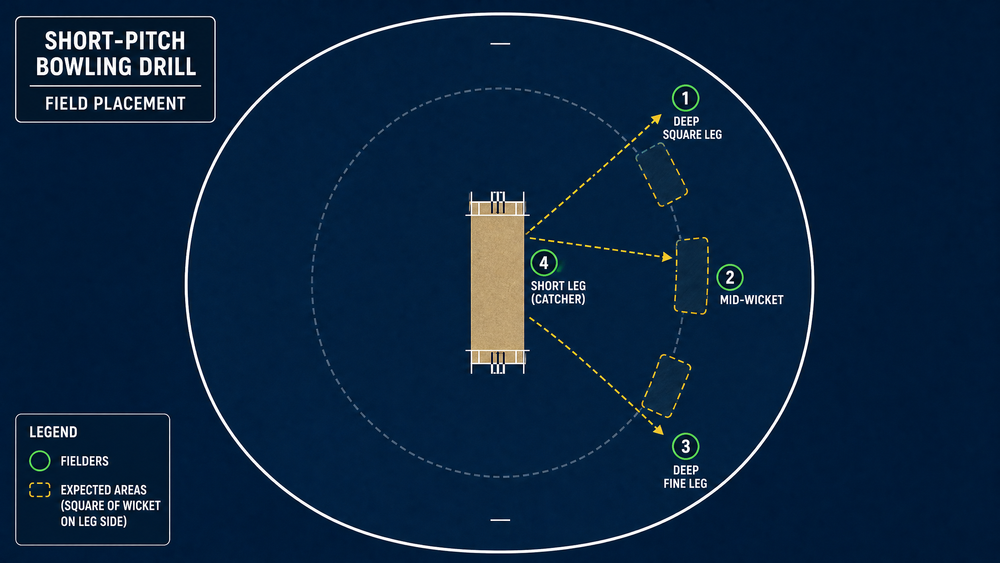
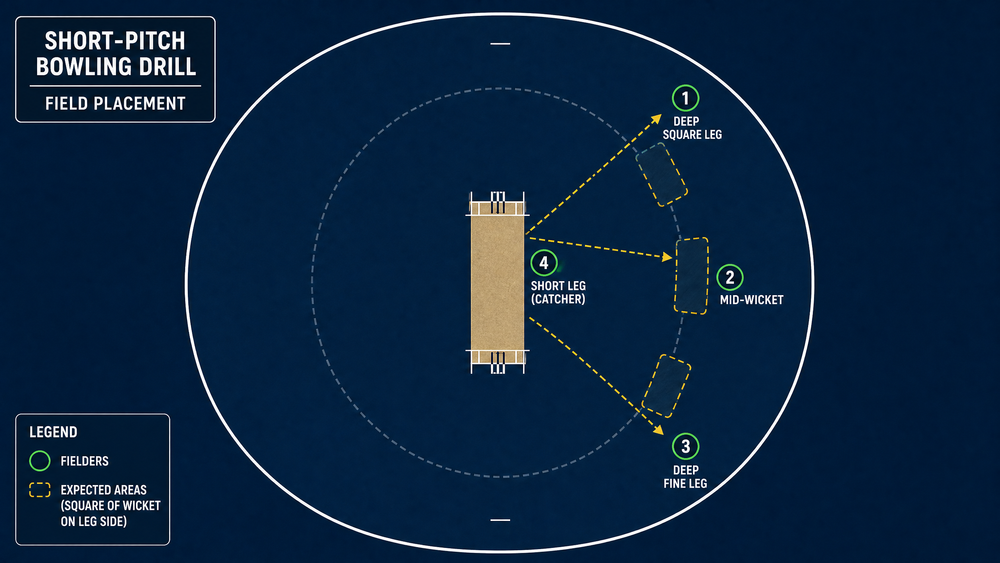
The batter begins in a normal guard at the batting crease. The feeder/bowler operates from 18–20 yards and aims into the marked short-length channel. Use four active field positions once the drill reaches match simulation: 1. Deep Square Leg is the pull-shot boundary rider; 2. Mid-Wicket is an inner-ring catcher for mistimed pulls; 3. Deep Fine Leg covers the hook-shot boundary; and 4. Short Leg is the close catcher for fended or gloved balls. Keep every fielder outside the immediate danger area until the feeder and batter are controlled.
3. Step-by-Step Instructions
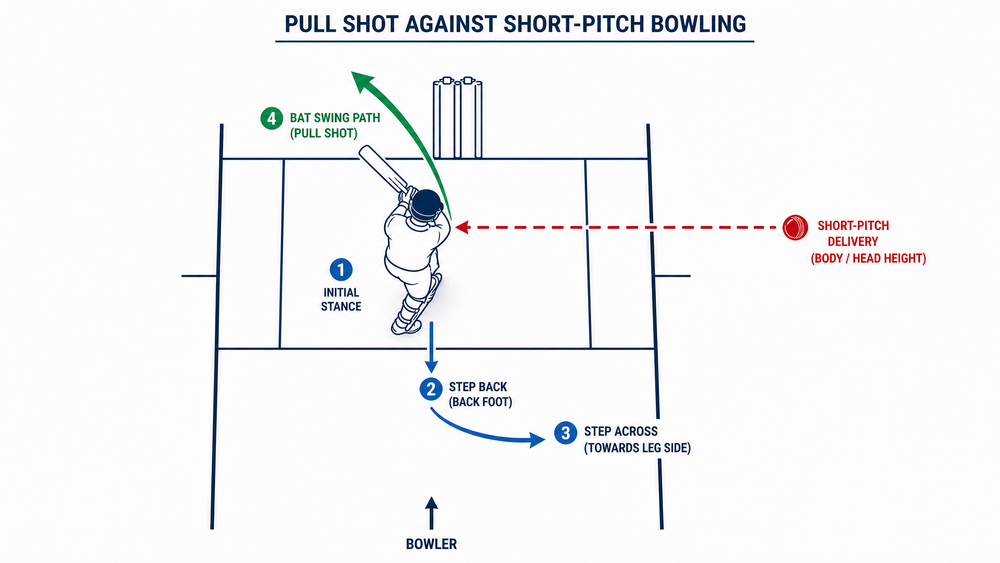
Step 1 — Movement and Evasion: 5 minutes. Stand 10 yards from the batter and feed soft-ball, underarm short deliveries rising around chest height. The batter does not play a shot. Their task is to identify the bounce, move back and slightly across toward off stump, keep eyes level, and sway or duck under a ball that is above their scoring zone. Give feedback after every three balls, not every ball, so rhythm develops.
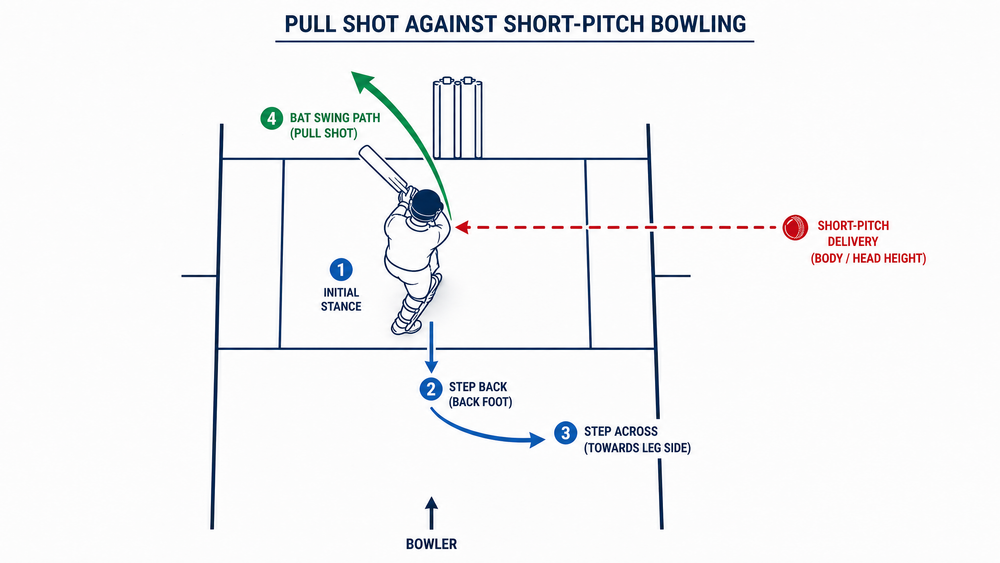
Step 2 — Controlled Pull: 8 minutes. Move back to 15 yards and feed overarm or with a side-arm at low pace. Deliveries should arrive between waist and chest height, on or just outside leg stump. Ask the batter to move back and across, let the ball arrive, and pull along the ground through the mid-wicket-to-square-leg channel. Award one point for a grounded contact into the target zone, and reset the count after any top edge.
Step 3 — Decision Ball: 10 minutes. Move the feeder to 18–20 yards and increase bounce gradually. Deliver six-ball sets: two scoring short balls below shoulder height, two head-height balls to evade, one good-length ball to defend or leave, and one surprise fuller ball. The batter must call “play” or “leave” immediately after release, then act. This prevents premeditation and makes the coach’s assessment simple: was the decision correct before the execution is judged?
Step 4 — Pull and Hook Options: 10 minutes. For a ball outside the body line and approaching head height, introduce the hook as an advanced option. The batter must only hook when their head is still, the ball is in view, and there is adequate control of line and height. Encourage use of pace: a compact swing, contact beside or slightly in front of the body, and a controlled finish toward fine leg. If the ball is too high, the correct answer remains evasion.
Step 5 — Match Simulation: 12 minutes. Set the four fielders and play two six-ball overs per batter. Award two points for a grounded shot into the designated square-leg or fine-leg zones, one point for a correct evade, and subtract one point for a top edge, catch, body strike, or a pull attempted at an unsuitable ball. Rotate the batter, feeder, and fielders after each two-over block. Use the final six balls to review the player’s score and one personal technical focus.
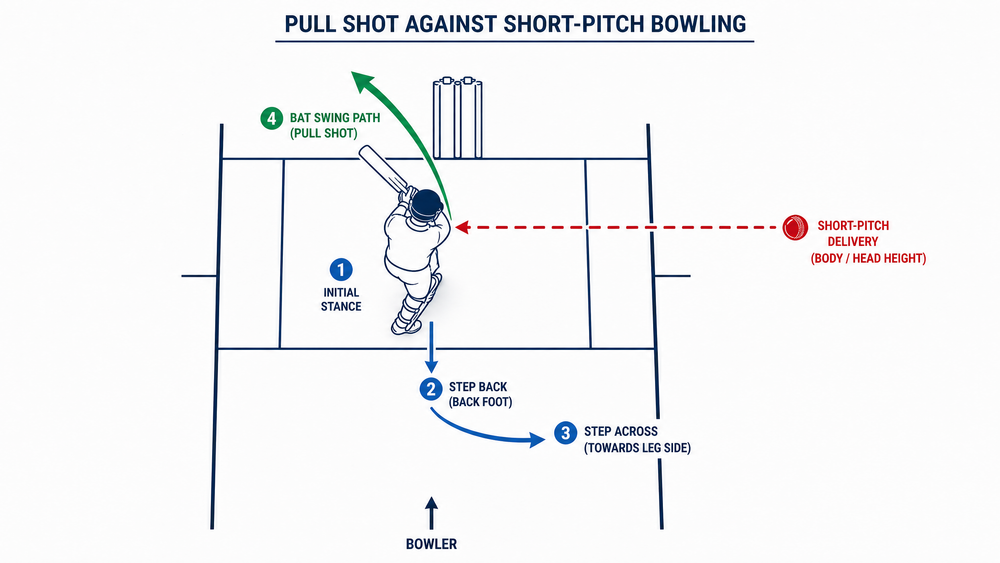
4. Key Coaching Points
| Focus area | What the coach should reinforce |
|---|---|
| Early length recognition | Train the player to watch the feeder’s release and pick up the short length as soon as the ball leaves the hand. An early read buys balance and choice. |
| Back and across | The first move is backward and fractionally toward off stump, not away toward square leg. This keeps the body inside the line and gives the hands room to work. |
| Stable head and eyes | Demand level eyes through contact or evasion. A player who turns away from the ball cannot judge height, line, or a safe scoring option. |
| Contact point | The pull is played when the ball arrives around waist-to-chest height. The hook is reserved for an outside-the-line ball that is controlled at upper-chest-to-head height. |
| Wrist roll | On the pull, roll the top hand over the ball after contact to keep it down. A high follow-through without wrist control invites the deep-square-leg catch. |
| Decision before ego | Praise the correct leave as strongly as the boundary. The drill must teach that a head-high ball is not automatically an invitation to hook. |
5. Common Mistakes
| Mistake | What it looks like | Coach correction |
|---|---|---|
| Backing away | The player drifts toward leg stump and exposes the stumps or loses access to the ball. | Put a flat cone just outside leg stump and require the back foot to travel toward, not beyond, that line. |
| Early commitment | The pull begins before the player has judged bounce, leading to a top edge. | Alternate short and good-length balls and ask the player to call the length before playing. |
| Falling away | Weight remains behind the back foot and the shot balloons. | Freeze the finish for two seconds; check that the chest and head have stayed balanced over a strong base. |
| Eyes closing or head turning | The player flinches at chest or head height. | Return briefly to soft-ball evasion feeds, reward visual tracking, then rebuild pace gradually. |
| Pulling balls above control height | The player hooks anything short, regardless of height or line. | Set an explicit shoulder-height decision line: above it, evade unless the advanced player has a clear outside-the-line hook. |
6. Variations & Progressions
For a confidence-building variation, begin with wet tennis balls or incrediballs at 10–12 yards. The exaggerated bounce teaches the visual cue and safe movement without undue fear. Progress to cricket balls only once the player can keep their eyes on the ball and make a consistent evasion decision.
For a tactical progression, create a No-Leave Zone in the short-length channel below shoulder height. Any ball that lands in that zone must be scored from with a controlled pull; balls above it must be evaded. The scoring constraint shifts the player from passive survival to clear, disciplined intent.
For advanced players, add fatigue and uncertainty. Run the match-simulation overs after a demanding fielding set, while mixing short balls with yorkers and good-length deliveries. This exposes whether the player can still recognise length and maintain balance when tired.
7. Age Adaptations
| Age group | Adaptation |
|---|---|
| Under 8–Under 12 | Use soft balls only and teach awareness, eyes-on-the-ball, and swaying/ducking. Do not require hook shots; safety and calm movement are the priorities. |
| Under 14–Under 16 | Introduce the pull only for balls below chest height. Control pace closely, use grounded target zones, and keep close catchers out until technique is reliable. |
| Open / senior | Use full protective equipment, realistic pace, fielders, and mixed-length sequences. Include hooks only for batters who demonstrate stable head position and controlled decision-making. |
Finish by asking each batter one question: “Which ball today was yours to score from, and which ball was yours to leave?” Their answer will tell you whether the session has improved judgement as well as technique.
