

Cricket
Death-Overs Bowling Plan: Three Fast-Bowling Fields That Win the Final Overs
A coach-ready three-ball death-overs system that links yorker, wide-yorker and slower-bouncer execution to clear field settings, communication and repeatable match practice.
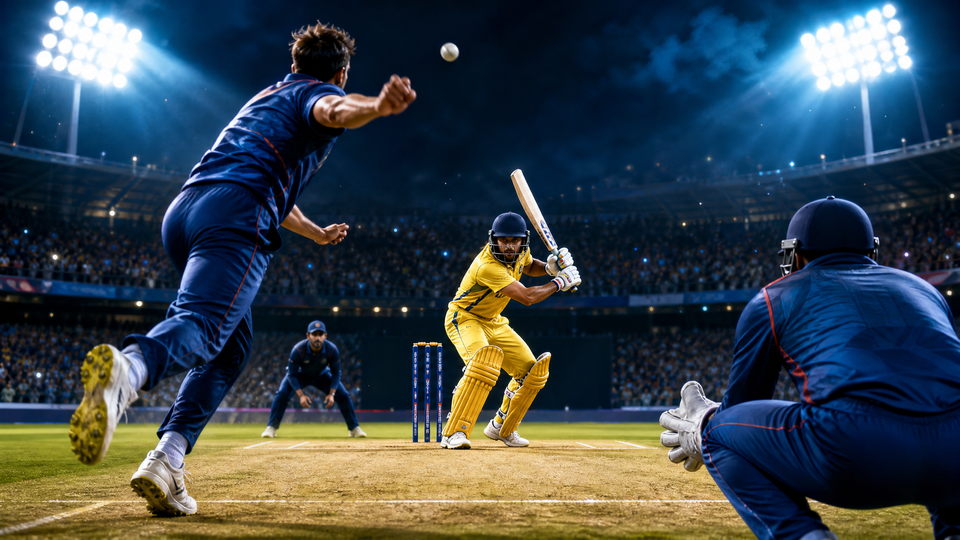
What you need
1 match-condition cricket ball, 2 complete sets of stumps, 6 flat cones or marker discs, spare balls, scoreboard or scoring app
1. Overview
A death-overs plan is not a collection of clever deliveries. It is a shared decision between the captain, bowler, wicketkeeper and fielders: one ball, one target, one field that protects the most likely miss. This resource gives a right-arm fast bowler three linked options against a right-handed batter: the straight yorker, the wide yorker and the slower-ball bouncer. Use it from over 16 onward in T20 cricket, or in the final 10 overs of a 50-over innings, when the batting side is hunting boundaries and your field must be set before the bowler begins the run-up.
The 22-yard pitch is only the delivery corridor. The real coaching task is to make eleven players defend an oval together. The diagrams assume a five-outside-the-circle death-over setting; always check your competition’s local playing conditions and fielding restrictions before play. The laws describe a wicket as three stumps and two bails and the pitch as 22 yards long, so use the crease and stumps as fixed, visible reference points in every practice.1
2. Setup
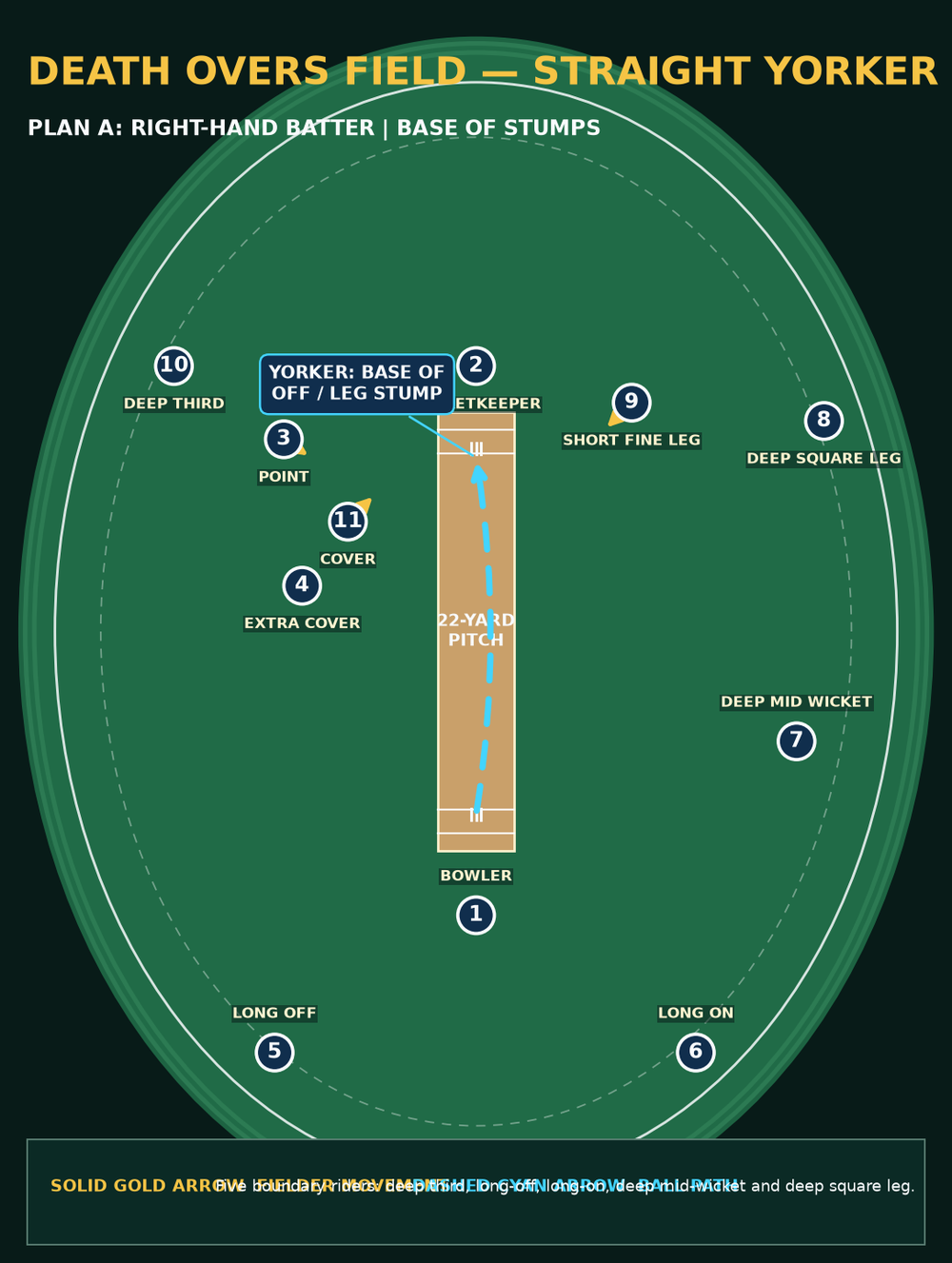
Set two full sets of stumps on a standard 22-yard pitch. Use one new or match-condition ball, six flat cones or marker discs, and a spare set of balls behind the bowler’s arm. On the oval, mark a practical inner circle at roughly 27–30 metres and a boundary line appropriate to your venue. Place a boot, flat marker or rubber cone at the base of off stump, base of leg stump and just inside the wide guideline. These targets turn vague instruction such as ‘nail it’ into an observable outcome.
| Number | Role | Coach’s starting responsibility |
|---|---|---|
| 1 | Bowler | Confirm ball type, line and missed-length plan before starting the run-up. |
| 2 | Wicketkeeper | Repeat the target, check leg-side/off-side boundary protection and own the final field call. |
| 3–7 | Boundary riders | Start one step inside the rope, square to the likely hitting arc and move on release, not after contact. |
| 8–11 | Ring fielders | Be balanced, walk in as the bowler loads, and attack the first 5–10 metres after a block or mis-hit. |
Run this set play with 11 players whenever possible. In a net, keep the bowler, wicketkeeper, batter and four target fielders live; represent unavailable fielders with cones and insist the active players call their names before each ball.
3. Step-by-Step Instructions
Plan A — Straight Yorker: close the straight boundary
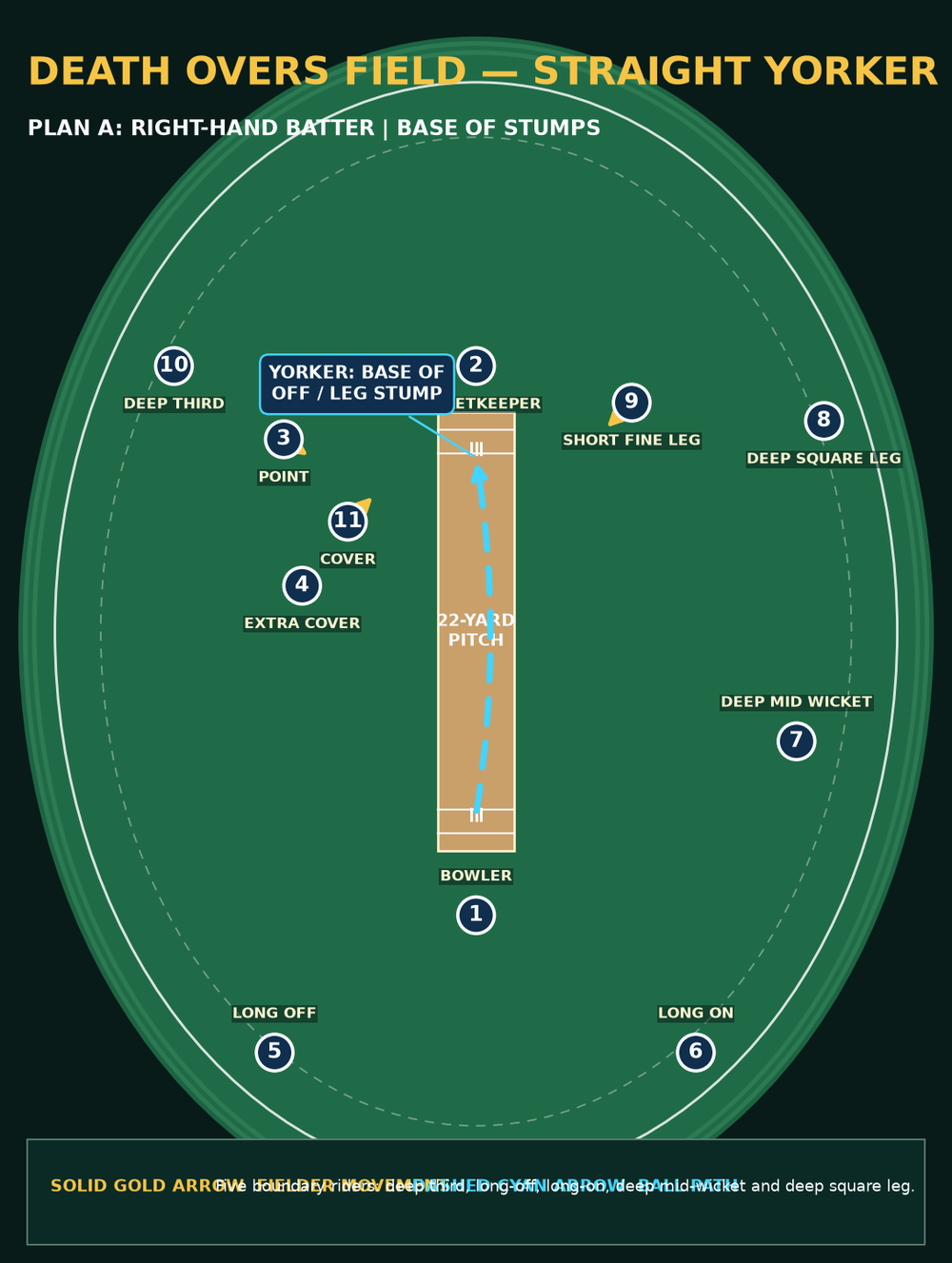
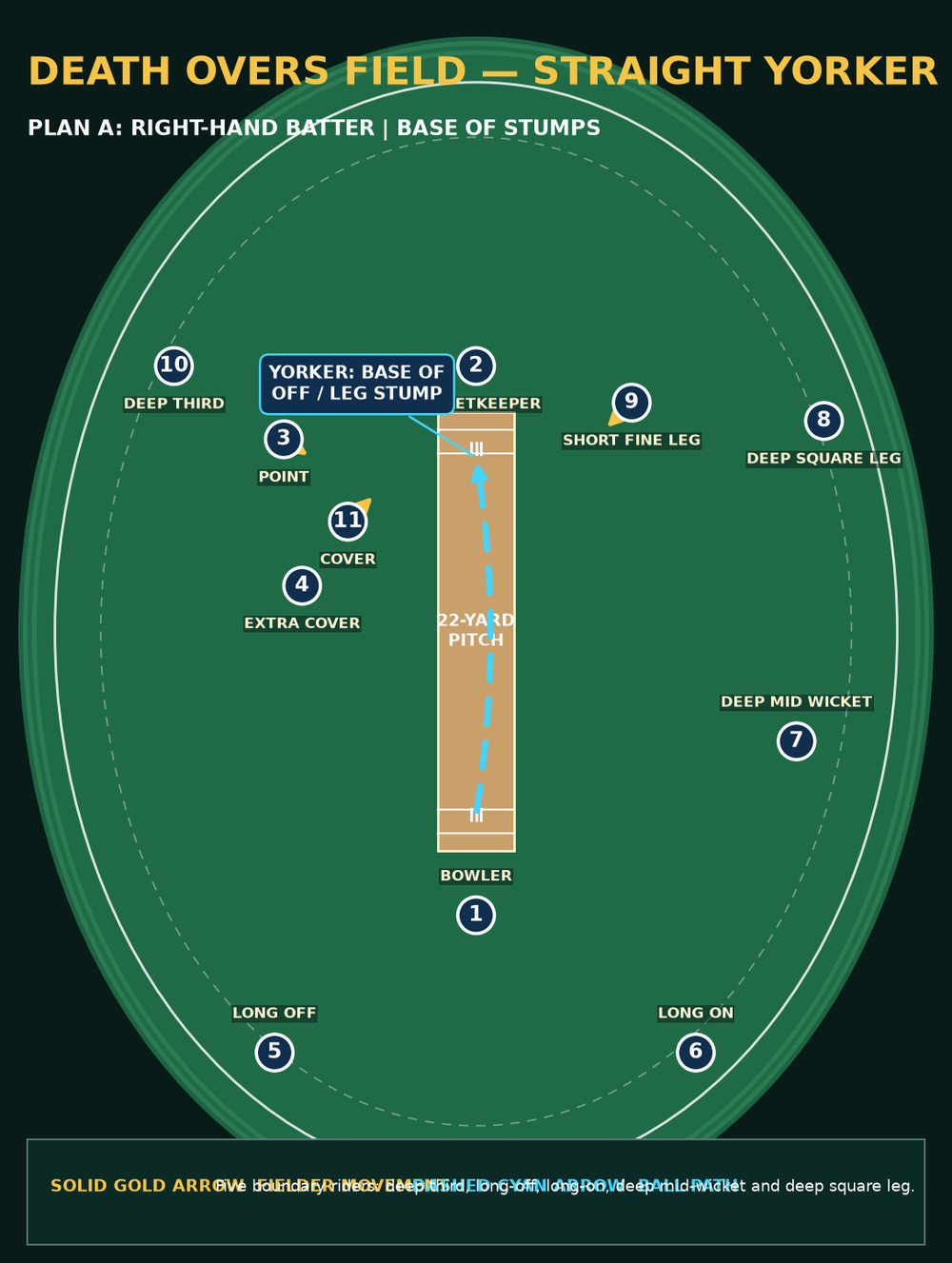
- Call the plan before the bowler turns. Captain or keeper says, ‘Straight yorker, base of off; five out: deep third, long-off, long-on, deep mid-wicket and deep square.’ The bowler repeats the target. This takes less than five seconds and removes guesswork.
- Set the field. Put 3 at Point, 4 at Extra Cover, 5 at Long Off, 6 at Long On, 7 at Deep Mid Wicket, 8 at Deep Square Leg, 9 at Short Fine Leg, 10 at Deep Third and 11 at Cover. Long-off and long-on protect the straight miss; the two leg-side riders protect the clipped or pick-up shot.
- Give the bowler one physical cue. For a right-arm bowler, use a tall front side and let the bowling hand travel down the line of the front thigh. The desired landing point is 0–30 cm from the popping crease, at the base of off or leg stump.
- Synchronise movement. As the bowler enters the final two strides, Point, Cover and Short Fine Leg take two controlled steps in. Boundary riders hold depth until release, then move forward on a ground ball or across the line of the strike on a mis-hit.
- Review the miss. If the ball is a low full toss, keep the straight riders deep and correct the release point. If it becomes a half-volley, do not bowl it again immediately; reset with the wide-yorker plan.
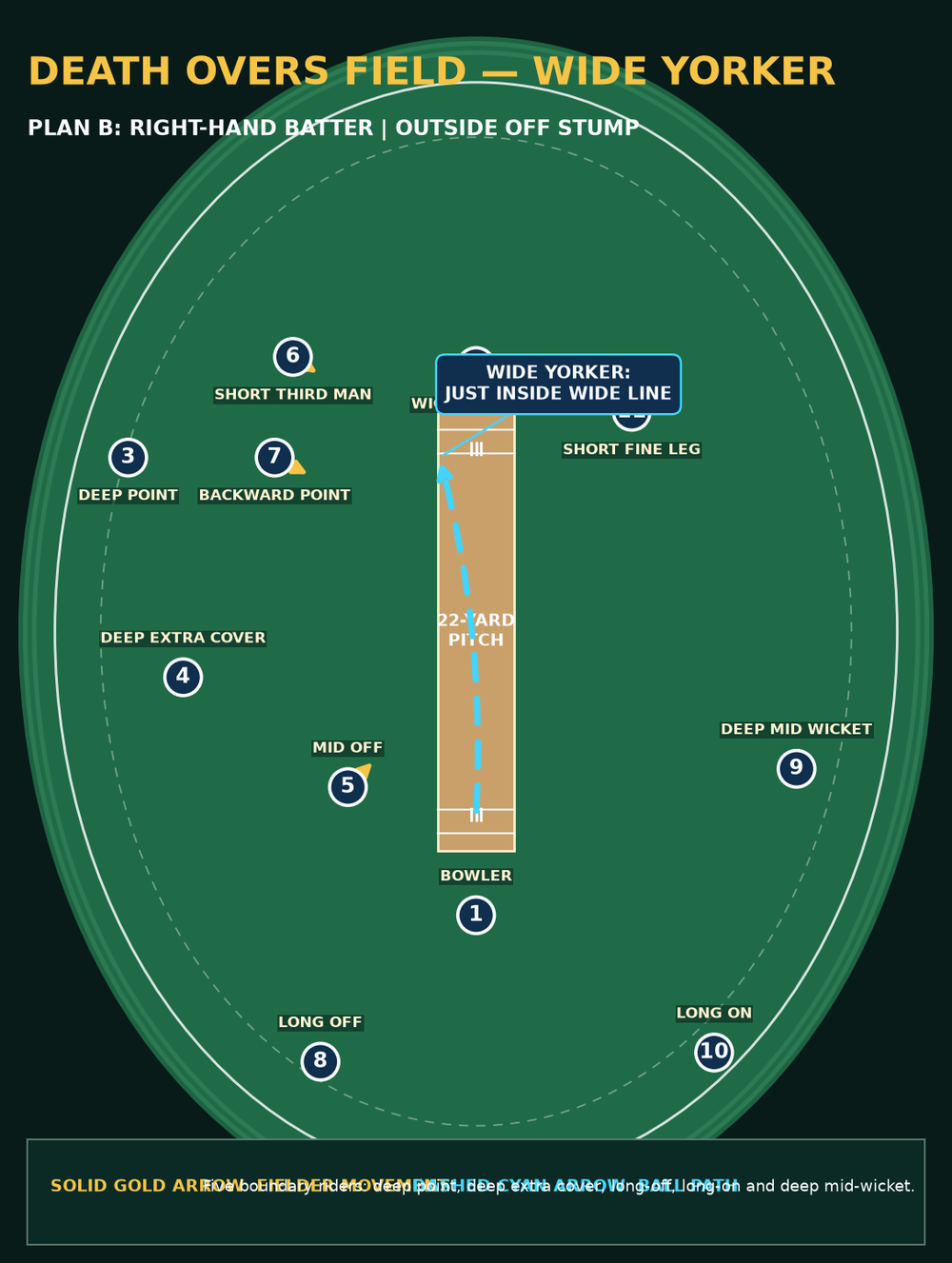
Plan B — Wide Yorker: remove the hitting arc through the line
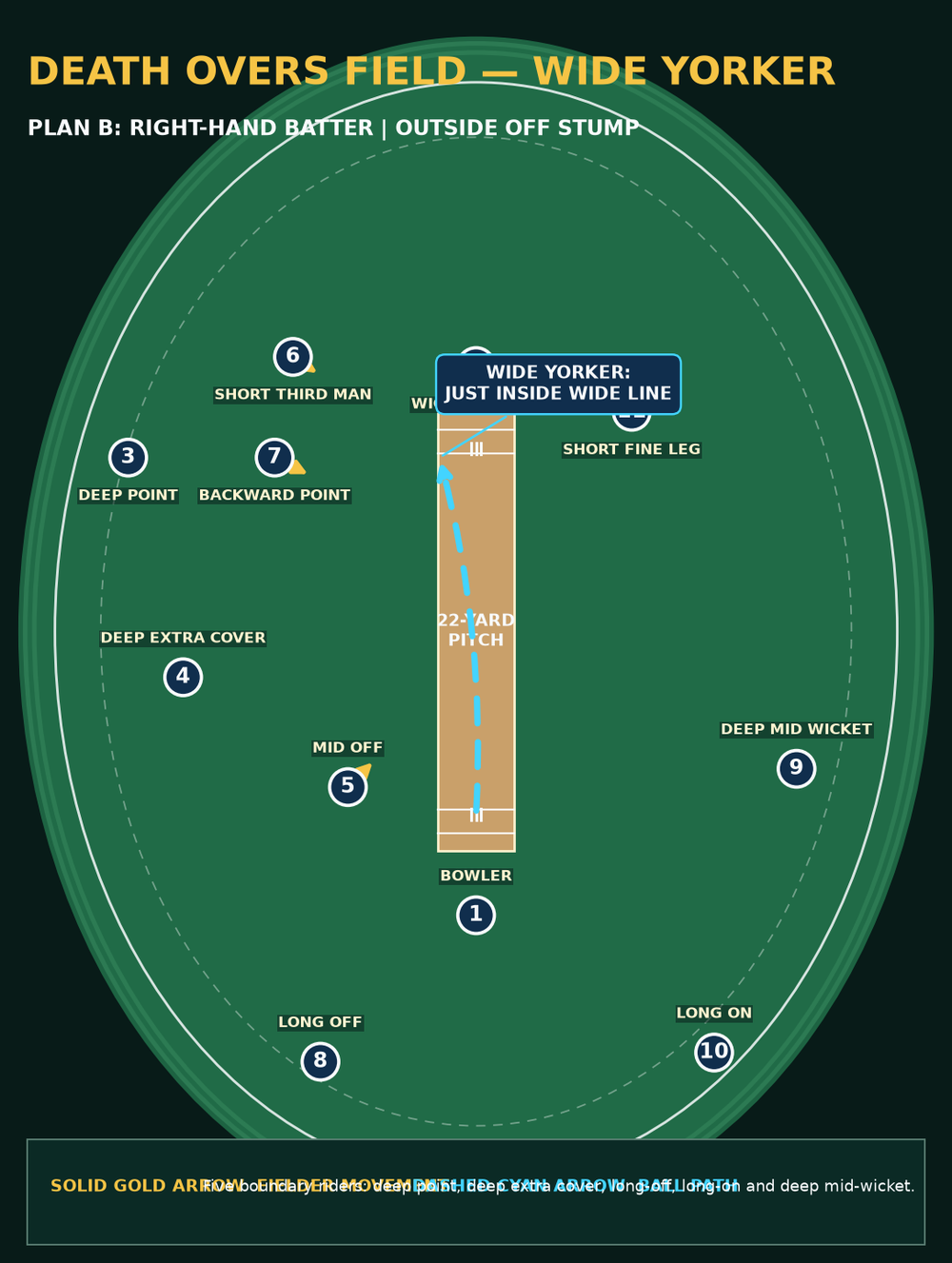
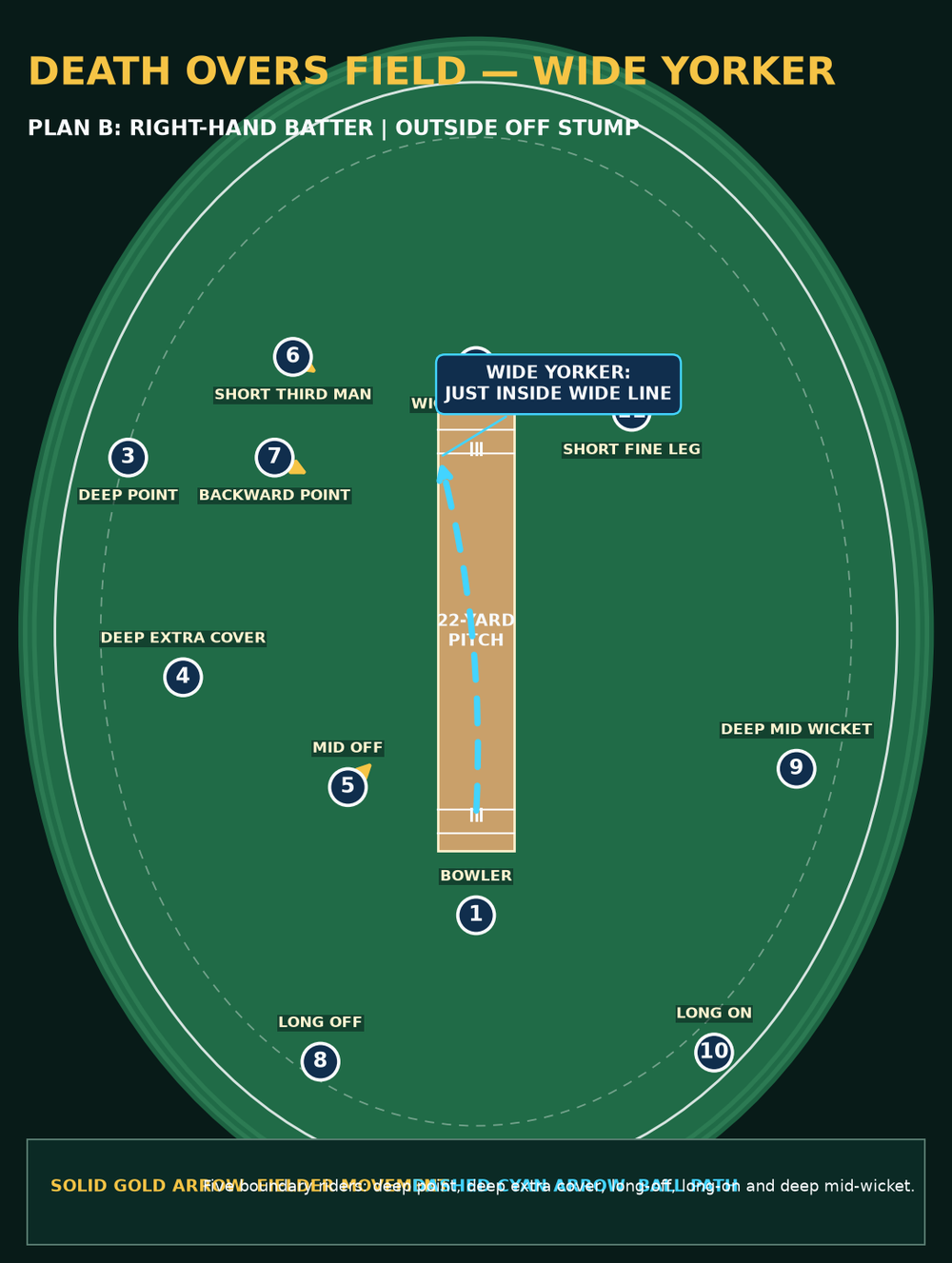
- Declare the off-side plan. The keeper calls, ‘Wide yorker, just inside wide; protect the slice.’ Ensure 3 Deep Point, 4 Deep Extra Cover, 8 Long Off, 9 Deep Mid Wicket and 10 Long On are the five boundary riders.
- Build the support field. Place 5 at Mid Off, 6 at Short Third Man, 7 at Backward Point and 11 at Short Fine Leg. The three off-side ring players are not spectators; they are there for the guided edge, toe-ended squeeze and miscued cut.
- Aim at a legal corridor. The ball should pitch yorker-full outside off stump but inside the wide guideline. Get the bowler to select a target no wider than one bat width outside the tramline; a ball too wide gifts an extra and breaks pressure.
- Coach the release shape. Keep the run-up unchanged, but angle the front foot and shoulder only enough to access the outside-off line. The wrist should stay behind the ball so the bowler does not drag a slower ball onto a hittable length.
- Close the ball. Deep Point and Deep Extra Cover move early only after release. Short Third Man attacks the edge; the keeper decides whether a single is worth giving up. The bowler must turn, back up and be ready for a return throw at either end.
Plan C — Slower-Ball Bouncer: make the batter supply the power
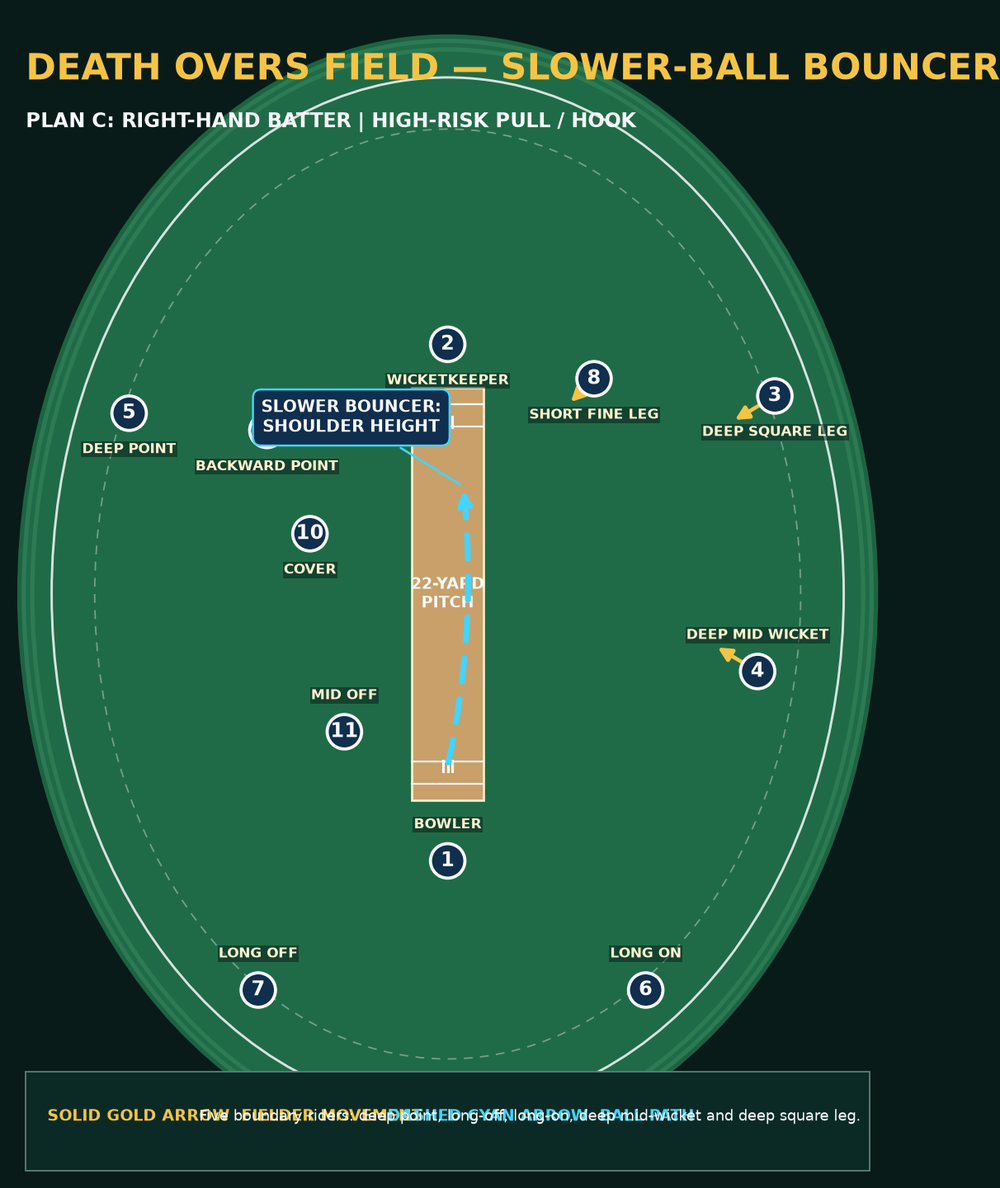
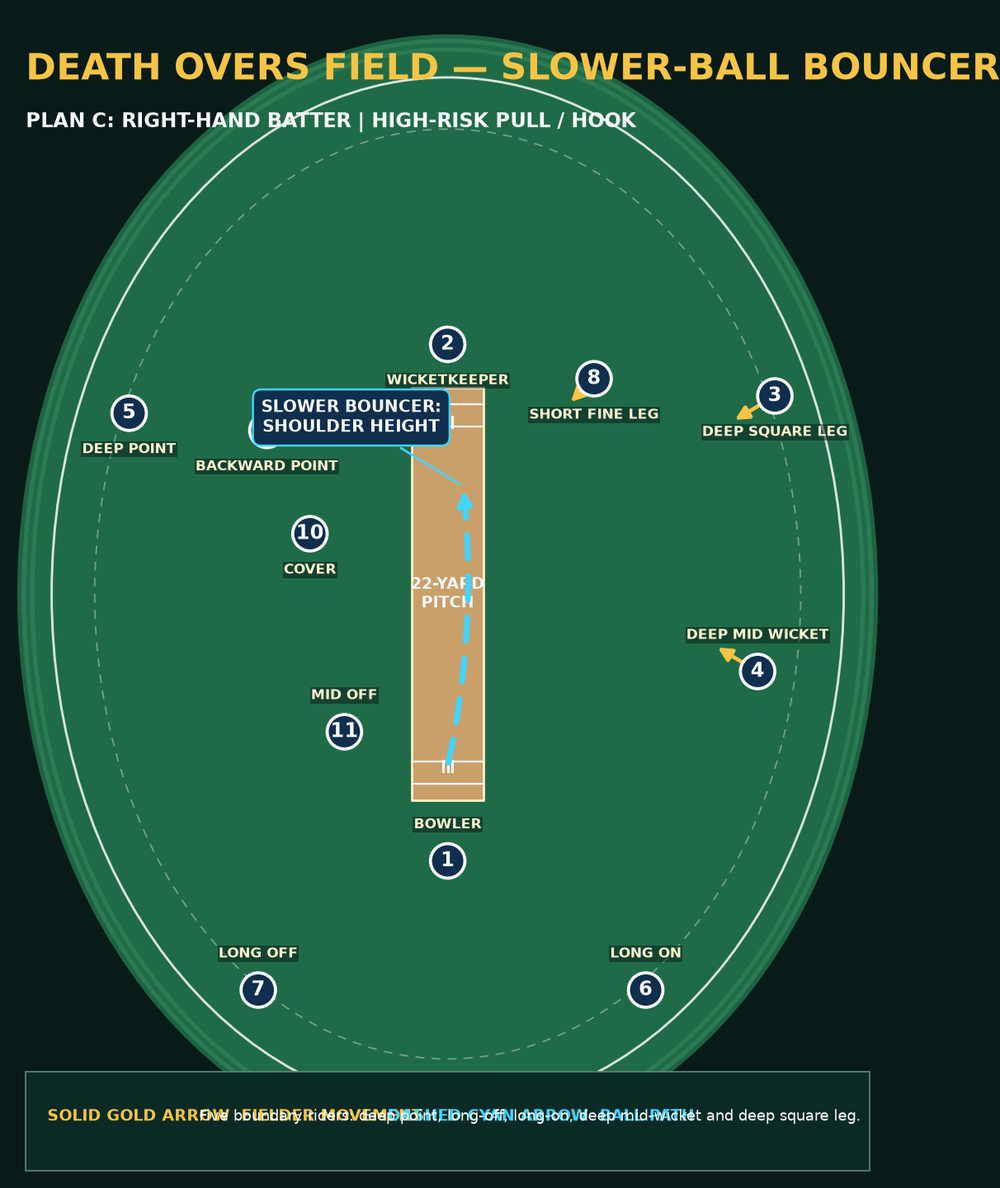
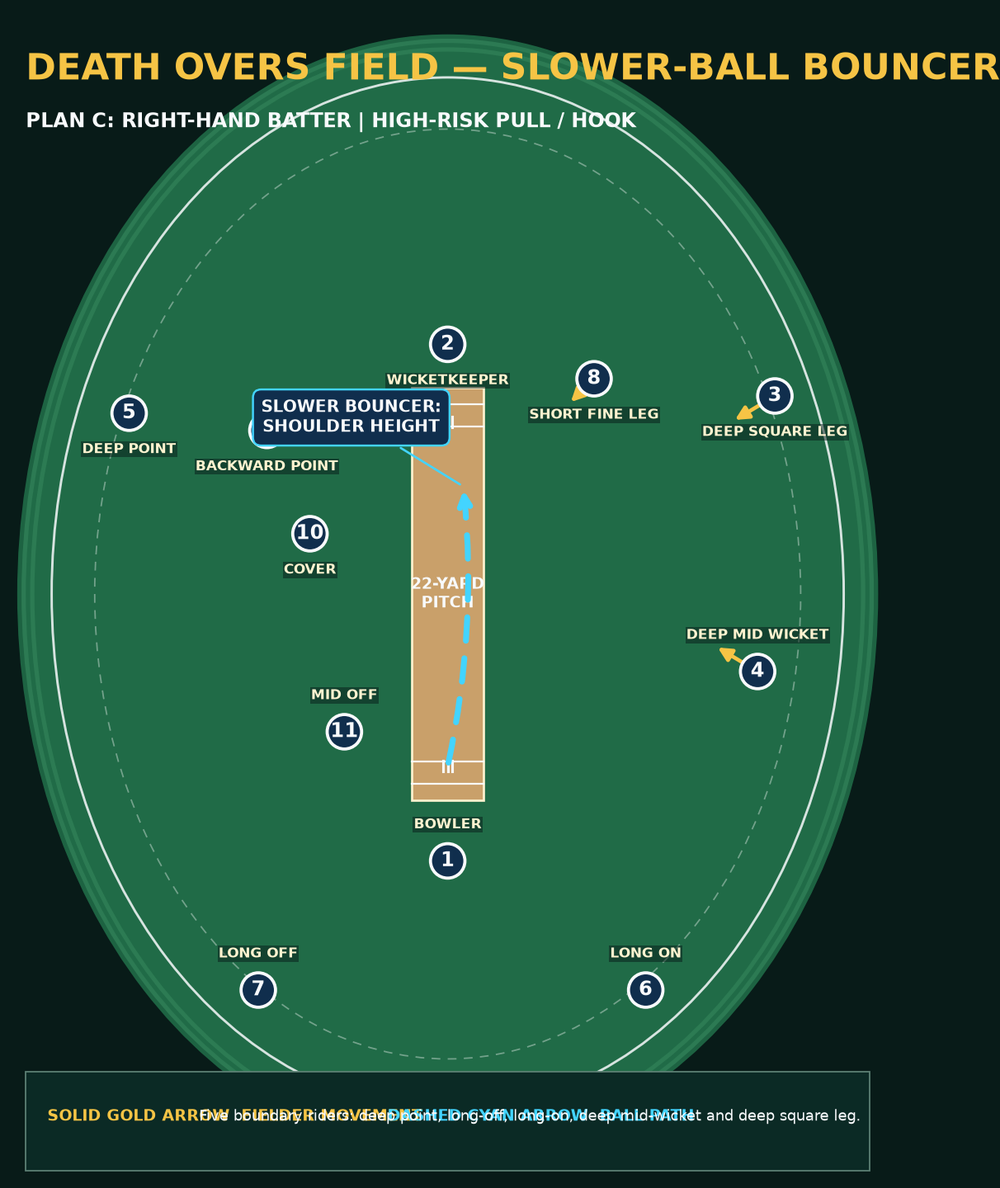
- Use this as a surprise, not an automatic variation. Call it after the batter has shown a strong front-foot swing, opened their stance or moved early for a yorker. The keeper confirms the height rule in your competition and checks the leg-side riders are ready.
- Set the catching map. Put 3 at Deep Square Leg, 4 at Deep Mid Wicket, 5 at Deep Point, 6 at Long On and 7 at Long Off. Keep 8 Short Fine Leg, 9 Backward Point, 10 Cover and 11 Mid Off inside. This places five boundary riders where the most forceful mishits travel.
- Deliver from the same run-up. Use an off-cutter or back-of-the-hand grip only if the bowler can retain normal arm speed. Land the ball roughly 6–8 metres from the batter, around shoulder height after the bounce; the goal is a checked pull, top edge or mistimed hook, not a waist-high full toss.
- Coach the take. Deep Square Leg and Deep Mid Wicket start still, watch the ball from hand and move in on the slower trajectory. They must call loudly, keep hands soft above eye line and accept that the safest outcome may be one run rather than a diving stop.
- Follow with a contrast ball. If the slower bouncer succeeds or the batter is late, return to the straight yorker. If the batter stays deep in the crease, use the wide yorker. The value is in changing the batter’s decision time.
4. Key Coaching Points
- Own the target before the run-up. A bowler who changes their mind in the last three steps commonly produces a half-volley. Demand a verbal target and a clear missed-length response.
- Make the field honest. Never place fielders because a diagram looks balanced. Every fielder must be able to answer: ‘What shot am I protecting, and where do I move when the ball is released?’
- Practice at match tempo. Bowl in blocks of six with a 20–25 second clock from the end of the previous ball. Death skill is technique plus time pressure, not technique in isolation.
- Use the keeper as the plan leader. The wicketkeeper sees the batter’s movement, can protect a young bowler from overthinking and is best placed to reset the message after a boundary.
- Protect the bowler’s confidence. Judge execution before outcome. A nailed wide yorker that is squeezed for one is a win; a poorly executed yorker that happens to hit a fielder is not.
- Train the return. After every strike, the bowler covers the non-striker’s end and the nearest ring fielder attacks the ball. Late-innings run-outs often come from this second action.
5. Common Mistakes
| Error | What the coach sees | Immediate correction |
|---|---|---|
| Yorker becomes a half-volley | Batter drives on the up or clears long-off. | Move the target 20 cm nearer the bowler for the next repetition; rehearse the release beside a cone. |
| Wide yorker becomes a wide | Keeper has to dive; pressure disappears. | Narrow the bowler’s visual target to one bat width outside off and reduce the side-on angle. |
| Field contradicts the plan | Boundary follows a correct ball into an unprotected zone. | Stop play, name the intended scoring shot, and move the relevant rider before the next ball. |
| Slower ball is telegraphed | Batter waits, then hits with control. | Rehearse the same run-up, arm speed and non-bowling-arm action as the stock ball. |
| Fielders react after contact | Easy second run or boundary from a mishit. | Use a ‘release call’ drill: all fielders take their first movement as the ball leaves the hand. |
6. Variations & Progressions
Begin with a closed-skill target circuit: each bowler delivers six balls at the three marked targets, earning two points for the planned zone, one point for a safe miss and minus one for a no-ball, wide or half-volley. Progress to a live 12-ball scenario: defend 18 runs with one set batter, a scorekeeper and the full field. The captain may choose only one field change per over, forcing better pre-ball planning. For advanced groups, add a batter-movement read: the batter may shuffle across, back away or premeditate a scoop, and the bowler must call their selected plan before beginning the run-up.
Useful variations are the slower yorker after two hard yorkers, the back-of-the-hand slower bouncer after a wide-yorker field has been shown, and an off-stump yorker with Deep Third moved squarer when the batter is deliberately opening the face. Change only one factor at a time in training: line, pace or field—not all three.
7. Age Adaptations
For Under 10 and Under 12 players, use a shortened run-up and one plan only: a straight, full ball at the base of the stumps. Work with five to seven players, cones for deep fielders and praise process over pace. For Under 14, introduce the wide-yorker target once bowlers can land four of six straight yorkers within one metre of the crease. Keep bouncers within local junior safety rules and teach the field map without forcing a complex disguised slower ball. For Under 16 and open-age groups, run all three plans under a clock, with the wicketkeeper leading calls and bowlers adapting to batter movement. At every age, finish with one question: ‘What did our field make the batter do?’ If players can answer that, the set play is becoming match-ready.
