Cricket
The 10-Run Defense: A Three-Ball Death Overs Cluster
A structured three-ball set play that removes improvisation, stabilizes the field, and forces batters into high-risk shots during the final overs.

What you need
1 match ball, Boundary markers, Target cones (for practice)
The 10-Run Defense: A Three-Ball Death Overs Cluster
Defending a tight total in the final overs is one of the hardest challenges in modern cricket. The "10-Run Defense" is a structured three-ball sequence designed to remove improvisation from the bowler, stabilize the field, and force the batter to take high-risk options. Instead of reacting emotionally to every shot, the captain and bowler commit to a pre-called sequence.
1. Overview
When to use it:
Deploy this set play during the final three overs of a limited-overs match (T20 or One-Day) when defending a low target, typically 10 to 15 runs per over.
What it achieves:
This sequence limits the batter's ability to predict length while keeping the field largely static. By grouping deliveries into a three-ball cluster, the bowler focuses purely on execution rather than second-guessing the field. It protects the short straight boundaries and forces the batter to hit square or over the longer boundaries.
2. Setup
Equipment Needed:
- 1 match ball (white ball for limited overs)
- Standard 22-yard (20.12 m) pitch and oval boundary markers
- Target cones (for practice sessions)
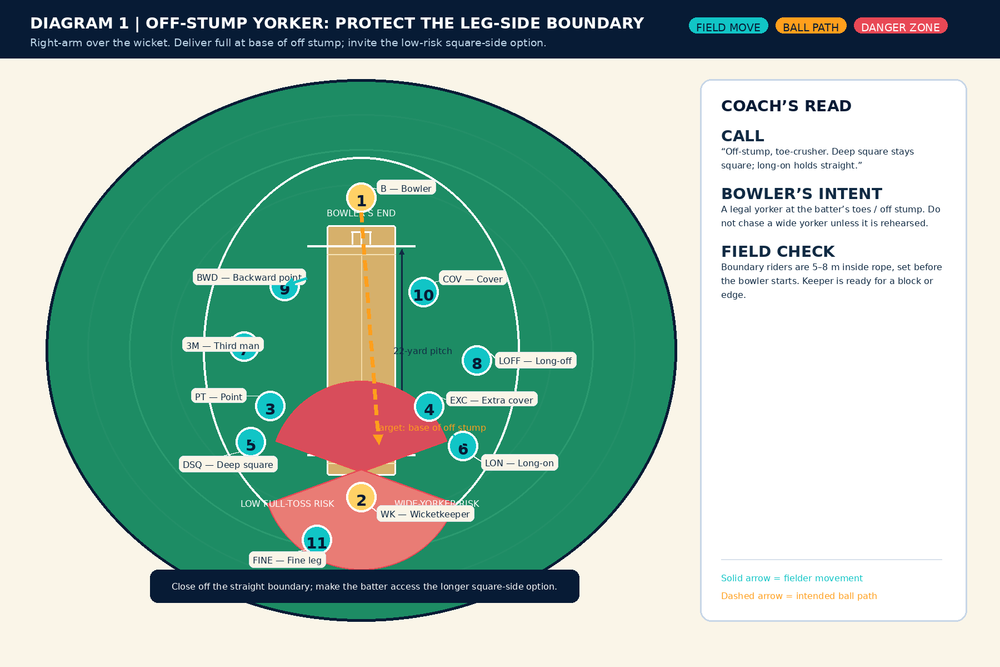
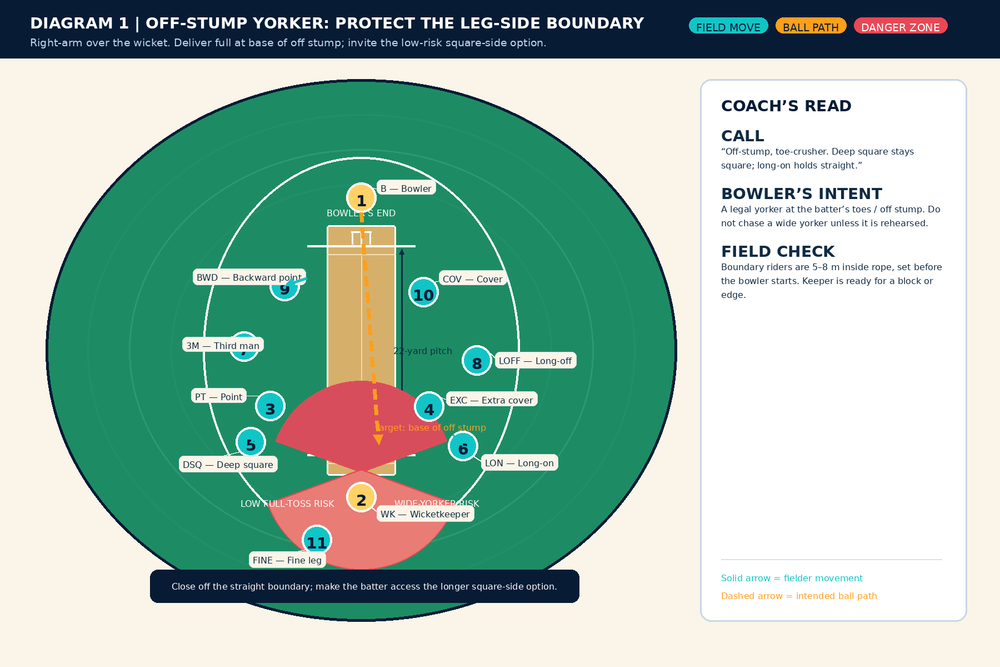
Base Field Setup (Right-Arm Fast, Over the Wicket): The pitch is 22 yards (20.12 m) long under MCC Law 6.1 Use the following numbered positions so the captain, bowler, and fielders share the same language.
| No. | Position | Starting instruction |
|---|---|---|
| 1 | Bowler | Over the wicket; align run-up to attack off stump. |
| 2 | Wicketkeeper | Stand back; own the block, edge, and inside nick. |
| 3–5 | Point, Deep Square Leg, Third Man | Point saves one; both boundary riders protect the square release. |
| 6–8 | Long-on, Long-off, Deep Midwicket | Hold the straight and deep leg-side arcs, 5–8 m inside the rope. |
| 9–11 | Backward Point, Cover, Mid-off / Fine Leg | Tight inner-ring singles and reinforce the named boundary zones. |
Note: Ensure boundary riders are stationed 5 to 8 meters inside the rope before the bowler starts their run-up. This allows them to step back as the ball is delivered, maintaining forward momentum.
3. Step-by-Step Instructions
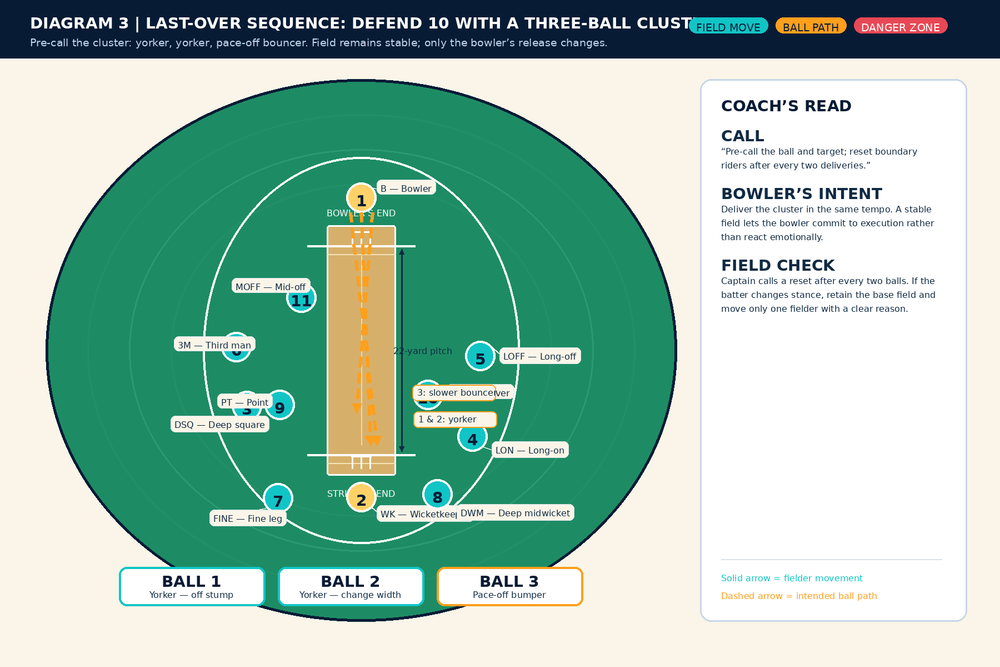
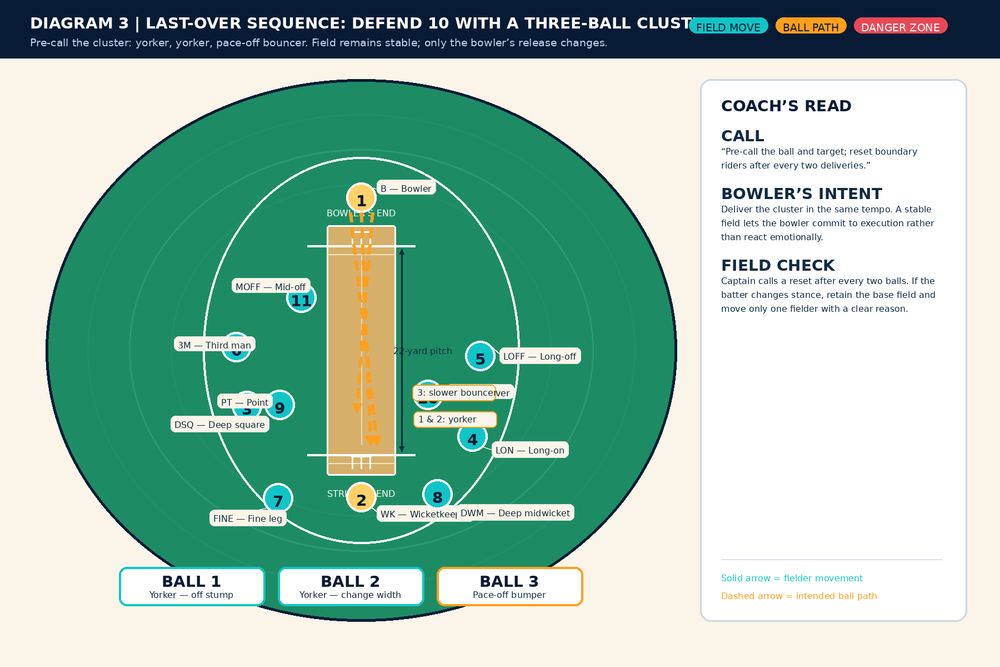
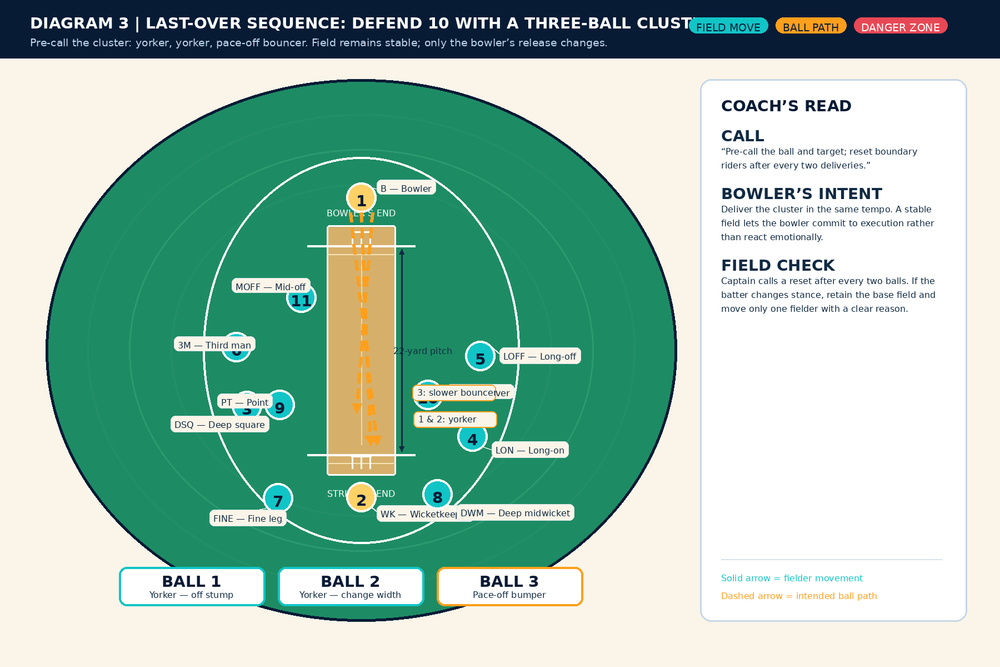
The set play relies on a strict three-ball sequence: two yorkers followed by a pace-off bouncer.
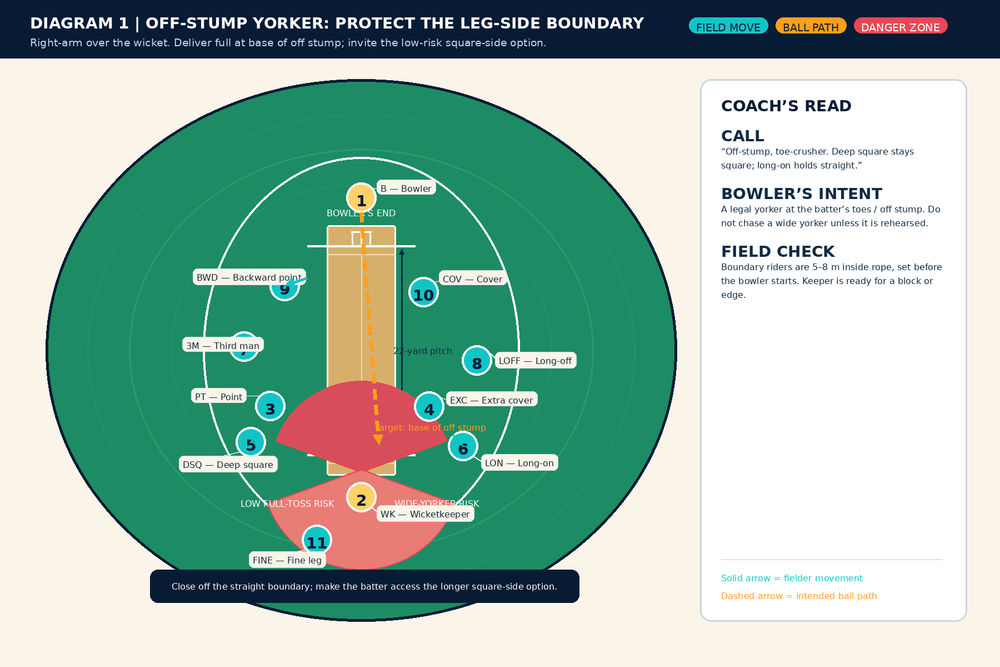
Ball 1: The Off-Stump Yorker
The goal of the first delivery is to deny elevation and close off the straight boundary.
- The Field: Set the base field. Ensure Long-on and Long-off are straight. Deep Square Leg stays square to cover the sweep or mis-hit.
- The Delivery: The bowler targets the base of off stump. Do not chase a wide yorker unless the batter backs away early.
- The Outcome: A successful execution results in a dot ball or a jammed single into the covers.

Ball 2: The Yorker Width Variation
The batter will expect a change in length. You will deny them by repeating the length but subtly changing the line.
- The Field: Maintain the exact same field. Do not move a fielder unless the batter drastically changed their stance on Ball 1.
- The Delivery: The bowler delivers another yorker, this time aiming at the toes or middle stump.
- The Outcome: The batter, expecting a slower ball or bouncer, is often caught deep in their crease, resulting in a cramped shot.
Ball 3: The Pace-Off Bumper
Having seen two full deliveries, the batter’s weight is forward. It is time to change the length and pace.
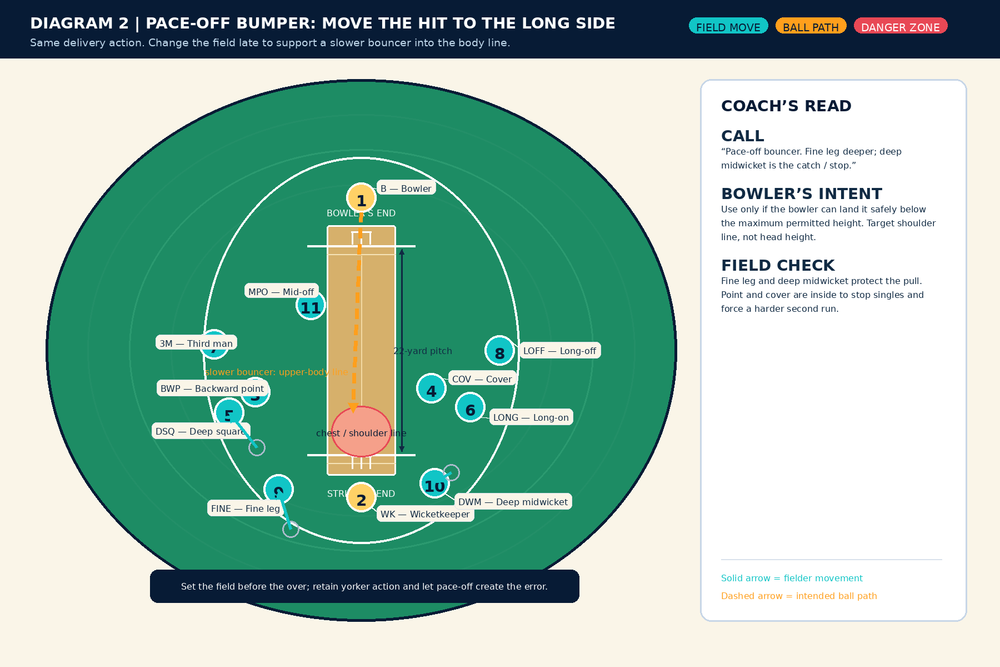
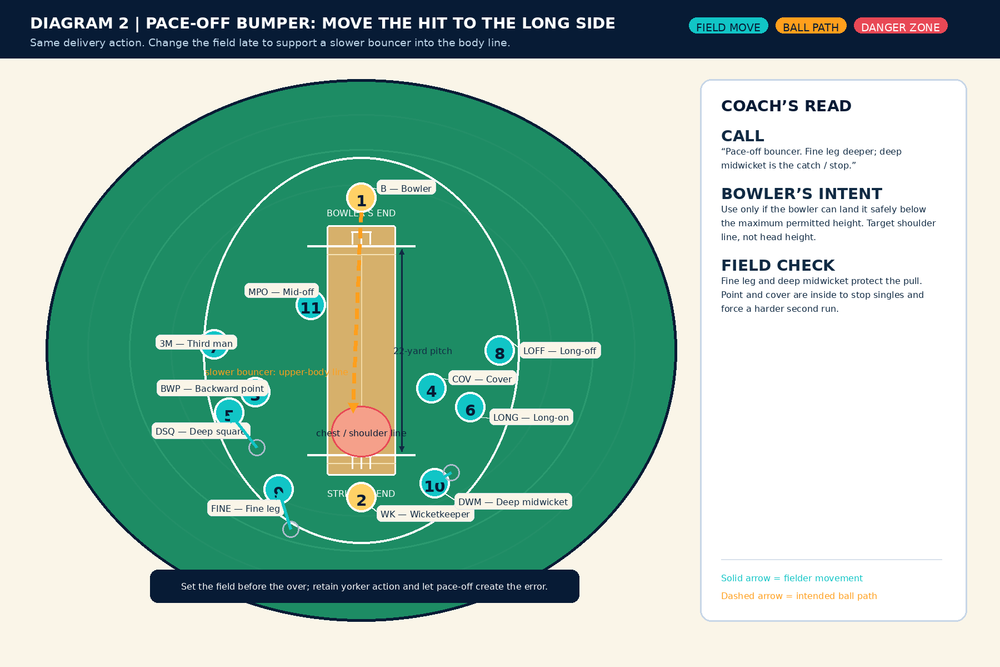
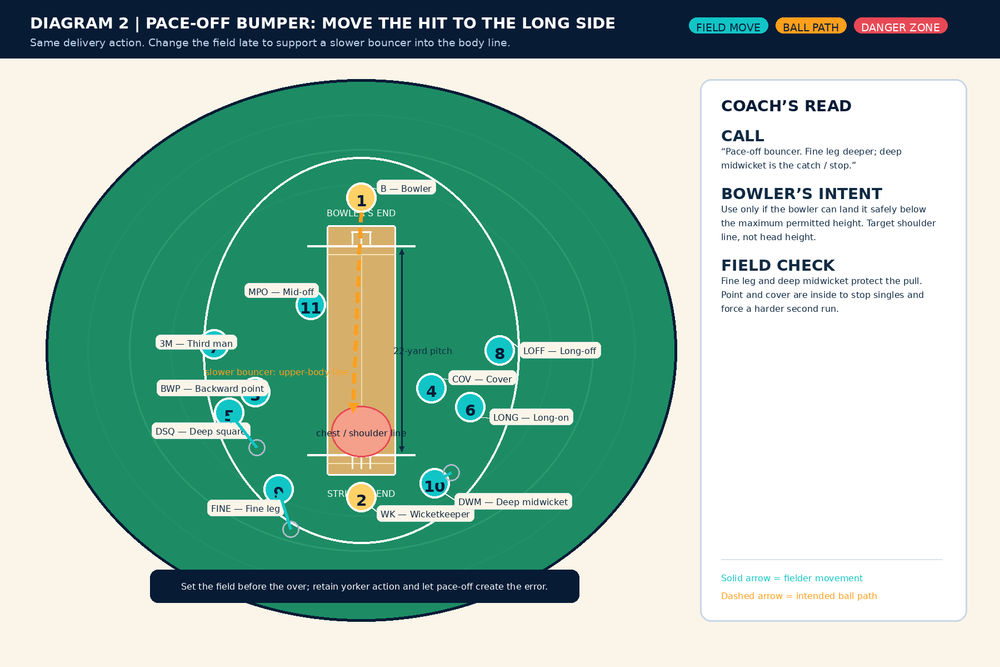
- The Field Move: The captain signals a subtle shift. Fine Leg drops deeper. Deep Midwicket becomes the primary catch/stop position. Point and Cover step slightly tighter to save the single.
- The Delivery: Using the exact same arm speed, the bowler delivers a slower bouncer (e.g., an off-cutter or back-of-the-hand slower ball) targeting the batter's chest or shoulder line.
- The Outcome: The batter is forced to play a pull shot with no pace on the ball, often resulting in a mistimed catch to Deep Midwicket or Deep Square. Keep the height safe and within the match playing conditions: MCC Law 41 treats short-pitched deliveries as dangerous when their speed, length, height, and direction create a likely injury risk, and repeated deliveries over a standing batter’s head may be unfair.2
The Reset
After the third ball, the captain calls a reset. The cluster is complete. Assess the required run rate and decide whether to repeat the sequence or shift to wide yorkers.
4. Key Coaching Points
- Commit to the Cluster: The bowler must bowl the three balls as a unit. Do not abandon the plan if Ball 1 goes for a boundary.
- Action Fidelity: The slower bouncer must be bowled with identical arm speed to the yorker. If the arm slows down, a high-quality batter will read the change in pace.
- Boundary Positioning: Fielders must not start on the rope. Starting 5 meters in allows them to attack the ball or step back safely.
- Clear Communication: The captain and bowler must explicitly name the delivery and target before the over begins. (e.g., "Off-stump, toe-crusher. Deep square stays square.")
5. Common Mistakes
- Chasing the Wide Yorker: Bowlers often miss their line when trying to bowl too wide, resulting in a wide or a full toss easily carved over point. Stick to the off-stump line.
- Fidgeting with the Field: Moving a fielder after every ball signals panic to the batter and disrupts the bowler's rhythm.
- Bowling the Bouncer Too High: A slower bouncer that floats above head height is an easy wide call. The target is the shoulder/chest line.
6. Variations & Progressions
- The Wide Yorker Shift: If the batter consistently steps to the leg side to open up the off side, shift the line to a wide yorker and move Third Man to Deep Backward Point.
- The Spin Variation: For a spinner, replace the pace-off bouncer with a darted arm ball at the pads, maintaining the same field structure.
7. Age Adaptations
- Under 8s / Under 10s: Use a shortened run-up and a softer ball. Make the set play one delivery only: an underarm or controlled overarm target ball at the base of the stumps, with five fielders in safe, simple positions.
- Under 12s / Under 14s: Focus entirely on the off-stump yorker. Remove the slower bouncer from the sequence to avoid dangerous high full tosses. Practice hitting a target cone at the base of the stumps.
- Under 16s: Introduce the pace-off delivery, but allow a back-of-a-length slower ball rather than a bouncer until the bowler has reliable height control.
- Open / Senior: Execute the full three-ball sequence with strict field placements, legal short-pitched bowling, and precise pace variations.
References