

Cricket
Cricket Ground Fielding and One-Touch Pick-up Drill
A practical, high-repetition fielding drill that teaches players to attack a rolling ball, secure the pick-up, and return it accurately under time pressure.

What you need
10–14 cricket balls, Incrediballs or tennis balls, 16–20 flat cones, 2 sets of stumps or 6 stump cones, 2–3 training bibs, Stopwatch or phone timer, Optional wicketkeeping gloves and catching mitt
Ground Fielding and One-Touch Pick-up Drill
Overview
This is a high-repetition ground-fielding drill for teaching players to read a rolling ball early, attack it on the correct line, secure it with a long barrier or clean one-touch pick-up, and return it accurately to the wicketkeeper or a nominated stump. Use it early in a fielding block to establish safe body shapes, then revisit it before limited-overs cricket when every saved run and direct-hit chance matters. The drill deliberately joins movement, handling and throwing; players do not simply collect a stationary ball and pose.
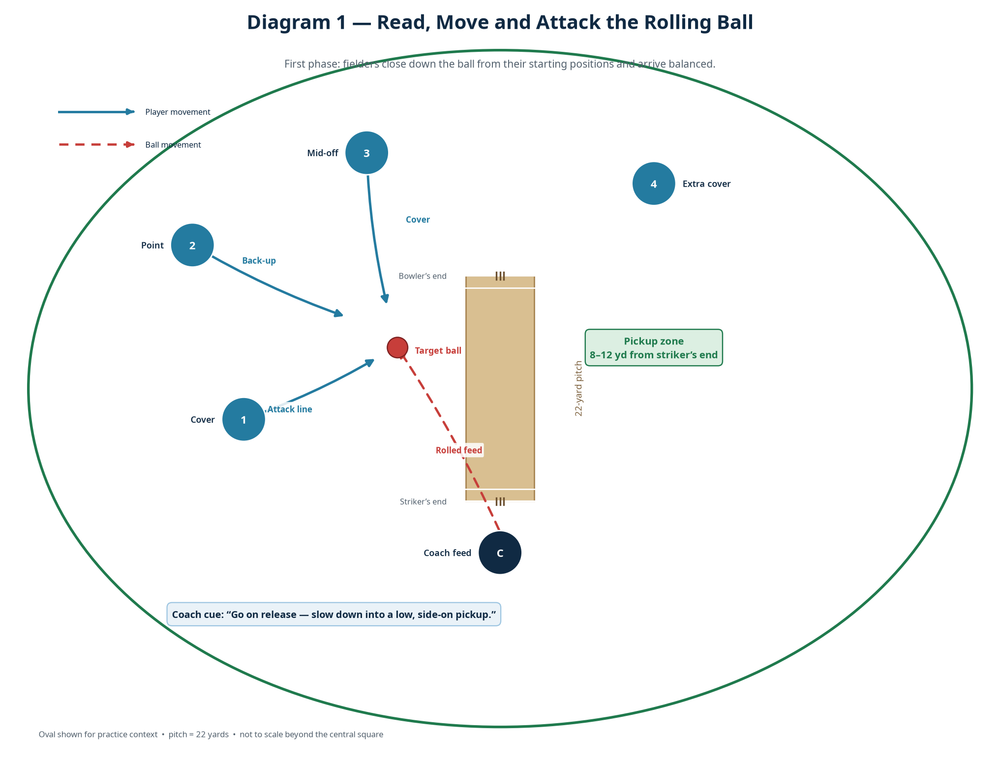
The full 22-yard pitch is retained so players see a genuine cricket picture: a ball fed from the striker’s-end area travels into cover, point, extra cover or mid-off, and the return is made toward the wicketkeeper. Under Law 6.1, the standard pitch is 22 yards (20.12 m) long, which makes it a reliable anchor for a realistic setup.1
Session outcome: By the end of the block, each fielder should be able to close down a rolling ball, get their head and hands behind it, complete one controlled transfer, and release an accurate return without losing balance.
What the coach is training
| Phase | Desired player behaviour | Coach’s observable standard |
|---|---|---|
| Read and move | Reacts as the ball leaves the feeder’s hand and takes the shortest safe line. | The fielder arrives under control, rather than running past the ball. |
| Gather | Uses long barrier when the ball is travelling quickly; uses a one-touch pick-up only when balance allows. | Head is over the ball and the non-picking leg protects the channel behind it. |
| Return | Transfers once, sets the throwing side, and throws through the target. | Ball reaches the keeper’s glove side or hits the target stump. |
Setup
Mark a 22-yard pitch with two sets of stumps, or use cones to show each end. Place the wicketkeeper at the striker’s end and position the coach or feeder 4–6 yards behind the striker’s-end stumps. Put a line of four to six fielders at cover, approximately 18–25 yards from the striker’s-end wicket and 10–15 yards off the off side. Set a 3-yard-wide pickup gate with two flat cones 8–12 yards from the striker’s-end stumps. The coach rolls every feed through that gate.
Use six players as the minimum: feeder, wicketkeeper, active fielder, two back-up fielders and one rotating player. Eight is ideal. Use 10–14 balls, 16–20 flat cones, two stump sets, bibs and a stopwatch. Begin with tennis balls or Incrediballs for younger players; move to regulation balls when technique is reliable. Allocate 25 minutes: 4 minutes demonstration, 8 minutes technical repetitions, 8 minutes return-to-target challenge and 5 minutes competitive rotation.
Step-by-Step Instructions
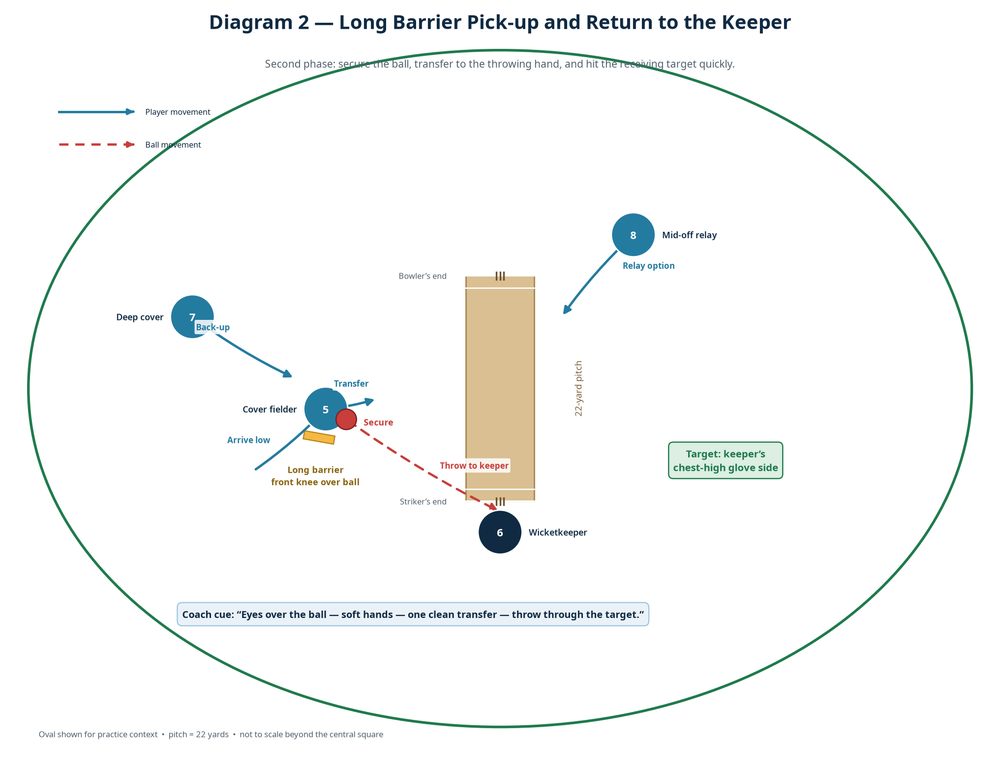
Demonstrate the finish first. Put the active fielder in the cover position. Show one controlled long barrier: approach quickly, shorten the final two steps, turn the body slightly side-on, lower the hips, place the front foot beside the ball and bring the picking hand down behind it. The opposite knee and shin create the barrier. Finish with the throwing shoulder pointing at the wicketkeeper.
Start with a predictable rolled feed. On the call “ready,” the feeder rolls the ball from just behind the striker’s-end stumps into the pickup gate. The fielder moves on the release, not after the ball has passed them. Insist on a low approach and a deceleration step 1–2 yards before the ball.
Secure before speeding up. For the first six balls, the fielder must use the long barrier and pause for half a second after the gather. This gives the coach time to check head position, hand shape and the barrier leg. A clean stop is worth more than a fast miss.
Add the one-touch pick-up. Once the barrier is secure, allow a one-touch pick-up where the ball is rolling slowly and the player is balanced. The player scoops with the fingers down, gathers the ball into the throwing hand in one action, then takes one recovery step toward the target. If the ball is misread, the player must revert to the barrier rather than gambling on a flashy pick-up.
Return to a live target. The wicketkeeper gives a clear target at chest height on the glove side. The fielder makes one transfer only and throws through the target. For senior groups, reward a direct hit on the striker’s-end stumps; for developing groups, count a catchable return inside a 1.5-metre target lane.
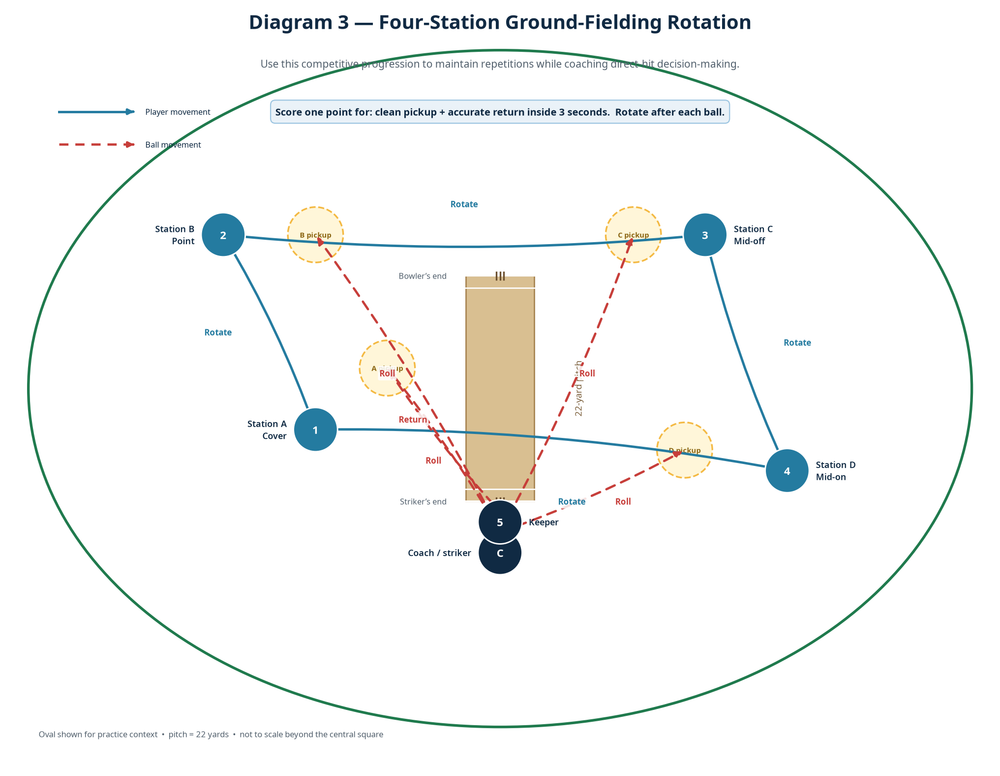
Build communication and back-up. The nearest support fielder calls “mine” only if taking responsibility; the next player moves behind the active fielder by 3–5 yards as back-up. After the return, the active fielder follows their throw, joins the next station, and the next player is set before the feeder releases the next ball.
Run the timed challenge. Use three sets of six balls. Start the clock when the ball leaves the feeder’s hand and stop it when the keeper catches it or the stumps are hit. Award one point for a clean first gather, one for an accurate return and one bonus point for completion inside 3.0 seconds. Any ball that goes through the fielder scores zero; this protects technique from reckless pace.
Key Coaching Points
| Coaching point | Language to use on the ground | Why it matters |
|---|---|---|
| Approach under control | “Fast early, small late.” | The final short steps allow the hands to meet the ball rather than stab at it. |
| Head over the ball | “Get your nose behind the seam.” | The eyes track the bounce and the body creates protection behind the gather. |
| Build a long barrier | “Front foot beside it; knee closes the gate.” | A miss is contained instead of becoming an extra run. |
| Give soft hands | “Receive the ball, don’t punch it.” | Relaxed fingers cushion the ball and prevent a fumble forward. |
| Transfer once | “Gather, show, throw.” | Extra transfers make a run-out chance disappear. |
| Throw through the target | “Chest to target; finish down the line.” | The fielder has a repeatable release rather than an off-balance flick. |
Common Mistakes
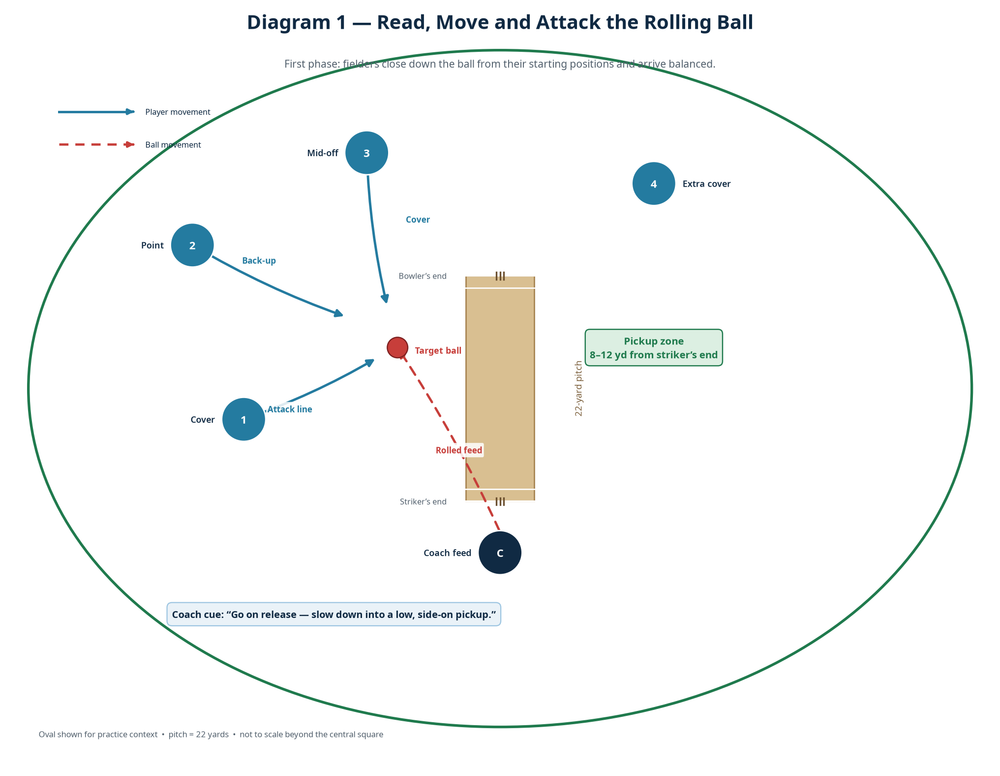
The most common error is over-running the ball. Players sprint hard until the last stride, their hips rise, and they reach across the body. Correct it by moving the pickup gate one yard closer and requiring the player to call “small steps” before the gather. A second error is allowing the ball to travel between the feet. Rehearse the long barrier without a ball and check that the front foot is beside—not behind—the line of the ball.
Watch also for players scooping with a stiff, upward palm. This usually lifts the ball into the chest or past the shoulder. Ask for fingers down and a soft receiving action. Finally, do not tolerate a hurried, side-arm throw when the player has time to set. Freeze the player after the gather: front shoulder, hips and throwing arm should be directed toward the wicketkeeper before release.
Variations & Progressions
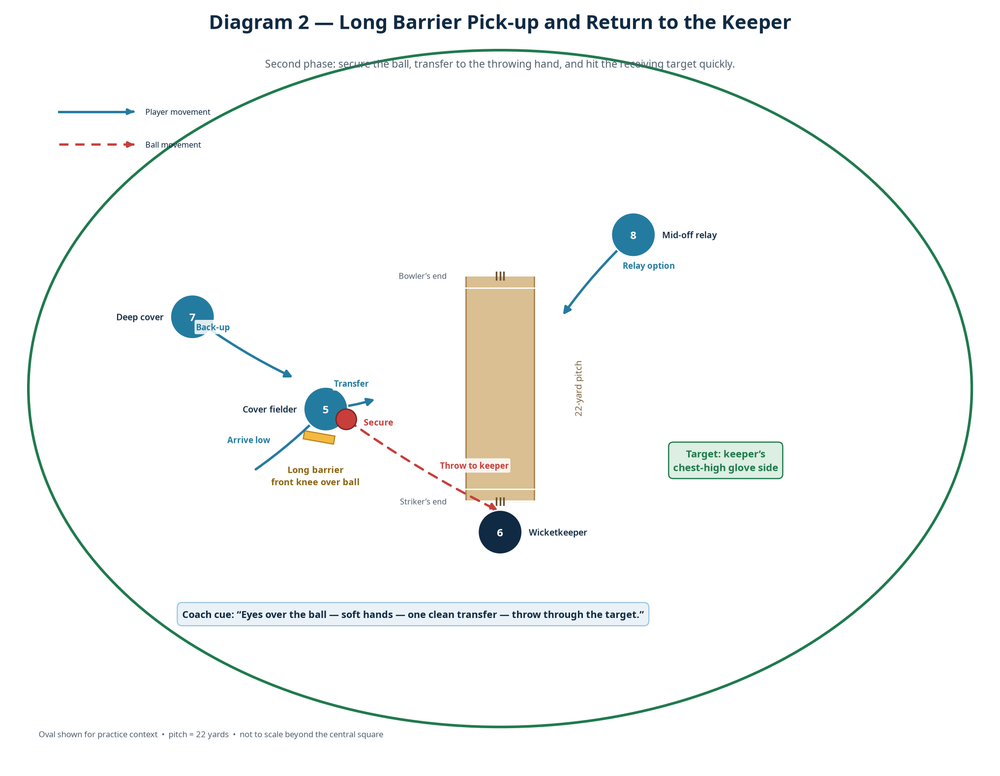
Easier: stationary-to-rolling ladder. Start with a stationary ball in the pickup gate, then roll it slowly, then add a slight angle. This works well when introducing long barrier mechanics or when players are anxious around a harder ball.
Harder: random feed and decision call. Feed left, right or straight at random, with the fielder beginning 5 yards deeper. Call “keeper” or “bowler” as the ball is released so the fielder must choose the target and turn the correct way after pickup.
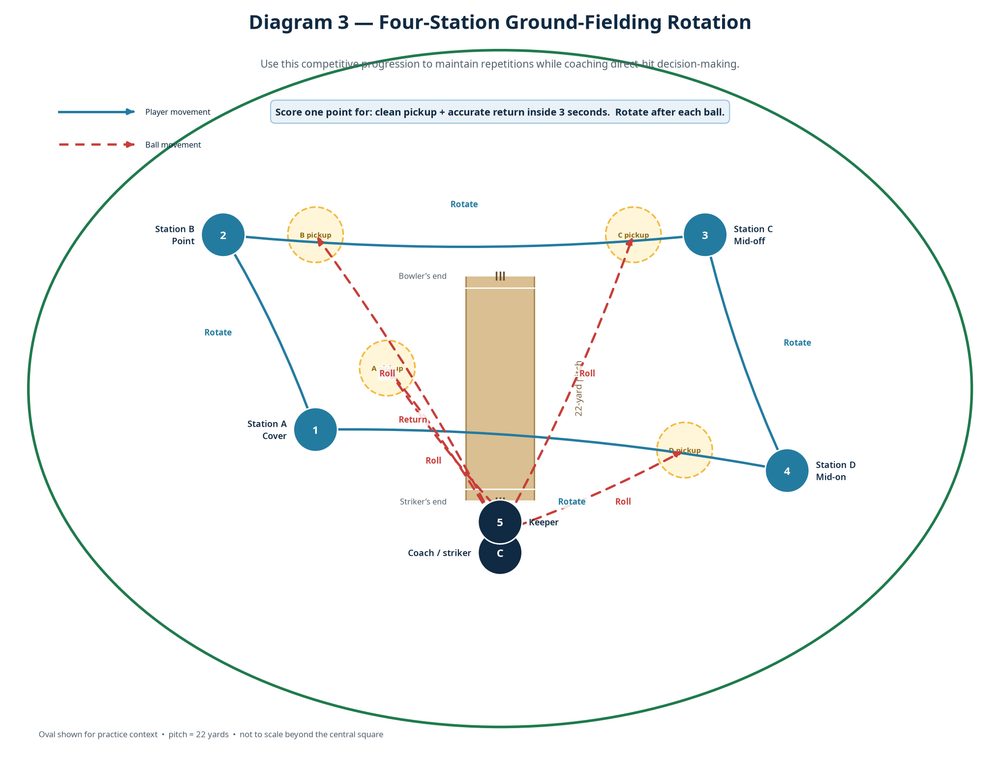
Match-like: relay and direct-hit contest. Add mid-off as a relay 12–15 yards from the bowler’s-end stumps. The active fielder must decide whether the direct return is on or whether the relay is safer. Score two points for a direct hit, one for a clean relay, and deduct one for an overthrow.
Age Adaptations
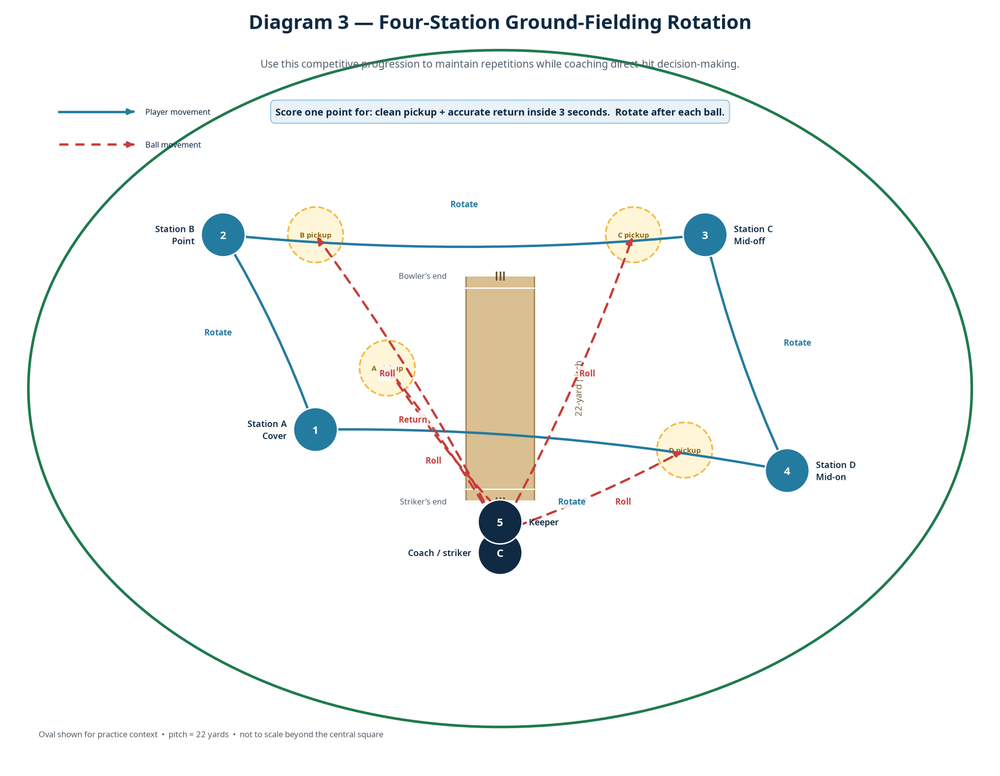
For Under 8s, use soft balls, make the pickup gate 4 yards wide, shorten the feed to 5–8 yards and praise stopping the ball before throwing. Keep rotations short: four balls each, then swap. For Under 10s and Under 12s, retain the 22-yard-pitch picture but reduce the target to a coach with a large catching mitt or cone gate; introduce the one-touch pick-up only after a secure barrier is consistent.
For Under 14s and Under 16s, use regulation balls where appropriate, narrow the gate to 2–3 yards and time the complete action. Add a live runner from the non-striker’s end so the return has a genuine purpose. For open-age or advanced players, demand target selection, a stronger throwing line and immediate recovery after the release. At every level, stop the drill when quality drops: crisp, coached repetitions beat a long queue of tired fumbles.
Coach’s Finish
Bring the group in for a 30-second review. Ask: “What got the ball back quickest—rushing the pickup, or arriving balanced?” Reinforce the answer: fielding speed begins with clean feet and finishes with a purposeful throw. Finish with one final six-ball team challenge, then carry the same standards into the next catching or throwing activity.
