

Cricket
Spin Bowling Variations: Six-Ball Deception Drill
Teach developing spinners to disguise an off-break, top-spinner and arm ball while using a close-catching field to turn pressure into wickets.

What you need
6 cricket balls, 8-10 cones, 1 set of stumps, wicketkeeping gloves, batting helmet, scorecard
Overview
This 20-minute, game-realistic drill teaches a finger spinner to make three deliveries look the same until release: the stock off-break, the top-spinner and the arm ball. The tactical aim is not simply to ‘bowl different balls’; it is to establish a repeatable stock-ball threat, read the batter’s response, then select a variation with a wicket-taking reason. It suits an Under-14 group and above, but the intent is transferable to any right-arm or left-arm finger spinner once the coach mirrors the field. Use one right-handed batter as the default picture; reverse the field and lines for a left-hander. The wicketkeeper and close catchers are active players, not props: every ball should have a plan, a target and a realistic chance.
The outcome is controlled deception. Bowlers should finish able to call their delivery before the run-up, land it in the intended zone, retain the same approach and arm speed, and explain what dismissal they are trying to create.
Setup
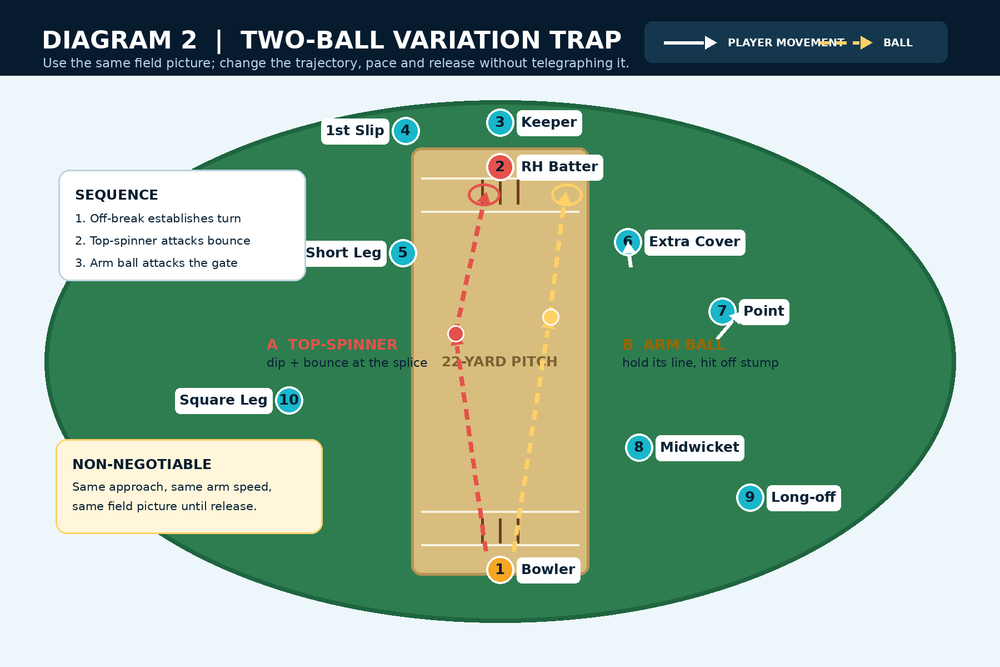
Mark a full 22-yard pitch on an oval or use a prepared wicket. Set 10 players as shown: 1 bowler, 2 right-hand batter, 3 wicketkeeper, 4 first slip, 5 short leg, 6 extra cover, 7 midwicket, 8 long-off, 9 point and 10 square leg. Place one flat cone on a good-length off-stump line and a second cone just outside off, 4–5 metres from the batter’s crease. Have six balls, stumps, 8–10 cones, gloves/helmet and a simple scorecard ready.

Brief the group on the visual language: solid arrows are fielder movement; dashed arrows are ball paths. The close catchers stand only as close as their age, equipment and confidence allow. The coach works from square of the wicket to see the bowler’s release, landing area and batter’s feet.
Step-by-Step Instructions
0:00–3:00 | Demonstrate and rehearse. Show the stock off-break first: fingers behind and slightly to the side of the seam, upright wrist, strong front side and a full follow-through towards the target. Then show the top-spinner: same approach and arm path, but the fingers roll more directly over the top so the ball dips and bounces. Finally show the arm ball: same action, but the seam and release allow it to hold its line rather than turn. Do not chase extra pace; chase a late, believable difference.
3:00–8:00 | Stock-ball calibration. The spinner bowls two sets of six. The first four balls in each set must be stock off-breaks pitched on or just outside off stump; the final two can be stock balls with a different loop. The batter plays normally but scores only by beating the infield. Award the bowler one point for landing in the target zone, two for a bat-pad, outside edge or bowled/LBW chance, and minus one for a ball that would be a wide or long hop. Keeper and slip call whether the ball carried as planned. Rotate the bowler after 12 balls.
8:00–14:00 | Build the six-ball sequence. The new bowler nominates a plan privately to the coach: balls 1–2 stock off-break, ball 3 top-spinner, ball 4 stock, ball 5 arm ball, ball 6 the variation dictated by the batter’s feet. The batter is encouraged to press forward to the stock ball, then decide whether to sweep, defend or use the crease. Fielders react only after release; short leg and extra cover use the small solid-arrow movements in Diagram 1 to sharpen the catching zone. Pause for 15 seconds after each six to ask: ‘What did the batter show us, and which ball will exploit it?’
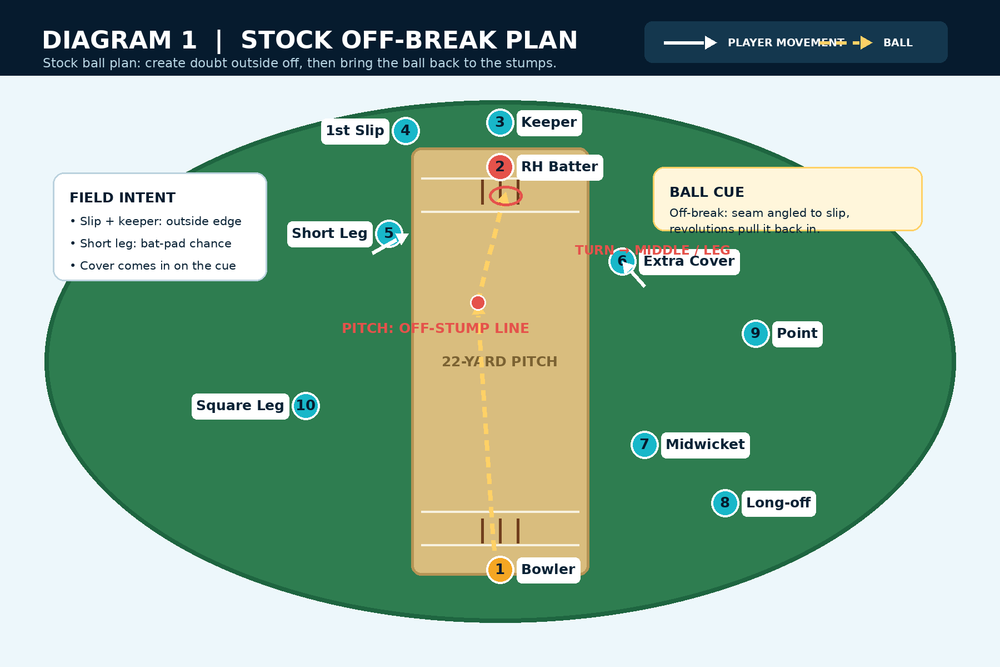
14:00–18:00 | Live pressure over. Play one scored over per bowler. The batter receives 12 balls maximum, then swaps with the next batter; keepers and close fielders rotate every over. The bowler earns a bonus point only when a variation follows a purposeful stock ball, not when it is used at random. If the batter advances early, the top-spinner can threaten the splice; if they play for turn, the arm ball attacks the gate or pads.
18:00–20:00 | Review and reset. Each spinner states their best stock-ball cue, their most convincing variation and one ball they will practise next. Finish with three shadow releases at the target, then collect equipment.
Key Coaching Points
- Match the pictures. Run-up tempo, gather, arm speed and finish should remain recognisably the same. A change in grip is acceptable; a visible change in action is a giveaway.
- Own the stock ball. The off-break must repeatedly threaten off stump before the arm ball has value. Coach a high release, a stable front knee and spin generated by fingers rather than a collapsing wrist.
- Vary flight before forcing pace. The top-spinner needs enough overspin to dip later and climb from a good length. Encourage a fuller, slower loop only when the field is ready for a mishit.
- Set a dismissal, not a trick. Slip and keeper hunt the outside edge; short leg hunts bat-pad; the arm ball targets the gate, front pad or lbw line. Name the dismissal before the ball.
Common Mistakes
- Telegraphing the variation: the bowler shortens the run-up, changes arm speed or looks at their grip. Reset the routine and use a single pre-delivery breath.
- Searching for massive turn: the ball is dragged short and becomes hittable. Reward a threatening off-stump length over dramatic sideways spin.
- Using the arm ball as a half-volley: the bowler pushes it faster without a target. Keep the same length cone and let seam, angle and disguise do the work.
Variations & Progressions
Start with a target-only challenge: no batter, but the wicketkeeper still calls carry and turn. Progress to a left-hand batter, reversing slip, short leg and the attacking line. For an advanced group, remove the bowler’s pre-call: the coach signals the variation after the bowler has started the run-up, requiring a calm late decision. Finally, give the batter a scoring reward for identifying the variation before it pitches; this tests how well the bowler disguises it.
Age Adaptations
Under-10: use a 16–18 yard pitch, soft ball and one variation only—the top-spinner after stock balls. Keep short leg at a safe distance and reward target hits rather than dismissals. Under-12: use a full or near-full pitch, introduce the arm ball from a standing start, and allow close catchers only with appropriate protection and confidence. Under-14 and older: use the full tactical field, live scoring and the six-ball selection sequence. For open-age players, add a planned over to a set batter and judge success by whether the sequence changes their footwork, not only by wickets.
