Cricket
Middle-Overs Bowling Change: The Two-Over Squeeze
A coach-ready two-over bowling-change set play that uses disciplined fourth-stump bowling, a moving inner ring, and boundary protection to turn middle-over singles into dot-ball pressure.

What you need
full set of stumps, 12–18 cricket balls, 10 flat cones, 30-yard-circle reference cones, coloured bibs, stopwatch, scorecard or whiteboard
Middle-Overs Bowling Change: The Two-Over Squeeze
1. Overview
Use this set play when the batting side has settled, is pinching comfortable singles, and is beginning to dictate the middle overs. The aim is not merely to “hold” an over. It is to use a pre-planned bowling change, a repeatable field, and decisive inner-ring movement to create 12 legal balls of accumulating pressure. The preferred outcome is a run-rate stall followed by a forced shot, not a speculative wicket ball every delivery.
This resource uses an off-spinner against a right-hand batter as the base picture, but it transfers to other bowlers once you alter the attacking side. The pitch is the standard 22-yard (20.12 m) playing surface 1. Where used, set the inner ring on or just inside the 30-yard circle.
Coach’s call: “Two overs, one message: protect the boundary, win the dot ball, make them hit through us.”
| Coaching outcome | What the batters feel | What the fielding side must deliver |
|---|---|---|
| Restrict singles | No easy release after a defensive shot | A close, balanced inner ring and a quick first three steps |
| Protect the release shot | The boundary is guarded rather than gifted | Two deliberate boundary riders in the batters’ strongest zones |
| Create a false option | A straight or inside-out hit looks available | A slower ball or change of angle with a catcher/rider ready |
2. Setup
Run this as a 24-minute, 11-a-side scenario: four minutes to brief, 16 minutes live, and four minutes to review. Use a full oval if possible; otherwise cone a 60–70 m boundary and retain the 22-yard pitch. You need stumps, 12–18 balls, 10 flat cones, a stopwatch, scorecard/whiteboard, and coloured bibs.
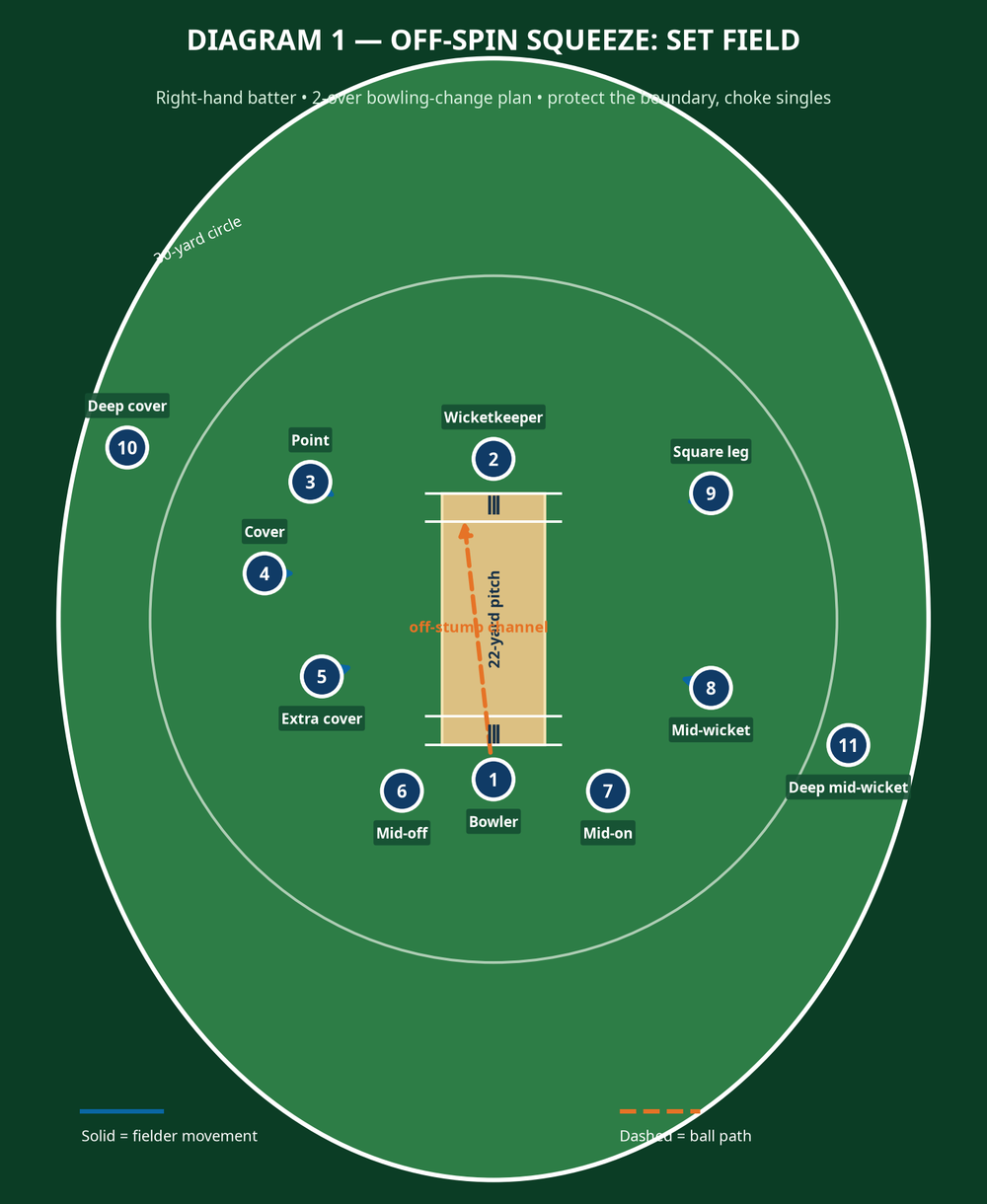
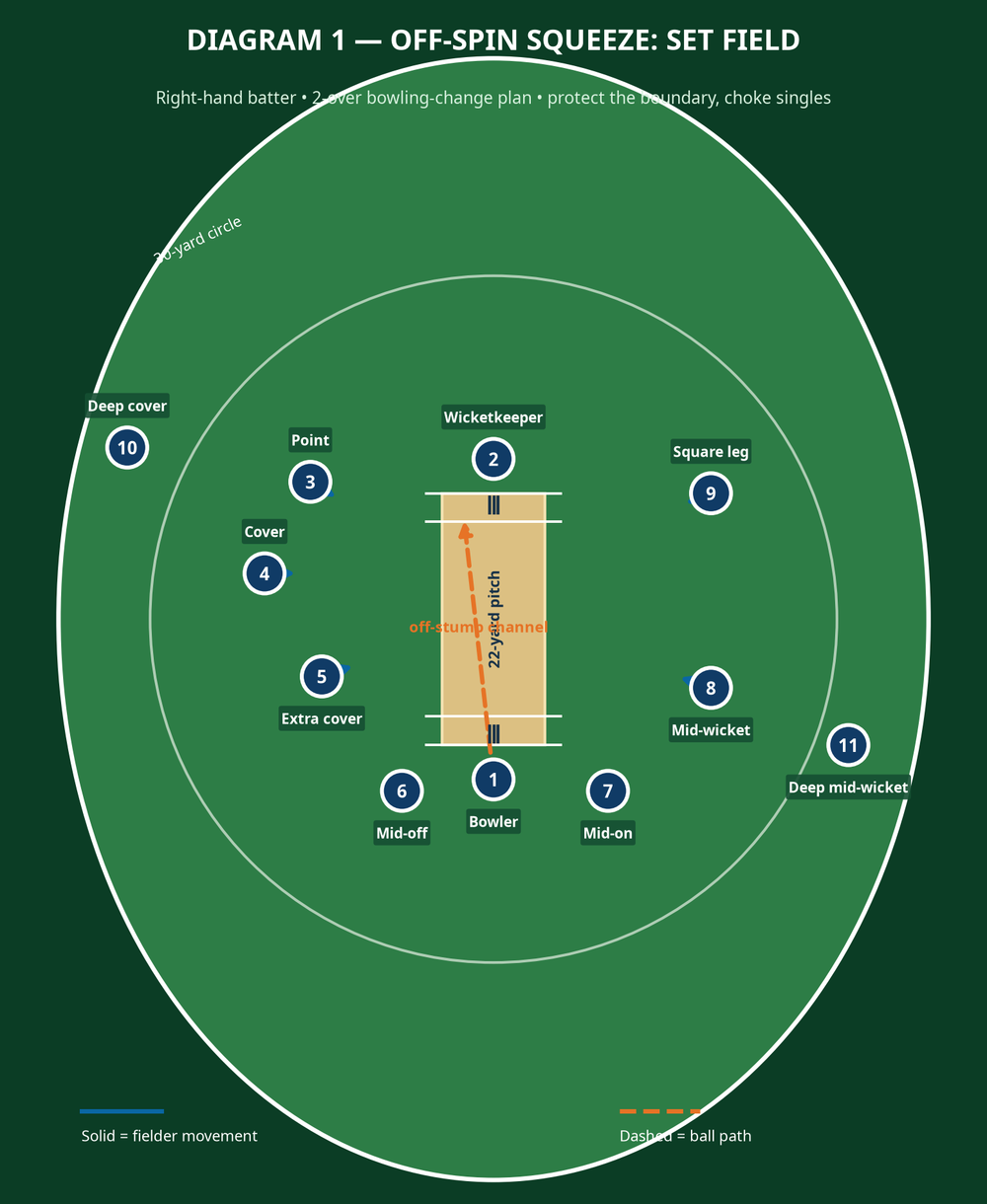
Number the field as follows for Diagram 1: 1 Bowler, 2 Wicketkeeper, 3 Point, 4 Cover, 5 Extra Cover, 6 Mid-off, 7 Mid-on, 8 Mid-wicket, 9 Square Leg, 10 Deep Cover, 11 Deep Mid-wicket. The captain puts 3–9 on, or no more than 2 m behind, the inner-circle line. Keep 10 and 11 4–6 m inside the rope initially so they can attack a mis-hit rather than retreat under it. For an off-spinner to a right-hander, number 1 starts around the wicket only if the bowler can still land a repeatable fourth-stump line; otherwise use over the wicket and retain the same off-side squeeze.

Diagram 1: Base field and delivery plan
The dashed orange route is the first-ball target: good length outside off. The solid blue arrows show the 2–3 pace “walk-in” at the bowler’s gather, giving the off-side ring a head start on a pushed single.
3. Step-by-Step Instructions
Name the two-over contract. Before the change, tell the bowler the exact plan: “Your first 12 balls are fourth-stump or wider, good length; one slower ball in each over only after you have earned it.” Tell every fielder which end is their first throw. The wicketkeeper owns calls at the striker’s end; Mid-off owns the bowler’s end on a checked drive.
Place the field with a clock running. Give the group 45 seconds to reach their numbers. Coach the captain to stand at mid-off, point to each player, and confirm the boundary pair first. If a player is absent, remove the least relevant close fielder, not a boundary protector. Rehearse the field without a ball once: bowler’s run-up, fielders walk in, simulated push, clean pickup, return to the correct end.
Bowl the first over for dots, not wickets. Start with a stock good-length ball in the off-stump channel. Repeat the line, varying flight or pace only slightly; use a flatter ball only if the batter advances. Log any leg-stump ball as a “release ball,” even when it becomes a dot.
Win the ball after the bat-ball contact. At release, inner-ring fielders take their 2–3 steps in. They stay low, hands in front of the feet, and move through the ball on a forward angle. For Under 14 and above, target a sub-1.5-second pickup-to-throw; younger groups use a clean stop and underarm return. Throw to the safe end—no hopeful direct hits.
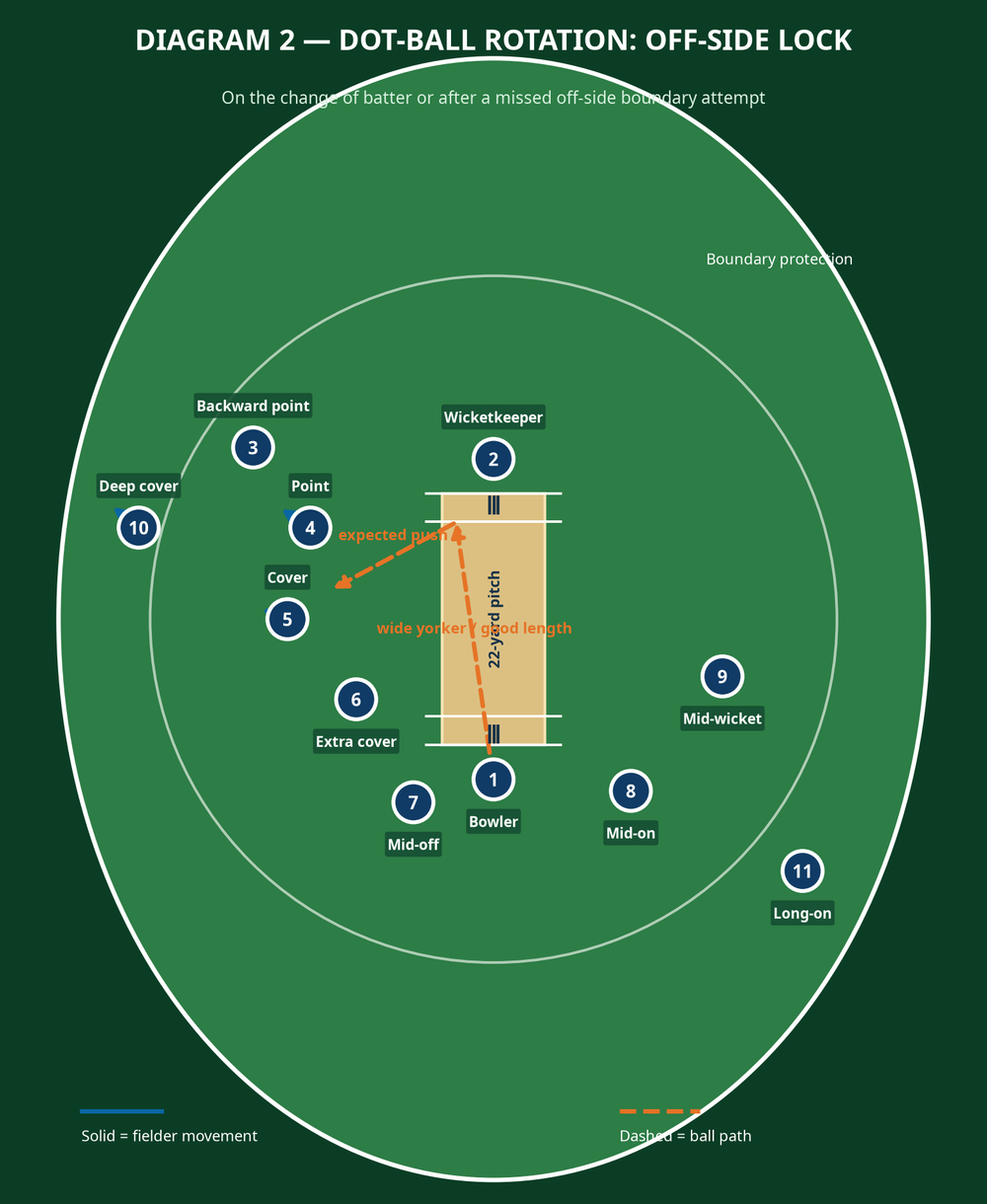
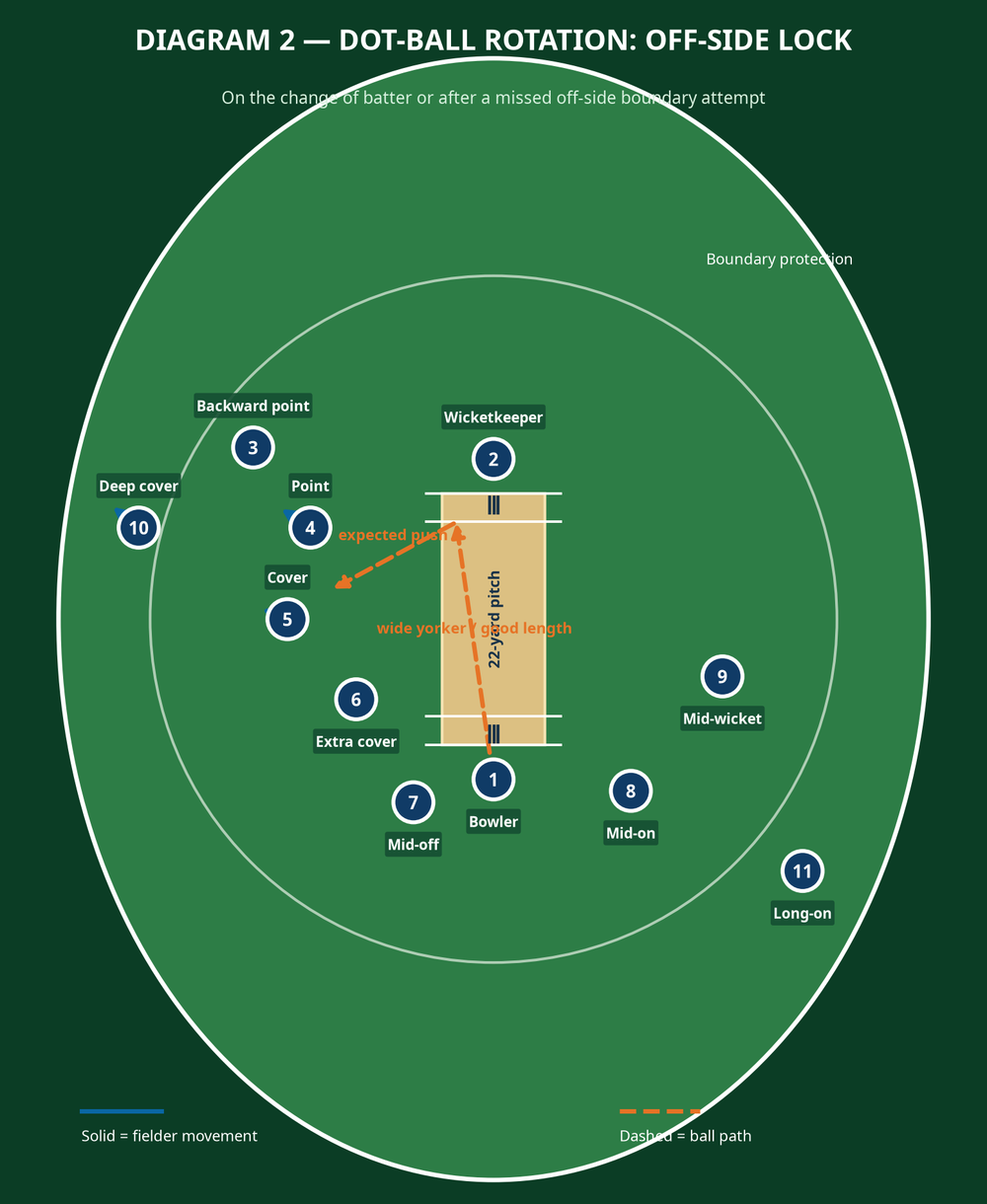
Read the batter’s response and rotate one piece only. After a dot ball or a new batter, move Diagram 1 into the off-side lock in Diagram 2. Shift Backward Point, Point, Cover and Extra Cover 2–4 m toward the anticipated push. Do not move three fielders after every delivery; the batsman should see a stable field with one purposeful adjustment, not a scattered unit.
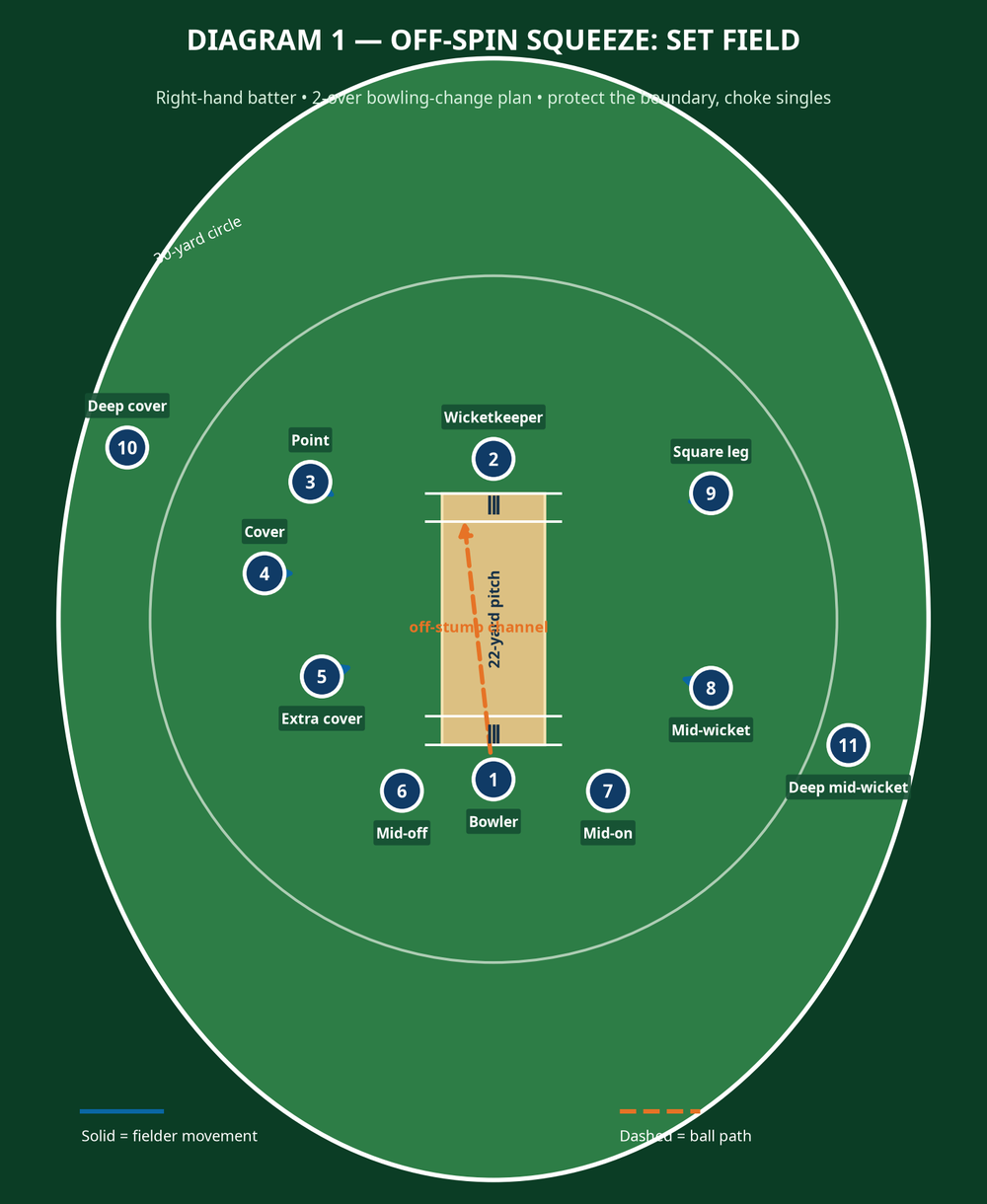
Diagram 2: Off-side lock after the batter searches for a single
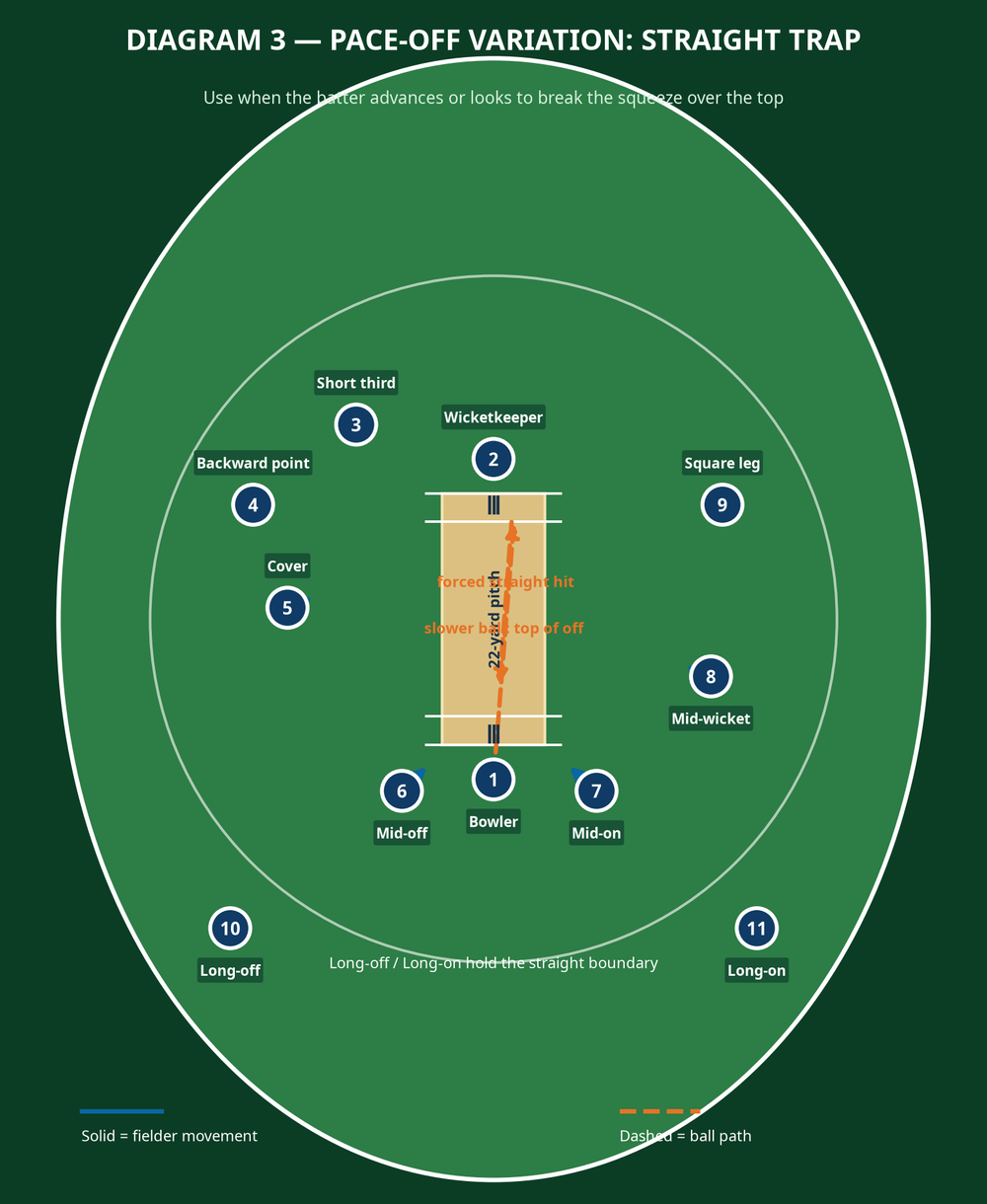
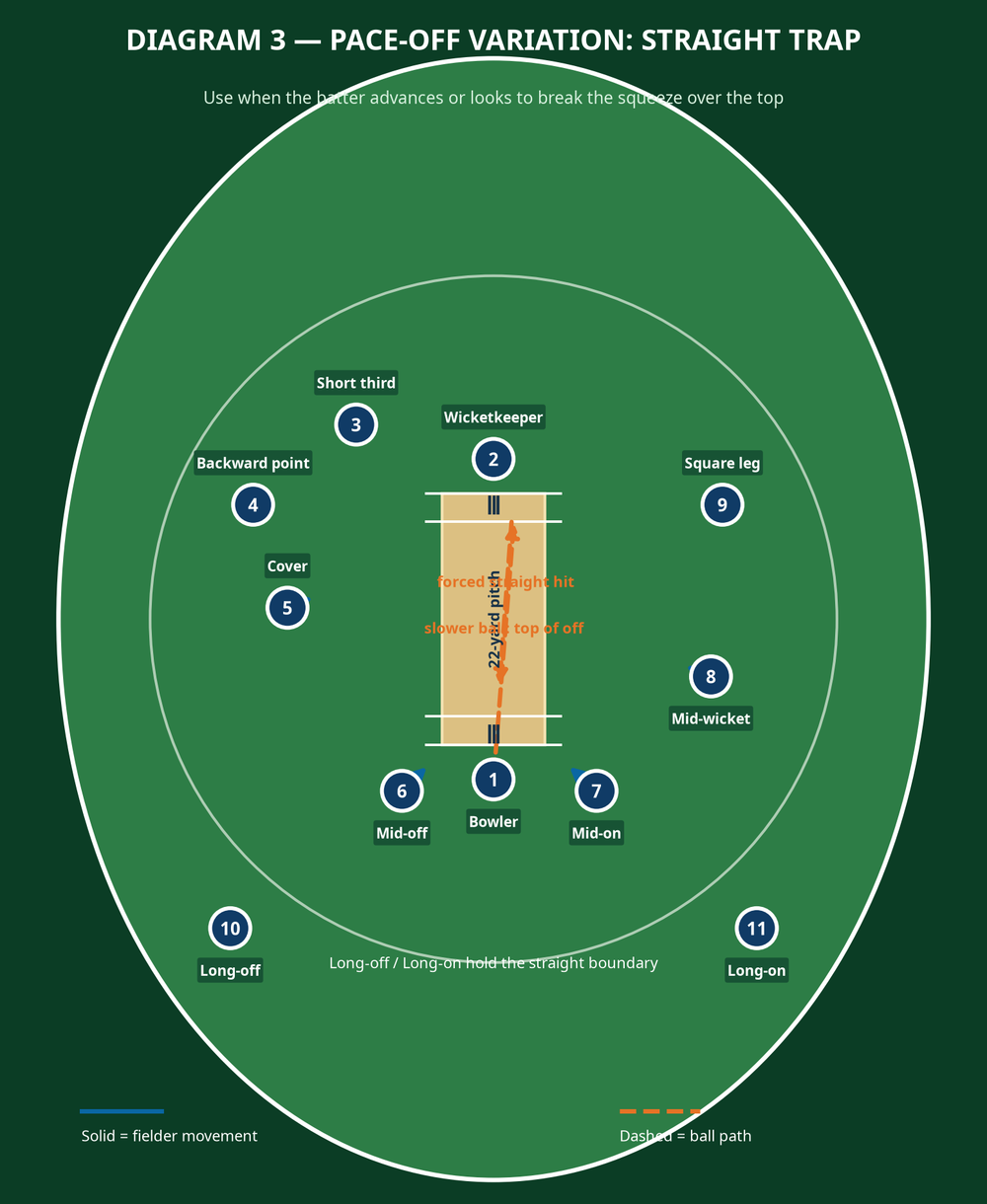
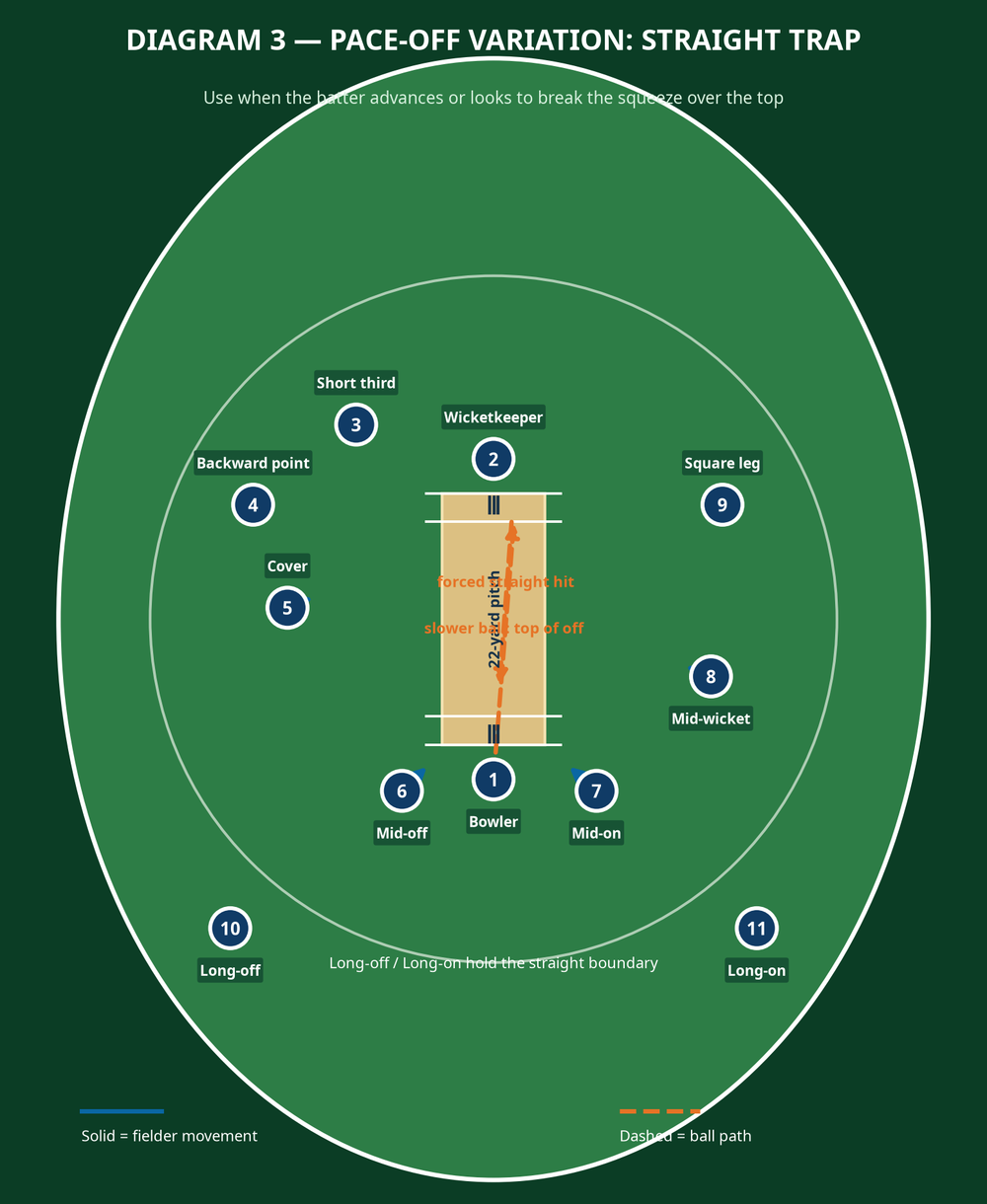
Set the trap ball. After three dots or a forced cover drive, call the pace-off ball. Use the same arm speed and land it at the top of off. Mid-off and Mid-on close the straight “V” by 2–3 m while Long-off/Long-on hold the boundary. Coach a mistimed straight hit, cover push, or checked single—not a miracle dismissal.
Finish and debrief with the scoreboard. Record dots, singles conceded, boundary balls, and missed run-out chances across the two-over block. The basic success target is 7+ dots, no more than 8 runs conceded, and zero unforced overthrows. Ask the bowler first: “Which ball felt easiest to land?” Ask the captain second: “Where did the batter try to escape?” Then repeat immediately with a left-hander or a new bowling type.
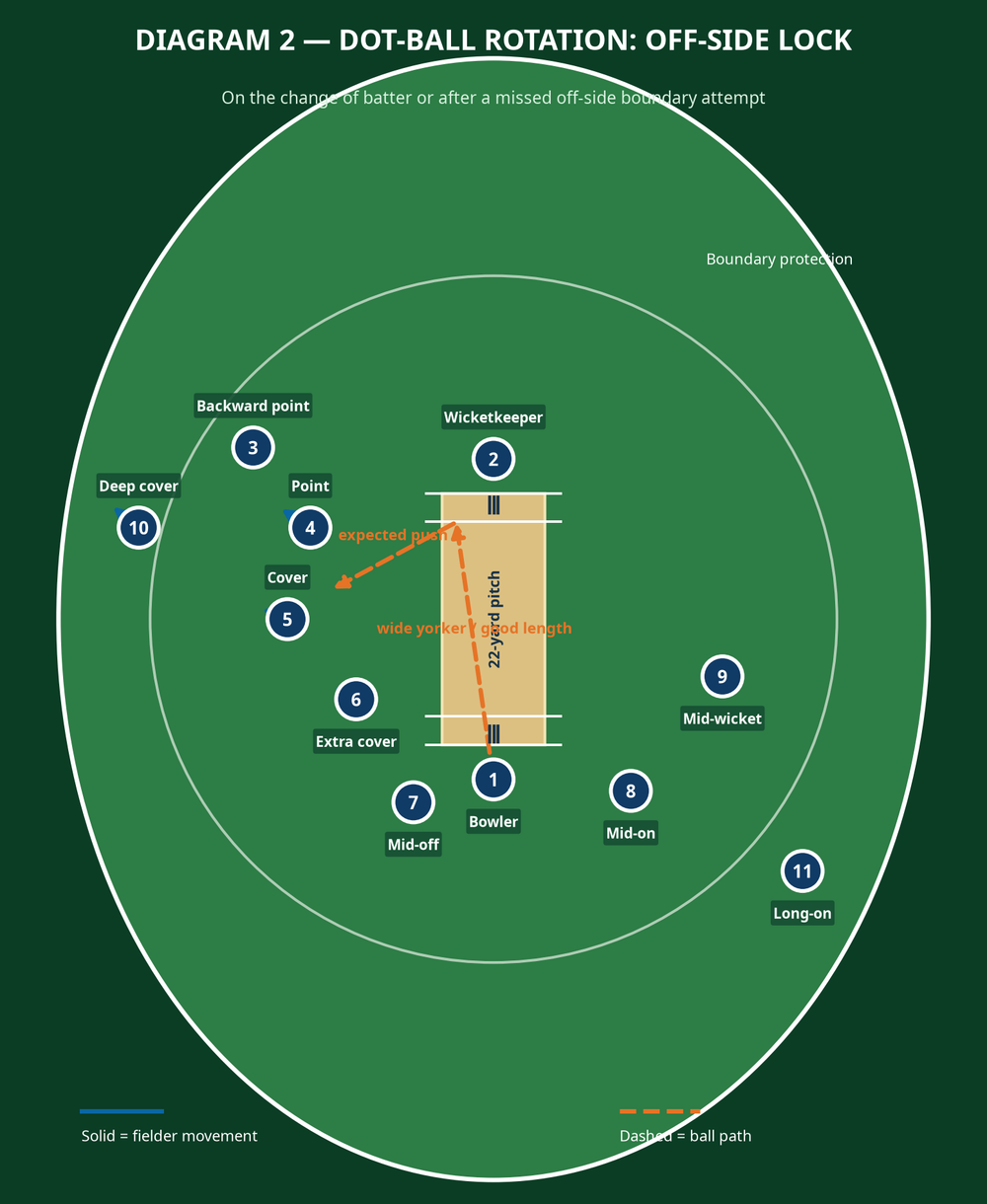
Diagram 3: Pace-off straight trap
4. Key Coaching Points
- Bowling to the field is non-negotiable. If Cover is saving one, the bowler must create contact in Cover’s lane; a leg-side half-volley makes the whole plan irrelevant.
- The first three steps decide the squeeze. Coach fielders to move at the release, not after the sound of bat on ball. The movement is forward and balanced, never a blind sprint.
- Hold the boundary pair honest. Deep Cover and Deep Mid-wicket start 4–6 m inside the rope and assess early.
- Use the keeper as the information hub. The keeper calls batter movement and the next ball.
- Change one variable at a time. Alter flight, pace, angle, or field position—not all four.
- Reward process. A dot created by correct line and a clean stop is a win.
5. Common Mistakes
| Error to spot | Why it fails | Immediate correction |
|---|---|---|
| The bowler chases a wicket with a leg-side ball | It opens the easiest single and removes the off-side funnel | Reset the target to fourth stump and bowl one stock ball |
| Fielders wait flat-footed | A pushed ball beats the ring by a metre | Rehearse the bowler’s gather as the trigger for two steps in |
| Boundary riders hug the rope | They are too deep to catch a miscued shot or cut off twos | Start 4–6 m in; coach the retreat line after contact |
| The side changes the field after every ball | Players stop anticipating and the batter reads uncertainty | Make one movement only, linked to observed shot selection |
| Throws chase a low-probability run-out | Overthrows undo several dot balls | Demand a safe end and a chest-high return before speed |
6. Variations & Progressions
Easier: controlled feed. Start with a coach feeding underarm or sidearm to the batter’s off side. The bowler rehearses run-up and release separately while the field learns their trigger movement. Score one point for a stopped single and two for a clean first-throw return.
Harder: live decision game. Give the batting pair a target of 18 runs from two overs. They earn bonus points for a successful sweep, reverse option, or straight loft. The captain may change only one fielder per ball and must declare the next-ball plan aloud to the keeper before the run-up.
Advanced: match-state switch. Start at 112/2 after 20 overs with a right- and left-hander. The captain gets 20 seconds to reset after each change of strike. A late field bowls one ball unchanged.
7. Age Adaptations
For Under 8, use a shortened soft-ball space and five or six fielders. Keep one target: bowl at the stumps and stop the first run. Number the fielders, use visible cones for their lanes, and allow rolling/underarm returns.
For Under 10 and Under 12, retain the full positional language but work on a shortened wicket only if the local program requires it. Use an eight-player ring, one boundary rider, and a three-ball mini-over. Emphasise the walk-in trigger, safe pickup, and clear “yes/no” calls rather than tactical deception.
For Under 14 and Under 16, use the full 22-yard pitch, live batter, fourth-stump plan, written target, and one pace-off ball per over.
For open-age players, give the captain responsibility for match-ups, left/right switches, and boundary-rider depth. The bowler and wicketkeeper must state the intended scoring area before every over.
References