

Cricket
Powerplay Field Setting Play: Off-Side Squeeze to Wide-Yorker Trap
Build a disciplined powerplay field that tempts the drive, protects the scoring pockets and turns one well-called change-up into a wicket chance.

What you need
1 full set of stumps and bails, 12–16 flat markers or cones, 2 cricket balls appropriate to the group, Measuring tape or pre-marked 30-yard circle, Batting helmet, pads and gloves, Stopwatch
Overview
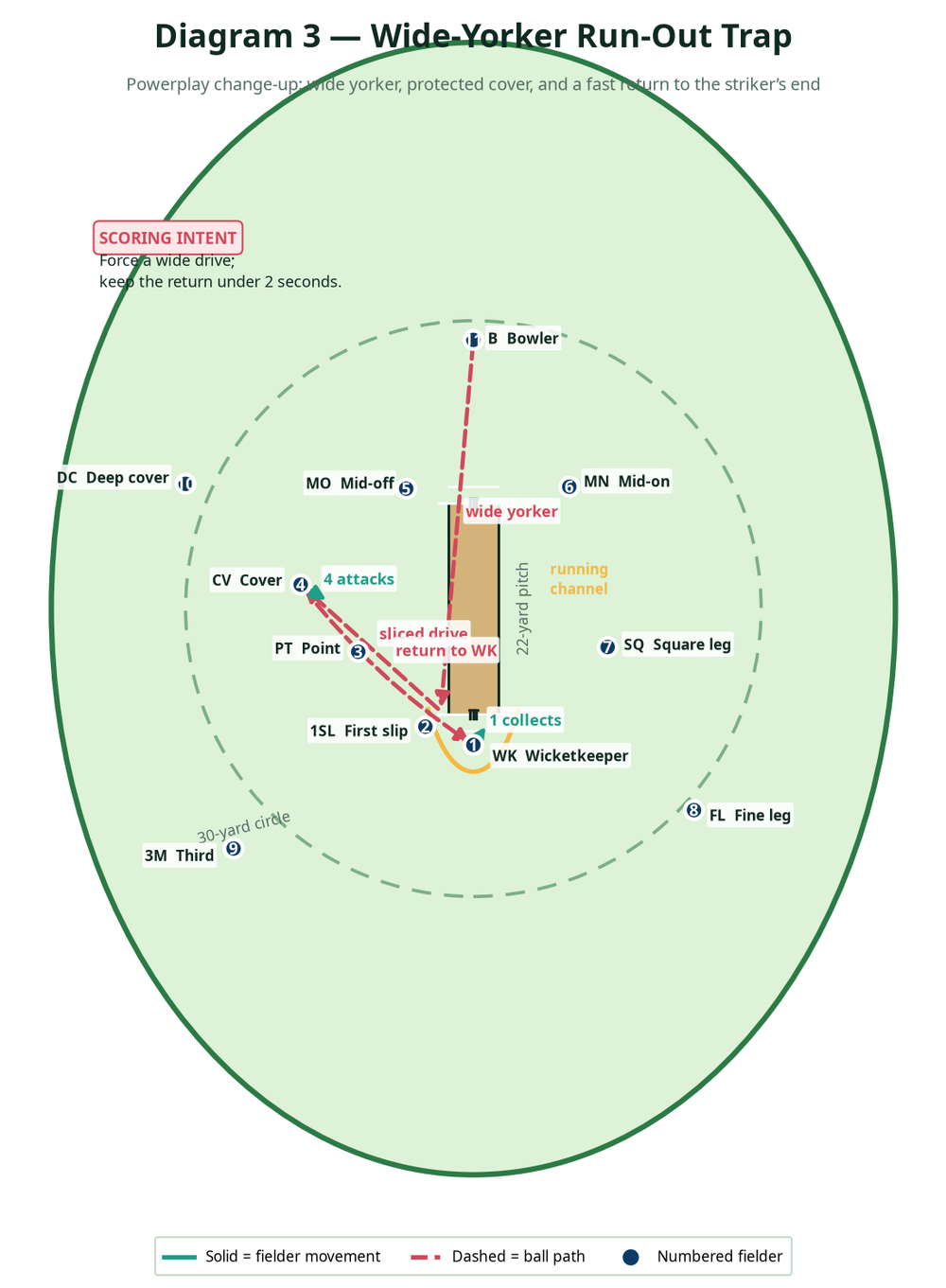
This set play gives a captain and coach one repeatable powerplay plan rather than eleven independent fielders. The primary ball is a full fourth-stump seam delivery that invites the drive into a dense off-side ring. The secondary ball is a wide yorker that uses the same picture, then asks Cover and the wicketkeeper to create a rapid return for a run-out or a stopped single. It is most effective against a right-handed batter who wants to launch through cover early, although the field can be mirrored for a left-hander.
Use it after the opening over, when the bowling unit has settled and the captain can communicate the plan clearly. For an ICC men’s T20I reference, the first six overs are powerplay overs and only two fielders may be outside the 30-yard restriction area at the instant of delivery; coaches must check their own competition’s playing conditions before setting the field. [2] The training pitch is the full 22 yards (20.12 m) from wicket to wicket, so do not compress the run-up or the decision distances merely because the group is young. [1]
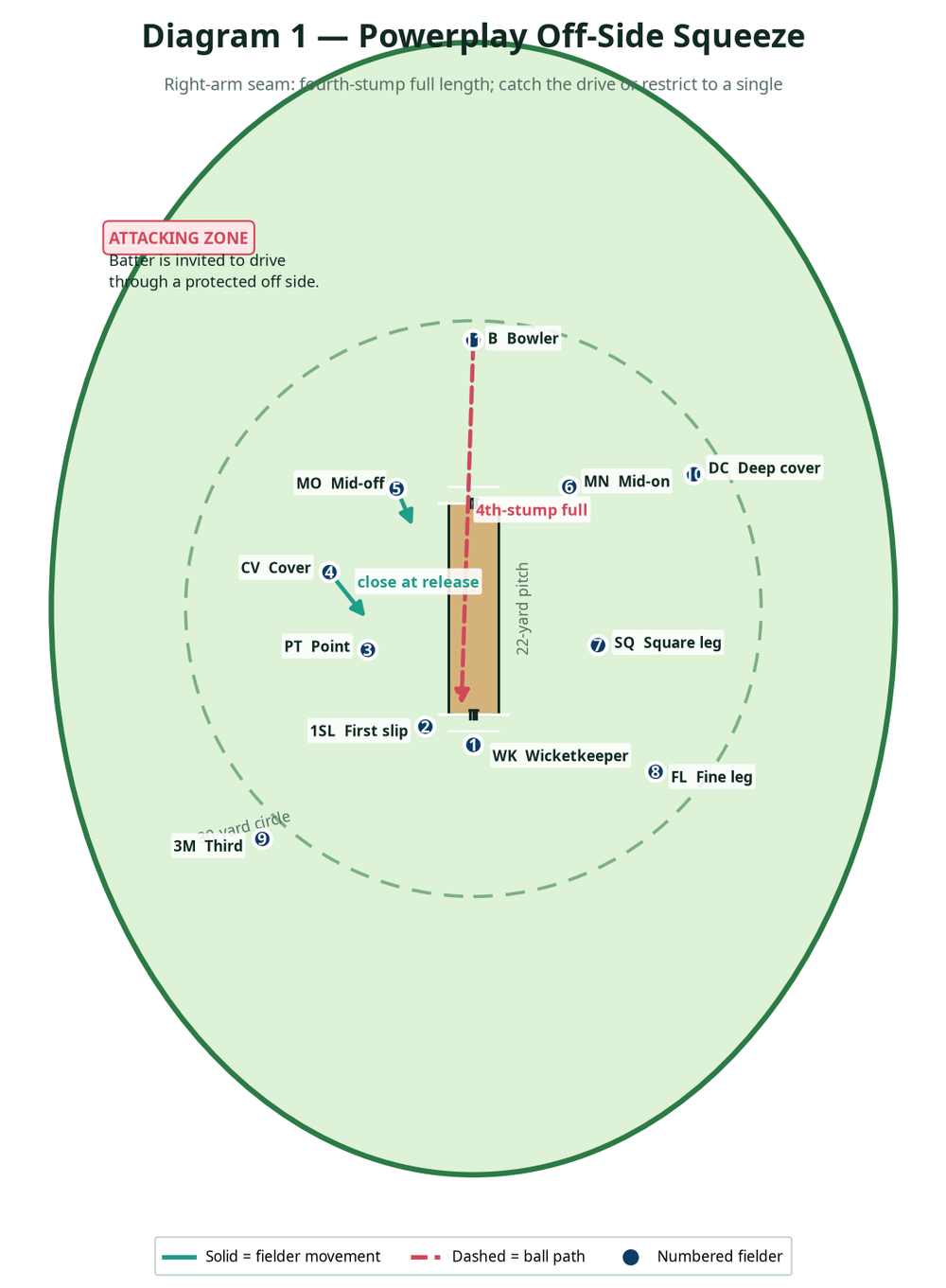
Setup
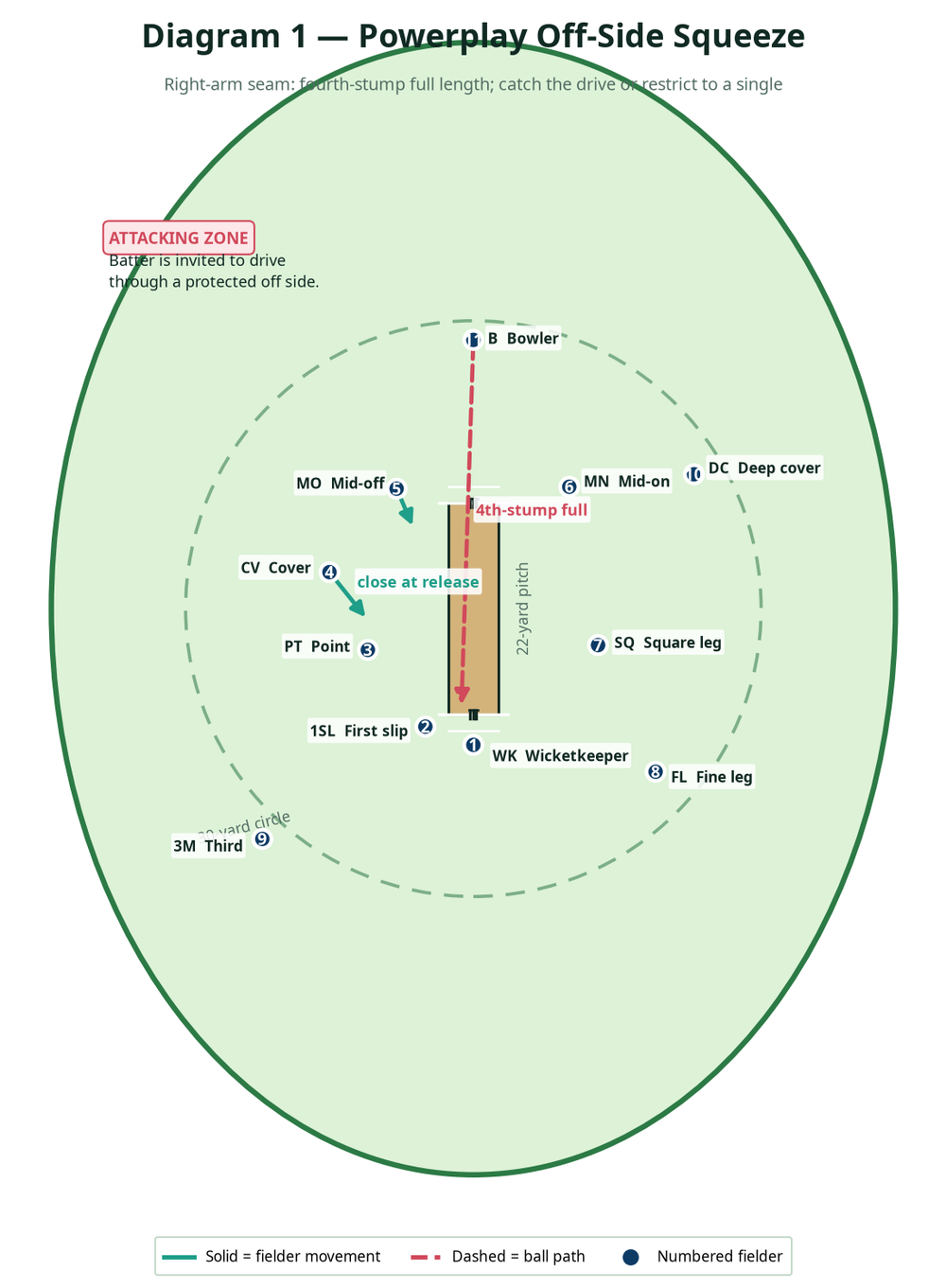
Mark the pitch, the two popping creases and a 30-yard inner circle on an oval. Place a cone 2 m behind the wicketkeeper to give a clear collection target and put a flat cone 5 m either side of Cover to define the protected drive lane. Give the bowler six balls per spell and run the drill in pairs: one captain, one bowler, one wicketkeeper, eight fielders and a batter. Where fewer than eleven players are available, retain WK, First Slip, Point, Cover, Mid-off, Square Leg, Fine Leg and Bowler; the captain can represent the two deep positions with cones.
| No. | Position | Starting instruction | Job on the primary ball |
|---|---|---|---|
| 1 | Wicketkeeper | Up to a medium pacer; 1.0–1.5 m behind stumps | Take cleanly or direct the return at the striker’s end. |
| 2 | First Slip | 3–4 m to keeper’s off side | Stay low for outside edge. |
| 3 | Point | 12–15 m square on the off side | Stop the square cut; release only on the agreed short-ball call. |
| 4 | Cover | 14–18 m, slightly straighter than normal | Attack the driven ball and feed the keeper. |
| 5 | Mid-off | 15–18 m, one step inside the drive line | Cut off the checked drive and back up Cover. |
| 6–8 | Mid-on, Square Leg, Fine Leg | Balanced leg-side safety line | Protect the straight push, clip and deflection. |
| 9–10 | Third, Deep Cover | Only where competition restrictions permit | Make the boundary ball a two, not a four. |
| 11 | Bowler | Full run-up, aligned to off stump | Own the plan: seam position, length and follow-through. |
Step-by-Step Instructions
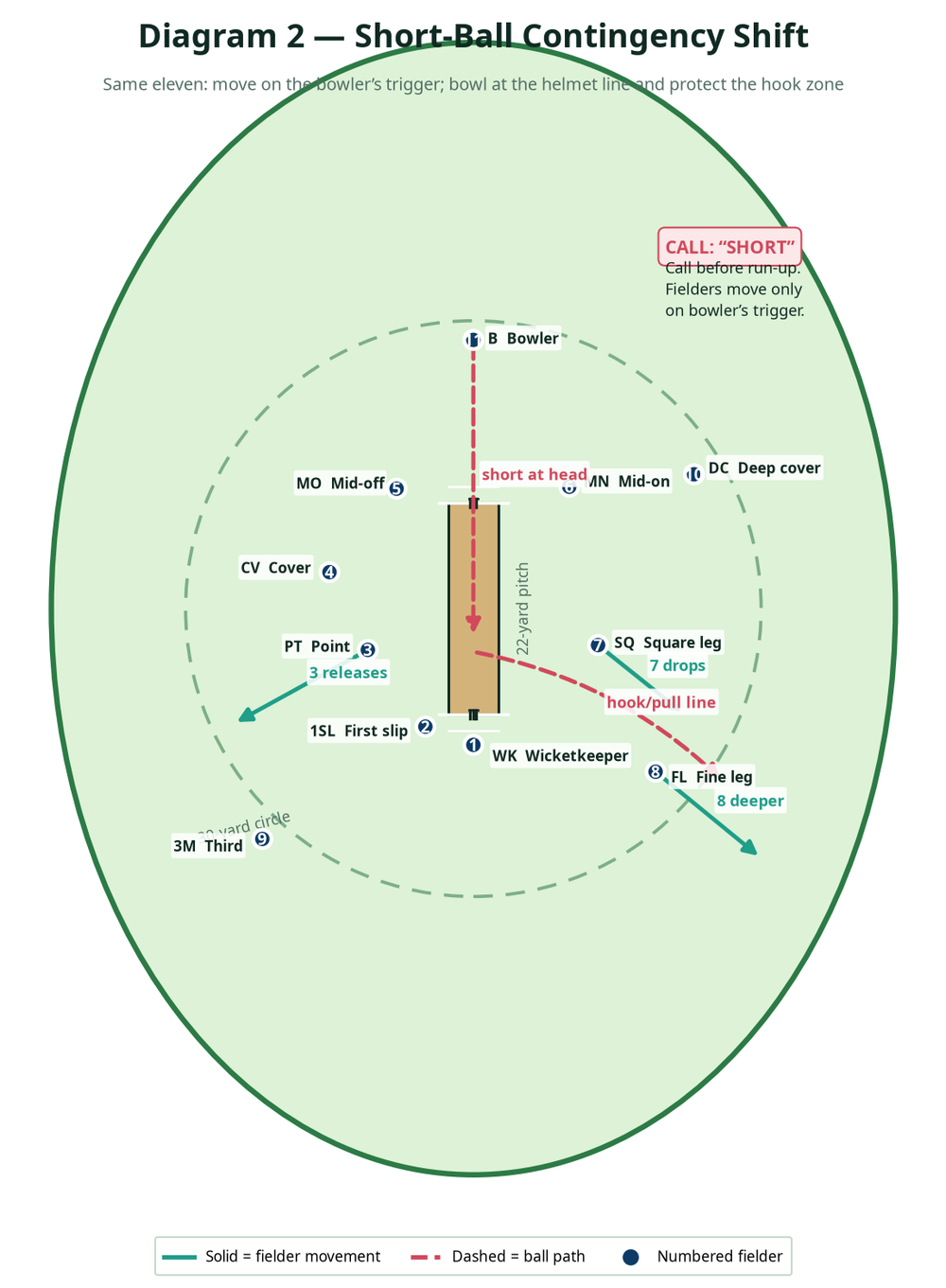
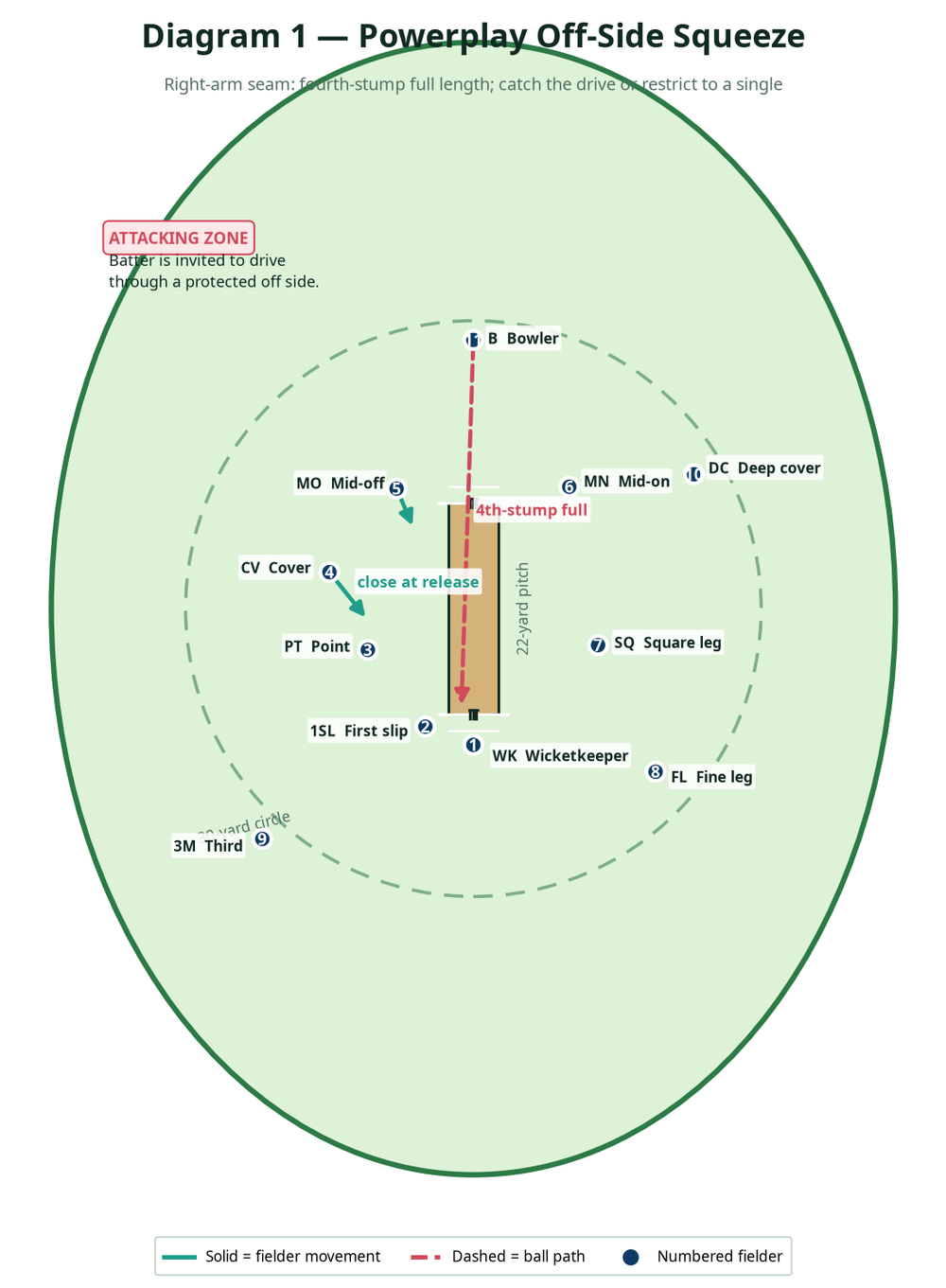
Call the plan before the run-up. The captain uses one short call, such as “squeeze,” and gets a verbal echo from Cover, Point and the wicketkeeper. The bowler then confirms the target: fourth stump, full length, with the seam upright.
Set the field before the ball comes into play. Check that players are not creeping after the bowler starts. Fielders may make only minor adjustments before the ball reaches the striker; a significant pre-delivery move is unfair movement. [3] Coach the initial stance rather than relying on late movement.
Deliver the attacking ball. Bowl at the top of off stump to a full length: aim for a landing area approximately 4–6 m from the striker’s popping crease for developing seamers, then tighten it as skill allows. The bowler’s follow-through must finish two strides down the pitch and toward the likely return.
Close the off-side gate. Cover takes one anticipatory step toward the drive line on release, Mid-off squeezes 2–3 m toward Cover, and Point stays low and ready to dive. The aim is not to manufacture movement after release; it is to arrive in a legal, balanced starting position that makes the drive look available but hard to beat.
Score the first response. If the ball beats the bat, award the bowling group two points. If it finds Cover, Mid-off or Point cleanly with no run, award one point. If the batter beats the ring, freeze play and ask which player was late, too deep or facing the wrong way.
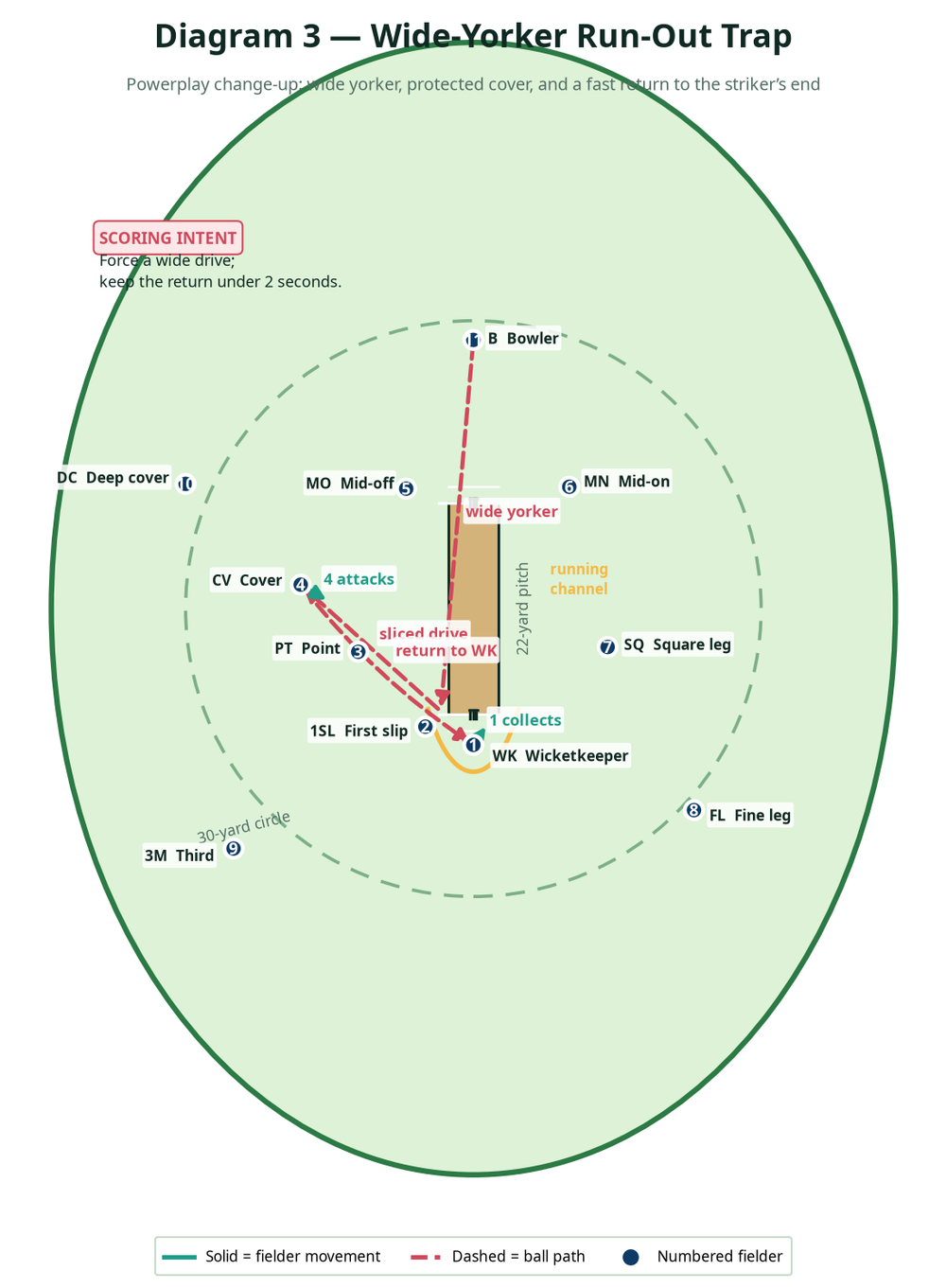
Run the wide-yorker change-up. After two fourth-stump balls, the captain calls “wide.” The bowler targets a yorker just outside off stump; Cover is primed to attack a sliced drive and the wicketkeeper prepares to receive a return at the striker’s end. Do not use this ball unless the bowler can keep it within a safe legal margin.
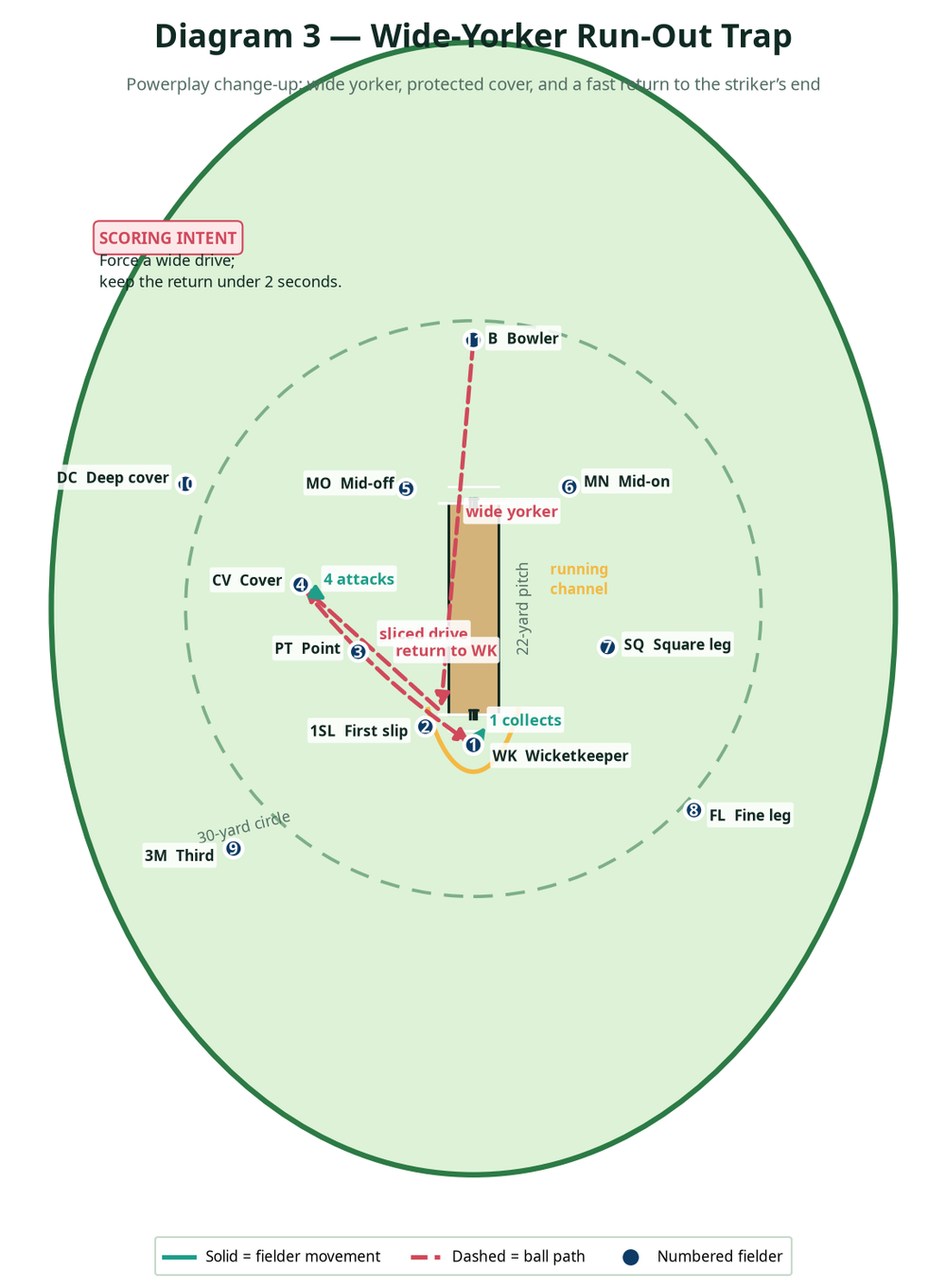
Complete the return. Time Cover’s clean pick-up and release to the wicketkeeper. The performance standard is ball in hand at Cover to wicketkeeper’s gloves in under 2.0 seconds on a clean chance. The keeper calls the end, shows a large target, then either breaks the wicket or sends the ball to the bowler’s end.
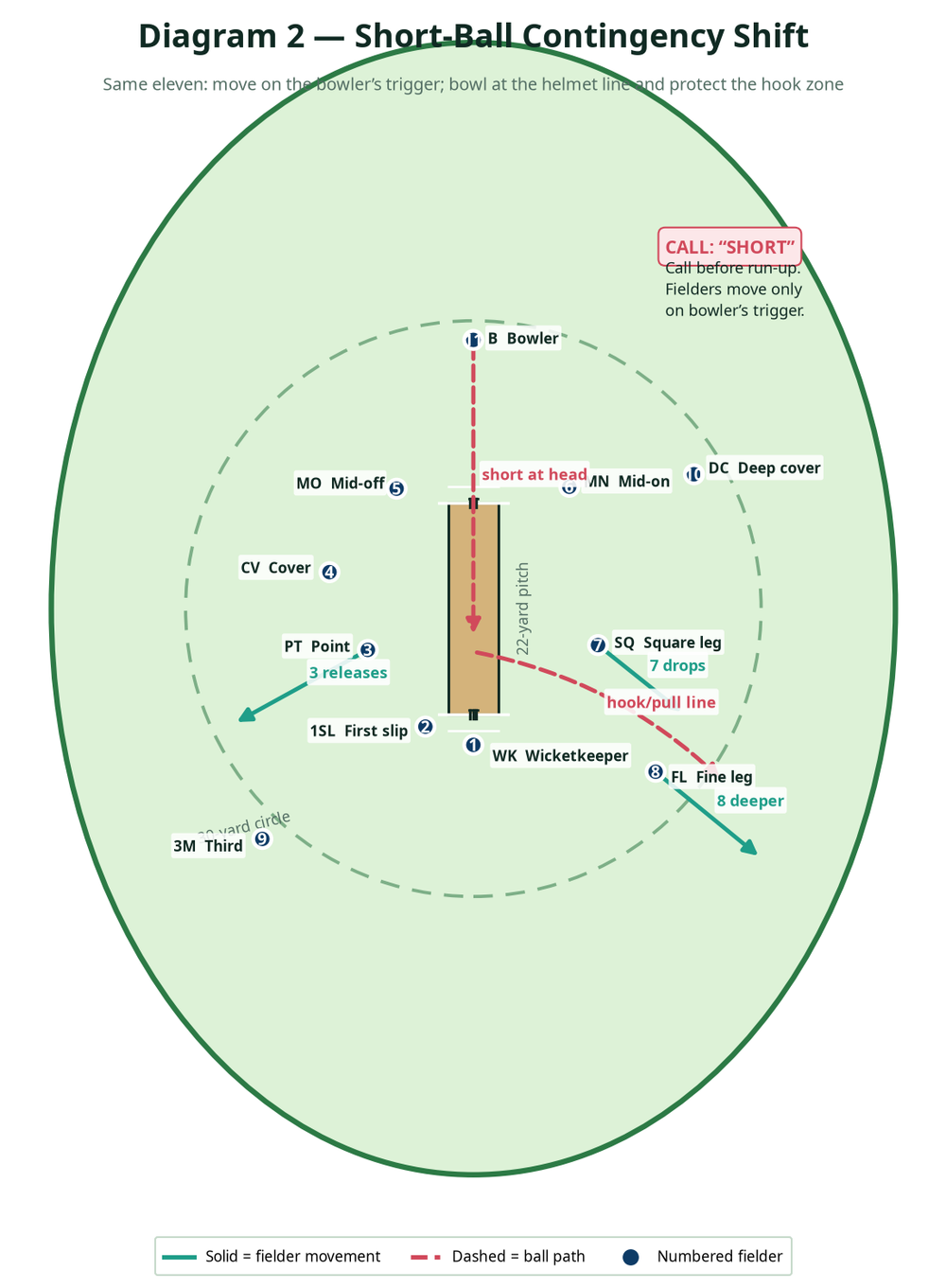
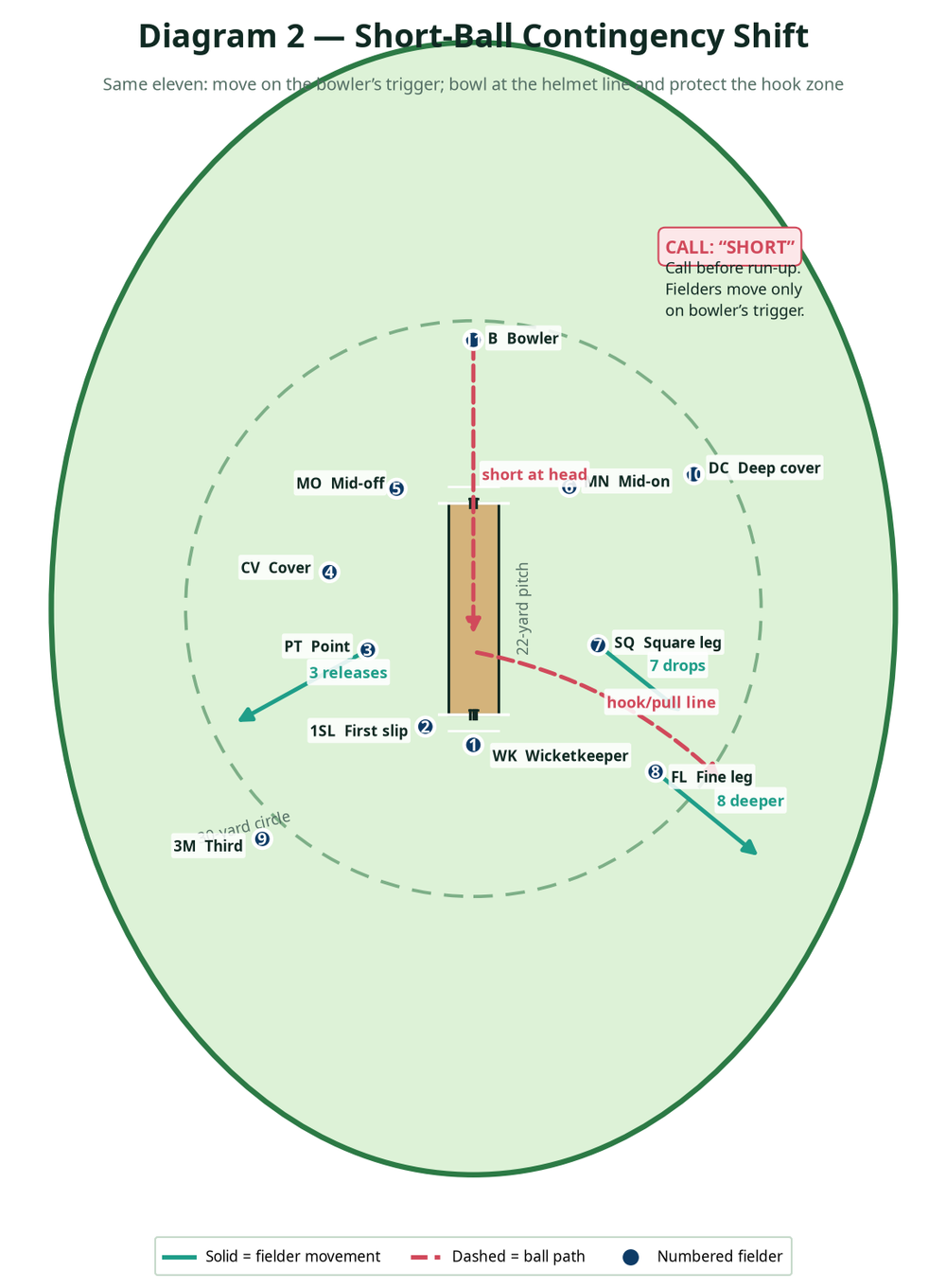
Add the short-ball contingency only on command. When the captain calls “short” before the run-up, Square Leg drops into the hook zone, Fine Leg goes 8–12 m deeper and Point releases toward a deeper square position. The bowler must bowl the intended short length; if the ball is merely back of a length, the original off-side squeeze is safer.
Key Coaching Points
- One message per ball: name the line, length and scoring outcome before the bowler turns. “Fourth-stump full; Cover owns the drive” is clearer than a long tactical lecture.
- Field to a length, not a wish: do not keep an attacking ring if the bowler cannot consistently challenge the front foot. Bring the ring back 3–5 m until contact quality improves.
- Show early hands: Cover and Point start with weight on the balls of the feet, hands low and eyes level; a spectacular dive is a recovery, not the target technique.
- Protect the keeper’s throwing lane: Mid-off must not stand directly between Cover and the wicketkeeper on the wide-yorker ball.
- Train the captain’s scan: before each ball, check numbers outside the circle, leg-side balance, wicketkeeper depth and the bowler’s delivery plan.
Common Mistakes
| Error | What the coach sees | Immediate correction |
|---|---|---|
| Ring too deep | Drives become easy singles or twos | Move Cover and Mid-off 3 m closer, then rehearse first step. |
| Bowler drags short | Batter hits through the vacant cover region | Return to a fuller cone target; reduce run-up pace before increasing it again. |
| Silent field | Two players chase, nobody backs up | Insist on a pre-ball echo and a named back-up fielder. |
| Illegal late shift | Fielders run while the ball is on its way | Freeze and reset; all major movement happens before the ball is in play. [3] |
Variations & Progressions
For a control-first variation, remove the slip and place a second fielder at cover-point; reward three consecutive dots rather than wickets. For a wicket-first variation, keep First Slip and add a catching cover 8–10 m from the bat, but require the bowler to hit the fourth-stump zone in four of six balls. For an advanced game progression, give the batter a scoring target of 12 from six while the fielding group earns a bonus point for a wicket, a direct-hit run-out attempt, or three balls in the planned zone.
Age Adaptations
For Under 8–Under 10, use a shortened pitch only where local development guidance permits, soft balls, eight fielders and a 15–20 m inner circle. Teach the picture with rolls and underarm throws before pace bowling. For Under 12, use the full 22-yard pitch where players can do so safely, retain seven or eight positions, and give the bowler a large full-length landing box. For Under 14–Under 16, use eleven players, competition-legal restrictions and the timed Cover-to-keeper return. Open-age groups should add batter scouting: change the off-side squeeze to a straighter plan only when the batter’s scoring map justifies it.
