Cricket
Powerplay Off-Side Squeeze: An Attacking Field-Setting Play
A coach-ready powerplay plan that aligns a disciplined fourth-stump bowling line with an attacking off-side ring, live catching options and rehearsed one-run denial.

What you need
2 sets of cricket stumps with bails, 6–10 cricket balls appropriate to the age group, 30–40 flat cones, Measuring tape or 30-yard reference rope, Bats, helmets, wicketkeeping gloves and protective equipment, Two scoring markers or a coaching clipboard
Powerplay Off-Side Squeeze
Overview
This set play gives your bowling side a clear identity for the first overs: make the batter score through a packed off side, retain genuine edge-catching options, and turn every defensive contact into a chance to stop the easy single. It is an attacking containment field, not a defensive spread. The plan suits a right-arm-over bowler operating to a right-handed batter with a fourth-stump line and a full-to-good length. Use it at the start of a limited-overs innings, immediately after a new batter arrives, or when conditions offer carry and seam.
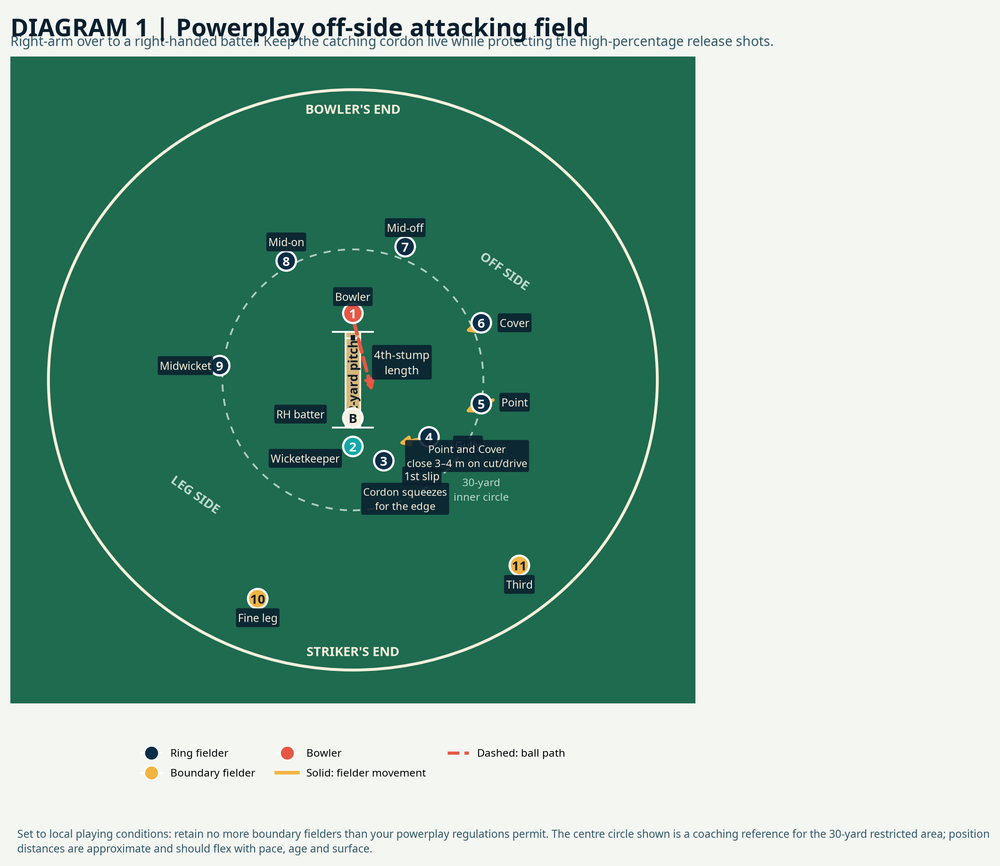
The objective is simple: the bowler owns the channel outside off; the wicketkeeper, first slip and gully hunt the outside edge; Point and Cover shut down the release cut and checked drive; Mid-off and Mid-on protect the straight response. The fielding restriction in a powerplay is competition-specific, so confirm your league’s current playing conditions before deciding how many fielders may stand outside the inner circle.2 The pitch itself is 22 yards (20.12 m) long in the standard Laws, while junior governing bodies may set a different length.1
Coach’s outcome: By the end of the drill, your players should set the field in 30 seconds, call the plan before the bowler starts, and complete a controlled ball-to-keeper return inside three seconds after a cut or defensive push.
Setup
Mark a full oval if one is available. Set the two wickets on the 22-yard pitch and cone a 30-yard reference circle from the pitch centre; if the ground is small, keep the relative angles and reduce the running distances, rather than compressing the ring into the pitch. Put one coach or competent player at the striker’s end, one right-handed batter on strike, and an 11-player fielding unit. A second batter may stand at the non-striker’s end for realistic running, but a coach can control this role in the first teaching block.
| No. | Position | Start point and job |
|---|---|---|
| 1 | Bowler | Top of mark; attacks the fourth-stump corridor. |
| 2 | Wicketkeeper | Two to four metres behind the stumps, adjusted for pace and bounce. |
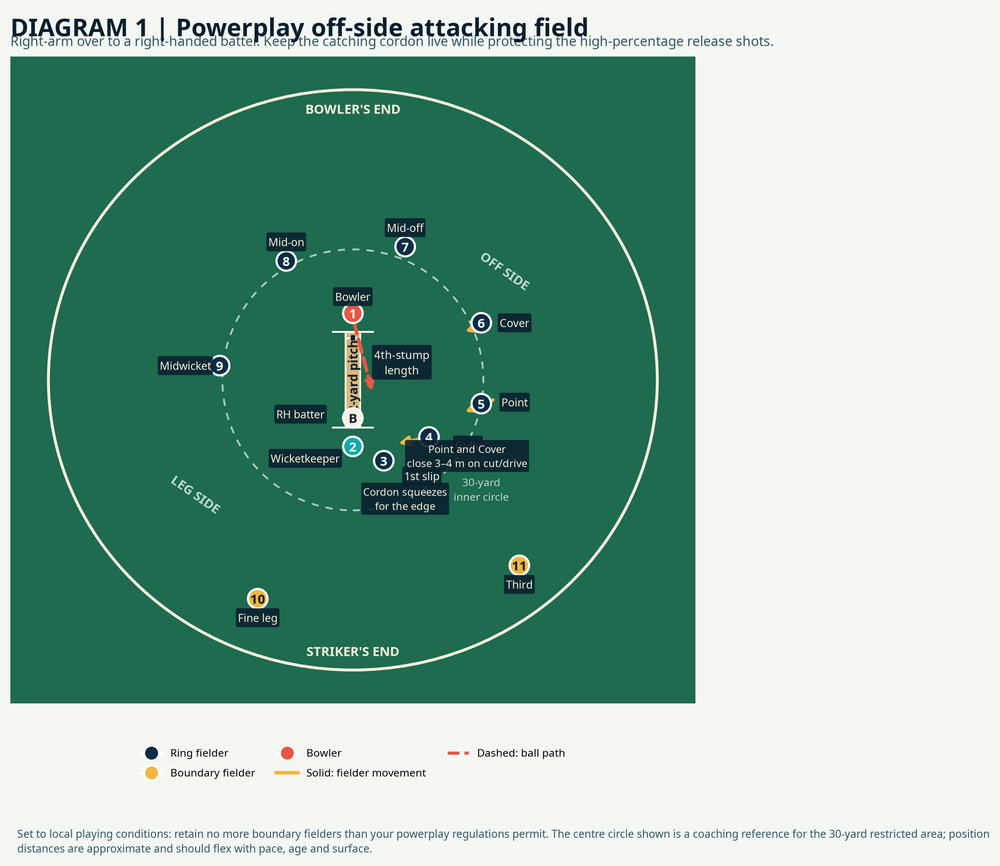
| 3–4 | First slip and Gully | About 6–10 m behind the batter; set for a firm edge, not a wide miss. |
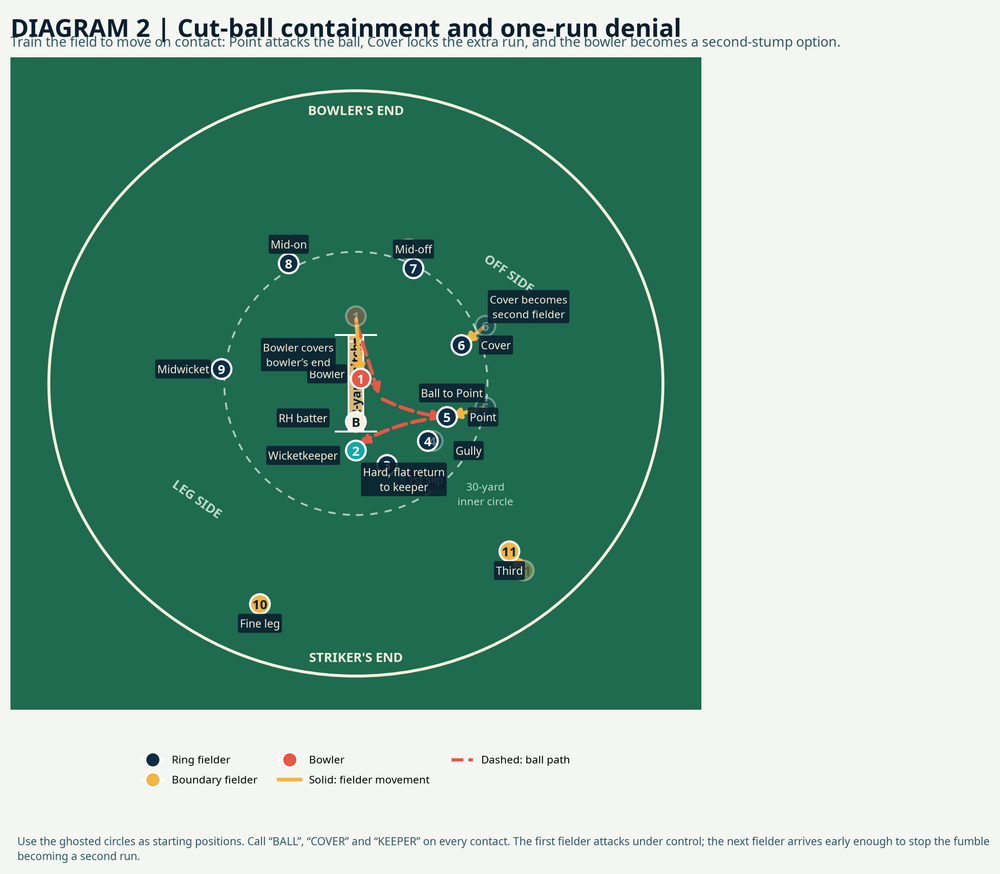
| 5–6 | Point and Cover | Inside the circle, 20–30 m from the batter; squeeze 3–4 m on contact. |
| 7–9 | Mid-off, Mid-on, Midwicket | Inside the circle; protect straight drives and the checked leg-side push. |
| 10–11 | Fine leg and Third | On the boundary or permitted deep line; prevent the uncontrolled release shot. |

Before the first ball, the captain names the plan aloud: “Fourth stump, good length; off-side ring; one run max.” The bowler repeats the target, Point names the attacking side, and the keeper confirms the cordon. This brief verbal routine matters: it prevents an individual fielder from drifting square or deep while everyone else remains committed to the plan.
Step-by-Step Instructions
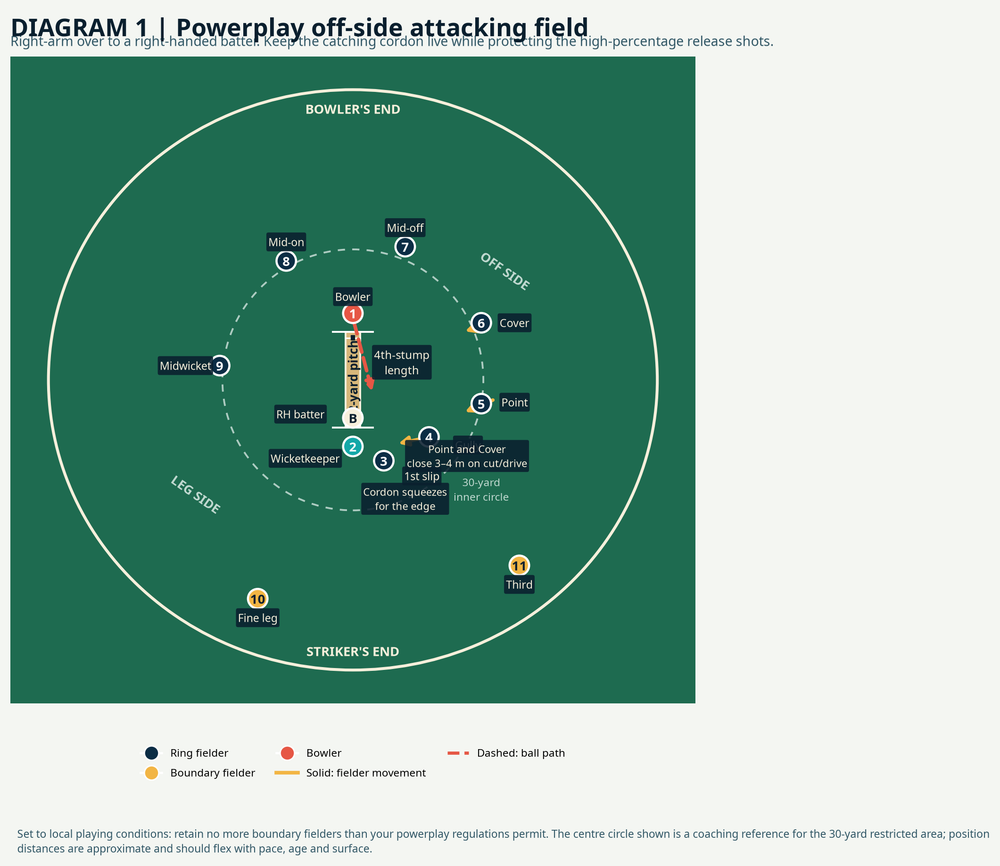
Walk the field in position order. Start with the keeper, then first slip and Gully, then Point, Cover, Mid-off and Mid-on. Use the striker’s stumps as the reference. Ask each player, “What ball am I here for?” Do not accept “the ball”; demand a specific answer such as “the thick outside edge” or “the checked cover drive.”
Set the bowler’s target. Put a flat cone 4–6 m short of the batter on a fourth-stump line. For the first six balls, the bowler aims to land on or just beyond that cone. Do not ask for extravagant swing; accuracy and a stable seam are the priority. The captain keeps Mid-off slightly straighter than Cover so that a full ball does not leak down the ground.
Rehearse the no-ball-contact movement. On the coach’s clap, the bowler completes the follow-through and turns towards the striker’s stumps; Point and Cover take two quick squeeze steps in; Gully moves one step forward; the keeper stays low and balanced. Freeze after two seconds, correct angles, then reset. Run three rehearsals without a ball.
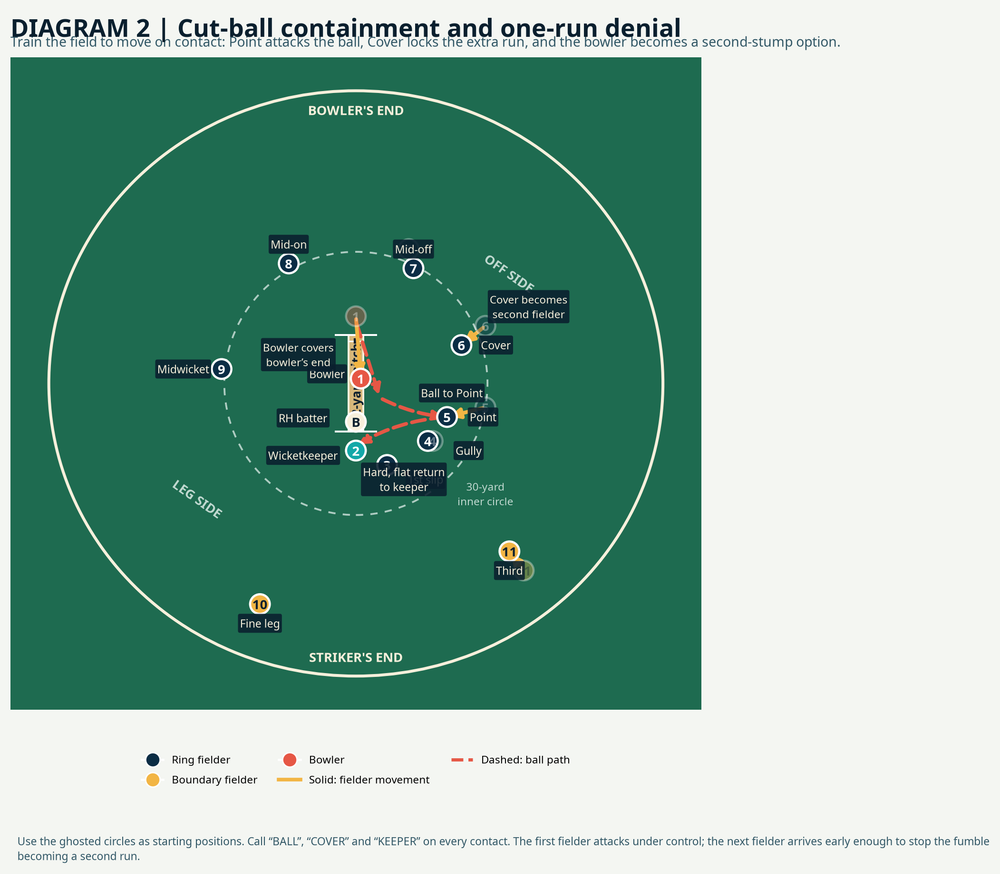
Add a controlled cut-ball. The coach feeds or the bowler delivers a short-of-length ball that the batter guides into Point’s zone. Point attacks on the line of the ball with a low last stride, Cover arrives 4–5 m behind as the second fielder, and the bowler sprints to the bowler’s-end stumps. Point returns flat to the keeper unless the batter has clearly committed to the second. The standard is: clean pickup, decisive call, release in one action.
Score the fielding unit, not the batter. Award two points for a dot ball, one point for holding the batter to a single, and a bonus point for an edge carried to the cordon or a run-out chance created. Deduct one point when a fielder moves after the shot rather than on contact, or when the return is looped. Bowl two overs, rotate the bowler and the close catchers, then give the unit a 45-second review.
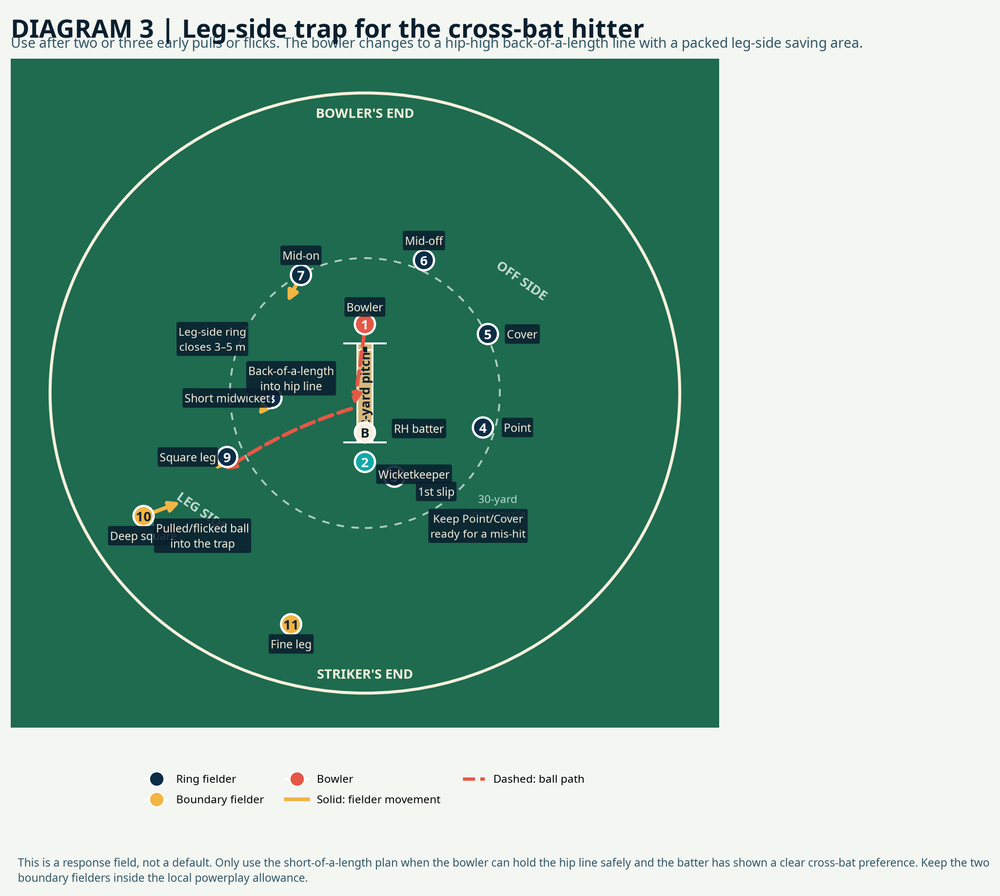
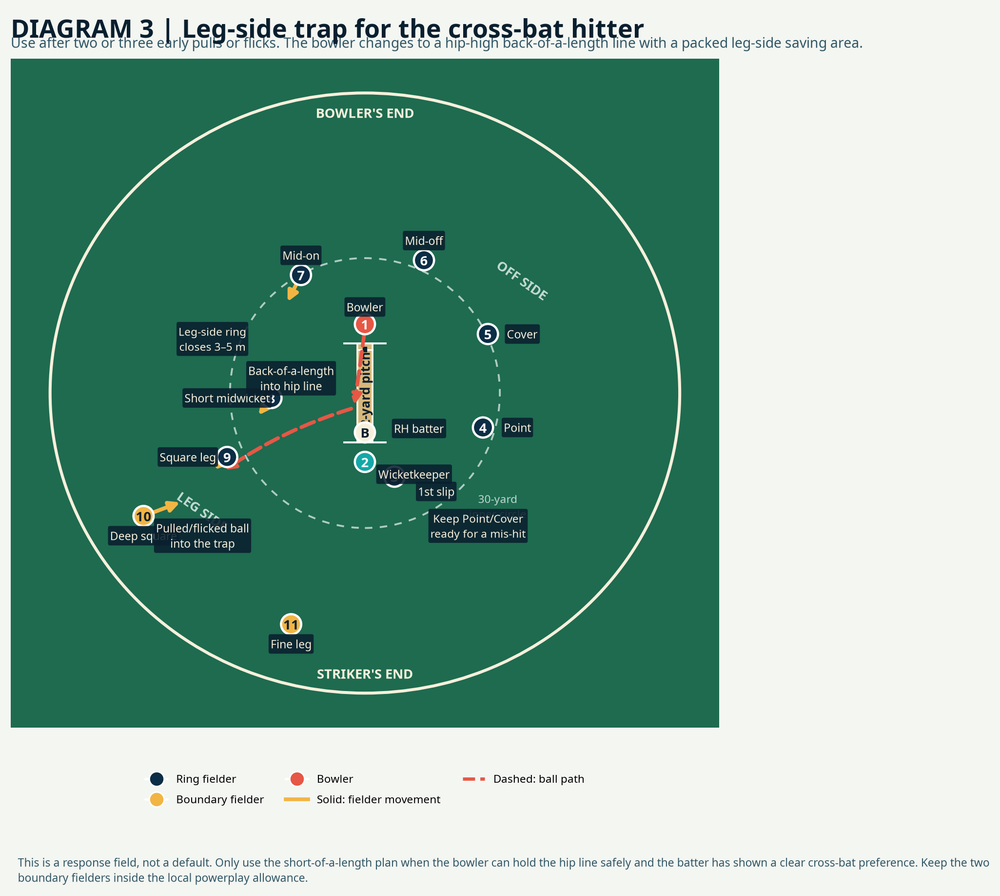
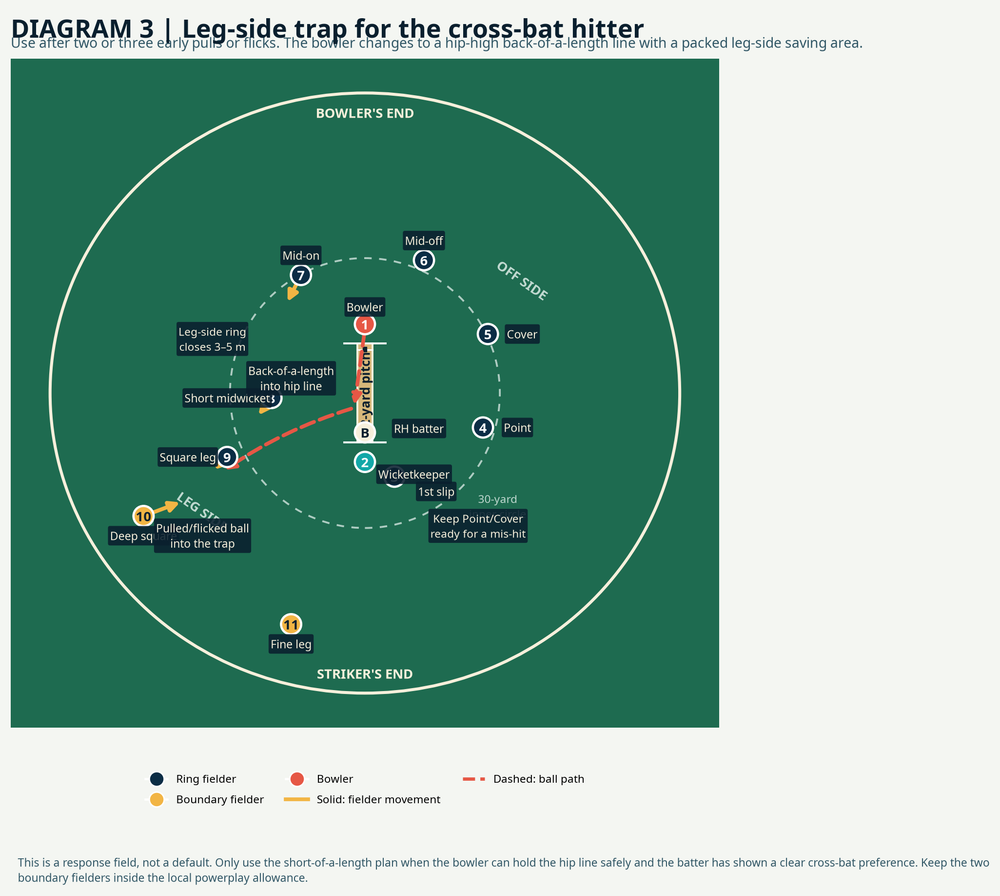
Install the response field only when earned. If the batter has shown two or three deliberate pulls or flicks, shift to the leg-side trap. Mid-on, Short Midwicket and Square leg tighten by 3–5 m, Deep square protects the cross-bat boundary, and the bowler uses a controlled back-of-a-length hip line. This is a tactical answer to a pattern, not a default field.
Key Coaching Points
| Coaching cue | What you should see |
|---|---|
| Bowl to the field | The fourth-stump target and the off-side ring point at the same scoring area. |
| Move on contact | Point and Cover begin before the ball arrives, without pre-judging its exact line. |
| First fielder attacks; second fielder saves | One player fields the ball while the support player expects a bobble or overthrow. |
| Keeper owns the communication | Clear calls of “yes”, “no”, “keeper” and “stumps” replace silent chasing. |
| Cordon stays catch-ready | Slip and Gully are balanced forward, hands presented, until the ball is past them. |
Keep the language short under pressure. “Channel.” “Squeeze.” “Ball.” “Cover.” “Stumps.” These are better on-field cues than long technical explanations. Between balls, coach the cause rather than merely the outcome: if a cover drive beats Cover, ask whether the bowler missed full and wide, whether Cover was too deep, or whether the support angle was wrong.
Common Mistakes
The most frequent mistake is setting an aggressive field but bowling safely down leg side. Correct it by returning immediately to the cone target and asking the bowler to name the channel before the run-up. The second is Point attacking too square and allowing the ball to go behind them; set their first step slightly forward and towards the striker. Third, Cover watches rather than backing up; make the support run compulsory even when Point fields cleanly. Fourth, players bunch around the 30-yard circle, leaving a straight gap. Re-mark Mid-off and Mid-on with cones before the next set. Finally, coaches sometimes move to the leg-side trap after one mistimed pull. Require a repeated batter pattern before changing the field, otherwise players learn reaction rather than evidence-based decision-making.
Variations & Progressions
Start with coach-fed balls and a stationary non-striker; this lets younger or new fielders learn angles without reading the release. Progress to live bowling, but prescribe the off-side channel for six balls. Then make the decision live: the captain may call the leg-side trap only after the batter has shown the agreed trigger twice. For an advanced group, award the batting pair bonus runs for beating the ring through a named gap, forcing the fielding unit to re-set between deliveries and communicate a justified adjustment.
A useful left-handed-batter variation is to mirror the field and bowling channel: retain the same principles—edge coverage, packed scoring side, and one-run denial—while swapping the off-side and leg-side roles. Do not simply flip positions on a diagram; check every player’s throwing line to the keeper and which boundary fielder is permitted by the competition conditions.
Age Adaptations
| Age group | Adaptation |
|---|---|
| Under 8–10 | Use a shortened pitch as set by the local junior programme, six fielders, soft ball and a 15–20 m reference circle. Teach only “field, call, return.”1 |
| Under 12–14 | Use a 7–9 player field and remove the slip if confidence is low. Keep Point, Cover, Mid-off, keeper and bowler as the core shape. |
| Under 16–Open | Use the full 11-player unit, live bowlers, real running, score pressure and captain-led field changes. |
Finish with one over in match conditions. Do not stop the ball after a misfield. Let the consequence play out, then review the unit on three questions: Was the ball matched to the field? Did the ring move on contact? Did we protect the second run? That debrief turns a diagram into a repeatable powerplay habit.
References