Cricket
High-Intensity Running Between Wickets: The Call & Commit Drill
A timed, match-relevant running-between-the-wickets drill that teaches clear calls, explosive turns, precise bat grounding, and sound second-run decisions.
What you need
6 cricket balls or incrediballs, 2 cricket bats, 8 cones or flat markers, 2 sets of stumps or target stumps, Full batting protective equipment, Stopwatch or whistle
1. Overview
The Call & Commit Running Between the Wickets Drill gives coaches a repeatable way to teach the habits that create extra runs without reckless run-outs: an instant first call, a hard first run, a tight turn, and a decisive second decision. It is not simply a sprinting exercise. Every repetition begins with a realistic scoring cue, demands a verbal decision, and finishes with the pair checking the ball and each other before they recommit.
Use it after technical batting work, when players are warm enough to sprint and you want to move the session from isolated technique into match-relevant pressure. A full block lasts 24 minutes: two minutes to demonstrate, three blocks of six minutes' work, and two-minute coaching resets between blocks. Each working block contains three 90-second efforts, with 30 seconds between efforts for feedback and rotation. On a regulation surface, use the standard 22-yard / 20.12 m pitch; it is 10 ft / 3.05 m wide under MCC Law 6.1.1
Coach's outcome: By the final block, each pair should make its call before the first runner reaches the halfway line, ground the bat at every finish, and complete the appropriate number of runs without a communication error.
2. Setup
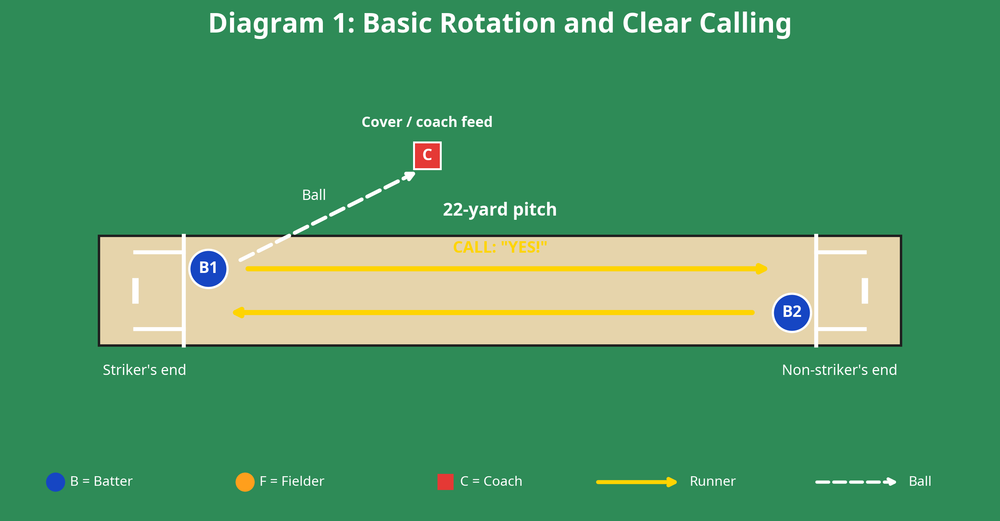
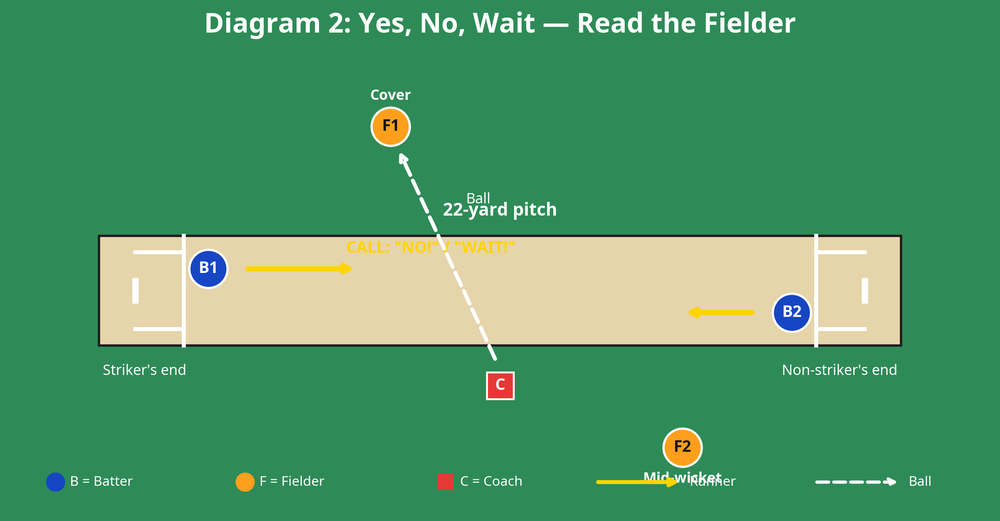
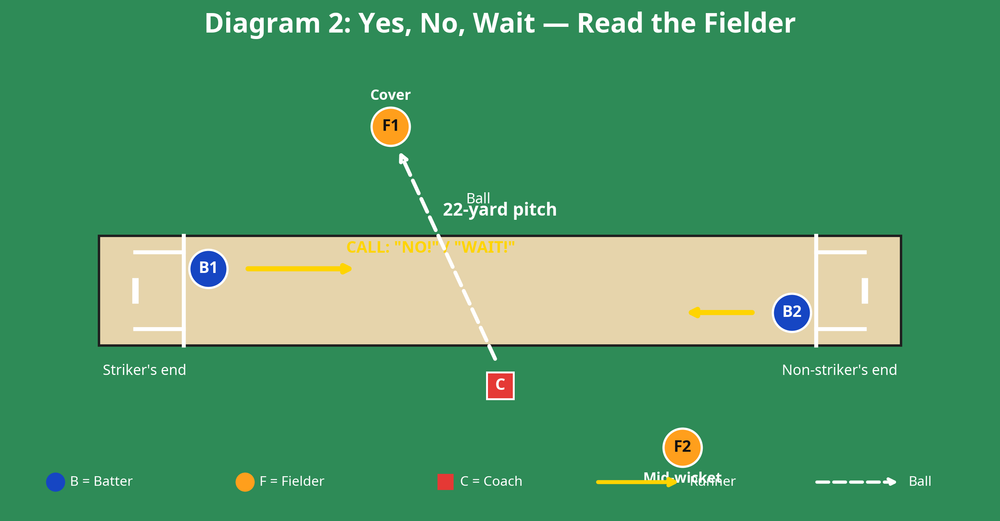
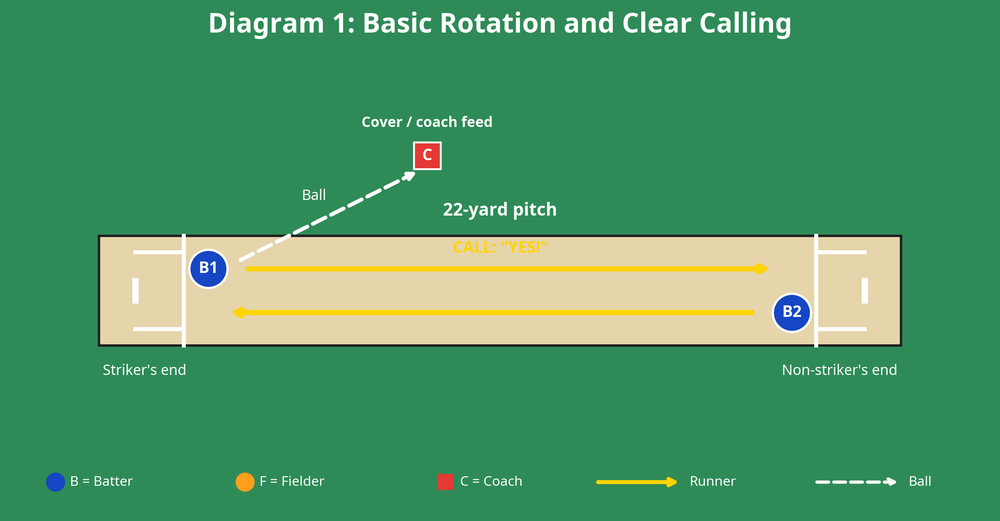
Set up on a marked pitch whenever possible. Place Batter 1 (B1) at the striker's end and Batter 2 (B2) at the non-striker's end. Position the Coach (C) 5 yards (4.6 m) square of the striker, just beyond the edge of the pitch, where they can feed safely and see both runners. In the decision phase, place Fielder 1 (F1) at cover, approximately 15 yards (13.7 m) from the striker, and Fielder 2 (F2) at mid-wicket, approximately 18 yards (16.5 m) from the non-striker's end. A wicket-keeper may replace C at either end when the group is confident.
The popping crease is 4 ft / 1.22 m in front of and parallel to the bowling crease.2 If you are on an unmarked outfield, cone each popping crease and use a tape measure rather than estimating. Coaches should remind players that a batter is in the ground only when some part of their person or bat is grounded behind the popping crease.3 That makes every bat slide in this drill meaningful, rather than cosmetic.
| Item | Quantity | Coaching use |
|---|---|---|
| Cricket balls or incrediballs | 6 | Keep feeds flowing; avoid a pause after a misfield. |
| Cricket bats | 2 per active pair | Players use the bat they normally compete with. |
| Cones or flat markers | 8 | Mark crease extensions, safe running lanes, and feeder positions. |
| Stumps or target stumps | 2 sets | Give the thrower a clear, match-relevant target. |
| Full batting kit | 1 set per batter | Recommended from U12 upward for authentic movement. |
| Stopwatch / whistle | 1 | Run the 90-second work and 30-second reset intervals accurately. |
3. Step-by-Step Instructions
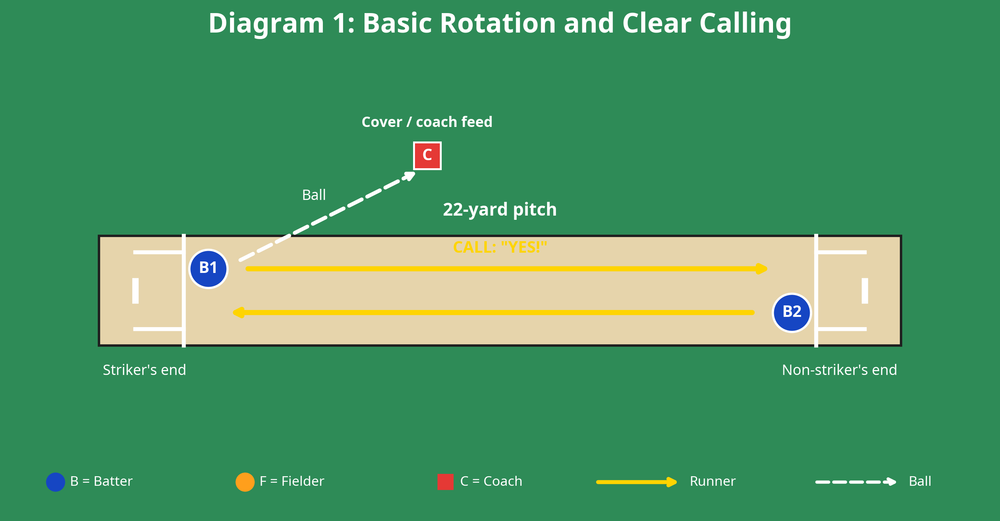
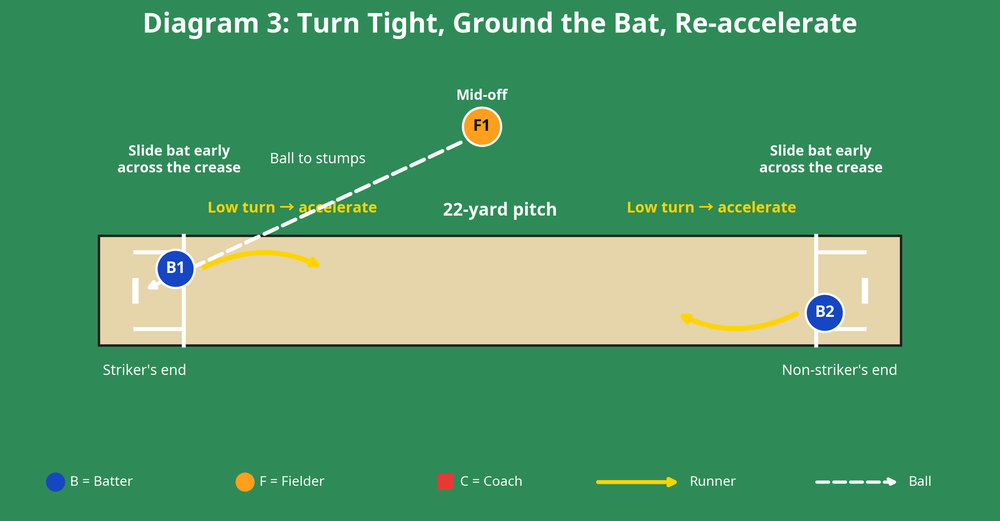
Brief the pair. Give B1 and B2 one non-negotiable rule: the caller owns the decision and the partner reacts at full pace. In this version, B1 calls on shots in front of square and B2 calls on shots behind square. The coach may reverse that convention later, but do not change it during the first block.
Set the starting detail. Both players begin with their bat grounded behind their popping crease, body facing the coach, and eyes level. B2 begins a small anticipation movement but must not leave early. The coach calls “Play” and feeds or points to a nominated scoring zone.
Create the first call. B1 simulates the shot, immediately calls “Yes!”, “No!”, or “Wait!”, and points the first three strides toward the opposite end. Demand a call by the time the ball has travelled 5 yards (4.6 m), not after the fielder has picked it up.
Sprint the first run. If the call is “Yes,” both players sprint on opposite sides of the pitch: B1 uses the side nearest the ball after striking and B2 takes the opposite lane. Their objective is to cross at approximately 11 yards (10.1 m), with no veering into each other’s path and no running down the centre of the wicket.
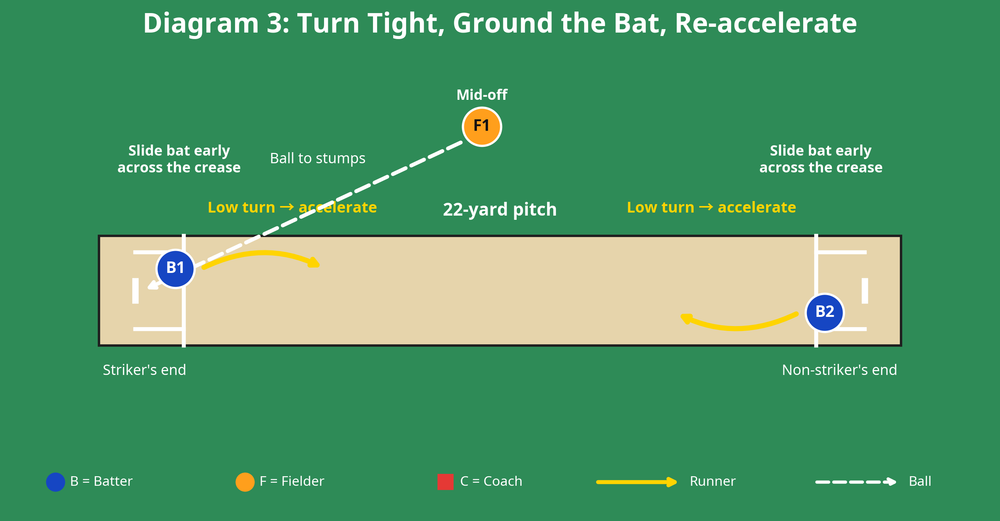
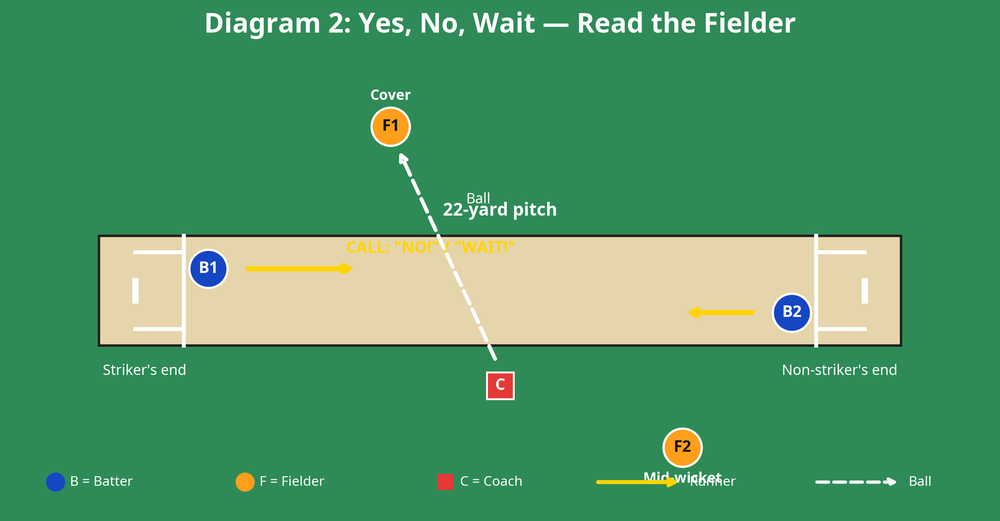
Make the ground properly. In the final 2 yards (1.8 m), each batter lowers their hips, extends the bat early, and slides it across the popping crease. The head stays stable enough to scan the ball; the player does not simply charge through the line and turn blind.
Turn and reassess. Immediately after grounding the bat, each batter opens toward the ball. C either holds the ball, points to the active fielder, or gives F1/F2 a live roll. The new striker calls the second decision. If the return is slow or misfielded, the call is “Yes, two!”; if the danger end is covered, it is “No!”; if the ball is still travelling, use “Wait!”
Finish the sequence. The pair completes one, two, or three runs, as dictated by the cue. On the final run, the active fielder throws under control at the target stumps. The runner must ground the bat, then decelerate outside the pitch before returning to the queue.
Rotate quickly. After each 90-second effort, swap B1/B2 with the next pair and move the fielder roles. Give one concise correction—such as “call earlier” or “turn lower”—rather than a long stoppage.
Score quality, not just volume. Award one point for a correct first call, one for a clean bat-grounding action, one for a correct second decision, and one for a legal, controlled finish. A pair earns a maximum of four points per ball. The running total encourages precision when fatigue rises.
4. Key Coaching Points
| Coaching point | What the coach should see | Immediate cue |
|---|---|---|
| Call early and loudly | The caller speaks before the runners reach halfway; the partner responds without looking back. | “Name it early; own it.” |
| Run the first run hard | First three steps are explosive and neither runner assumes a single. | “Make the fielders hurry.” |
| Use separate running lanes | Batters cross safely and preserve the centre strip. | “Own your side of the wicket.” |
| Slide the bat early | The bat is grounded behind the line before the body passes it. | “Bat first, body through.” |
| Turn low, eyes up | Hips drop, head turns toward the ball, and the player can re-accelerate. | “Low turn; find the ball.” |
| Check the danger end | The next caller identifies where the throw can beat them. | “Read arm, angle, and end.” |
5. Common Mistakes
Correct late or doubled calls by asking who owned the decision, then repeating at 60% pace. Correct jogging by demanding a sprint through a cone 2 yards beyond the crease. Demonstrate a low, open turn whenever players turn blind, insist on a grounded bat, and mark lanes if runners drift into the centre of the pitch.
6. Variations & Progressions
| Progression | How to run it | What it adds |
|---|---|---|
| Traffic-light calling | C gives a green, amber, or red signal after the shot; the pair converts it to “Yes,” “Wait,” or “No.” | Faster verbal processing without a live throw. |
| Two active fielders | F1 gathers at cover and F2 backs up at mid-wicket; C rolls to either at random. | Reading arm strength, angle, and the danger end. |
| Three-run pressure | The pair must complete three runs from a deep-shot cue, with a live throw on the final run. | Re-acceleration and decision-making under fatigue. |
7. Age Adaptations
For Under 8s and Under 10s, use a softer ball, cones instead of stumps, and a shortened pitch chosen for the group. Focus on a single outcome: loud “Yes” and “No” calls followed by a safe bat grounding. Keep efforts to 30 seconds, then rotate. Under MCC Law 6.6, the relevant governing body determines junior pitch length, so local competition guidance should always take priority.1
For Under 12s and Under 14s, progress to a marked or full-length pitch, 60-second efforts, and one active fielder. Teach the “Wait” call explicitly and insist on separate lanes. Do not overload the session with punishment; use the four-point quality score so players can learn quickly from an error.
For Under 16s and Open players, use full kit, live throws, and the full 90-second blocks. Ask fielders to disguise whether they will throw to the striker’s or non-striker’s end, then review whether the pair identified the genuine danger end. The best version is competitive: pairs need a target score, but the coach must protect technique by subtracting a point for poor communication even when the runners make their ground.
References