

Cricket
Wicket-Keeping Agility: Lateral Collection and Standing-Up Reaction Series
A progressive, coach-led wicket-keeping drill that sharpens lateral footwork, soft hands, close-range reactions and rapid recovery at the stumps.

What you need
1 set of stumps and bails, 12–18 cricket balls, 6 cones, wicket-keeping gloves, wicket-keeping pads, wicket-keeping helmet, sidearm thrower (optional), Katchet board or deflection ramp (advanced progression)
Overview
Wicket-Keeping Agility: Lateral Collection and Standing-Up Reaction Series is a progressive, coach-led session for improving the two movements that decide whether a keeper turns a half-chance into a clean take: getting the head and feet into the ball line when standing back, then reacting compactly when standing up. Use it early in a specialist keeping block, before a net session, or as a 24-minute station within a fielding circuit. It suits an intermediate keeper from Under 14 upward, but the distances and ball type scale cleanly for younger groups.
The drill separates movement quality from speed. In phase one, the keeper moves 0.8–1.2 m to either side from a balanced base and collects a bounced feed. In phase two, the keeper works close to the stumps against a rapid three-ball sequence. Coaches should insist on the full sequence: move, set the head, receive with soft hands, recover and reset. The regulated pitch is 22 yards (20.12 m) long and 10 ft (3.05 m) wide, giving coaches a reliable frame for placing the stumps and feeder. 1
Session outcome: By the end of the block, the keeper should move their feet before reaching with their gloves, collect with the head inside the ball line, and return to a balanced base within three seconds.
Setup
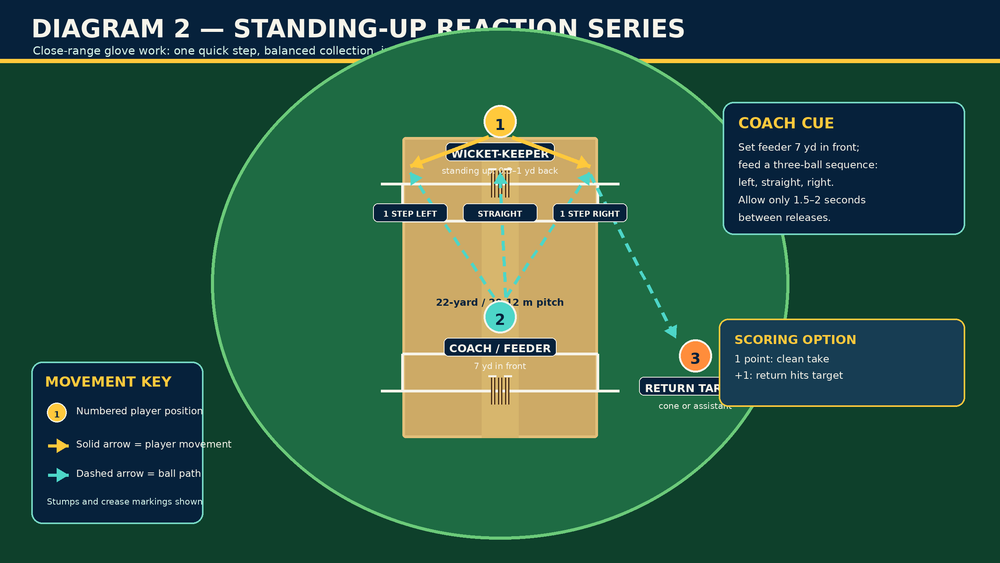
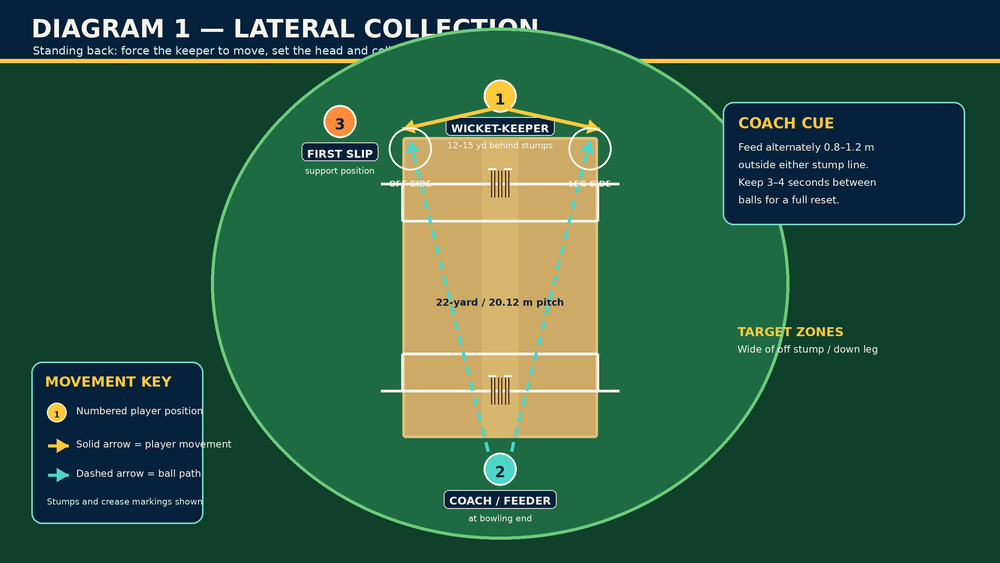
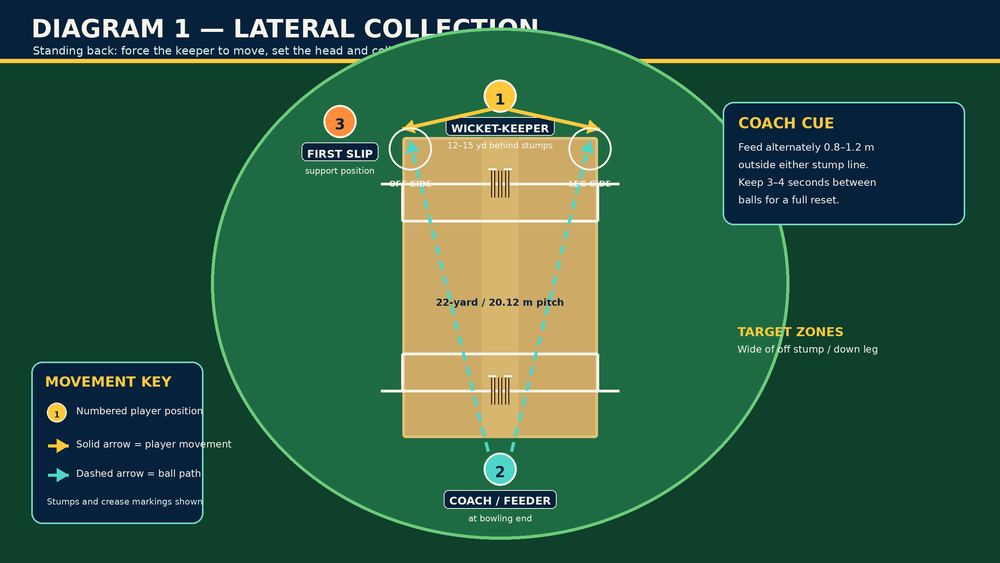
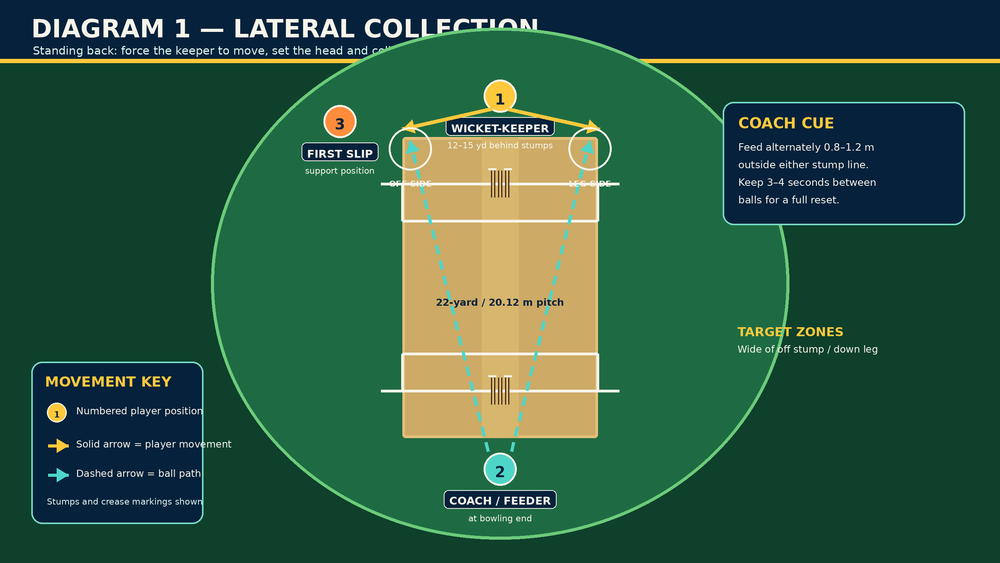
Set the activity on one end of a full pitch or on a marked 22-yard strip on the oval. Diagram 1 uses Position 1: Wicket-Keeper, Position 2: Coach/Feeder, and Position 3: First Slip. The coach may replace First Slip with a cone in a two-person session, but a live slip is better because it preserves realistic communication and gives the keeper an outlet for edged balls. A wicket-keeper is the only fielder permitted to wear gloves and external leg guards, so ensure correctly fitted keeping equipment before pace or hard-ball feeds. 2
| Item | Quantity | Coaching set-up |
|---|---|---|
| Stumps, bails and crease markers | 1 set | Mark the bowling and popping creases accurately at both ends. |
| Cricket balls | 12–18 | Use softer training balls first if the keeper is young or new to the drill. |
| Cones | 6 | Place two collection gates 0.8–1.2 m outside off and leg stump lines; use four more to define the feeder and return target. |
| Keeping gloves, pads and helmet | 1 set | Mandatory for hard-ball feeds; the helmet should remain on when the keeper stands up. |
| Sidearm or underarm feeder | 1 | Optional; use only after the keeper owns the basic movement pattern. |
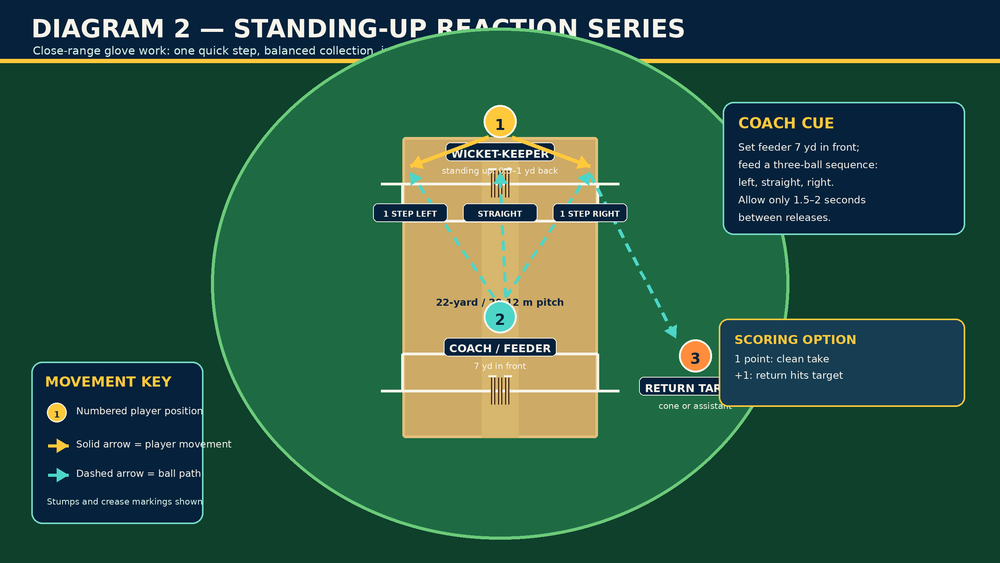
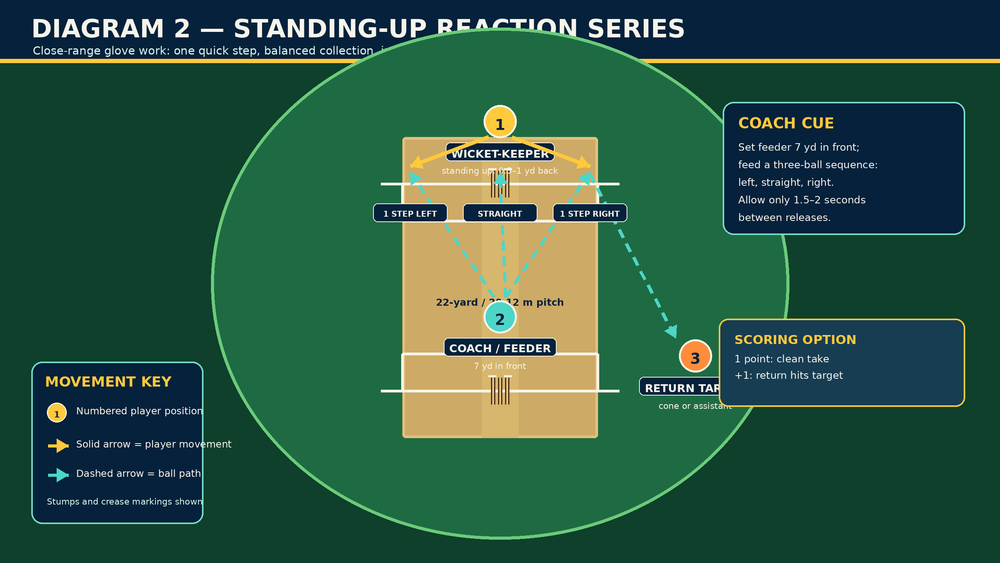
Place the keeper 12–15 yards behind the stumps for the standing-back phase. Set First Slip 3–4 m behind and 3–4 m wider than the keeper on the off side. Keep 5 m clear behind the keeper for safety. For the standing-up phase, bring the feeder to 7 yards (6.4 m) in front of the stumps and position the keeper 0.5–1 yard behind the wicket.

Diagram 1: Standing-back lateral collection
In Diagram 1, solid gold arrows show footwork and dashed teal arrows show ball flight. Feed alternately to off-side and leg-side zones, below chest height, with 3–4 seconds for a complete reset. The feed must demand a purposeful first step without forcing a desperate reach.
Step-by-Step Instructions
Brief and demonstrate (2 minutes). State the non-negotiables: “Move the feet first, head to ball line, hands give on impact.” Demonstrate a poor reach and then the correct shuffle so players can see the difference.
Set the starting position (2 minutes). Position 1 crouches with feet just wider than hip width, knees flexed, weight on the balls of the feet and gloves relaxed in front of the knees. The chin is level and the eyes are fixed on Position 2. Ask First Slip to call “yours” only if the ball enters their realistic zone; this prevents automatic, late calls.
Run the controlled lateral series (8 minutes). Position 2 sends sets of six bounced feeds: three outside off stump and three down leg, in a deliberately mixed order. At release, the keeper makes a short directional shuffle or a positive first step off the outside foot. They must arrive with the nose and sternum behind the line of the ball, receive it in the glove webbing, allow the hands to travel back 10–15 cm, then return the ball to the feeder. Rotate after two sets of six; give immediate feedback after the second and fourth ball, not after every delivery.
Add the decision cue (4 minutes). On four of the next 12 feeds, send a ball close enough to First Slip for a genuine communication decision. The keeper should call early and clearly if taking it; if not, they stay balanced and let the slip complete the chance. Do not allow the coach to create collisions for the sake of difficulty.
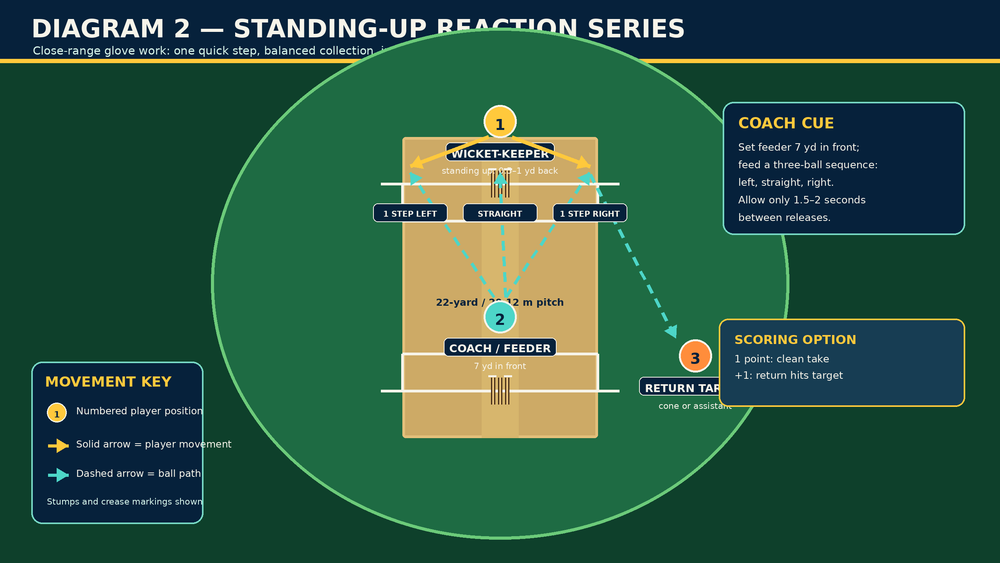
Transition to standing up (2 minutes). Move Position 1 to 0.5–1 yard behind the stumps and bring Position 2 to the 7-yard feeder mark. Re-state the new intention: short feet, no excessive dive, and hands returning immediately to the stumps after every take.
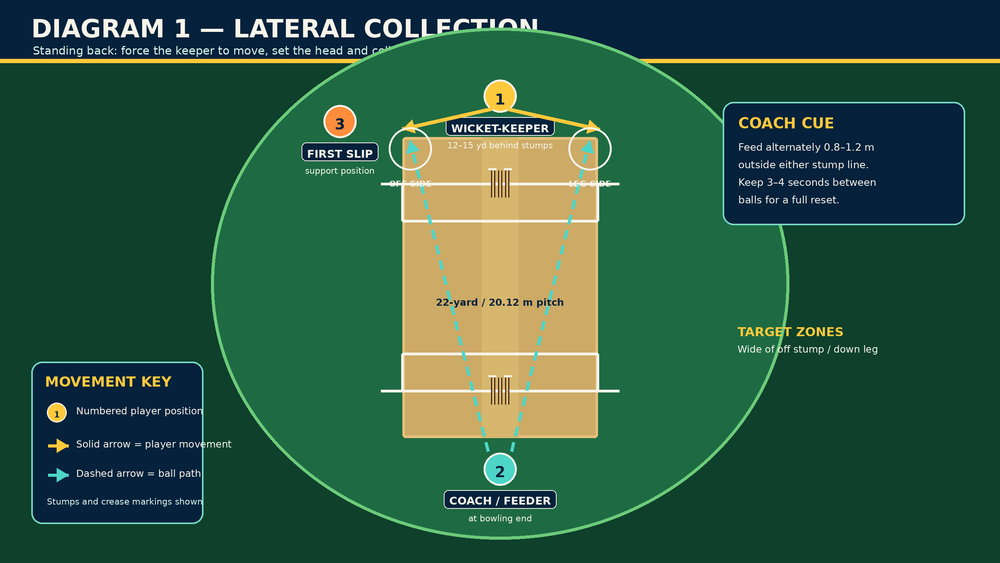
Diagram 2: Standing-up reaction series
Diagram 2 uses a left–straight–right sequence in 1.5–2-second intervals. The keeper makes no more than one decisive step where possible. Award one point for a clean take and one more when the return hits Position 3’s target. Run four sequences, rest 45 seconds, then swap roles.
- Finish with a pressure set (4 minutes). Give the keeper a target of 10 clean takes from 12 balls. If a take is dropped, reset the score to the previous even number rather than adding punishment. The coaching target is repeatable technique under mild pressure, not fatigue-induced scrambling.
Key Coaching Points
| Coaching priority | What the coach should see | Immediate cue |
|---|---|---|
| First movement | The outside foot drives the body into the ball line; feet do not cross. | “Push, then shuffle.” |
| Head position | The keeper’s head arrives behind or just inside the ball line before the gloves receive it. | “Nose to ball.” |
| Base and posture | Hips stay low enough to move; chest remains forward rather than falling backward. | “Stay loaded.” |
| Hand action | Gloves present early with thumbs relaxed; hands give on contact rather than snatch. | “Soft hands, quiet catch.” |
| Recovery | After the take, the keeper regains a compact base and returns hands toward the stumps. | “Catch, recover, ready.” |
| Communication | The keeper owns their ball call early and listens to the slip call on the edge of their zone. | “Call once, call early.” |
Common Mistakes
The usual error is standing up before the keeper has moved into line. Reduce the feed pace and insist on a low starting shape. Keepers also reach with static feet; make one visible lateral step compulsory before every collection. Watch for hard hands—a loud impact, rebound or locked elbows—and rehearse a gentle underarm catch with hands travelling back. Finally, prevent over-diving: if one short step reaches the ball, a dive teaches the wrong solution.
Variations & Progressions
Use these progressions only when the keeper produces at least 10 clean takes from 12 in the prior level. Easier: feed underarm from 10–12 yards with an Incrediball or tennis ball and give a five-second reset. Harder: use a sidearm from the bowling crease, vary bounce deliberately, and require the ball to be returned to a single-stump target. Advanced: place a Katchet board or angled deflection ramp 5–6 m in front of the keeper, but keep feeds below shoulder height and use a helmet, gloves and close supervision. The ramp changes the visual cue and develops reaction quality without changing the core movement principle.
Age Adaptations
For Under 8s, use tennis balls, a feeder 5–6 m away and one-direction feeds. For Under 10s, use an Incrediball from 7–10 m and cones instead of live First Slip. For Under 12s, introduce pads, a hard training ball and alternating feeds from 12–16 m. For Under 14s and Under 16s, run the full diagram with a live First Slip and timed sequences. In open-age cricket, add pace and deflections only after technique is stable.
Coach’s Finish and Review
Close the station by asking the keeper one question: “What got you to the ball line first: your hands or your feet?” The correct answer should be the feet and head. Record clean takes out of 12, number of premature reaches, and the keeper’s best return-target score. Those three measures give a coach a practical baseline for the next session.
