Cricket
Elite Wicket-Keeping Agility & Recovery Drill
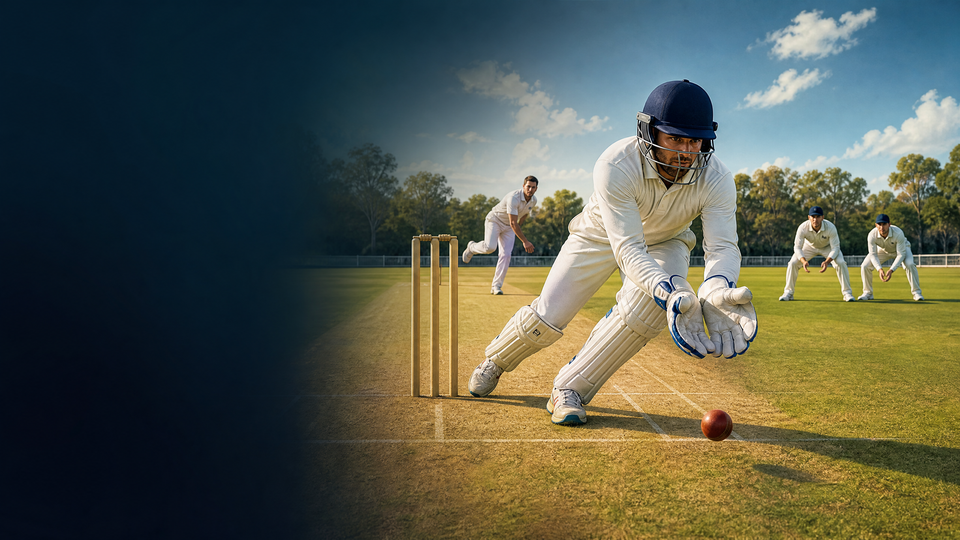
A high-intensity agility drill designed to develop a wicket-keeper’s lateral movement, balance, and rapid recovery behind the stumps.
What you need
wicket-keeping gloves, wicket-keeping pads, 6-8 practice cricket balls, 3 stumps, 2 agility cones, 2 target hoops
Elite Wicket-Keeping Agility & Recovery Drill
A comprehensive, high-intensity agility drill designed to develop a wicket-keeper’s lateral movement, balance, and rapid recovery behind the stumps. This resource provides head coaches and specialist keeping coaches with a structured framework to improve glovework under fatigue and replicate match-day pressure.
1. Overview
Wicket-keeping at an elite level demands explosive lateral movement, exceptional balance, and the ability to recover instantly after a take or a dive. This agility and recovery drill isolates the specific footwork patterns required to move efficiently from a central set position to collect wide deliveries on both the off and leg sides.
Coaches should use this drill during the specialist fielding block of a training session, or as a high-intensity physical conditioning station. It is particularly effective for correcting heavy-footed movement and ensuring keepers maintain a low centre of gravity while tracking the line of the ball. By incorporating immediate recovery and subsequent reaction phases, the drill closely mirrors the physical demands of keeping to pace bowlers on variable pitches.
2. Setup
Proper setup is critical to ensure the drill forces the correct movement patterns without compromising safety. The drill requires a flat, predictable surface, ideally on a grass practice wicket or a high-quality synthetic pitch.
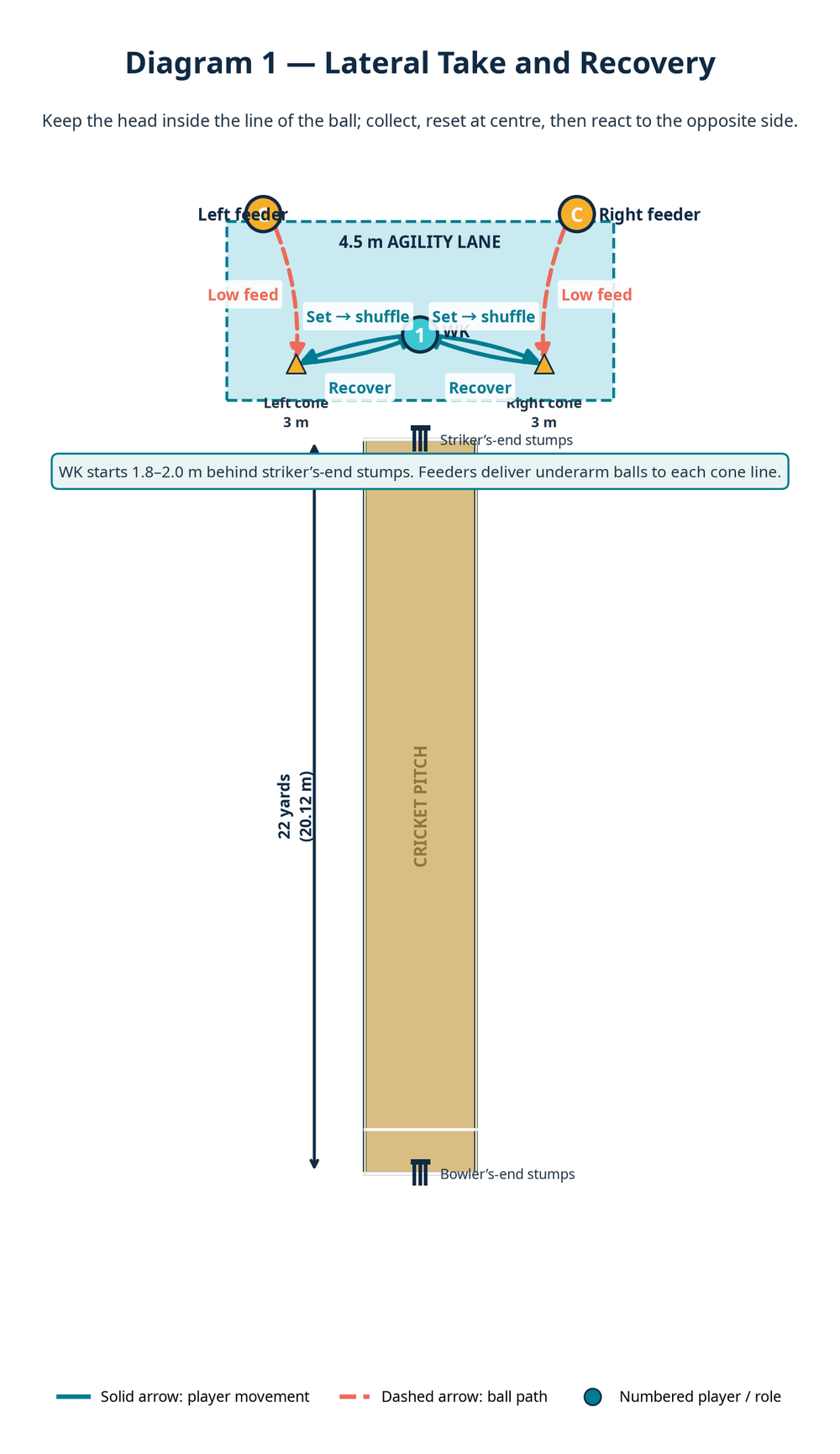
The full pitch diagram uses the regulation 22-yard/20.12-metre by 10-foot/3.05-metre playing-pitch dimensions set out in MCC Law 6.1.1
Equipment Needed:
- 1 pair of wicket-keeping gloves and pads
- 6–8 practice cricket balls (preferably a mix of new and slightly worn balls)
- 3 stumps (set up at the striker’s end)
- 2 agility cones (brightly coloured)
- 2 target hoops or additional cones for the release phase
Field Setup & Player Positions:
Establish a 4.5-metre agility lane directly behind the striker’s-end stumps. Place the left cone 3 metres to the off side (for a right-handed batter) and the right cone 3 metres to the leg side, forming a straight lateral line approximately 1.8 to 2.0 metres behind the stumps.
The Wicket-Keeper (WK) begins in their standard crouch position directly behind the stumps. Two coach feeders stand approximately 4 to 5 metres away, facing the keeper. One feeder is positioned to deliver to the left cone, and the other to the right cone.
3. Step-by-Step Instructions
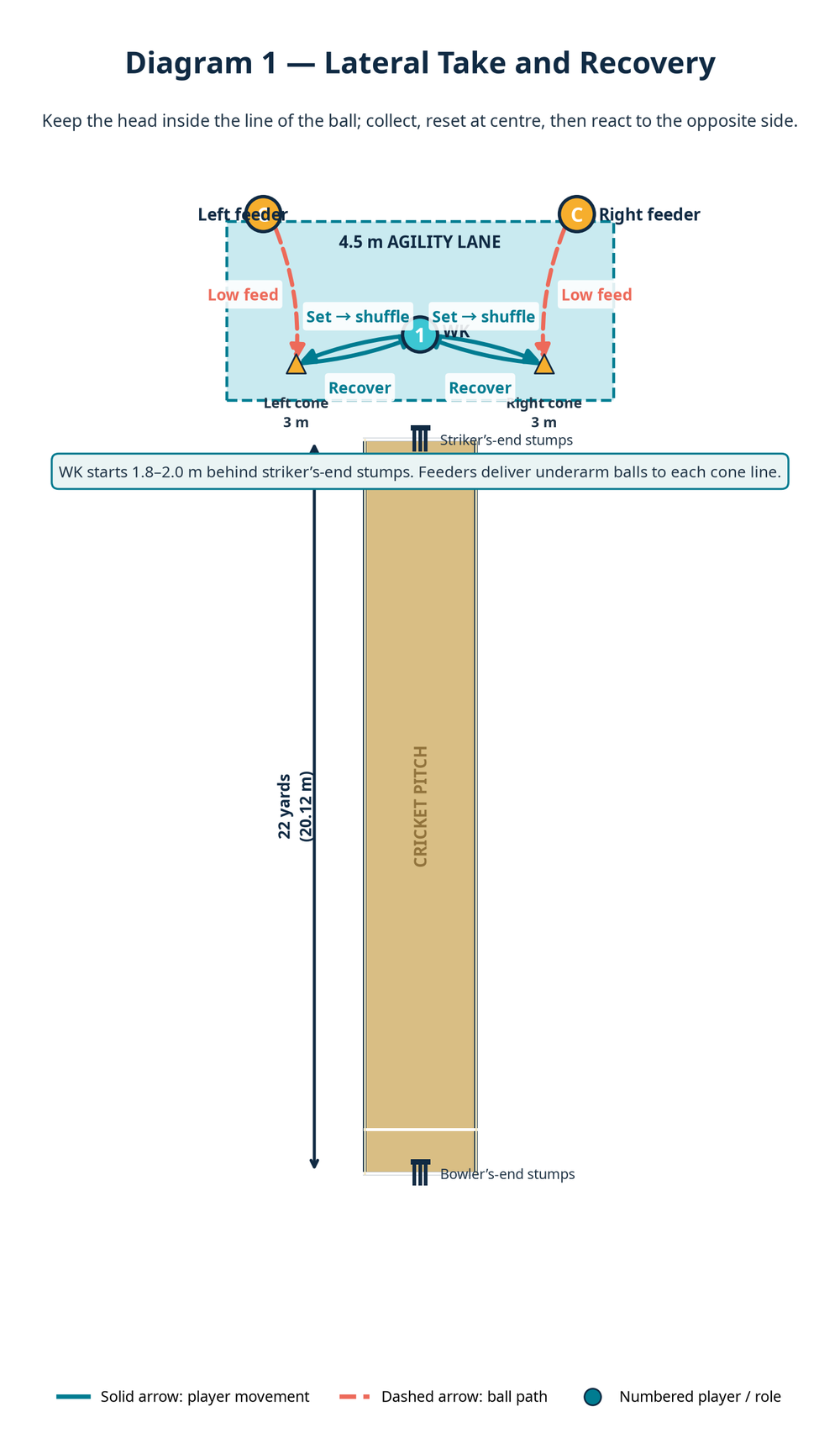
This drill is broken down into a continuous, high-intensity sequence. Coaches must dictate the pace, ensuring the keeper completes the full movement cycle before the next ball is fed.
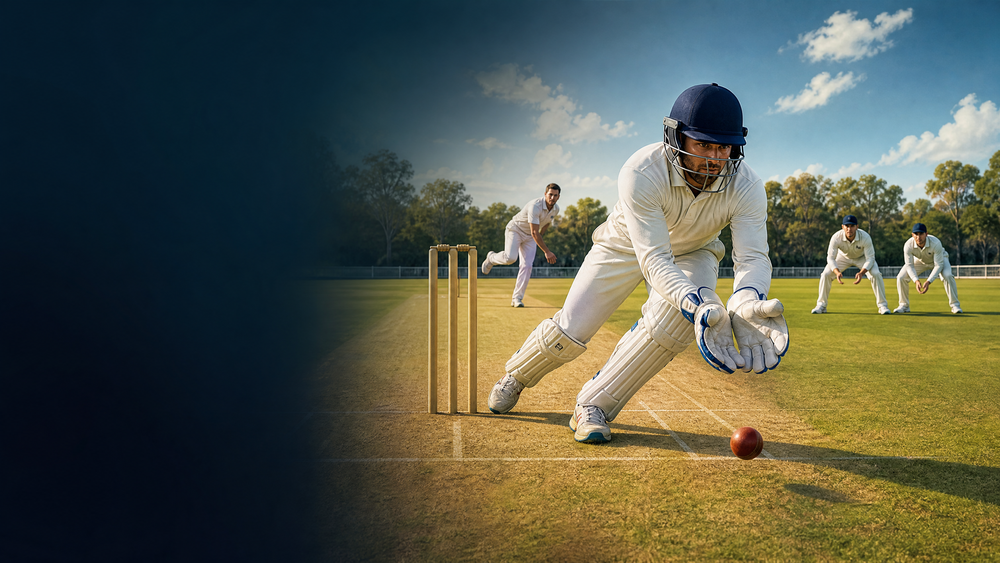
Phase 1: Lateral Take and Recovery
- The wicket-keeper assumes a balanced, low set position directly behind the central stumps.
- On the coach’s call, the left feeder delivers a firm, underarm throw aiming for the left cone.
- The keeper executes a rapid lateral shuffle, keeping their head inside the line of the ball, and takes the ball cleanly at the cone.
- Immediately upon collection, the keeper drops the ball and recovers back to the central set position.
- As soon as the keeper is set, the right feeder delivers to the right cone.
- The keeper repeats the lateral shuffle to the right, collects, drops, and recovers to the centre.
- Repeat this sequence for a set of 6 to 8 deliveries (3 to 4 each side).
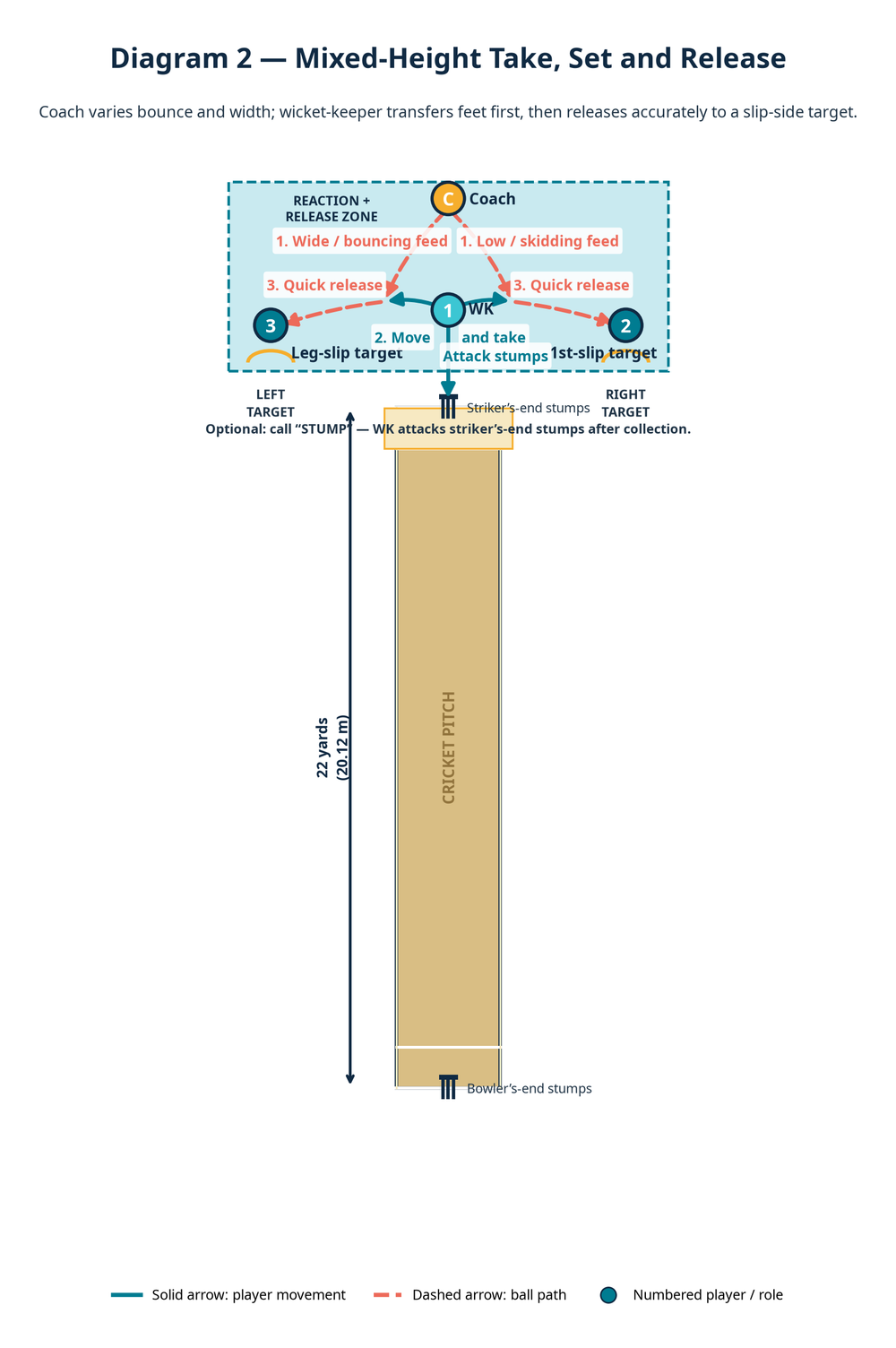
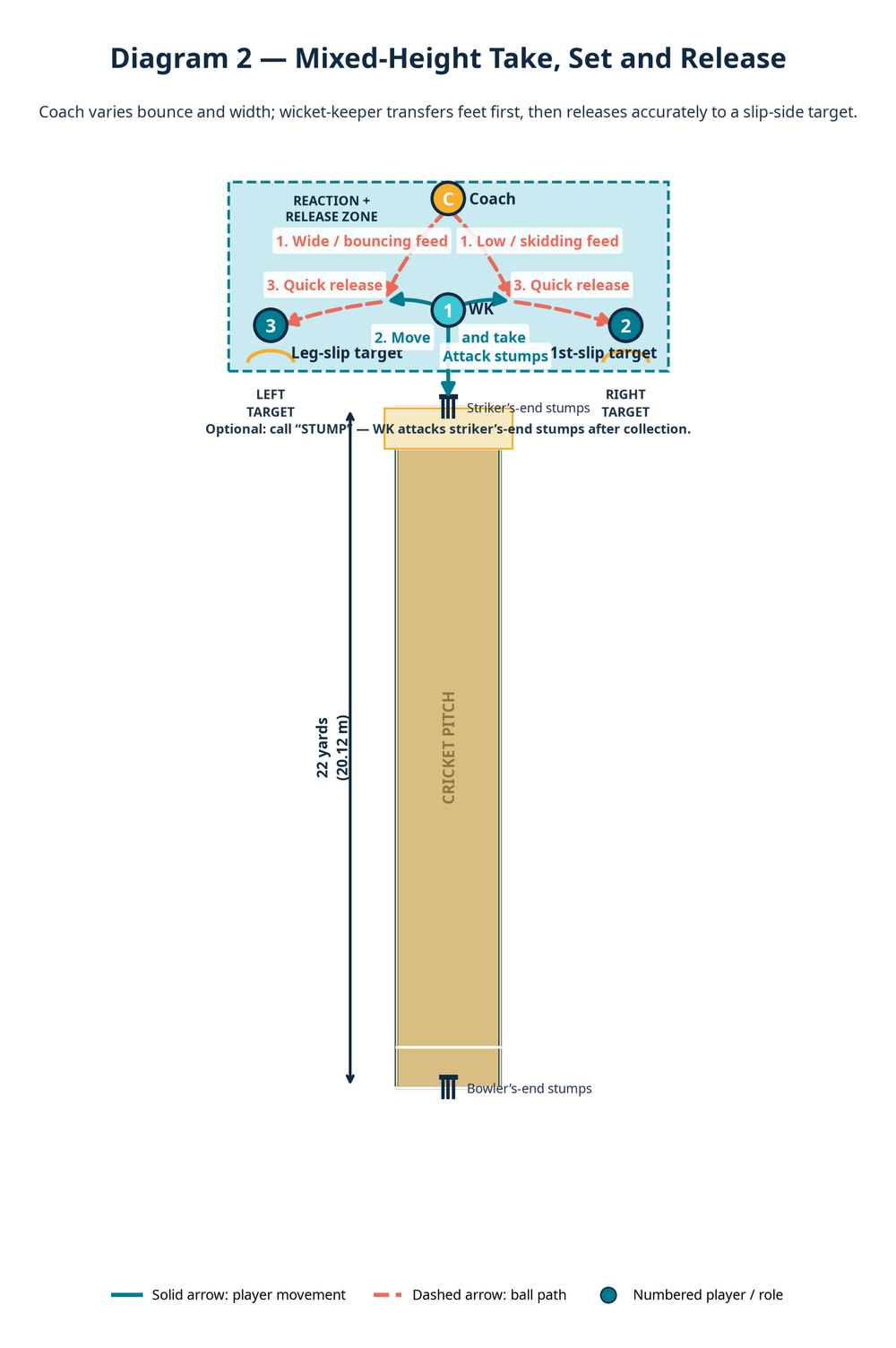
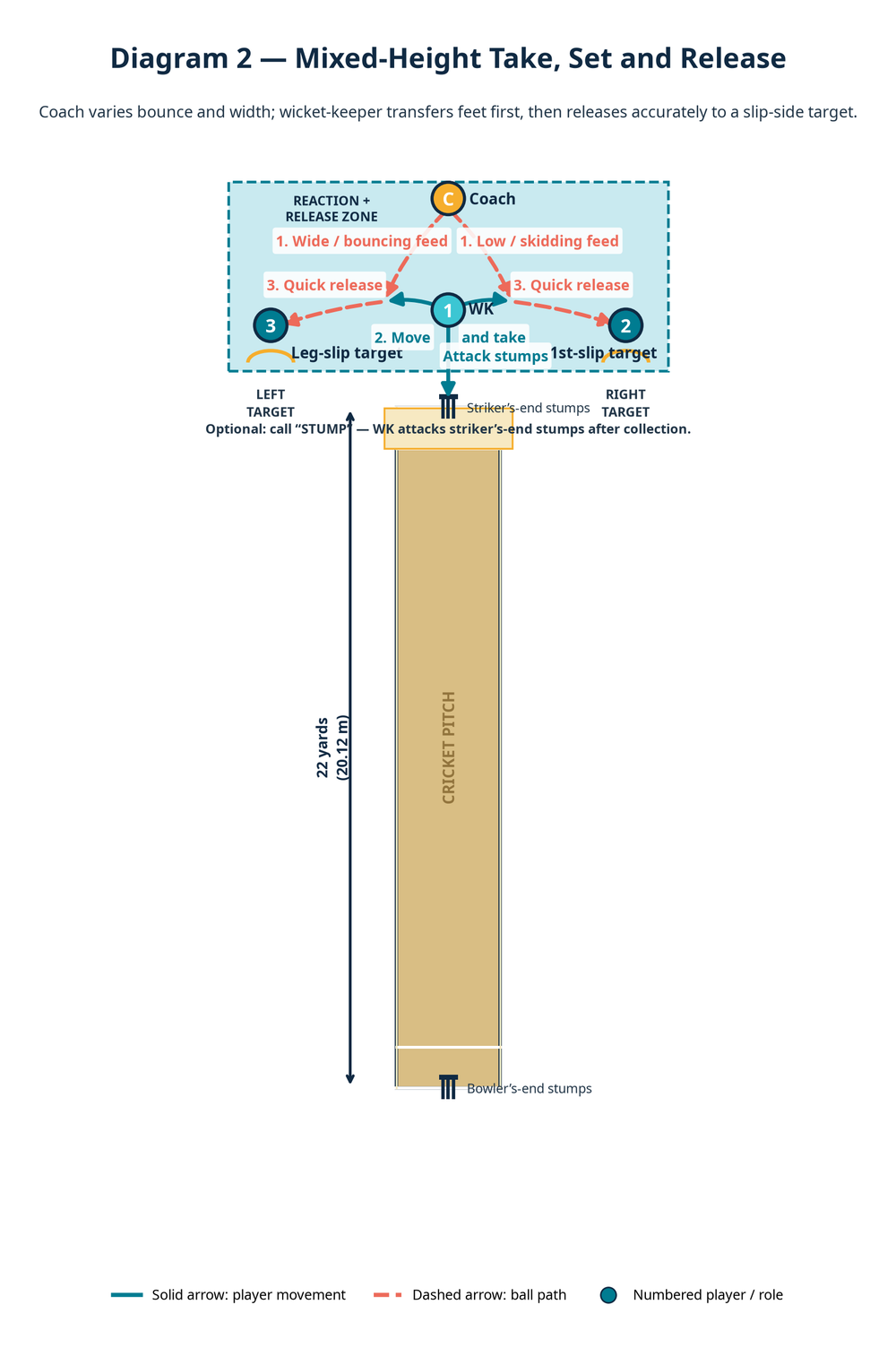
Phase 2: Mixed-Height Take, Set, and Release
Once the keeper has mastered the lateral shuffle, introduce the release phase to simulate run-out opportunities and sharp infield distribution.
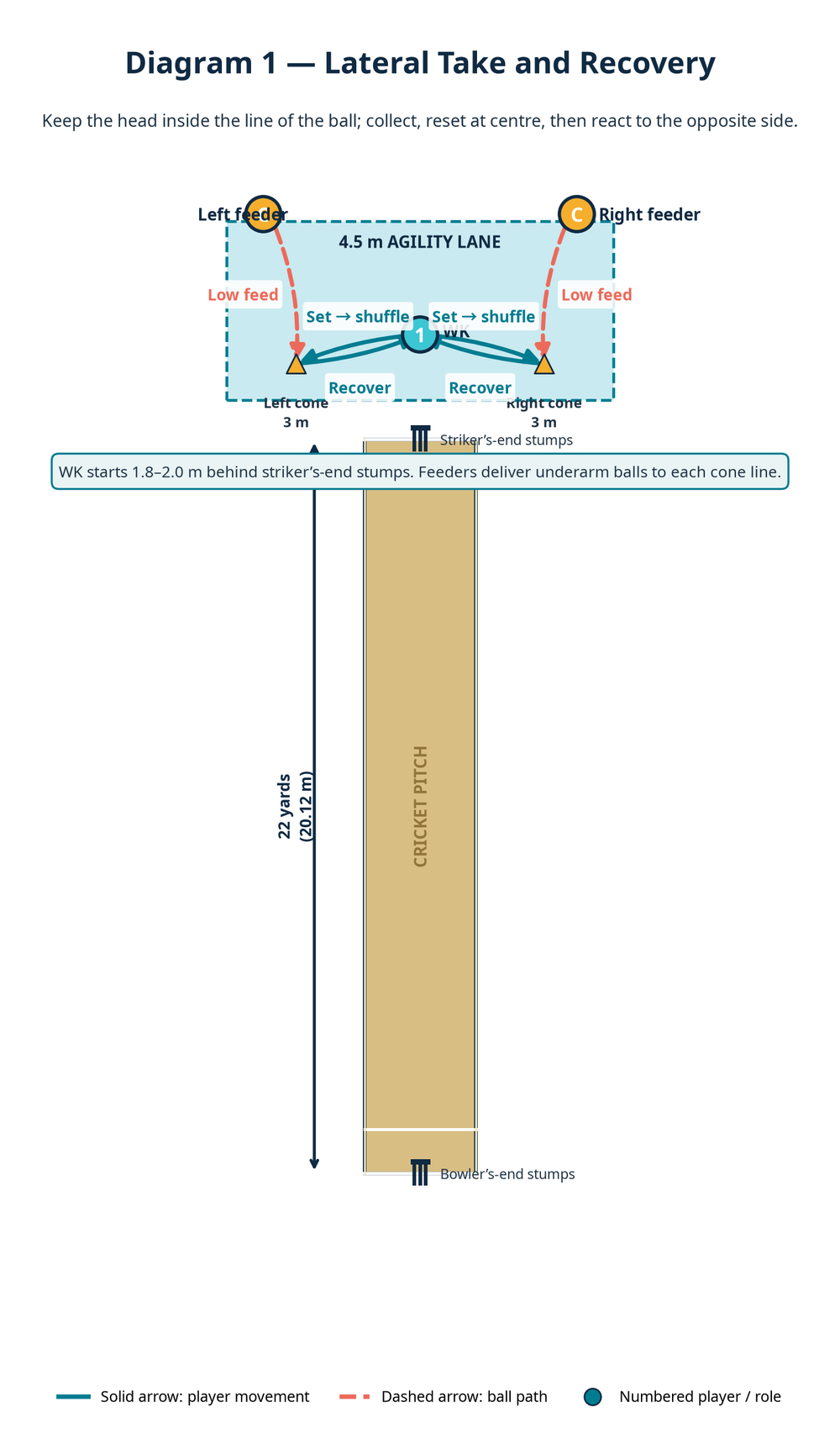
- The keeper starts in the central set position.
- A single coach feeder varies the delivery—mixing wide bouncing feeds with low, skidding feeds to either side of the stumps.
- The keeper must transfer their weight, move their feet first, and take the ball cleanly.
- Upon collection, the keeper immediately sets their base and executes a quick, accurate underarm or side-arm release to a designated slip-side target (e.g., a hoop placed at 1st slip or leg gully).
- Optional: The coach can occasionally call "STUMP," prompting the keeper to attack the striker’s-end stumps instead of throwing to the slip target.
4. Key Coaching Points
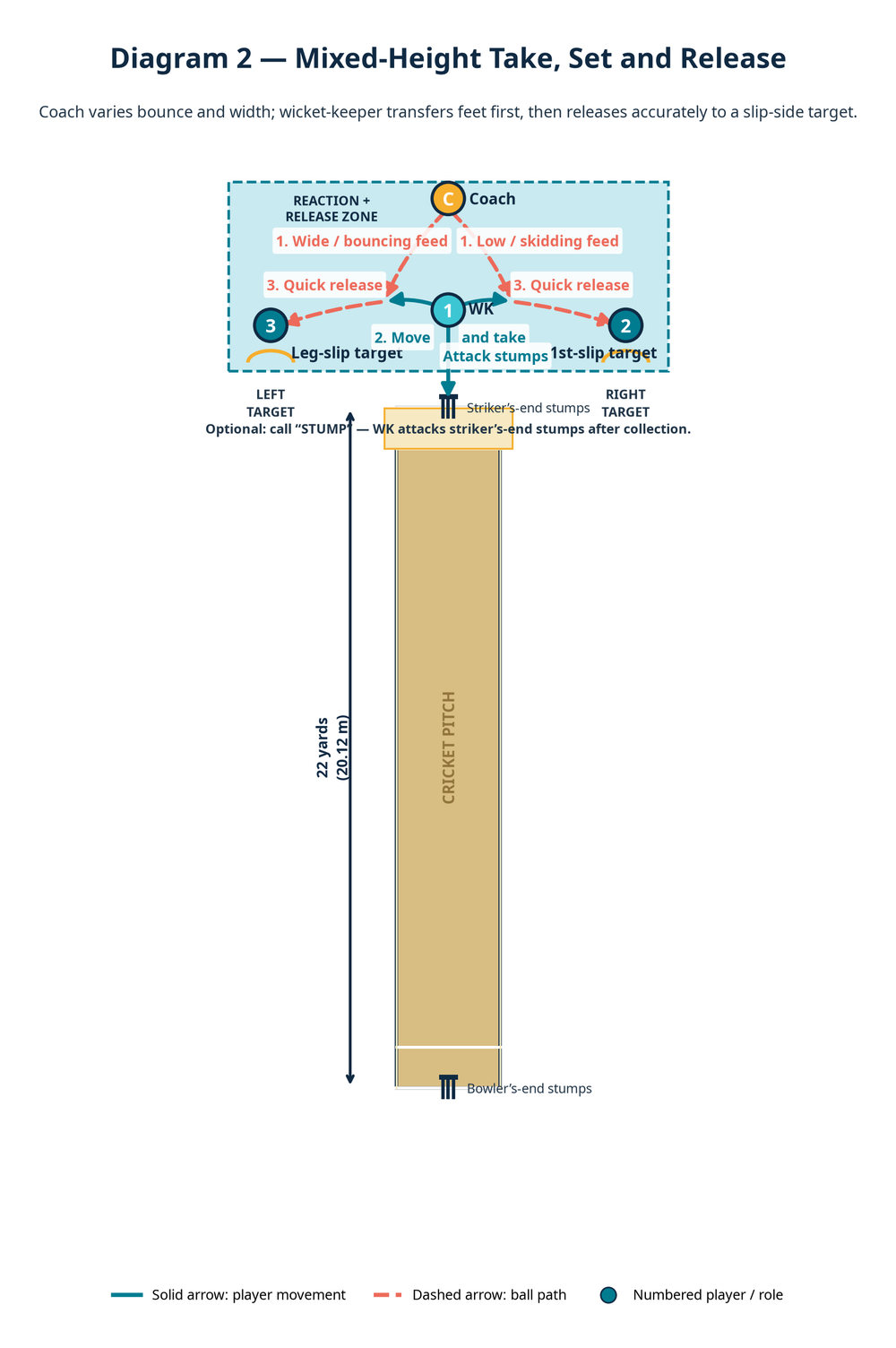
To maximize the effectiveness of this drill, coaches must closely monitor the keeper's technique and provide immediate, actionable feedback.
- Head Position: The head must lead the movement and remain inside the line of the ball upon collection. If the head falls outside the line, the keeper will lose balance and struggle to recover.
- Footwork First: Emphasise moving the feet to get the body behind the ball, rather than merely reaching with the hands. A strong, wide base ensures a clean take.
- Low Centre of Gravity: The keeper must stay low during the lateral shuffle. Popping up between takes wastes time and disrupts the line of sight.
- Soft Hands: Encourage "giving" with the ball upon impact. The hands should act as shock absorbers, bringing the ball softly into the body.
- Explosive Recovery: The transition from taking the ball to pushing off the outside foot back to the centre must be aggressive and immediate.
5. Common Mistakes
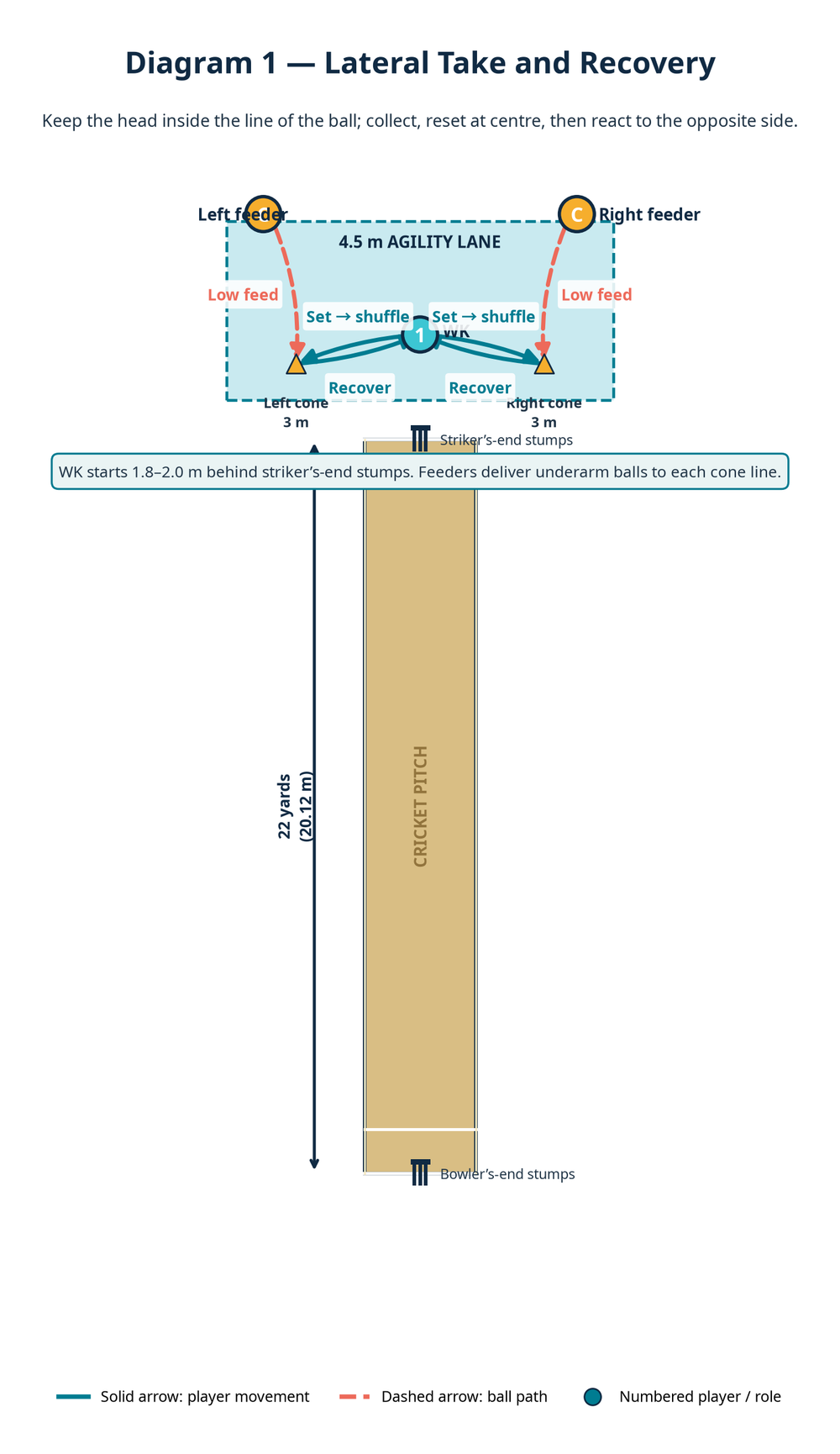
Watch for these frequent technical breakdowns, particularly as fatigue sets in during the latter stages of a set.
- Reaching Instead of Moving: Keepers often plant their feet and reach for wide deliveries. Correction: Force the keeper to touch the cone with their outside foot before taking the ball.
- Standing Up: Rising out of the crouch during the lateral shuffle. Correction: Set a physical or visual height limit (e.g., a string line) that the keeper must stay beneath.
- Hard Hands: Snatching at the ball, causing it to bounce out of the gloves. Correction: Remind the keeper to let the ball come to them and catch it near the body.
- Imbalanced Release: Throwing to the slip target while falling away. Correction: Insist on a momentary pause to establish a solid base before the release.
6. Variations & Progressions
Adapt the drill to challenge elite keepers or focus on specific match scenarios.
- Deflection Feeds: Use a slip cradle, a Katchet ramp, or a distinctively shaped reaction ball to create unpredictable bounce and deviations, forcing the keeper to adjust their line late.
- Pace Bowling Simulation: Move the feeders back to 10–12 metres and use a side-arm thrower (e.g., a RoboArm) to deliver high-velocity feeds, simulating keeping to genuine fast bowling.
- Blind Start: The keeper starts facing the stumps. On the coach's call, they must spin 180 degrees, locate the ball in flight, move, and execute the take.
7. Age Adaptations
This drill can be scaled for younger or less experienced wicket-keepers.
- Under 10s / Under 12s: Reduce the agility lane width to 2 metres total (1 metre each side). Use softer incrediballs or tennis balls to build confidence. Focus entirely on the footwork and soft hands, removing the rapid recovery requirement.
- Under 14s: Maintain a slightly narrower lane (3 metres). Introduce the recovery phase but allow a longer pause between feeds to ensure the set position is correct before the next movement.
- Under 16s: Run the standard drill dimensions. Introduce the mixed-height feeds and the release phase, focusing on the speed of the transition from catching to throwing.
References