

Cricket
The Diamond Agility & Reaction Drill for Wicket-Keepers
A high-intensity movement drill designed to improve a wicket-keeper's lateral speed, balance, and catching under fatigue.
What you need
Wicket-keeping gloves and pads, Helmet, 6-12 cricket balls, 4 marker cones, 1 set of stumps
1. Overview
The Diamond Agility & Reaction Drill is a high-intensity, multi-directional movement exercise designed specifically for wicket-keepers. This drill isolates the footwork, weight transfer, and explosive lateral movement required to cover wide deliveries, take edges, and react to unpredictable bounce. By incorporating a cone pattern and rapid ball feeding, coaches can develop a keeper's ability to maintain a strong, balanced base while moving quickly across the crease. This drill is best utilized during the early stages of a fielding session to activate fast-twitch muscle fibers or as a conditioning tool at the end of practice.
2. Setup
Proper setup is critical to ensure the drill mimics match conditions and challenges the keeper appropriately.
Equipment Needed:
- 1 pair of wicket-keeping gloves and pads
- 1 helmet (optional but recommended for realistic match feel)
- 6-12 cricket balls (mix of new and semi-new)
- 4 marker cones (preferably bright colors like yellow or orange)
- 1 set of stumps (batting end)
- 1 fielding mitt for the coach (optional)
Pitch & Field Setup:
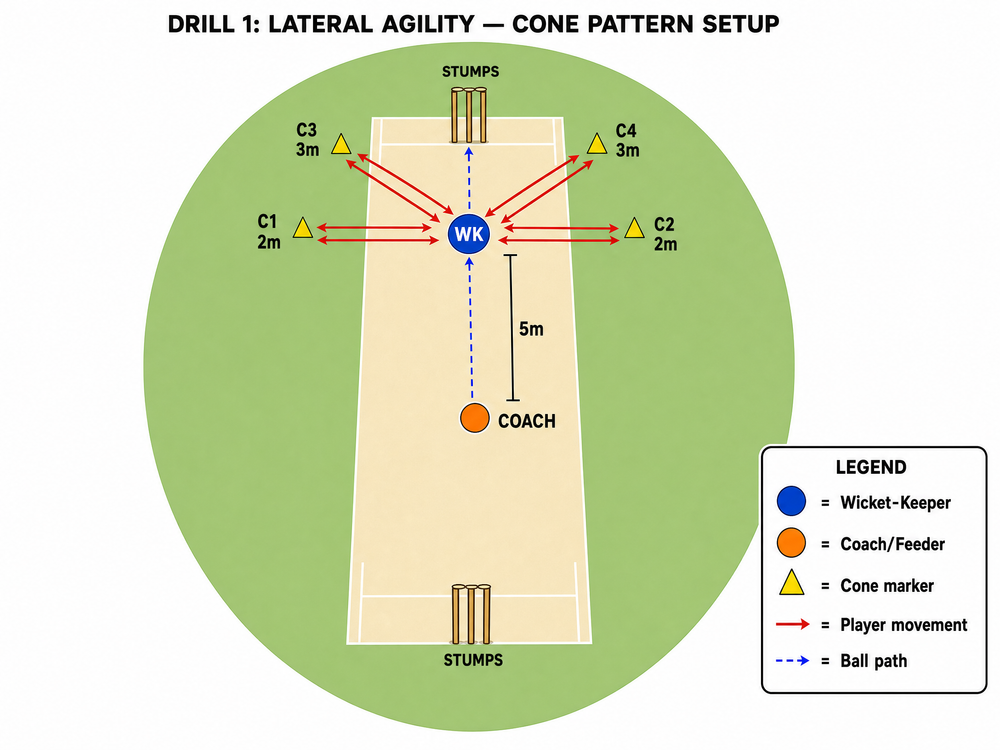
Set up on a standard 22-yard pitch or a designated fielding area. Place the stumps at the batting end. The wicket-keeper assumes their normal stance directly behind the stumps. The coach or feeder stands approximately 5 meters in front of the stumps on the off side, equipped with the cricket balls.
Cone Placement (The Diamond):
Place the four cones around the keeper's starting position:
- C1 (Leg Side): 2 meters directly to the keeper's left.
- C2 (Off Side): 2 meters directly to the keeper's right.
- C3 (Forward Leg): 3 meters forward and slightly left (simulating a wide leg-side delivery).
- C4 (Forward Off): 3 meters forward and slightly right (simulating a wide off-side delivery).
3. Step-by-Step Instructions
Execute the drill with a focus on quality of movement rather than just speed.
- The Starting Stance: The wicket-keeper starts in a balanced, athletic crouch behind the stumps, eyes focused on the coach's hand.
- The Call: The coach shouts a cone number (e.g., "Two!") or points to a specific cone.
- The Movement: The keeper explodes from their stance, using quick lateral or diagonal footwork to reach the designated cone. They must touch the cone with their outside hand while keeping their eyes forward.
- The Recovery: Immediately after touching the cone, the keeper pushes off their outside foot and rapidly returns to the central starting position behind the stumps.
- The Delivery: As soon as the keeper is balanced back in the center, the coach underarms or throws a ball towards the stumps.
- The Take: The keeper catches the ball cleanly, ensuring soft hands and bringing the ball toward their body.
- The Reset: The keeper tosses the ball aside or back to the coach and immediately resets into their crouch for the next call.
Repeat this sequence for 6 to 8 repetitions per set, aiming for 3 to 4 sets with a 60-second rest in between.
4. Key Coaching Points
To maximize the effectiveness of this drill, coaches should emphasize the following technical aspects:
- Stay Low: The keeper must maintain a low center of gravity throughout the movement. Popping up wastes time and disrupts balance.
- Lead with the Head: When moving laterally, the head should lead the movement, keeping the eyes level and focused on the ball's potential path.
- Push Off the Outside Foot: Powerful lateral movement comes from a strong push off the outside foot. Encourage explosive power rather than taking multiple small steps.
- Soft Hands on the Take: Even when fatigued from the movement, the keeper must concentrate on 'giving' with the ball upon catching it, drawing it into the body to absorb the impact.
- Quick Reset: The drill is only effective if the keeper can stabilize quickly upon returning to the center. Balance is just as important as speed.
5. Common Mistakes
Watch for these frequent errors and correct them immediately:
- Crossing the Feet: Keepers should use a side-step or shuffle. Crossing the feet during lateral movement can lead to tripping and a loss of balance.
- Taking Eyes Off the Feeder: Keepers sometimes look down at the cone when reaching for it. They must learn to feel for the cone while keeping their eyes up, simulating watching the ball.
- Standing Up Too Early: Rising out of the crouch before the ball is securely in the gloves increases the risk of fumbling. Stay down with the bounce.
- Reaching/Snatching: If the keeper doesn't move their feet fast enough, they will end up reaching for the ball with hard hands, leading to dropped catches.
6. Variations & Progressions
Once the keeper has mastered the basic drill, introduce these variations to increase the difficulty:
- Blind Call: The keeper starts facing away from the coach. The coach yells "Turn!" followed immediately by a cone call. The keeper must spin, locate the cone, and execute the movement.
- Double Movement: Call two cones in rapid succession (e.g., "One, then Four!"). The keeper must touch the first cone, transition immediately to the second, and then return to center for the catch.
- Deflection Feed: Instead of throwing the ball directly to the keeper, the coach throws the ball off a slip cradle, a Katchet board, or an uneven surface to simulate unpredictable edges and bounce.
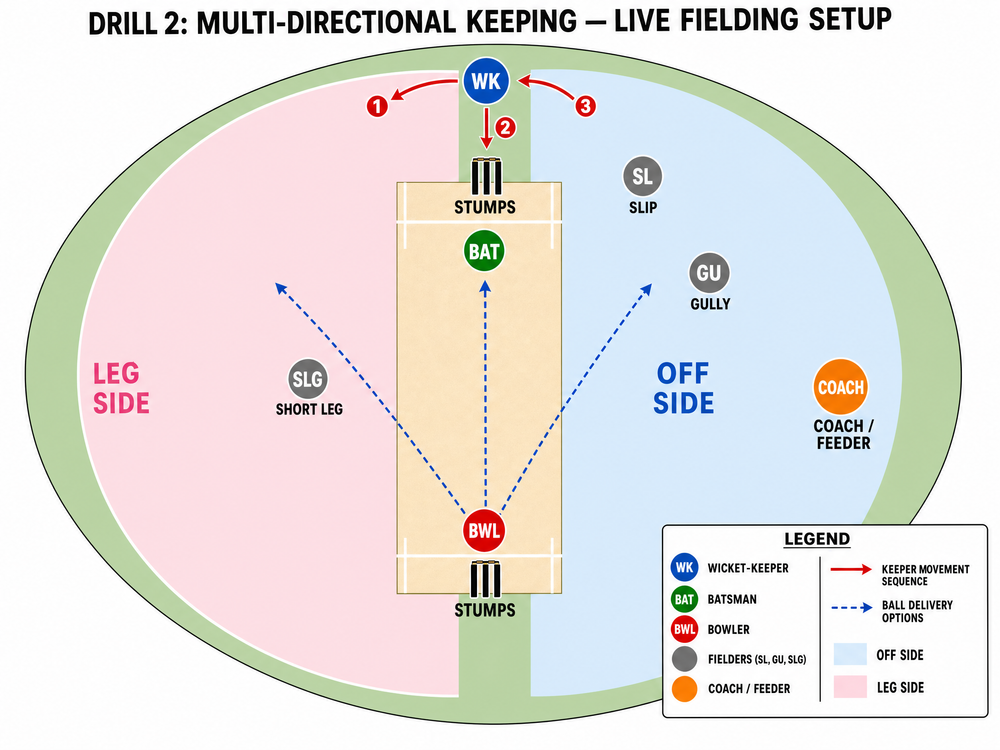
- Live Fielding Integration: As shown in Diagram 2, incorporate a batsman and fielders (Slip, Gully, Short Leg). The coach feeds the ball to the batsman who edges or deflects it, forcing the keeper to react to live, unpredictable trajectories while communicating with the slip cordon.
7. Age Adaptations
Tailor the drill to suit the physical development and skill level of your players:
- Under 10s / Under 12s: Reduce the distance of the cones to 1-1.5 meters. Use softer balls (Incrediballs or tennis balls) to build confidence. Focus entirely on footwork rather than speed.
- Under 14s / Under 16s: Standard distances apply. Introduce the 'Deflection Feed' variation using a Katchet board to challenge their reaction times. Emphasize the explosive push-off.
- Open / Seniors: Maximum intensity. Use the 'Double Movement' and 'Live Fielding Integration' progressions. The focus is on conditioning, rapid recovery, and taking difficult catches under physical fatigue.
