

Netball
Dynamic Drive & Stick: Footwork and Landing Technique Drill
Master the fundamentals of netball footwork with this comprehensive drill focused on aggressive drives, secure catching, and perfect, injury-preventing landing mechanics.
What you need
2-3 Netballs, 4-6 Marker cones, Bibs (optional)
1. Overview
The Dynamic Drive & Stick Drill is a fundamental conditioning and technique drill designed to perfect a player's footwork and landing mechanics under match-like fatigue. Proper landing technique is critical in Netball to prevent lower-limb injuries—particularly ACL tears—and to avoid stepping calls from umpires. This drill isolates the drive, the catch, and the landing phase, allowing coaches to observe and correct mechanics before adding defensive pressure. It is suitable for all court positions but is especially valuable for mid-courters (C, WA, WD) who transition rapidly from sprinting to stationary passing.
2. Setup
Equipment Needed:
- 2-3 Netballs
- 4-6 Marker cones
- 1 set of bibs (optional, for progressions)
Court Setup & Player Positions:
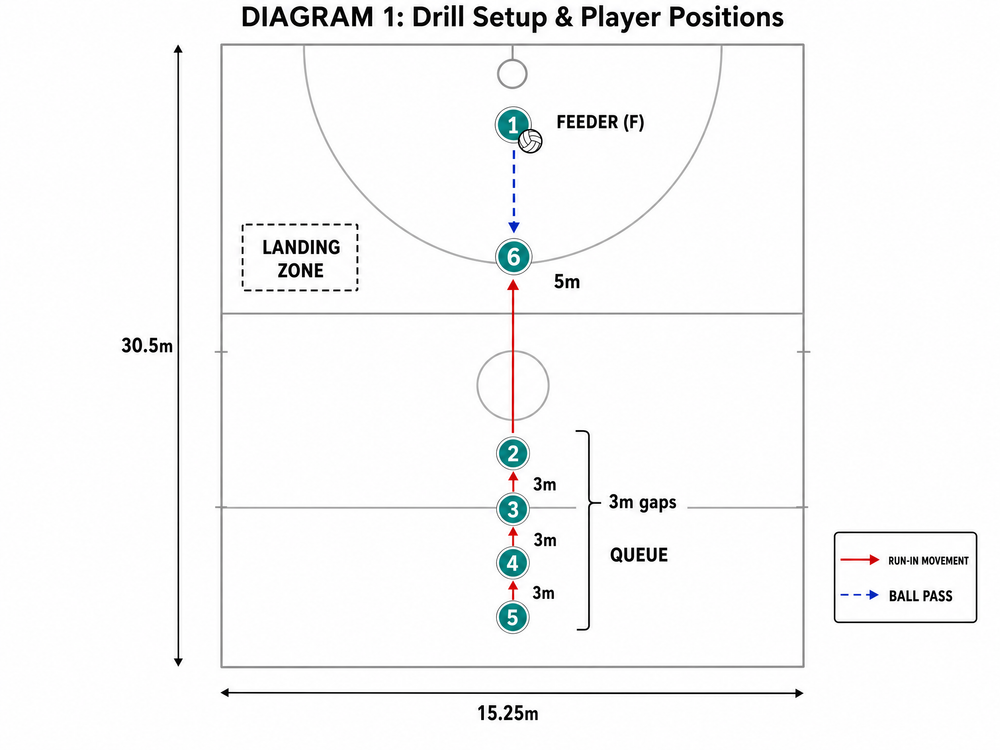
- Location: Use the centre third or one goal third (utilising the 30.5m x 15.25m dimensions).
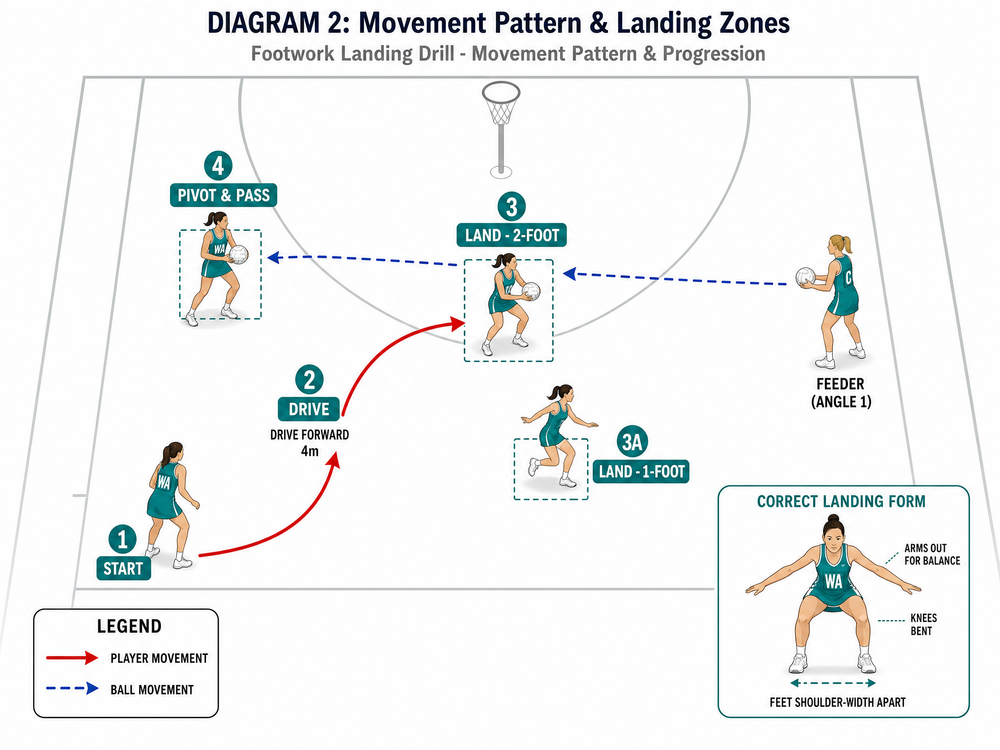
- Feeder (F): Positioned at the top of the designated area with a ball.
- Working Players (Queue): 4-5 players lined up in single file, starting 5 metres away from the feeder.
- Spacing: Ensure players in the queue maintain a 3-metre gap to avoid collisions and allow clear vision for the feeder.
3. Step-by-Step Instructions
- The Starting Position: The working player (Player 6) starts at the front of the queue in an athletic, ready stance—knees slightly bent, weight on the balls of the feet.
- The Drive: On the feeder's verbal command (e.g., "Go!"), the working player drives aggressively forward toward the feeder, sprinting for 4 metres.
- The Feed: As the player reaches the 4-metre mark, the feeder delivers a crisp, chest-height pass into the space just ahead of the player.
- The Catch and Land: The working player extends their arms to take the ball cleanly in the air. They must execute a strong two-foot landing (or a specific one-foot landing if instructed) within the designated landing zone, ensuring they absorb the impact through bent knees.
- The Pivot and Pass: Upon landing securely and establishing balance, the player pivots on their grounded foot (or either foot if a two-foot land was used) to face the feeder, and delivers a strong return pass.
- The Rotation: The working player jogs to the back of the queue, and the next player immediately steps up to begin their drive.
4. Key Coaching Points
- Eyes on the Ball: Players must track the ball from the feeder's hands all the way into their own.
- Strong Core and Balance: On landing, the player's core should be engaged, chest up, and hips square to the direction of the next pass.
- Soft Knees: Emphasise absorbing the landing impact. Players should "stick" the landing with bent knees rather than landing stiff-legged.
- Definite Footwork: If executing a one-foot landing, ensure the grounding foot is clearly established before the second foot comes down. This prevents the classic "stepping" violation.
- Pivoting Technique: The pivot must be executed on the ball of the grounded foot, keeping the body upright and balanced.
5. Common Mistakes
- Drifting on the Land: Players continuing their forward momentum after catching, resulting in a stepping call. Correction: Cue players to drop their hips and "brake" upon catching.
- Catching Too Close to the Body: Taking the ball into the chest rather than out in front. Correction: Encourage players to "go meet the ball" with extended arms.
- Narrow Stance on Landing: Landing with feet too close together, compromising balance. Correction: Remind players to land with feet shoulder-width apart.
6. Variations & Progressions
- Progression 1: The One-Foot Land. Require players to land specifically on their outside foot, forcing them to practice balance and control on a single limb before grounding the second foot.
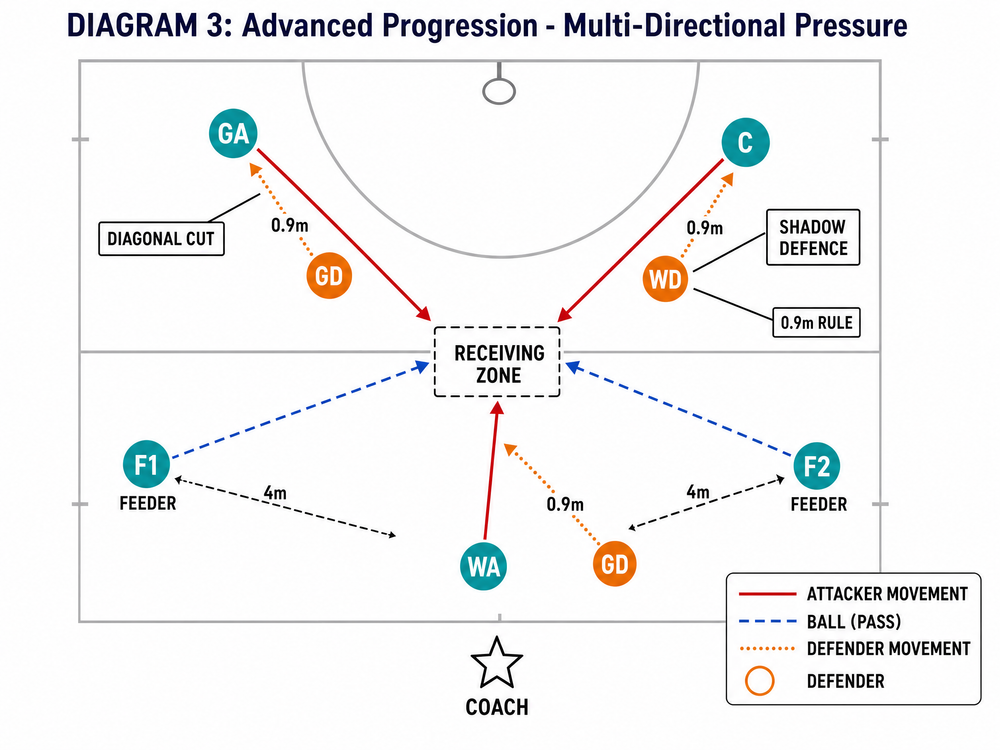
- Progression 2: Multi-Directional Pressure. Introduce a passive defender. As the attacker drives, a defender shadows them from 0.9m away. The attacker must use a sharp diagonal cut to lose the defender before receiving the ball.
7. Age Adaptations
- Under 8s / Under 10s: Focus purely on the two-foot landing ("jump and stick"). Keep the passing distance short (2-3 metres) and use a softer, smaller ball if necessary. Remove the pivot initially.
- Under 12s / Under 14s: Introduce the one-foot landing and pivoting. Ensure they understand which is their grounded foot. Increase the drive distance to build fitness.
- Under 16s / Open: Add defensive pressure, require high-speed drives, and introduce varied feeds (lob, bounce pass) to challenge their catching and landing mechanics under match-like stress.
