

Netball
Dynamic Shooting Circle Rotation Drill
Master the art of circle entry and rotation to create high-percentage shooting opportunities against tight defense.
What you need
1 netball, 4 marker cones, Team bibs (contrasting colors)
Overview
This dynamic drill focuses on developing seamless coordination between the Wing Attack (WA), Goal Attack (GA), and Goal Shooter (GS) in the attacking third. It is designed to teach players how to manipulate space within the 4.9m radius of the shooting circle, use rotation to confuse defenders, and create high-percentage scoring opportunities. Use this drill when your attacking unit is struggling to penetrate the circle or is becoming too static against a strong defensive zone.
Setup
- Equipment Needed: 1 netball, 4 marker cones, team bibs (contrasting colors for attackers and defenders).
- Court Setup: Use one third of a standard netball court (15.25m wide), focusing on the goal third and shooting circle.
- Player Positions:
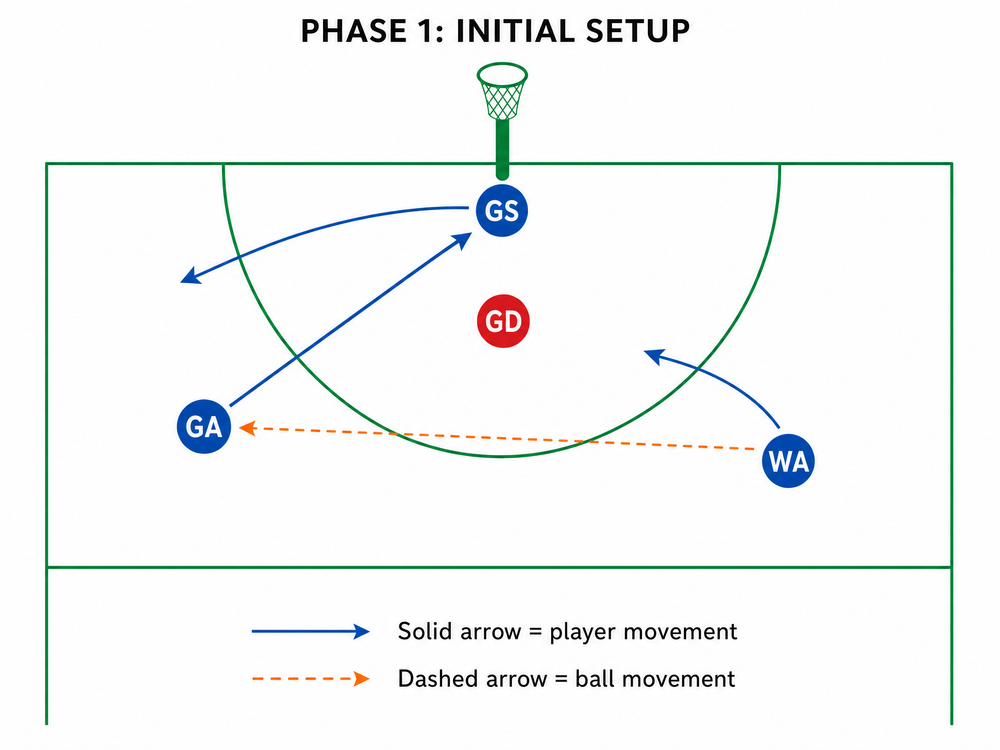
- GS (Goal Shooter): Starts deep in the circle, holding space near the goal post.
- GA (Goal Attack): Starts on the left edge of the shooting circle.
- WA (Wing Attack): Starts just outside the circle on the right side, with the ball.
- GD (Goal Defense): Starts in the center of the circle, marking the space between GS and GA.
Step-by-Step Instructions
Phase 1: Initial Setup and Entry
- Starting Position: The WA holds the ball just outside the circle on the right. The GS holds a strong position near the post, while the GA prepares on the left edge.
- The First Move: The GS initiates movement by driving out from the post toward the left baseline, drawing the GD's attention.
- The Cut: Simultaneously, the GA cuts sharply and diagonally toward the post, exploiting the space vacated by the GS.
- The Pass: The WA delivers a crisp, flat pass to the GA as they enter the circle.
Phase 2: Rotation and Shoot
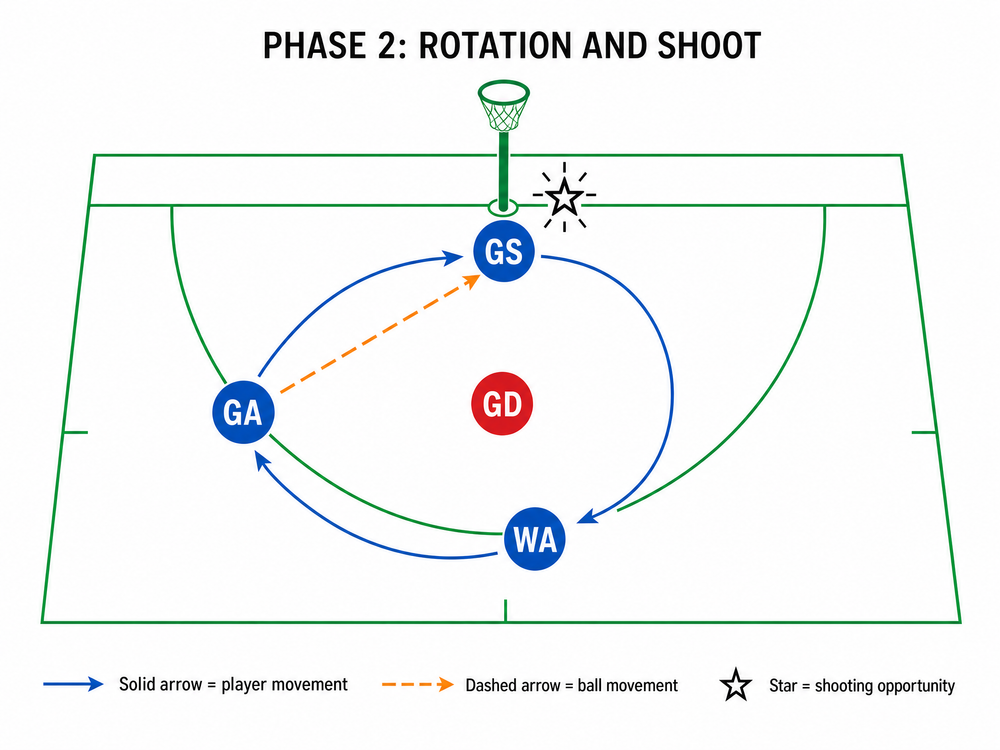
5. The Rotation: As the GA receives the ball, the GS continues their run, looping back toward the top of the circle. The WA drives onto the circle edge to offer a reset option.
6. The Decision: The GA must immediately assess the situation. If the GD commits to the GA, the GA passes to the GS who is now open near the post.
7. The Finish: The GS receives the pass, balances, and takes a high-percentage shot at goal.
8. Reset: If the shot is not available, the GA passes back to the WA on the circle edge, and the attacking trio resets their positions to initiate a new rotation.
Key Coaching Points
- Timing is Everything: The GA must not start their cut until the GS has committed to their initial drive, ensuring the space is clear.
- Strong Holds: The GS must demonstrate a strong physical hold before driving, forcing the defender to commit to a position.
- Crisp Passing: Passes from the WA must be flat, hard, and placed out in front of the driving GA.
- Eye Contact: Attackers must maintain eye contact to anticipate movements and avoid crowding the same space.
- Rebounding Position: After the shot is taken, the GA and GS must immediately establish strong rebounding positions.
Common Mistakes
- Moving Too Early: Attackers making their moves before the ball carrier is balanced and ready to pass, resulting in lost momentum.
- Crowding the Space: Both the GA and GS driving into the same area, making it easy for a single defender to intercept.
- Weak Passes: Looping or slow passes that allow the GD time to recover and contest the ball.
- Lack of Reset: Forcing a shot when the defense has covered the movement, rather than resetting with the WA on the circle edge.
Variations & Progressions
- Add a GK: Introduce a Goal Keeper (GK) to mark the GS, increasing the difficulty and forcing the attackers to work harder to create space.
- Time Limit: Challenge the attacking unit to complete the rotation and take a shot within 3 seconds of the WA receiving the ball.
- Reverse the Flow: Start the drill from the left side with the WA and GA swapping starting positions to practice rotation in both directions.
Age Adaptations
- Under 10s: Focus purely on the initial pass and cut (Phase 1). Remove the defender to allow players to master the timing of the movement.
- Under 14s: Introduce the full rotation (Phase 2) but with passive defense. Emphasize the quality of the pass and the balance before shooting.
- Open/Advanced: Run the drill at full match intensity with active, physical defense. Introduce multiple defensive setups (e.g., zone vs. one-on-one) to challenge decision-making.
