

Netball
The Fast Break Centre Pass: Overloading the Attacking Third
Learn how to execute a high-tempo centre pass set play designed to catch the defense off guard and secure a quick, high-percentage shot.
What you need
1 Netball, Standard Netball Court, Training Bibs (Optional)
1. Overview
The Fast Break Centre Pass is an aggressive, high-tempo set play designed to immediately penetrate the attacking third before the defensive structure can set. By utilizing synchronized lead runs from the Wing Attack (WA) and Goal Attack (GA), this play overloads one side of the court, creating a numerical advantage and a clear path to the goal circle. It is highly effective when you need a quick goal, when the opposition's Wing Defence (WD) is slow to react, or to shift the momentum of the game.
2. Setup
- Equipment: 1 Netball, standard netball court (30.5m x 15.25m), optional training bibs.
- Player Positions: Standard 7-a-side positions. The primary focus is on the Centre (C), Wing Attack (WA), Goal Attack (GA), and Goal Shooter (GS).
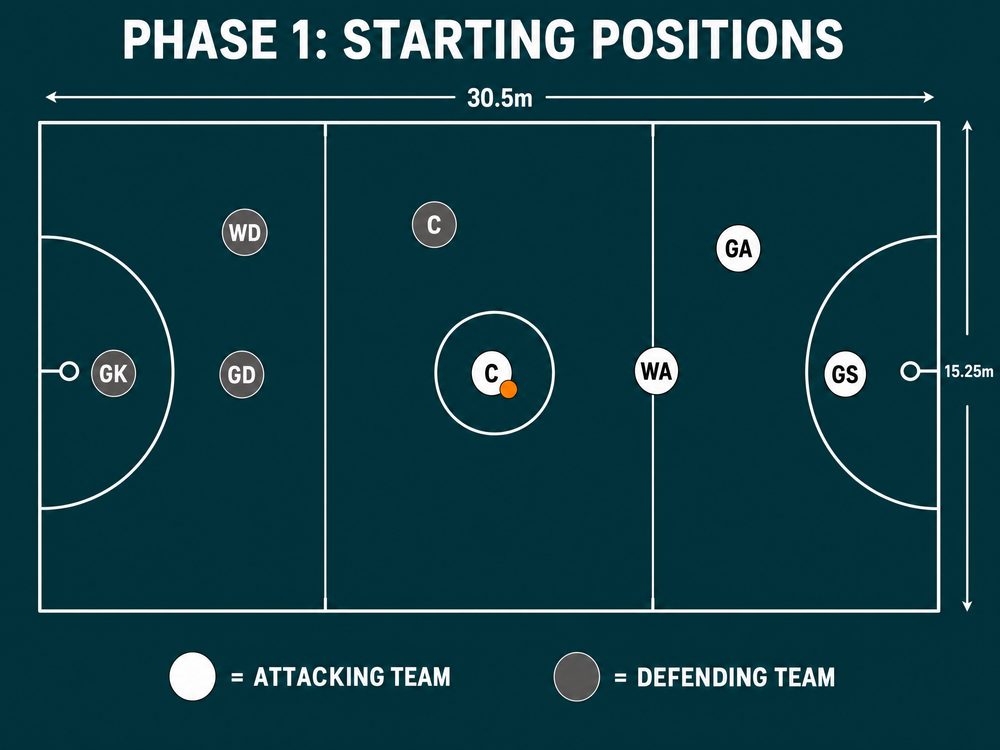
Starting Positions
- C: Inside the centre circle (0.9m radius), ball in hand, facing the attacking third.
- WA: Positioned on the transverse line, typically slightly offset to the right to draw the opposing WD wide.
- GA: Set deep in the attacking third, near the right sideline, ready to make a strong diagonal cut.
- GS: Positioned inside the goal circle (4.9m radius), holding space against the Goal Keeper (GK).
3. Step-by-Step Instructions
Phase 1: The Initial Drive
- The Whistle: On the umpire's whistle, the WA makes a sharp, explosive drive straight down the sideline into the attacking third, aiming to receive the ball just over the transverse line.
- The Delivery: The C steps forward and delivers a fast, flat, and accurate chest pass to the WA in stride. Timing is critical; the pass must meet the WA as they cross the line.
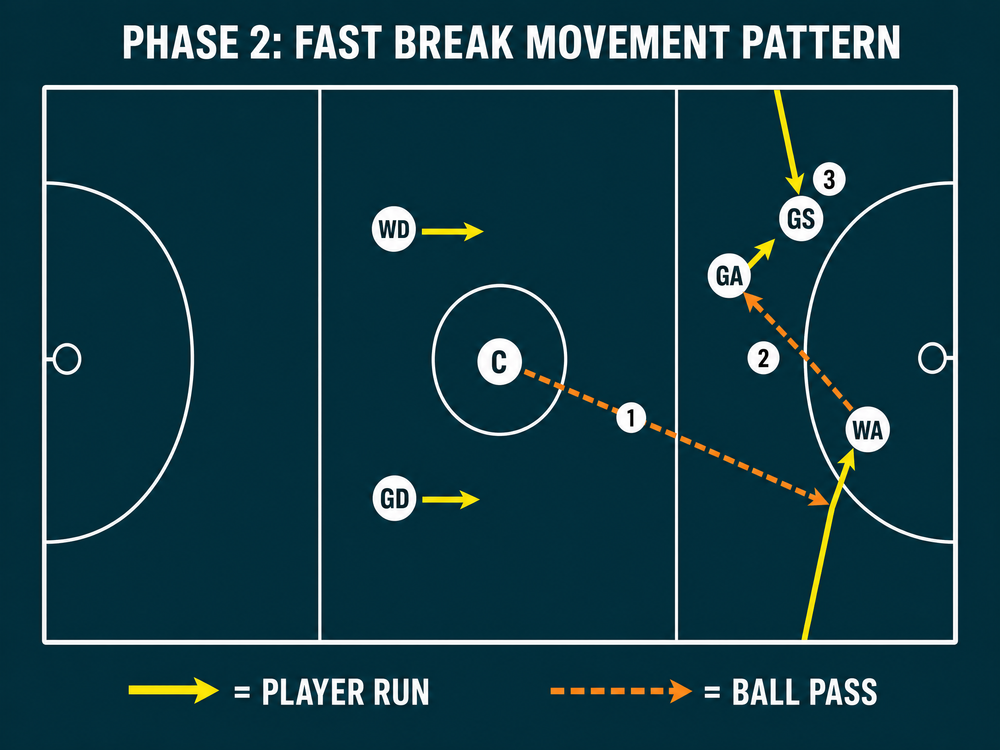
Phase 2: The Overload Cut
- The Secondary Lead: As the ball leaves the C's hands, the GA initiates a hard, diagonal cut from the right sideline towards the top center of the goal circle.
- The Connection: The WA receives the ball, lands balanced (preferably on the outside foot to open up the court), and immediately fires a pass to the driving GA.
Phase 3: The Scoring Opportunity
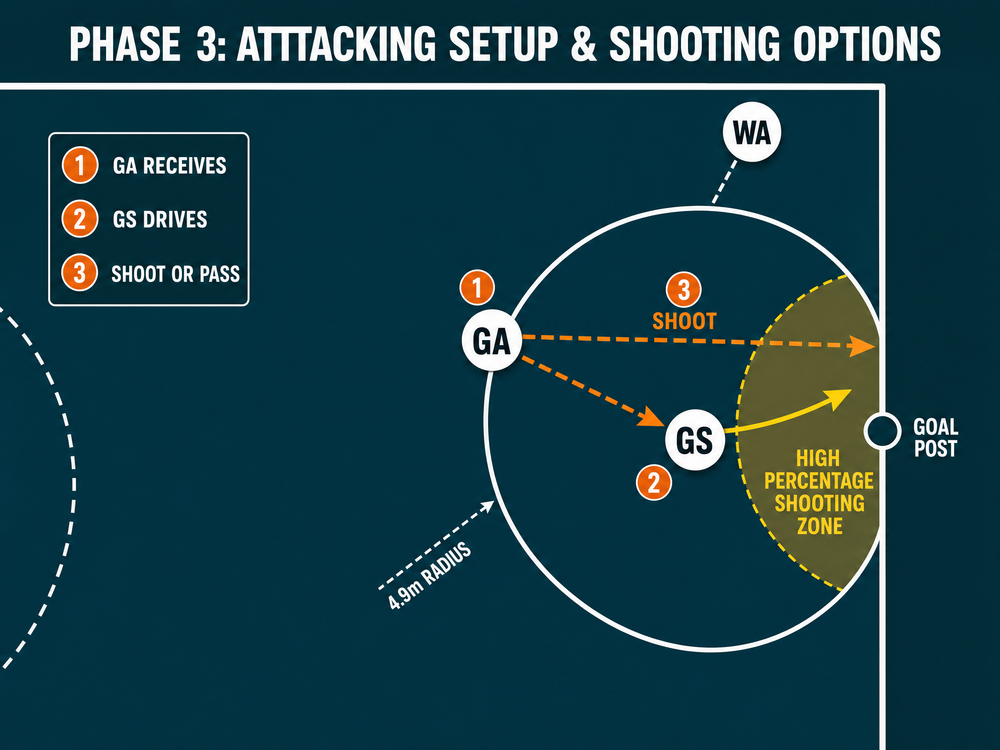
- Circle Entry: The GA receives the ball at the top edge of the goal circle. They are now in a strong attacking position.
- The Final Option: The GS, anticipating the play, drives across the baseline or holds a strong front position against the GK to create a clear passing lane.
- Execution: The GA has two immediate options: take the shot if open, or feed the GS in the high-percentage shooting zone close to the post.
4. Key Coaching Points
- Explosive First Step: The WA must use a strong, deceptive first step to lose their defender. A quick change of pace is essential.
- Flat, Hard Passing: Loopy passes will be intercepted. Passes from C to WA, and WA to GA, must be flat, hard, and placed out in front of the receiver.
- Timing is Everything: The GA must not start their cut too early. They should initiate their drive just as the C releases the ball to the WA.
- Vision and Balance: The WA must land balanced and with their eyes up, ready to spot the GA's run instantly.
- GS Positioning: The GS must actively work to keep the GK occupied, preventing them from coming out to contest the GA's catch at the top of the circle.
5. Common Mistakes
- WA Driving Too Deep: If the WA drives too far into the attacking third before receiving the pass, they compress the space for the GA's cut.
- Hesitation by the C: The C must know exactly where they are passing before the whistle blows. Hesitation allows the defense to adjust.
- GA Running Behind the Defender: The GA must cut in front of their defender (Goal Defence) to ensure a clear passing lane from the WA.
- Poor Landing by WA: If the WA lands off-balance or facing the sideline, they will struggle to execute the quick second pass to the GA.
6. Variations & Progressions
- Variation 1: The Dummy Run (The "Switch") If the defense anticipates the WA drive, the WA can make a hard decoy run, and the GA can drive up to the transverse line to receive the first pass from the C.
- Variation 2: The C Follow-Up After passing to the WA, the C immediately sprints to the top of the goal circle to offer a reset option if the GA is heavily defended.
- Progression: Add Defensive Pressure Start the drill unopposed (shadow defense), then progress to 50% pressure, and finally full, competitive defense to test the timing under match conditions.
7. Age Adaptations
- Under 10s/12s: Focus heavily on the fundamental passing technique (chest passes) and the timing of the WA's lead run. Simplify the play by just focusing on getting the ball safely to the WA over the transverse line.
- Under 14s/16s: Introduce the GA's diagonal cut and emphasize the speed of the second pass. Work on the WA landing on the correct foot to open their hips to the court.
- Open/Seniors: Execute at full match intensity. Incorporate the variations (like the dummy run) and focus on split-second decision-making at the top of the goal circle.
