

Football
4v4 High-Intensity Transition Small-Sided Game
Master the critical moments of transition with this 4v4 small-sided game designed to improve reaction speed, pressing triggers, and counter-attacking efficiency.

What you need
8 Cones, 2 Small Goals, Footballs, Bibs (2 colors)
Overview
The 4v4 High-Intensity Transition Small-Sided Game (SSG) is a staple in modern football coaching. It isolates the most crucial moments in the game: the immediate reaction upon losing possession (defensive transition) and the rapid exploitation of space upon winning possession (attacking transition). By limiting the player numbers and playing area, players are forced into continuous, high-intensity actions, replicating the physical and cognitive demands of a match. This drill is ideal for developing quick decision-making, cohesive team pressing, and clinical finishing under pressure.
Setup
Proper setup is critical to ensure the drill flows smoothly and achieves its intended intensity.
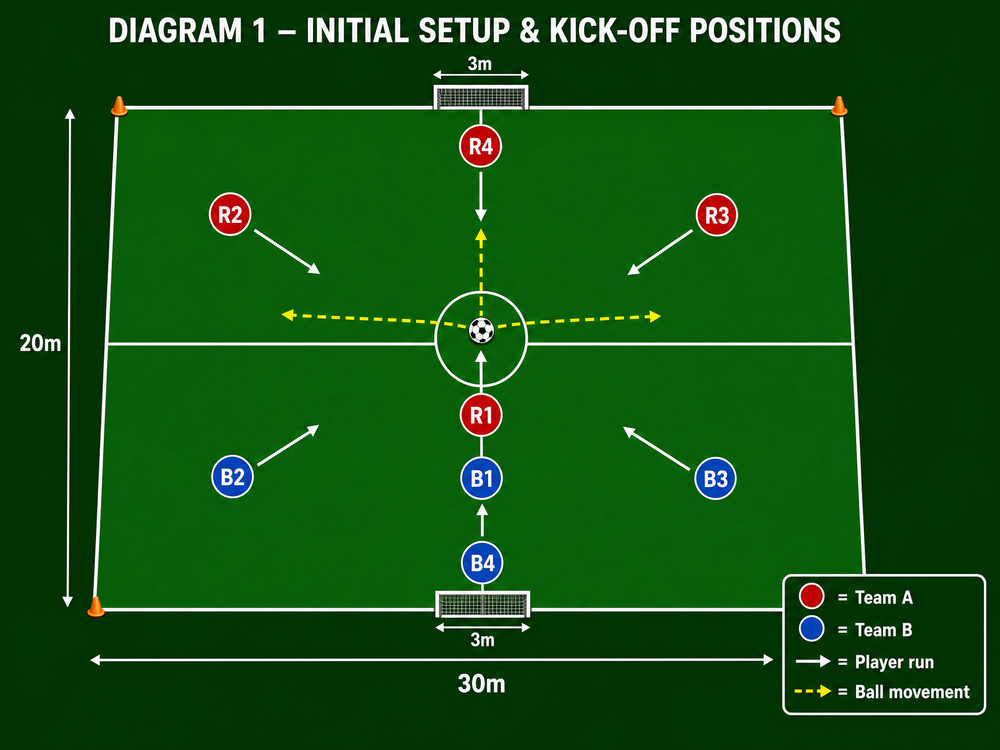
- Pitch Size: 30m x 20m (adjust slightly based on age and ability; tighter spaces increase technical demands, larger spaces increase physical demands).
- Equipment: 8 cones (4 for corners, 4 for a halfway line if desired), 2 small goals (approx. 3m wide, or use cones), a plentiful supply of footballs, and 2 sets of colored bibs (e.g., Red and Blue).
- Players: 8 players divided into two equal teams of 4 (Team A and Team B). No dedicated goalkeepers are necessary, but players can rotate as a 'sweeper' or 'fly-keeper' if desired.
Step-by-Step Instructions
- Initial Positioning: Divide the players into two teams of four. Set them up in a basic diamond shape (1 defender, 2 midfielders, 1 attacker) or a box shape (2 defenders, 2 attackers) depending on your tactical focus.
- The Kick-Off: The coach starts the game by playing a ball into the centre of the pitch or directly to one of the teams. The game begins immediately upon the first touch.
- General Play: Normal football rules apply, but with no offsides. The objective is simply to score in the opponent's goal.
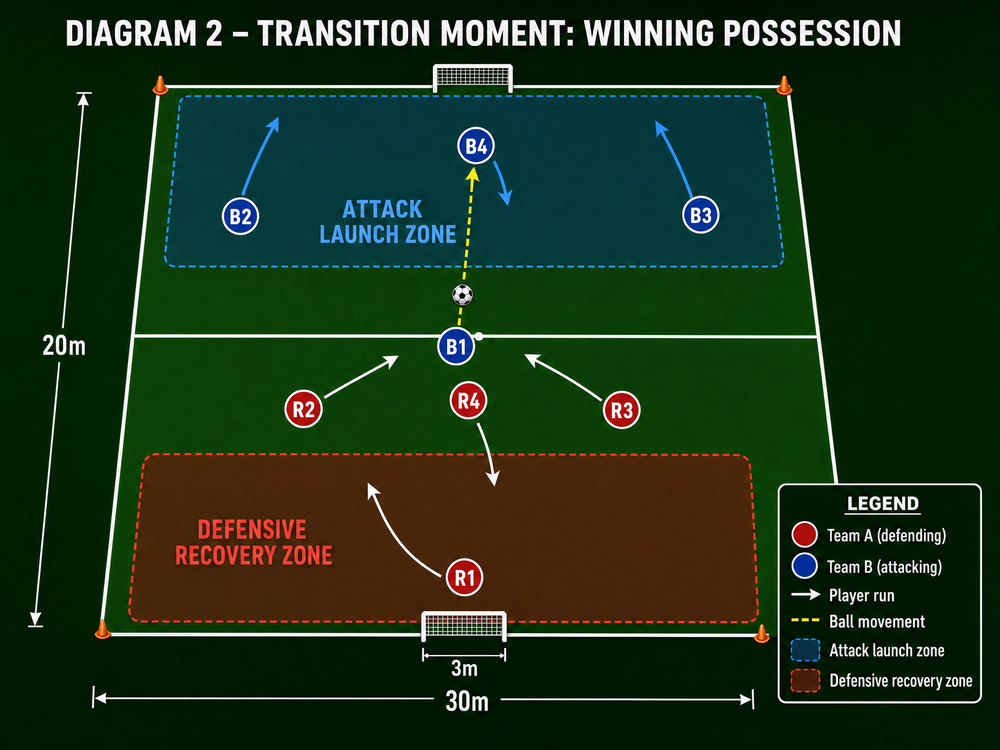
- The Transition Trigger: The core of the drill happens when possession changes hands.
- Upon losing the ball: The team that lost possession must instantly apply a high press to win it back within 3–5 seconds (the 'counter-press').
- Upon winning the ball: The team that won possession must look to secure the ball with a safe first pass or immediately attack the space left by the opponent.
- Restarts: If the ball goes out of play, the coach should immediately feed a new ball into the team that should have possession to keep the intensity high and simulate rapid restarts. Do not wait for players to fetch balls.
Key Coaching Points
- Instant Reaction (Defensive): The player closest to the ball upon losing possession must apply immediate pressure. The surrounding players must quickly close down passing lanes and support the pressing player. The mindset must shift from attack to defense in a fraction of a second.
- First Pass Security (Attacking): When winning the ball, the first pass is the most important. It should be away from the immediate pressure to secure possession, or a forward pass if a clear counter-attacking opportunity exists.
- Exploiting Space: The attacking team must rapidly expand the pitch upon winning the ball. Players must make dynamic, forward runs to offer passing options and stretch the disorganized defense.
- Communication: Constant verbal and non-verbal communication is vital. Players must dictate who presses, who covers, and where the space is.
- Intensity: This drill relies on match-realistic intensity. Coaches must demand maximum effort, particularly during the transition moments.
Common Mistakes
- Slow Reactions: Players taking too long to mentally switch from attack to defense, allowing the opponent to easily play out of trouble.
- Pressing Alone: One player presses aggressively, but the rest of the team drops off, leaving huge gaps for the opponent to exploit.
- Forcing the Attack: The team winning the ball immediately tries a difficult forward pass when the better option is to secure possession with a simple sideways or backward pass.
- Lack of Width: When attacking, players bunch up in the middle, making it easy for the defense to remain compact and win the ball back.
Variations & Progressions
- Touch Limit: Introduce a 2-touch or 3-touch limit to increase the speed of play and force quicker decision-making.
- Time Limit on Goals: To encourage rapid counter-attacks, stipulate that a team must score within 8 seconds of winning possession for the goal to count double.
- Target Zones: Instead of goals, use end zones. A team scores by successfully dribbling or passing to a teammate inside the opponent's end zone.
Age Adaptations
- Under 8 / Under 10: Focus primarily on the basic concept of reacting quickly when the ball is lost or won. Don't overcomplicate the tactical pressing structures. Increase the pitch size slightly to give them more time on the ball.
- Under 12 / Under 14: Introduce more specific pressing triggers and emphasize the importance of the first pass upon winning possession. Enforce the 3–5 second counter-press rule more strictly.
- Under 16 / Open: The drill should be played at maximum match intensity. Focus on complex pressing shapes, coordinated movements, and clinical finishing under pressure. Decrease the pitch size to increase the cognitive and physical demands.
