Build-Up From the Back: Creating a 3+2 Platform and Playing Through the First Press
A coach-ready 11v6 set play that teaches a goalkeeper-led 3+2 build-up, how to draw the first press, and how to exit through a third-player combination.
Equipment Needed
Build-Up From the Back: Creating a 3+2 Platform and Playing Through the First Press
Overview
This goalkeeper-led build-up set play teaches the back line to create a free player, tempt the first press, then use the pivot and a third-player action to leave the defensive third facing forward. It uses a 105 x 68 m pitch reference, inside the stated 100–110 m by 64–75 m range; on other pitches, preserve player distances rather than exact lines.
Use it against a one- or two-forward press. The aim is to fix the first presser, access the free player, and exit before the opposition can lock the next line. Coach players to choose whether to play through, around or back through the goalkeeper.
Setup
Use a full-size goal and a 60 x 68 m area from the goal line to 7.5 m beyond halfway. Mark left, central and right corridors, two 4 m wide exit gates and an 8 m-deep central target zone. Blue scores by receiving through a gate or finding 9 in the target zone facing forward. Red scores by regaining and finishing within eight seconds.
Run 11 blue players against 6 red pressers. Blue is a 4-3-3: 1 goalkeeper; 2 right-back; 3 left centre-back; 4 right centre-back; 5 left-back; 6 holding midfielder; 8 advanced midfielder; 10 attacking midfielder; 7 and 11 wingers; and 9 centre-forward. Red uses two forwards, two central midfielders, a wide midfielder and a covering defender.
| Item | Detail | Coaching purpose |
|---|---|---|
| Balls | 10–12, with a server behind the goal | Keeps repetition sharp; restart immediately. |
| Cones or flat discs | 24–30 | Marks corridors, the 60 x 68 m area, target zone and exit gates. |
| Bibs | Two contrasting colours | Makes the pressing picture instantly readable. |
| Goals | One full-size goal; two 4 m exit gates | Creates a clear consequence at both ends. |
| Work block | 4 x 4 minutes, with 90 seconds coaching/reset | Enough repetition without losing speed or concentration. |
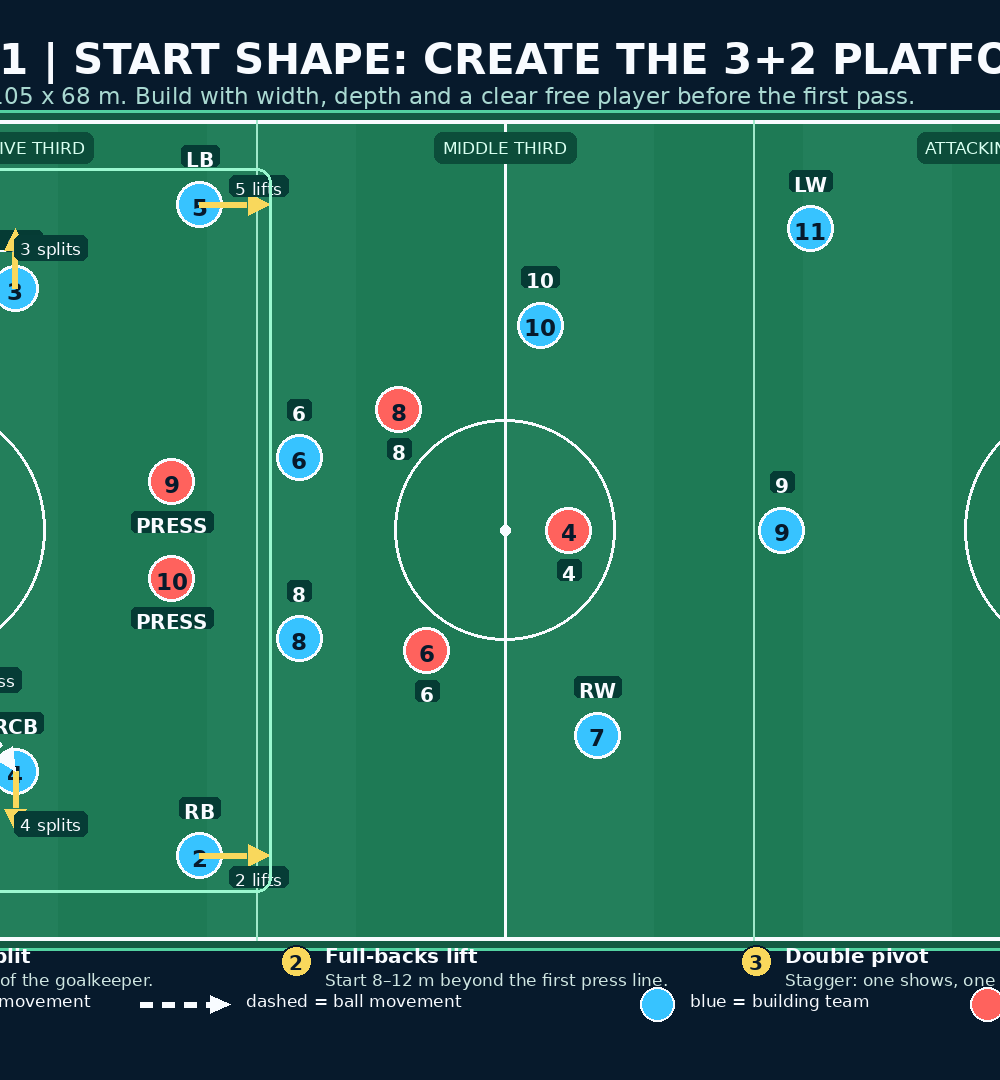
Start with 3 and 4 split 18–20 m from 1 and full-backs 8–12 m higher. Player 6 begins 8–10 m ahead of the centre-backs, between the red forwards but not hidden behind them. Stagger 8 higher than 6, keep 7 and 11 wide, and use 9 to pin the last red defender.
Step-by-Step Instructions
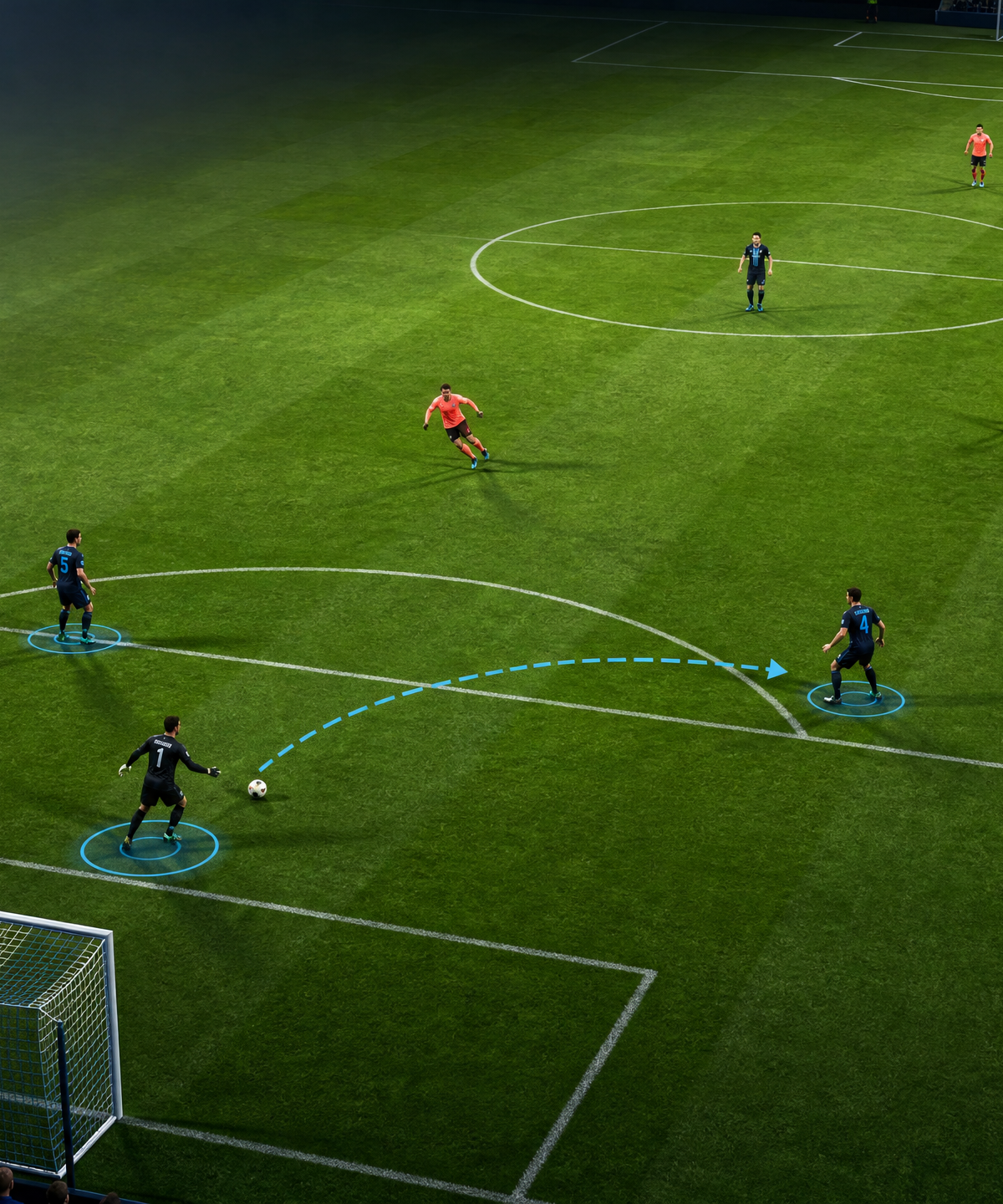
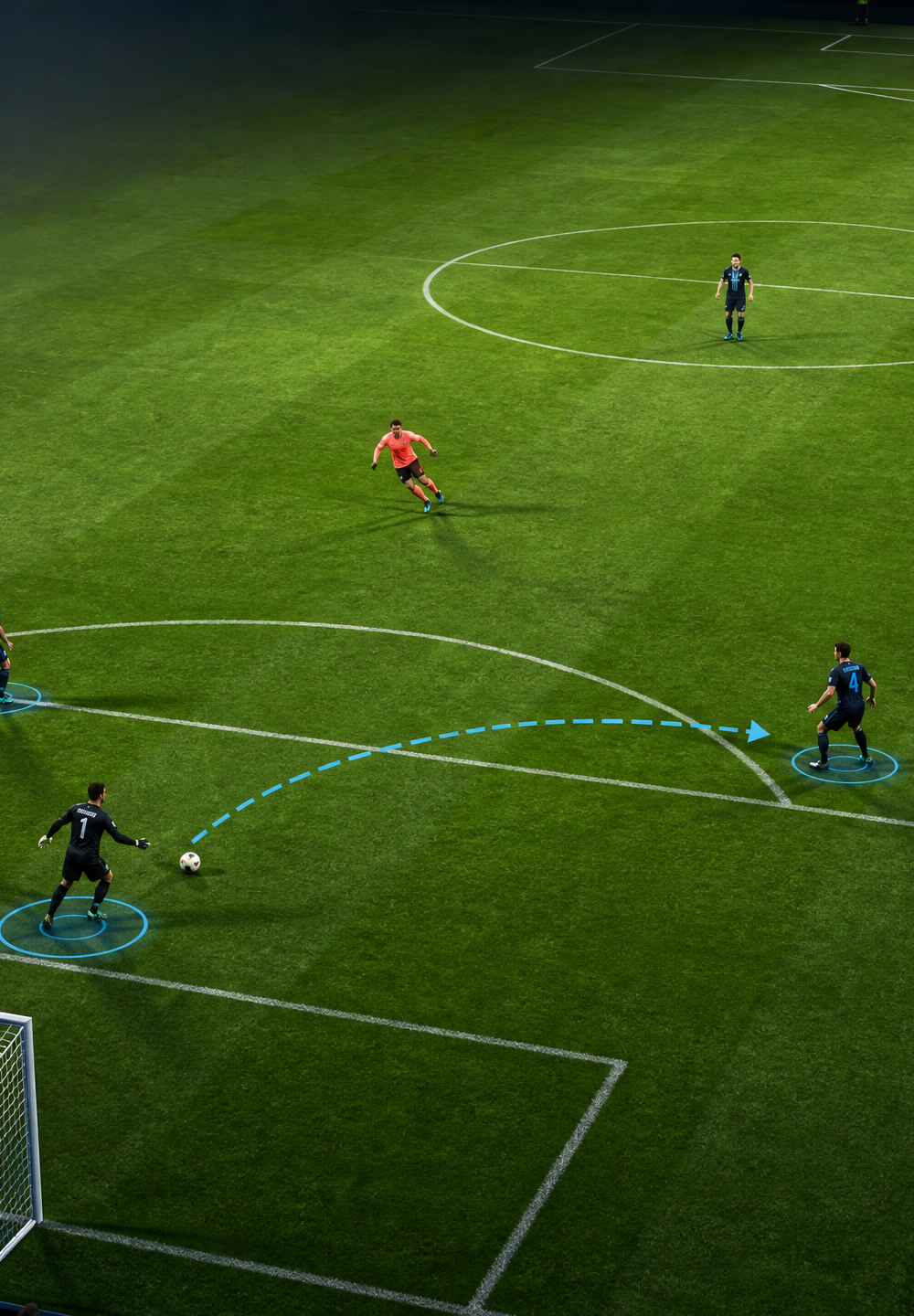
Build the starting picture. Player 1 stands slightly off-centre for a clear first-pass angle. Players 3 and 4 open toward the touchline and scan; full-backs lift only when they can receive ahead of the press.
Release the first pass. On the coach’s call, 1 finds the centre-back furthest from the nearest red forward. The receiver takes the first touch away from pressure and decides within two touches. Red presses live as the ball leaves 1.
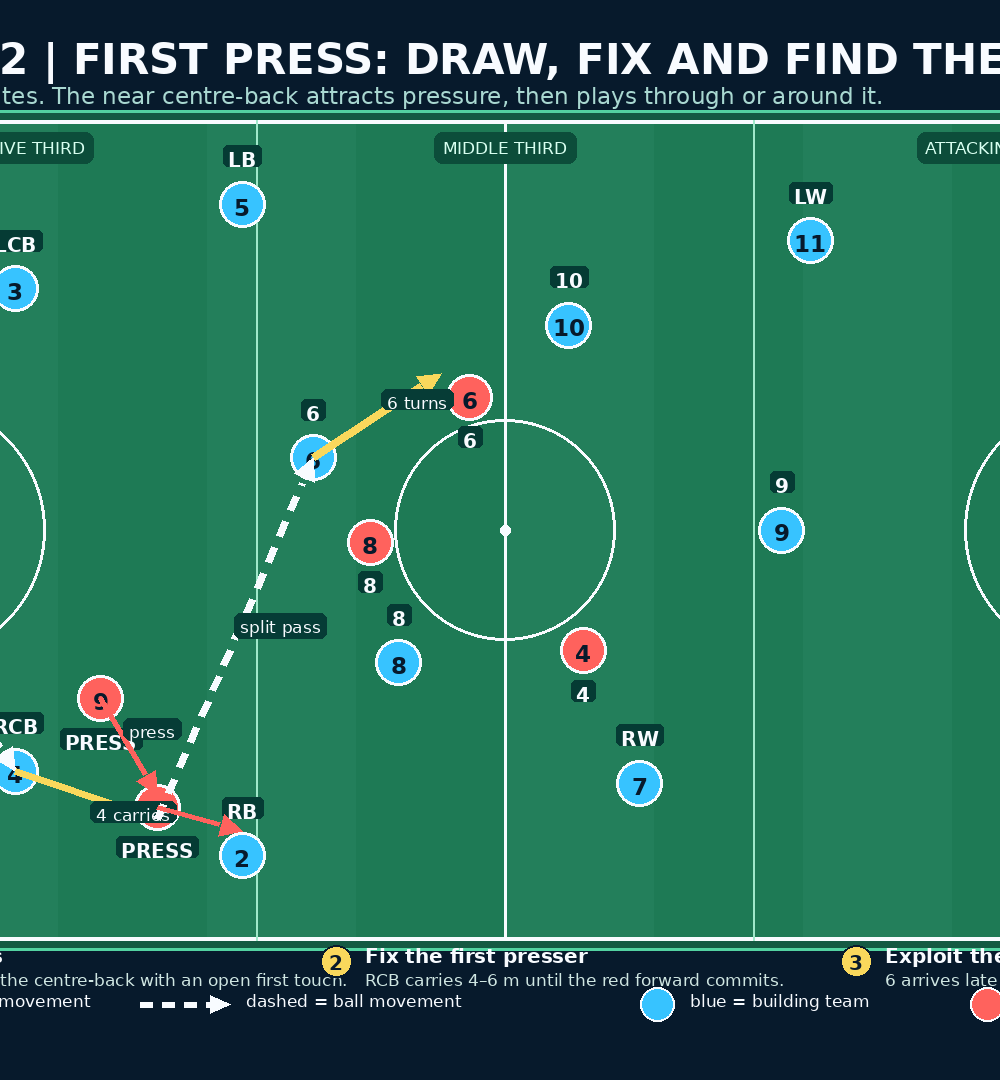
Draw a forward. If red stays off, the centre-back carries 4–6 m at that player. This fixes the presser and opens 6, 8, a full-back or the far centre-back. Communicate the next pass before it arrives.
Arrive with 6. Player 6 checks away then arrives on the blind side of the nearest red midfielder as 4 carries: “check, see, arrive.” Receive half-open. Keep 8 higher on a different line so one red midfielder cannot screen both.
Break the second line. Player 4 finds 6 only when 6 can turn or set a third player. If the lane closes, use 2 outside the red wide midfielder, then connect inside. Move the press before forcing vertical.
Use the third-player exit. Once 6 receives, Player 10 moves as the pass travels, not after it lands. The preferred sequence is 4–6–10–11 or 3–6–8–7. The final receiving wide player attacks the exit gate with a positive first touch. Give the team a maximum of 12 seconds from Player 1’s first touch to reach a gate or the central target zone.
Reset rather than gamble. If the second line closes and the receiver cannot turn, recycle through the nearest centre-back or Player 1. A reset is a successful decision when it keeps the team connected and moves the press to a new side.
Finish every repetition with a transition. On a red regain, blue has five seconds to recover compactly behind the ball. On a blue exit, blue keeps the ball alive for an additional six seconds beyond the gate before the next restart. This makes the end action resemble the first moments of a real counterattack or sustained possession.
Key Coaching Points
| Focus | Coach it with this detail |
|---|---|
| Goalkeeper as an outfield player | Player 1 must offer an angle 8–10 m behind the ball after every pass and should scan before the ball reaches the centre-back. |
| Width and depth | The centre-backs need 36–40 m of separation; the full-backs must be high enough to stretch the first press but close enough to receive securely. |
| Body shape | Demand a half-open stance. The first touch should either escape pressure or improve the next passing lane. Closed hips invite the press. |
| Attract to release | The ball carrier carries toward a presser until that player has committed; early release leaves the opposition’s shape intact. |
| Midfield timing | Player 6 must not stand in the cover shadow. The cue is to arrive as the centre-back’s head comes up. |
| Forward connection | The winger holds width and Player 9 pins the last defender. Their positions create the space for the central exit, even if they do not receive. |
Common Mistakes
| Mistake to spot | Immediate correction |
|---|---|
| Centre-backs remain too close to 1 | Freeze the picture. Reposition 3 and 4 18–20 m from 1 and repeat the first pass. |
| Player 6 stands behind a red midfielder | Ask 6 to check away, then reappear diagonally. Use a flat marker to show the passing window. |
| Centre-back releases the ball before fixing pressure | Give the ball carrier a minimum 4 m carry condition until the team understands the value of drawing the press. |
| Full-backs receive square and trapped | Move them 3–5 m higher or wider and coach their first touch down the line or inside, away from the pressing foot. |
| Blue forces the vertical pass after losing the angle | Reward the reset to 1 or the switch to the far centre-back; remove the belief that forward always means vertical. |
Variations & Progressions
Start with a guided pattern: the red front two press only after Player 1’s first pass, and central red players remain passive until 6 receives. This lets the team rehearse spacing and timing at match speed without immediate chaos. Progress to a live 6-player press with a 12-second exit clock; add one point for an exit after a third-player combination and two points if the wide receiver breaks forward on the first touch. For the hardest version, release an extra red defender into the second line and allow them to counterattack the full-size goal. Blue now needs to choose whether to play through, around or back based on the actual pressure.
Age Adaptations
For Under-8 and Under-10, use 6v3 or 7v4 in a 36 x 28 m area. Use two small gates and three messages: make the pitch big, show at an angle, and pass away from pressure. Start with unlimited touches, then add a three-touch cap.
For Under-12 and Under-14, use 8v5 on 50 x 44 m with a goalkeeper, two centre-backs, two wide players, a 6, an 8 and a 9. Keep the 3+2 picture but say “pass, support, play forward.” Reward either wide gate.
For Under-16 and open-age teams, run the full 11v6 model. Between blocks, ask players to name the free player; demand scanning, efficient touch count, and clear cues such as “set,” “turn,” “bounce,” or “reset.”
Finish with an 8–10 minute conditioned game. Award one bonus point for exiting the defensive third after using the goalkeeper and a third-player combination. Check that the pattern has become a usable behaviour, not a script.