

Football
Mastering the Build-Up from the Back: A 4-3-3 Tactical Guide
Learn how to confidently play out from the back, beat the high press, and transition smoothly into the attacking third using a structured 4-3-3 shape.
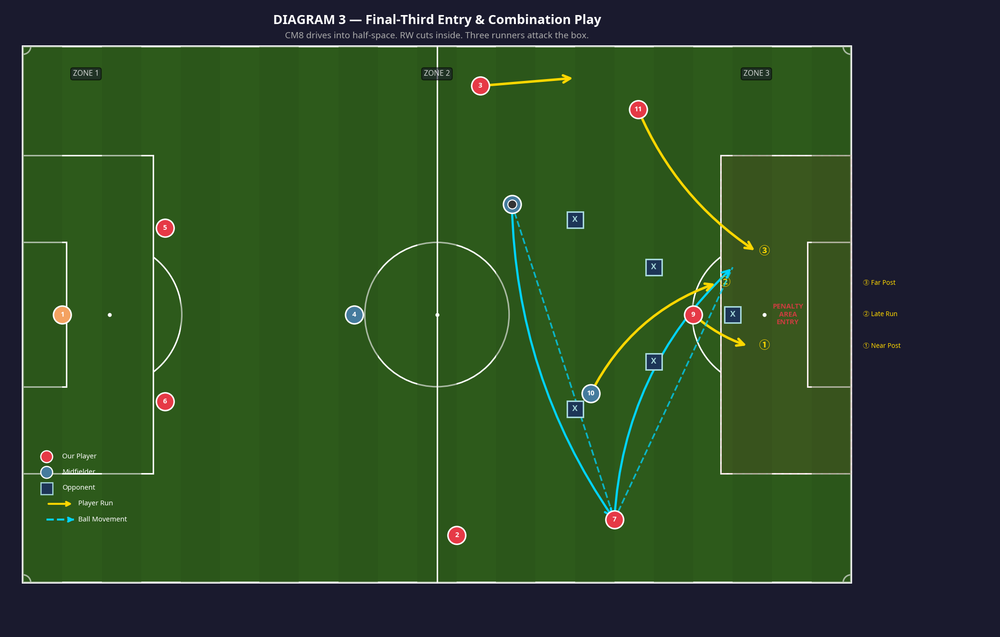
What you need
Full-size goal, Footballs, Cones/Markers, Bibs (two colours)
1. Overview
Building out from the back is a fundamental phase of play in modern football. This tactical set play focuses on establishing possession from the goalkeeper, manipulating the opposition's pressing structure, and creating numerical advantages to progress the ball safely through the thirds. Using a 4-3-3 formation, this guide provides a structured methodology to transition from defense to attack while maintaining control.
When executed correctly, this approach draws opponents forward, leaving spaces behind their midfield line that your attacking players can exploit. It requires technical proficiency, spatial awareness, and a collective understanding of passing angles and triggers.
2. Setup
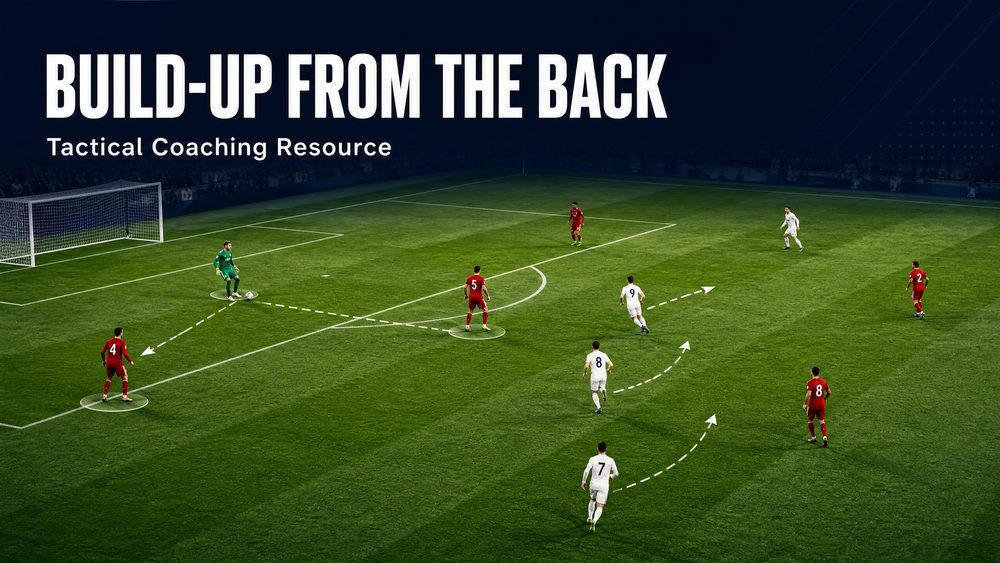
- Pitch Dimensions: Full pitch (100-110m x 64-75m) or a scaled-down version (e.g., 70m x 50m) for younger age groups.
- Players Required: 11 (1 Goalkeeper, 4 Defenders, 3 Midfielders, 3 Attackers).
- Equipment: 1 full-size goal, balls, cones/markers (to designate thirds and half-spaces), and bibs (two colours).
- Starting Positions:
- Goalkeeper (1): Central, ready to distribute.
- Centre-Backs (5 & 6): Split wide, positioned at the edges of the penalty area.
- Full-Backs (2 & 3): Pushed high and wide, hugging the touchlines in the middle third.
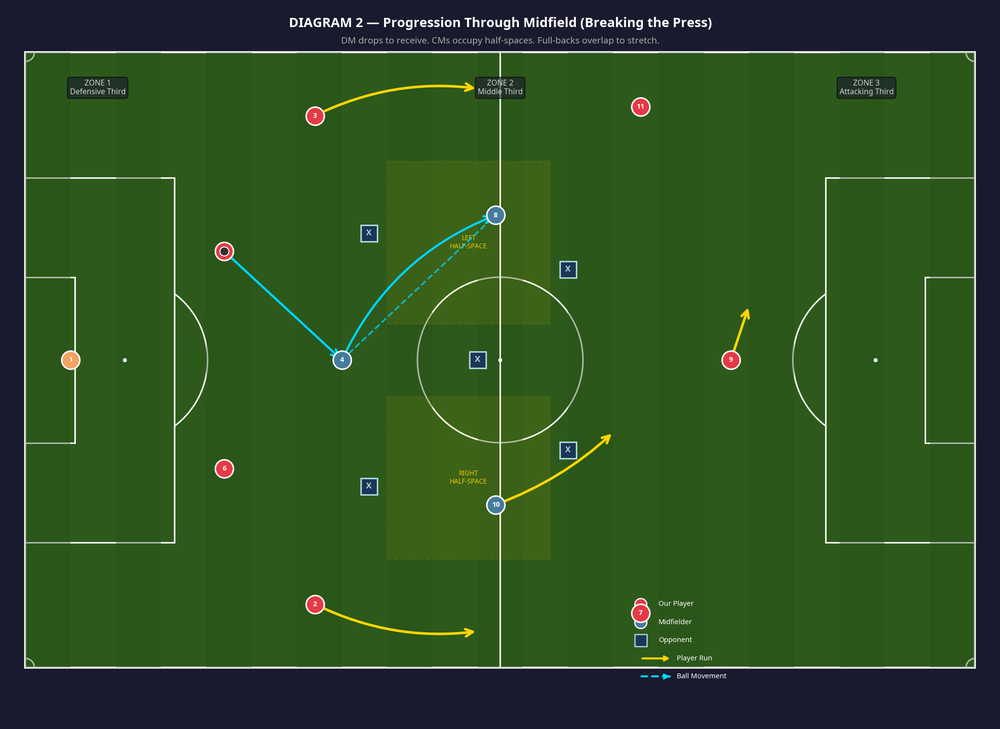
- Defensive Midfielder (4): Drops centrally to form a triangle with the Centre-Backs.
- Central Midfielders (8 & 10): Positioned higher in the half-spaces, ready to receive between the lines.
- Wingers (7 & 11): High and wide, pinning the opposition full-backs.
- Striker (9): Central, occupying the opposition centre-backs to create depth.
3. Step-by-Step Instructions
Phase 1: Initial Shape and Distribution
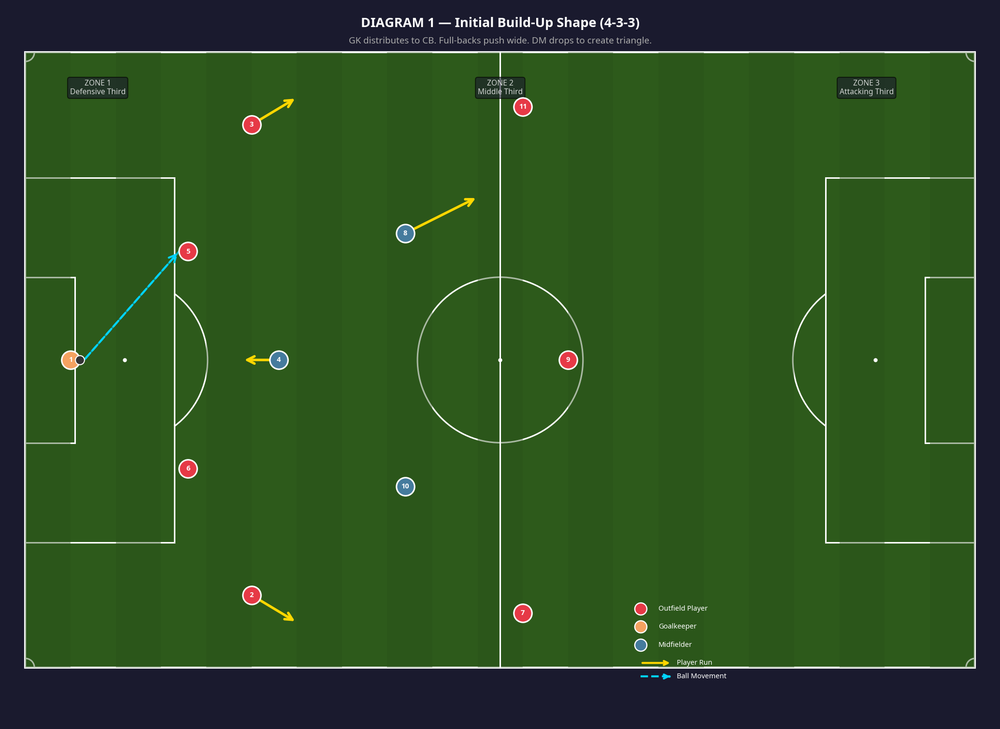
- Trigger: The Goalkeeper (1) places the ball for a goal kick or receives a back-pass.
- Movement: The Centre-Backs (5 & 6) split to the edges of the 18-yard box. The Defensive Midfielder (4) drops centrally, creating a 3v2 or 3v1 overload against the opposition's first line of pressure.
- Action: The Goalkeeper distributes to the left Centre-Back (5). As the ball travels, the Full-Backs (2 & 3) push higher up the touchlines.
Phase 2: Progression Through Midfield
- Trigger: The Centre-Back (5) receives the ball and faces forward.
- Movement: The opposition initiates a high press. The Defensive Midfielder (4) adjusts their angle to offer a safe passing option. Simultaneously, the Central Midfielders (8 & 10) drift into the half-spaces, positioning themselves behind the opposition's midfield line.
- Action: The Centre-Back (5) plays a firm pass to the Defensive Midfielder (4), who plays a quick one-touch pass (or turns if space allows) to the advancing Central Midfielder (8) in the left half-space. The Full-Backs continue their overlapping runs to stretch the play.
Phase 3: Final-Third Entry and Finishing
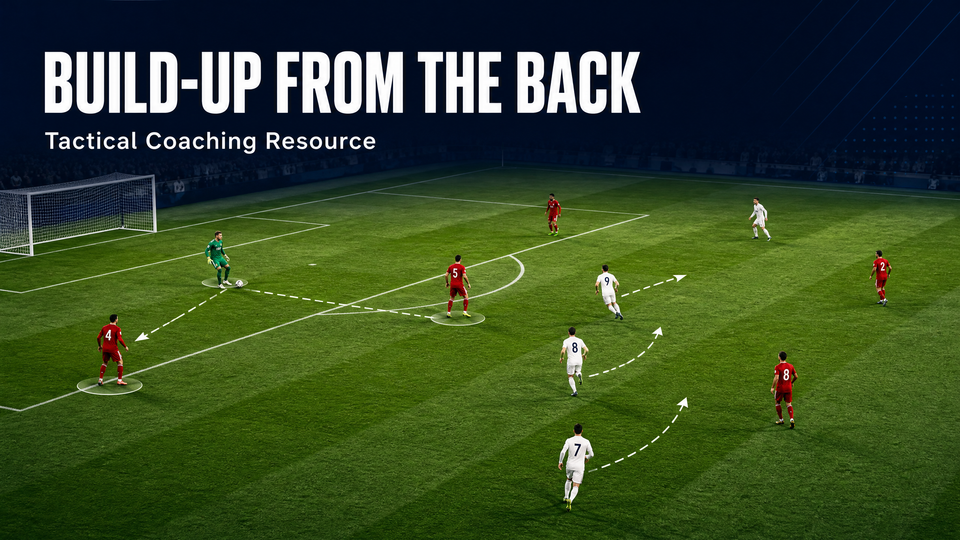
- Trigger: The Central Midfielder (8) receives the ball facing the opposition's defensive line.
- Movement: The Right Winger (7) makes an inverted run inside, dragging the opposition full-back. The Striker (9) makes a darting run towards the near post. The Central Midfielder (10) makes a late run into the box, while the Left Winger (11) attacks the far post.
- Action: The Central Midfielder (8) drives forward and plays a penetrating through-ball to the Right Winger (7). The Winger delivers a low, driven cross into the penalty area, targeting the three designated runners (near post, central, far post) for a first-time finish.
4. Key Coaching Points
- Body Shape: Players must receive the ball on the half-turn (open body shape) to see the entire pitch and play forward quickly.
- Pass Quality: Passes must be firm and played to the correct foot (the back foot) to allow the receiving player to progress seamlessly.
- Patience: Do not force the forward pass. If the vertical option is blocked, circulate the ball across the backline to shift the opposition and open new passing lanes.
- Triangles and Diamonds: Always maintain supporting angles. The player on the ball should have at least two passing options (left and right) at all times.
- Third-Man Runs: Encourage movements where player A passes to player B, who immediately sets up player C, bypassing the press effectively.
5. Common Mistakes
- Static Positioning: Players waiting for the ball rather than moving to create angles or drag defenders away.
- Over-Dribbling: Defenders or holding midfielders taking too many touches in dangerous areas, inviting pressure and risking turnovers.
- Poor Spacing: Full-backs not pushing high and wide enough, leading to a congested central area and making it easy for the opposition to defend narrowly.
- Forcing the Play: Attempting risky vertical passes when the opposition is compact, rather than switching the play to the weak side.
6. Variations & Progressions
- The "False Full-Back": Instead of pushing high and wide, one full-back inverts into central midfield alongside the defensive midfielder, creating a box midfield (3-2 shape) to dominate possession centrally.
- Direct to the Target Man: If the opposition commits too many players to the high press, bypass the midfield entirely with a clipped, accurate pass from the goalkeeper or centre-back directly to the striker, who lays it off to the advancing central midfielders.
- Underlap: The winger stays wide while the central midfielder or full-back makes a penetrating run through the inside channel (the underlap) to receive the ball behind the defensive line.
7. Age Adaptations
- Under-8 to Under-10: Focus on the basic shape (diamond or triangle). Emphasise the goalkeeper playing short and players receiving with an open body shape. Keep the pressure low initially (shadow defending).
- Under-12 to Under-14: Introduce the concept of the half-spaces and third-man runs. Apply active, structured pressing from the opposition to challenge decision-making under pressure.
- Under-16 to Open: Implement complex variations (e.g., inverted full-backs, rotational movement between wingers and midfielders). Focus on the speed of play, scanning, and exploiting the weak side quickly.
