

Football
Mastering the Build-Up from the Back: A Tactical Blueprint
Equip your team with a structured, step-by-step approach to playing out from the back, designed to draw pressure, break defensive lines, and create high-quality attacking opportunities.
What you need
1 full-size goal, 10-15 cones, Bibs (2 colours), Adequate supply of footballs
1. Overview
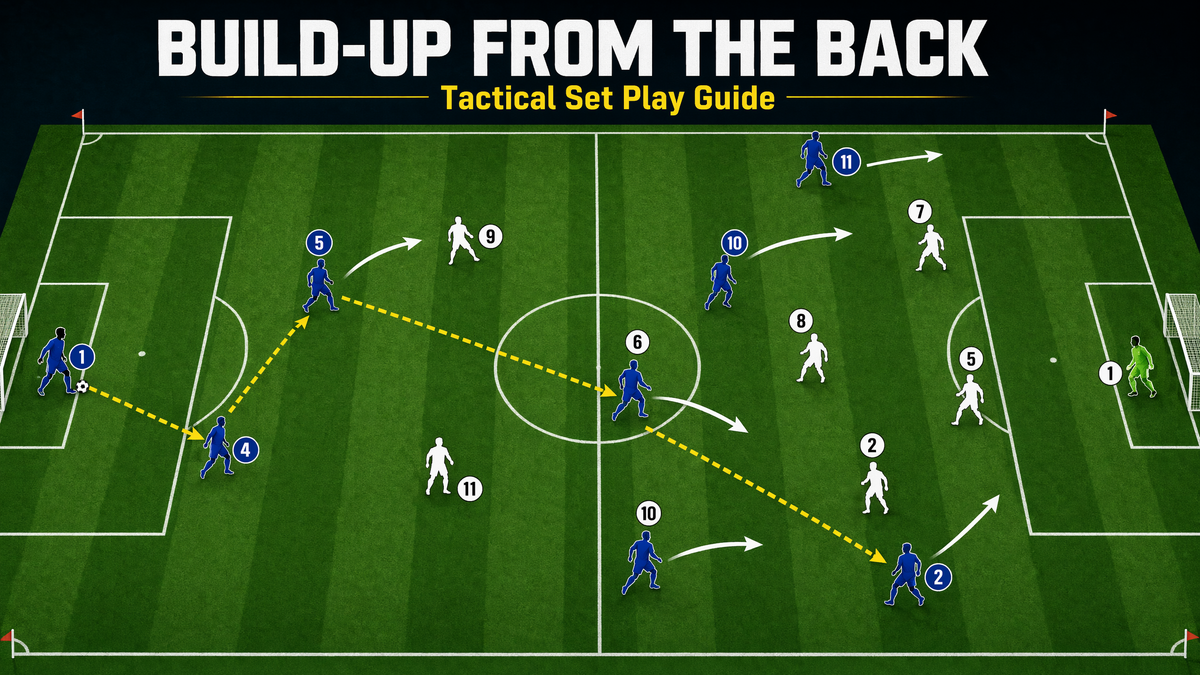
Playing out from the back has become a fundamental aspect of modern football. This tactical set play is designed to help your team maintain possession, draw the opposition forward, and exploit the spaces left behind. By utilizing the goalkeeper as an active participant and structuring the defenders and midfielders to create numerical superiority, teams can safely navigate high presses and transition smoothly into the attacking third. Use this set play when facing aggressive pressing teams or when you want to control the tempo of the match from the defensive third.
2. Setup
Pitch Dimensions: Standard 11v11 pitch (100-110m x 64-75m).
Equipment Needed: 1 full-size goal, 10-15 cones for marking zones, bibs in two contrasting colours, and an adequate supply of footballs.
Player Positions:
- Goalkeeper (1)
- Right Centre-Back (4) and Left Centre-Back (5)
- Right Back (2) and Left Back (3)
- Central Defensive Midfielder (6)
- Central Midfielders (8, 10)
- Attacking Midfielders/Wingers (7, 11)
- Striker (9)
3. Step-by-Step Instructions
Phase 1: Initial Shape & Goalkeeper Distribution
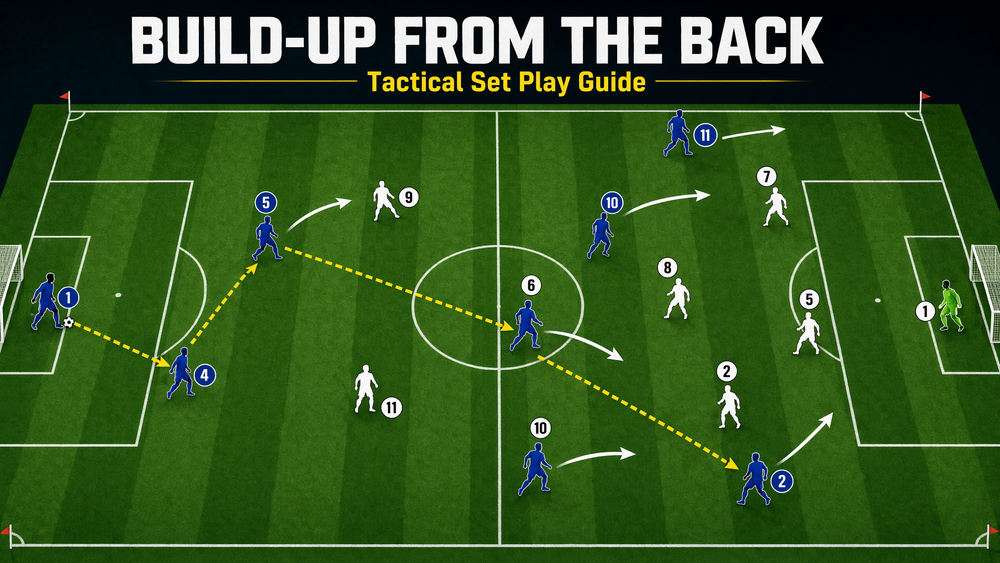
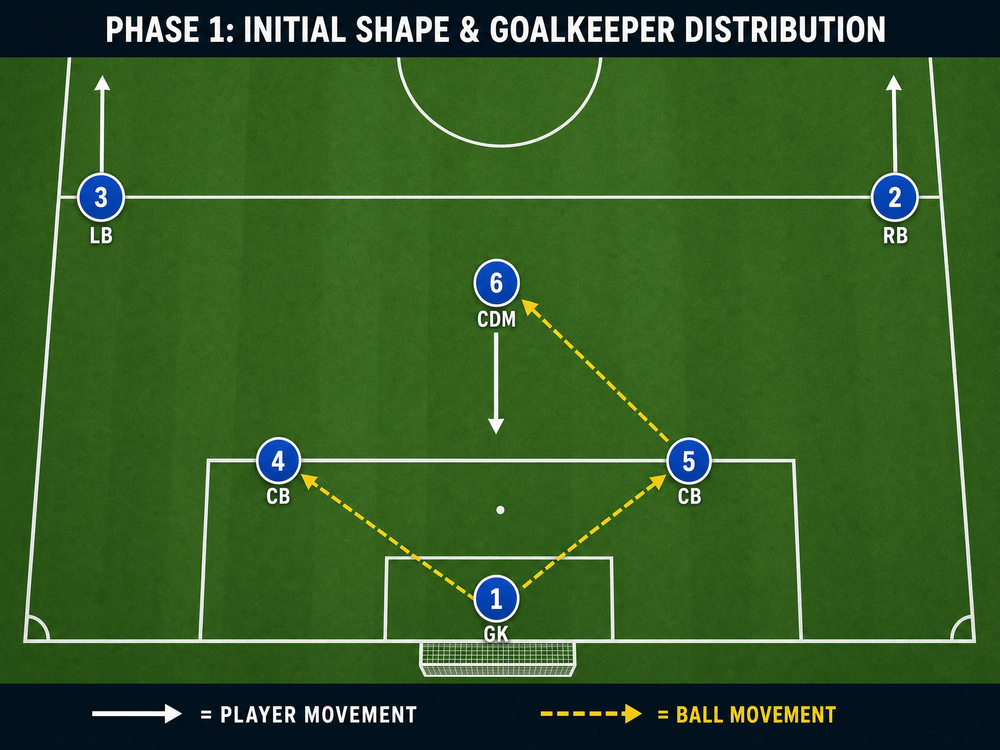
- The Starting Position: The Goalkeeper (1) starts with the ball. The two Centre-Backs (4 & 5) split wide, positioning themselves on the edge of the penalty area, approximately 8 to 10 metres apart.
- Fullback Positioning: The Right Back (2) and Left Back (3) push high and wide, hugging the touchlines near the halfway line to stretch the opposition horizontally.
- The Pivot Drop: The Central Defensive Midfielder (6) drops deep into the central space vacated by the Centre-Backs, offering a central passing option and creating a 4v3 or 3v2 overload against the opposing forwards.
- The First Pass: The Goalkeeper assesses the pressure. The primary option is a short, firm pass to either Centre-Back (4 or 5). If the Centre-Backs are tightly marked, the Goalkeeper can play directly to the dropping CDM (6).
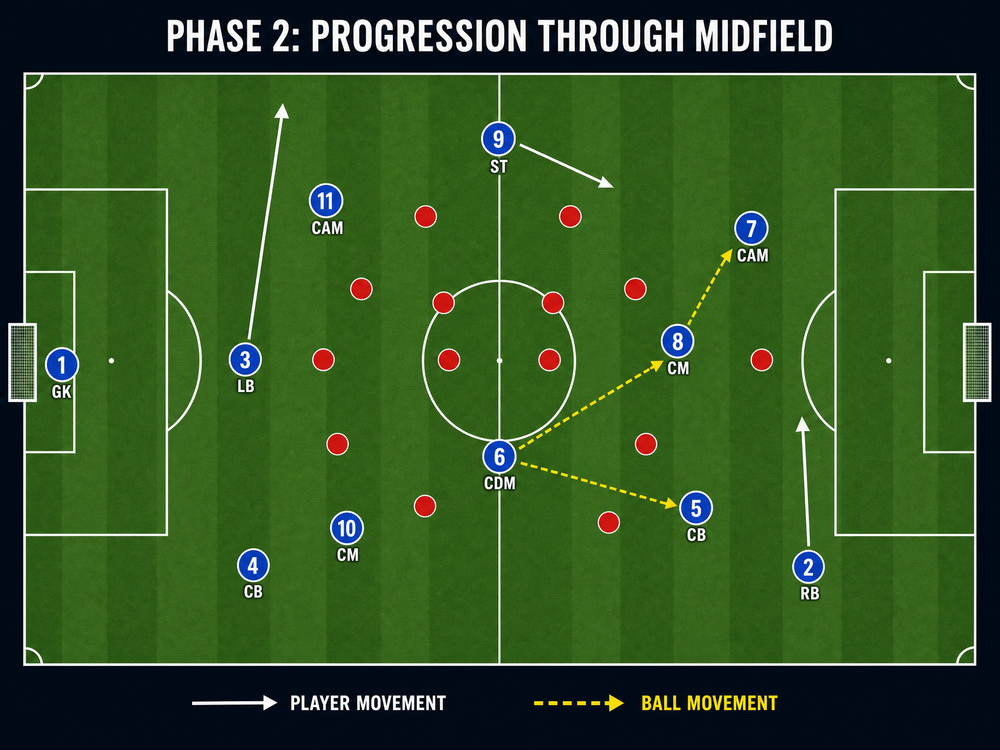
Phase 2: Progression Through Midfield
- Breaking the First Line: Once a Centre-Back receives the ball, they must immediately look to break the opposition's first line of pressure. If pressured from the outside, they look inside to the CDM (6). If pressured centrally, they look to play down the line to the advanced Fullback (2 or 3).
- Midfield Rotation: As the ball moves to the CDM (6), the Central Midfielders (8 & 10) stagger their runs. One drops slightly to offer a short option, while the other pushes higher into the half-space to pin the opposing midfielders.
- The Switch of Play: If the ball is played to the CDM (6) and the opposition has shifted heavily to one side, the CDM should look to switch the play quickly to the opposite side, finding the advanced Fullback or the other Centre-Back.
- Finding the Pocket: The ultimate goal of this phase is to find a Central Midfielder (8 or 10) or an Attacking Midfielder (7 or 11) in the 'pocket' between the opposition's midfield and defensive lines.
Phase 3: Final Third Entry & Attacking Options
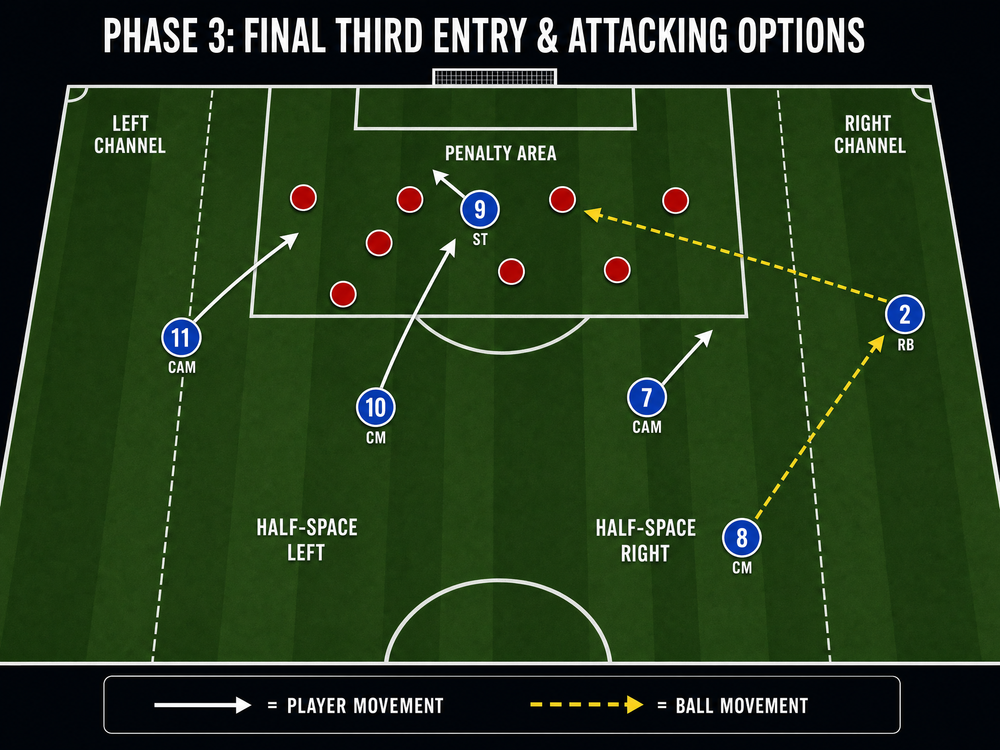
- Attacking the Space: Once a player receives the ball in the pocket, the team must immediately transition into an attacking mindset. The player on the ball looks to drive forward or play a penetrating pass.
- Wide Overloads: The advanced Fullbacks (2 & 3) continue their runs down the flanks, creating 2v1 overloads against the opposing fullbacks.
- Central Runs: The Striker (9) makes a diagonal run across the face of the opposing Centre-Backs, either looking to receive a through ball or dragging defenders away to create space for the arriving Midfielders (8 & 10).
- The Final Action: The play culminates in a cross from the wide areas, a cut-back from the byline, or a central combination leading to a shot on goal.
4. Key Coaching Points
- Body Shape: Players must receive the ball on the half-turn, facing forward whenever possible, to quickly assess their next option.
- Pass Quality: Passes must be firm, accurate, and played to the correct foot (usually the back foot) to allow for quick progression.
- Movement off the Ball: Static players are easy to mark. Continuous, coordinated movement is essential to create passing lanes and disrupt the opposition's defensive shape.
- Goalkeeper Involvement: The Goalkeeper must act as an extra outfield player, offering support and switching the point of attack when necessary.
- Patience vs. Penetration: While patience is required to draw the opposition out, players must recognize the moment to play the penetrating pass and accelerate the attack.
5. Common Mistakes
- Forcing the Play: Playing a risky pass into a heavily congested area instead of recycling possession and waiting for a better opportunity.
- Lack of Width: Fullbacks not pushing high and wide enough, failing to stretch the opposition and making it easier for them to press centrally.
- Static Midfielders: Central Midfielders failing to rotate or drop into pockets of space, leaving the Centre-Backs with no forward passing options.
- Poor Goalkeeper Distribution: Goalkeepers playing slow, inaccurate passes that put the receiving Centre-Back under immediate pressure.
6. Variations & Progressions
- Progression 1: Add Pressure: Start with passive opposition and gradually increase the intensity of the press until the team is playing against a fully active, high-pressing opponent.
- Progression 2: Time Limits: Introduce a time limit (e.g., 8 seconds) for the team to progress the ball from the Goalkeeper into the attacking half.
- Variation 1: The False 9 Drop: Instead of the CDM dropping deep, have the Striker (False 9) drop into midfield to create an overload, while the Wingers make diagonal runs in behind the defence.
- Variation 2: Direct Option: If the opposition presses with a high defensive line, the Goalkeeper can look to play a direct, lofted pass over the top to a fast Winger or Striker.
7. Age Adaptations
- Under 8 - Under 10: Focus on the basic mechanics of passing and receiving. Simplify the setup to 4v4 or 5v5 on a smaller pitch. Emphasize the Centre-Backs splitting wide and the Goalkeeper playing short passes.
- Under 12 - Under 14: Introduce the concept of the CDM dropping deep and the Fullbacks pushing high. Focus on body shape, scanning, and recognizing when to play forward vs. when to recycle possession.
- Under 16 - Open: Implement the full tactical structure. Focus on quick combinations, switching the play, and exploiting the spaces left by the opposition's press. Introduce complex variations and require players to make rapid decisions under high pressure.
