

Football
Mastering the Near-Post Corner: A Tactical Guide for Coaches
A comprehensive coaching resource detailing a highly effective near-post corner kick set play, complete with tactical diagrams, step-by-step instructions, and key coaching points to dominate the opposition.
What you need
football, cones, bibs, goal
1. Overview
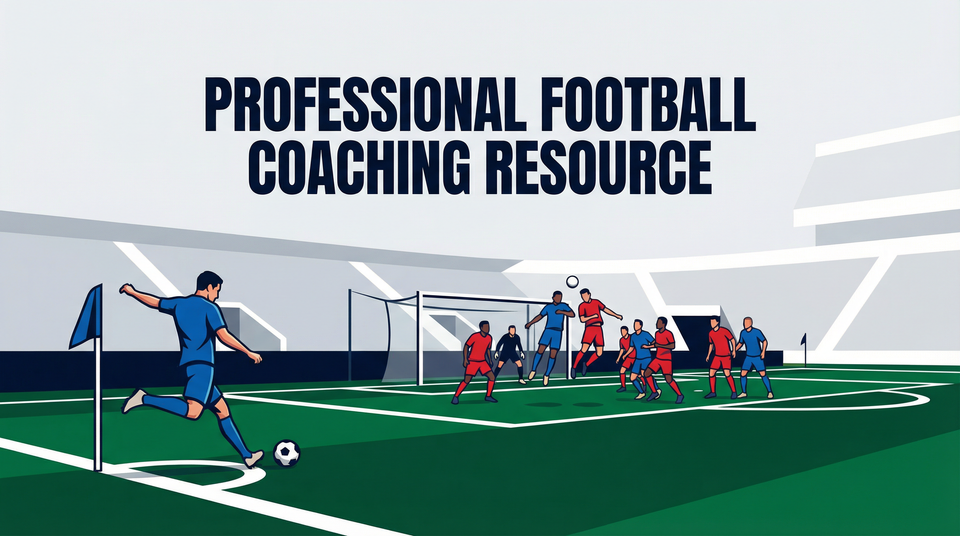
This set play is designed to create a high-percentage scoring opportunity from a corner kick by exploiting space at the near post. It relies on coordinated movement, precise delivery, and aggressive runs to create confusion for the defending team. The primary objective is a flick-on header at the near post for a second player to attack at the far post, or for the initial runner to score directly. It is most effective against teams that employ a zonal marking system or are slow to organize defensively on set pieces.
2. Setup

Equipment
- 1 full-size goal
- 5-10 footballs
- Cones or markers to designate starting positions
- 2 sets of different colored bibs for attacking and defending teams
Pitch Setup
- The drill is run from either the left or right corner flag on a standard pitch (100-110m x 64-75m).
- The attacking team will have 7 players involved in the routine, while the defending team will have a goalkeeper and 2-4 defenders.
Player Positions
- Taker (Player 3): A player with excellent delivery, capable of hitting a low, driven cross to the near post area.
- Near-Post Runner (Player 9): Your best header of the ball, typically your striker. Must be aggressive and have good timing.
- Far-Post Runner (Player 10): A clinical finisher, often the second striker or an attacking midfielder.
- Blocker/Screener (Player 7): A physically strong player to impede the path of the key defender marking the near-post zone.
- Far-Post Cover (Player 11): Positioned at the back post to capitalize on any flick-ons or over-hit crosses.
- Edge of Box (Players 6 & 8): Two midfielders positioned to win second balls and prevent counter-attacks.

3. Step-by-Step Instructions

- The Signal: The corner taker (Player 3) gives a pre-determined signal (e.g., raising one arm) to initiate the set play.
- The Delivery: Player 3 delivers a low, hard, inswinging cross aimed at the space approximately 6-8 yards from the goal line, directly in line with the near post.
- The Near-Post Run: As the taker approaches the ball, the Near-Post Runner (Player 9) makes an explosive, curved run from the edge of the penalty area towards the near-post zone.
- The Block: Simultaneously, the Blocker (Player 7) steps into the path of the defender assigned to the near post, creating a screen and freeing up Player 9.
- The First Contact: Player 9 attacks the ball at its highest point, aiming to either flick it on across the face of the goal or score directly with a powerful header.
- The Secondary Runs: As the ball is flicked on, the Far-Post Runner (Player 10) and Far-Post Cover (Player 11) attack the back-post area, anticipating the second ball.
- Edge of Box Cover: Players 6 and 8 hold their position at the edge of the penalty area, ready to challenge for any cleared balls or launch a second phase of attack.

4. Key Coaching Points

- Quality of Delivery: The success of this play hinges on the corner taker's ability to deliver the ball with pace and accuracy to the correct zone. It should be a driven cross, not a floated one.
- Timing of Runs: Players must time their runs to perfection. The movement should be explosive and start just as the taker makes contact with the ball.
- Aggression in the Attack: The Near-Post Runner (Player 9) must be committed and aggressive in attacking the ball. They must want to win that first header.
- The Screen: The block by Player 7 is subtle but crucial. It's not an outright foul, but a legal obstruction to create a yard of separation.
- Anticipation of Second Ball: Players 10 and 11 must assume the flick-on will be successful and attack the space at the back post with intent.
- Defensive Balance: Players 6 and 8 provide the safety net. They must maintain their discipline and not get drawn into the box too early.
5. Common Mistakes

- Poor Delivery: The cross is too high, too soft, or too close to the goalkeeper, making it easy to defend.
- Early Runs: The attacking players start their runs too early, arriving at the destination before the ball and being marked easily.
- Ineffective Screen: The blocker (Player 7) fails to impede the defender, allowing them to challenge for the first ball.
- Lack of Aggression: The Near-Post Runner (Player 9) is not committed to winning the header, allowing the defender to clear the ball.
- No Second-Ball Attack: The far-post runners (Players 10 & 11) are static and fail to anticipate the flick-on.
6. Variations & Progressions
Variations
- The Decoy Run: Player 9 makes the same near-post run, but as a decoy. The delivery is aimed over their head to Player 10, who is making a direct run to the penalty spot.
- Short Corner Option: If the defense is packing the box, the taker can play a short pass to Player 8, who then delivers the cross from a different angle.
Progressions
- Add More Defenders: Start with 2 defenders and gradually increase to 4 or 5 to increase the difficulty and realism.
- Live Scenario: Run the set play in a full 11v11 game situation to test its effectiveness under pressure.
7. Age Adaptations
- Under 10 / Under 12: Focus on the basic movements and the quality of the delivery. Simplify the runs and remove the blocking element. The goal is for the players to understand the concept of attacking a specific zone.
- Under 14 / Under 16: Introduce the blocker and more complex secondary runs. Emphasize the timing and synchronization of the movements. Players should be able to execute the play with more pace and precision.
- Open Age / Professional: At this level, all elements of the set play should be executed at high speed. Introduce variations and tactical adjustments based on the opposition's defensive setup. The focus is on flawless execution and clinical finishing.
