

Football
The Decoy & Curl: Free Kick Delivery Set Play
Master this deceptive free kick routine that uses a dummy run to manipulate the defensive wall and deliver a dangerous inswinging cross to the far post.
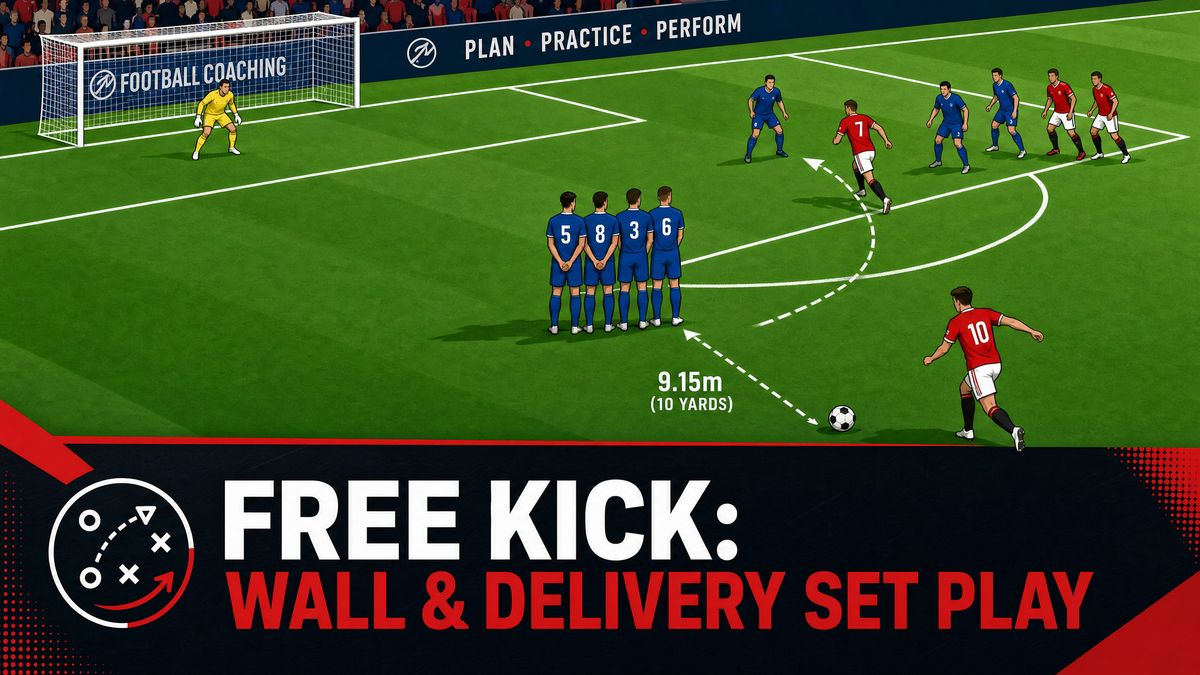
What you need
Football, Cones (for marking positions during practice), Training bibs (to differentiate attackers and defenders), Mannequins (optional, to simulate the defensive wall)
1. Overview
When faced with a well-organised defensive wall just outside the penalty area (20-25 metres from goal), a direct strike isn't always the highest percentage option. The Decoy & Curl set play is designed to manipulate the defensive structure, draw the goalkeeper's attention away from the primary delivery zone, and create a high-quality goal-scoring opportunity at the far post. By using a coordinated dummy run, this routine creates a momentary hesitation in the defensive line, allowing your attackers to exploit the space behind the wall.
This play is particularly effective when awarded a free kick in the wide-central channels (often called the 'half-spaces'), where the angle invites an inswinging delivery toward the back post.
2. Setup
Pitch Area: Attacking third, specifically a free kick awarded 20-25 metres from goal, slightly off-centre.
Player Personnel:
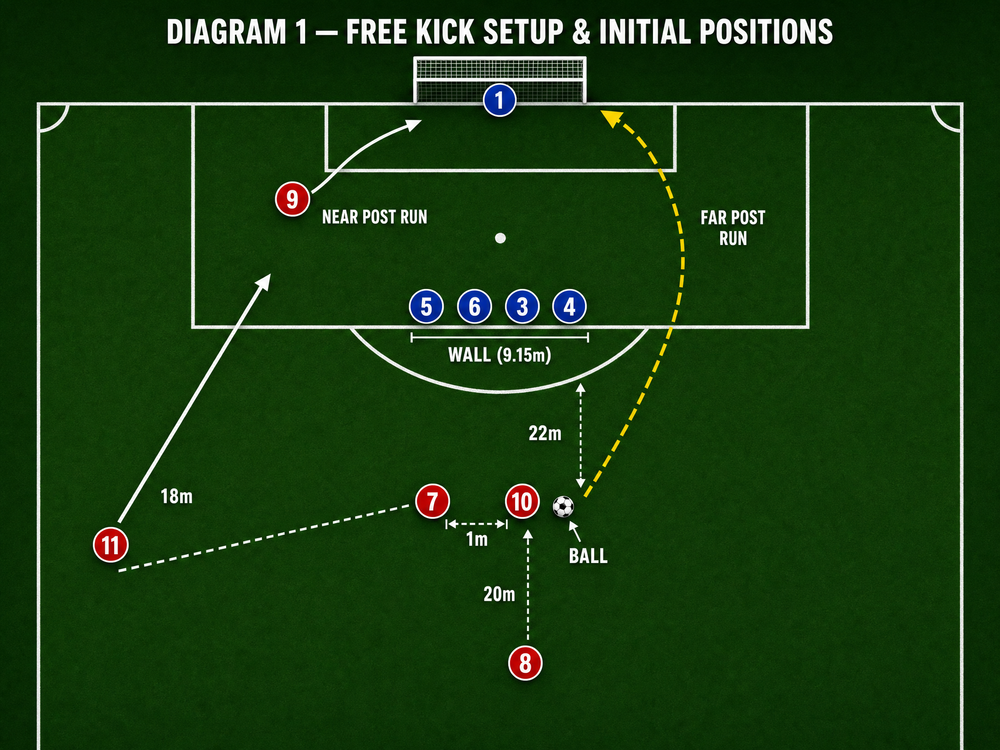
- #10 (Primary Taker): Your best dead-ball specialist, capable of delivering pace and whip.
- #7 (Decoy Runner): A quick player who can sell the fake run convincingly.
- #9 (Target Striker): Strong in the air, aggressive in attacking the ball.
- #11 (Far Post Attacker): Good anticipation and timing for late arrivals.
- #8 (Safety Outlet): Disciplined midfielder to provide defensive cover and a recycling option.
3. Step-by-Step Instructions
- The Stance: Both #10 and #7 stand over the ball to create uncertainty. #10 is positioned for a direct strike, while #7 is positioned 1 metre to the side, simulating a potential short pass or an alternative striking angle.
- The Trigger: The routine begins on the referee's whistle. #10 gives a subtle visual cue (e.g., adjusting socks or a specific hand signal) to initiate the movement.
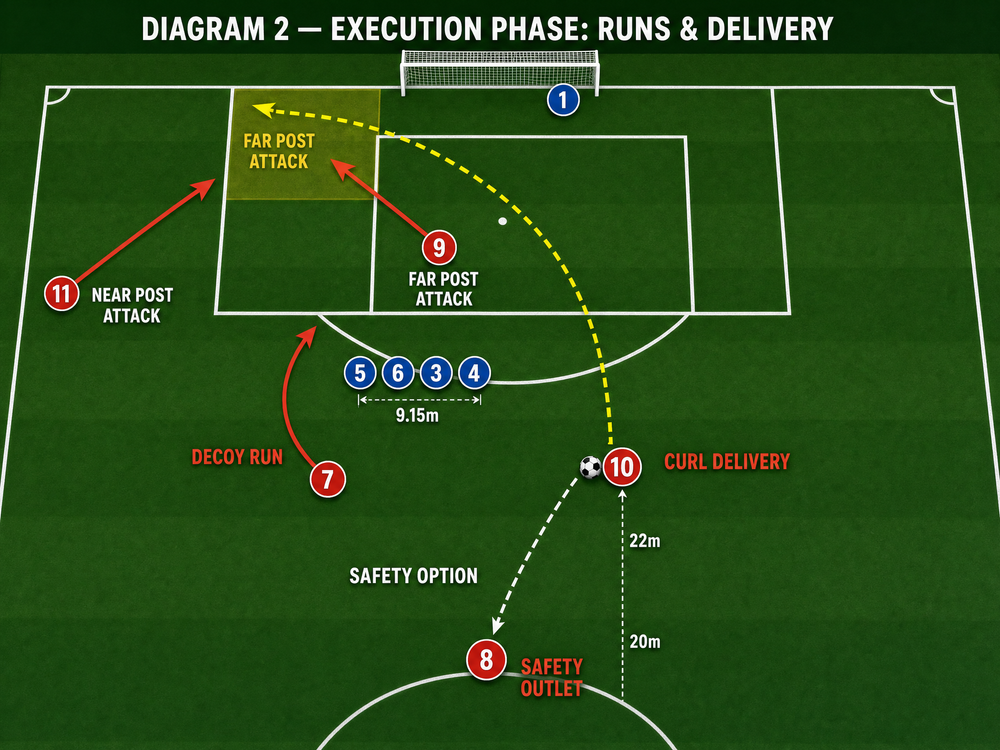
- The Decoy Run: #7 sprints aggressively around the outside of the defensive wall. This run must be completely convincing to draw the eyes of the defenders and potentially force the goalkeeper to take a half-step toward the near post.
- The Delivery: As #7 clears the wall, #10 strikes the ball. The technique requires an inswinging delivery (curling toward the goal) with enough pace to clear the first defender but dipping into the space between the penalty spot and the far post.
- The Attacking Runs:
- #9 makes a curved, aggressive run toward the near post, aiming to drag the central defenders with them.
- #11 times their run from the wide position, attacking the space at the far post created by #9's movement.
- The Safety Net: #8 holds their position 20 metres behind the ball, ready to intercept any clearances or receive a backward pass if the initial setup breaks down.
4. Key Coaching Points
- Selling the Dummy: The success of this play hinges entirely on #7's decoy run. They must sprint at full match pace and demand the ball, forcing the defence to react.
- Delivery Trajectory: The cross from #10 must have 'whip' and pace. A floated, slow cross gives the goalkeeper too much time to adjust and claim the ball. The target area is the corridor between the six-yard box and the penalty spot.
- Timing of Runs: #9 and #11 must hold their runs until #10 begins their approach to the ball. Running too early will result in being caught offside; running too late means the ball will bypass them.
- Attacking the Space, Not the Ball: Attackers should focus on arriving in the designated zones (near post and far post) rather than ball-watching. Trust that the delivery will arrive in the correct area.
5. Common Mistakes
- Poor Decoy Execution: If #7 jogs half-heartedly, the defence will ignore them, and the play loses its deceptive element.
- Over-Hitting the Delivery: #10 tries to put too much power on the cross, sending it out for a goal kick rather than allowing the attackers to attack it.
- Static Attackers: #9 and #11 stand still and wait for the ball to arrive, making them easy to mark. They must be moving dynamically as the ball is struck.
- Lack of Defensive Cover: #8 pushes too far forward, leaving the team vulnerable to a rapid counter-attack if the delivery is cleared.
6. Variations & Progressions
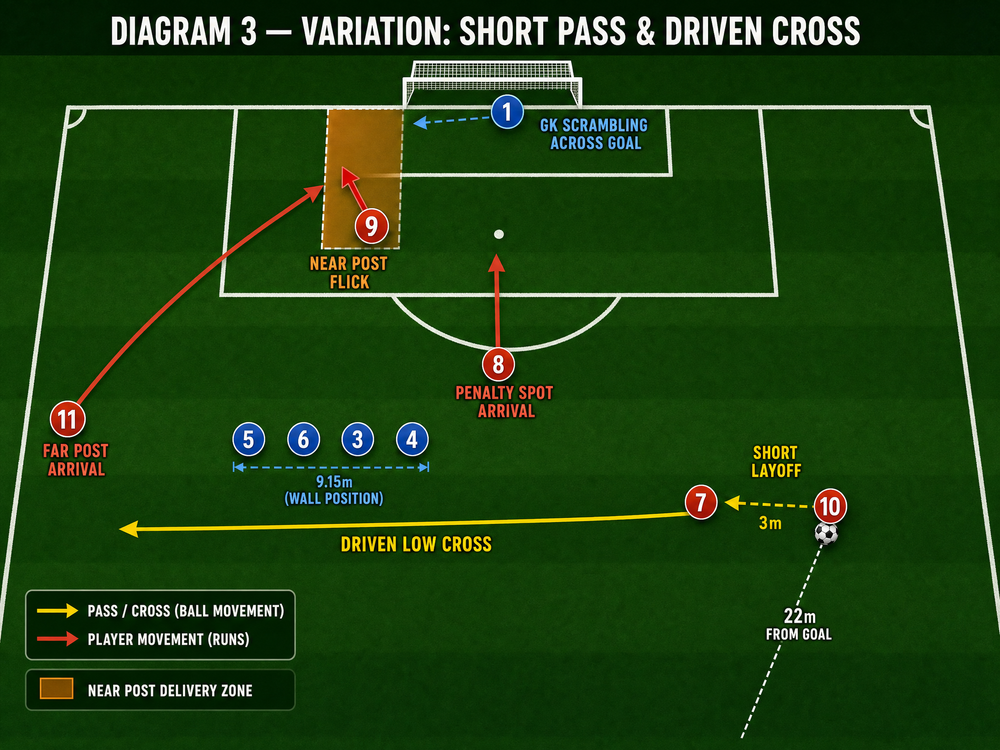
Variation 1: The Short Layoff (Diagram 3)
If the defence begins to anticipate the cross, use this variation. Instead of crossing, #10 plays a short, firm pass to #7, who has completed their run around the wall. #7 then hits a driven, low cross across the face of the goal for #9 or #11 to tap in.
Progression: Adding a Blocker
Introduce a designated 'blocker' (e.g., your #4 or #5) who stands in the wall or just in front of it. Their job is to legally obstruct the goalkeeper's line of sight or impede the nearest defender from tracking #9's run.
7. Age Adaptations
- Under 10 - Under 12: Focus purely on the delivery and one attacking run. Remove the complex decoy run and simplify the setup to a straightforward cross and finish. Emphasise the technique of striking a moving ball.
- Under 14 - Under 16: Introduce the decoy run but allow more margin for error on the delivery. Encourage players to communicate and coordinate the timing of the runs.
- Open / Senior: Execute the full routine with variations. Demand high-quality delivery, perfectly timed runs, and seamless communication. Introduce complex blocking schemes and secondary decoy movements.
