

Football
The Decoy & Deliver: Advanced Free Kick Set Play
Master the art of deception and precise delivery with this versatile free kick routine designed to dismantle organized defensive walls.

What you need
1 full-size football, Training bibs (two contrasting colours), Cones or markers, Portable defensive wall mannequins
Overview
The 'Decoy & Deliver' is an advanced free kick set play designed for situations where the ball is positioned centrally or slightly offset, approximately 20-30 metres from the goal. This routine leverages intelligent dummy runs to disrupt the defensive wall's stability, manipulate the goalkeeper's positioning, and create multiple high-percentage scoring opportunities. By introducing elements of unpredictability, this play forces defenders into split-second decision-making, often leading to marking errors and open spaces in critical areas of the penalty box.
Setup
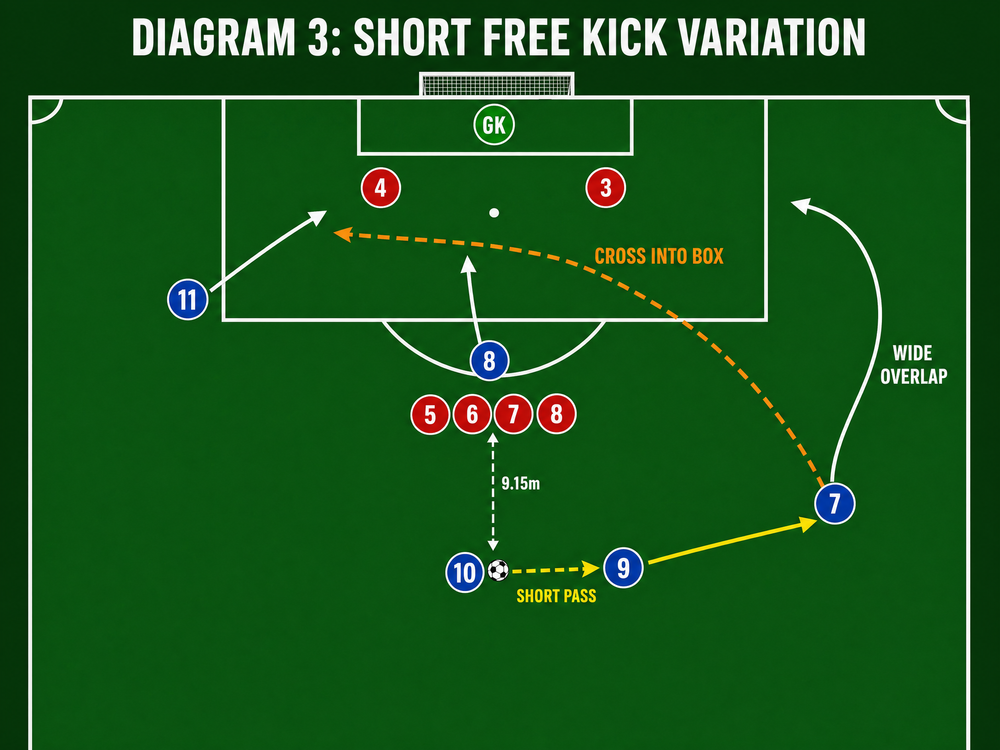
Equipment Needed:
- 1 full-size football
- Training bibs (two contrasting colours)
- Cones or markers for pitch setup (if using a partial pitch)
- Portable defensive wall mannequins (optional but highly recommended for training)
Pitch Setup:
Utilize the attacking half of a standard football pitch (100-110m x 64-75m). The primary focus area is the zone from the halfway line to the goal, specifically the penalty area and its immediate surroundings.
Player Positions:
- Player 10 (The Taker): Positioned directly over the ball, acting as the primary free kick taker.
- Player 9 (The Decoy): Positioned 2-3 metres to the right or left of the ball, prepared to make a convincing dummy run.
- Player 11 (Far Post Runner): Positioned on the far post edge of the penalty area, ready to attack the back post.
- Player 7 (Wide Option/Late Runner): Positioned wider, ready to exploit space or offer a short pass option.
- Player 8 (Central Attacker): Positioned centrally at the top of the penalty arc, prepared to attack the centre of the box or receive a cutback.
Step-by-Step Instructions

Phase 1: The Initial Setup
- Establish the Decoy: Player 10 and Player 9 stand over the ball. Their body language must suggest that either player could take the shot. This initial ambiguity forces the goalkeeper to prepare for multiple trajectories.
- Position the Runners: Players 11, 7, and 8 take up their starting positions on the edge of the penalty area, ensuring they are not offside but are close enough to exploit any gaps created by the wall's movement.
- Assess the Wall: Player 10 analyzes the defensive wall (typically 4-5 players) and the goalkeeper's positioning to identify potential weaknesses or gaps.
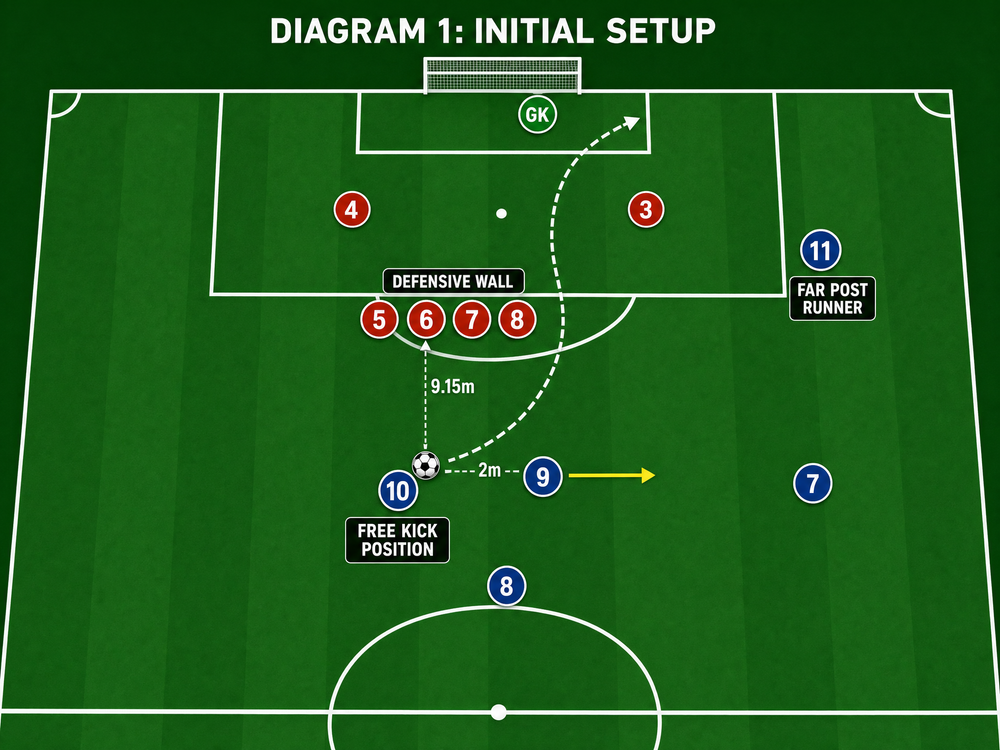
Phase 2: The Movement and Delivery
- The Dummy Run: On a pre-agreed signal (e.g., a hand raise or a specific call), Player 9 initiates a sprint over the ball, curving their run to the outside of the wall. This movement is designed to draw the attention of the defenders in the wall and potentially cause them to shift or break their line prematurely.
- The Delivery: Immediately following Player 9's run, Player 10 strikes the ball. Depending on the defensive reaction, Player 10 has three primary options:
- Option A (Curl Over Wall): If the wall holds firm but the goalkeeper shifts slightly toward the dummy runner, Player 10 curls the ball over the wall toward the far post.
- Option B (Through the Wall): If the wall fractures or jumps unevenly in response to the dummy run, Player 10 drives a low, hard shot through the gap, aiming for Player 8 who is crashing the centre of the box.
- Option C (Short Pass): If the defence drops deep quickly, Player 10 plays a short pass wide to Player 7, who then delivers a first-time cross into the penalty area.
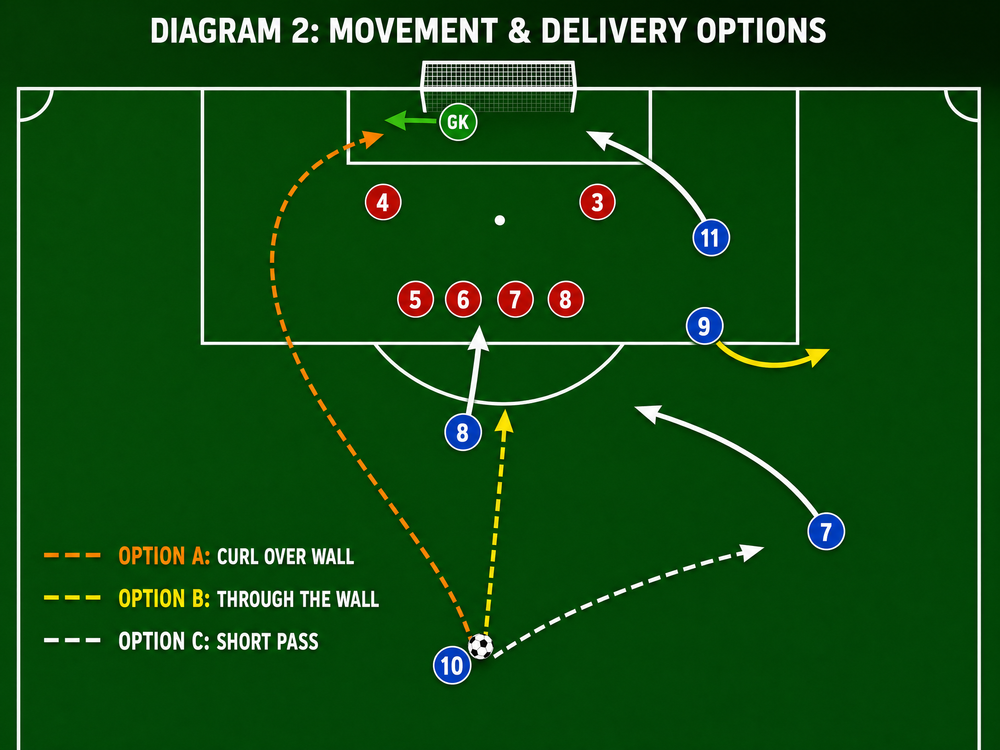
Phase 3: The Short Free Kick Variation
- The Wide Overlap: If the direct shot is deemed too risky, Player 10 plays a short, disguised pass to Player 9, who has peeled off instead of making the dummy run.
- The Delivery: Player 9 immediately plays the ball wide to Player 7, who is making an overlapping run down the flank.
- The Finish: Player 7 delivers a driven cross into the 'Zone 14' area (the central space just inside the penalty box), where Players 11 and 8 are arriving to finish the play.
Key Coaching Points
- Conviction in the Decoy: The dummy run by Player 9 must be executed at full sprint with genuine intent. If the run is half-hearted, the defensive wall will not react, and the play's effectiveness is neutralized.
- Timing is Everything: The synchronization between the dummy run and the actual strike is critical. Player 10 must strike the ball just as the wall is reacting to Player 9's movement, exploiting the momentary confusion.
- Quality of Delivery: Whether curling over the wall or driving a low shot, the technique of Player 10 must be precise. The delivery must have enough pace and accuracy to beat the goalkeeper or find the intended target.
- Aggressive Box Entry: The runners (Players 11, 7, and 8) must attack their designated zones aggressively, anticipating rebounds or second balls. They must not remain static after the ball is struck.
Common Mistakes
- Telegraphing the Play: Players looking directly at their intended targets or adopting obvious body shapes before the kick, allowing the defence to anticipate the routine.
- Poor Spacing: Runners starting too close to the wall or too far from the penalty area, reducing their ability to exploit the space created by the decoy.
- Lack of Communication: Failure to use a clear, disguised signal to initiate the play, resulting in mistimed runs and a disorganized execution.
Variations & Progressions
- The Double Decoy: Introduce a second dummy runner (e.g., Player 8) who runs over the ball from the opposite side before Player 10 strikes it. This adds another layer of complexity for the defence to process.
- The Layoff: Instead of a direct strike or a wide pass, Player 10 taps the ball slightly forward and to the side for Player 8, who has made a late run from deep, to strike a powerful first-time shot.
Age Adaptations
- Under 8 - Under 10: Focus primarily on the basic technique of striking a stationary ball and simple 2-player short pass variations. Avoid complex dummy runs that require advanced timing.
- Under 12 - Under 14: Introduce the concept of a single decoy runner. Emphasize the importance of communication and the basic timing of the runs.
- Under 16 - Open: Implement the full routine with all variations. Focus on the psychological aspects of deception, the precise execution of the delivery, and the aggressive attacking of the penalty box.
