

Football
High Press Play: Coordinated Front Three Execution
Master the art of the high press by coordinating your front three to force turnovers in the attacking third and create immediate goal-scoring opportunities.
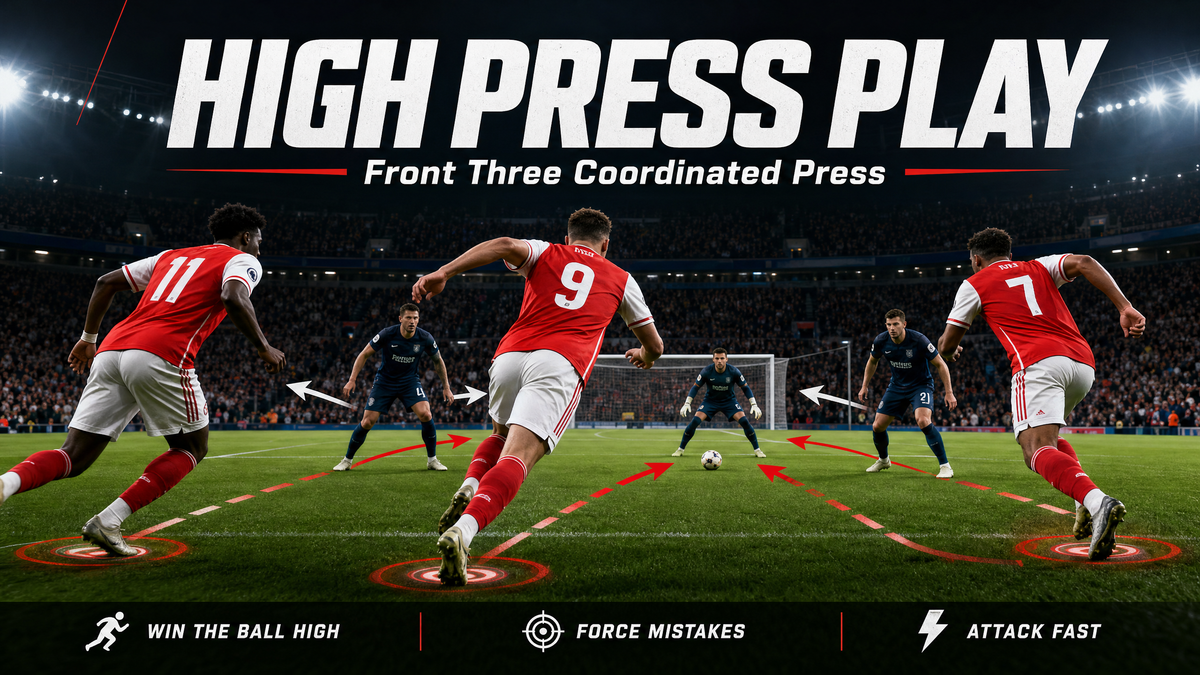
What you need
Full-size goals, Bibs (2 colours), Footballs, Flat markers
1. Overview
The high press from a front three (typically in a 4-3-3 or 3-4-3 system) is an aggressive defensive strategy designed to disrupt the opponent's build-up play right from their goalkeeper. By applying coordinated, intense pressure high up the pitch, your team aims to force rushed decisions, misplaced passes, and ultimately win the ball in dangerous areas close to the opponent's goal. This play is particularly effective against teams that insist on playing out from the back but lack the technical proficiency to do so under extreme duress.
When executed correctly, this is not just a defensive action, but your team's most potent playmaker. It requires supreme fitness, tactical discipline, and absolute commitment from all players, not just the front three, as the midfield and defensive lines must step up to compress the space and eliminate passing options.
2. Setup
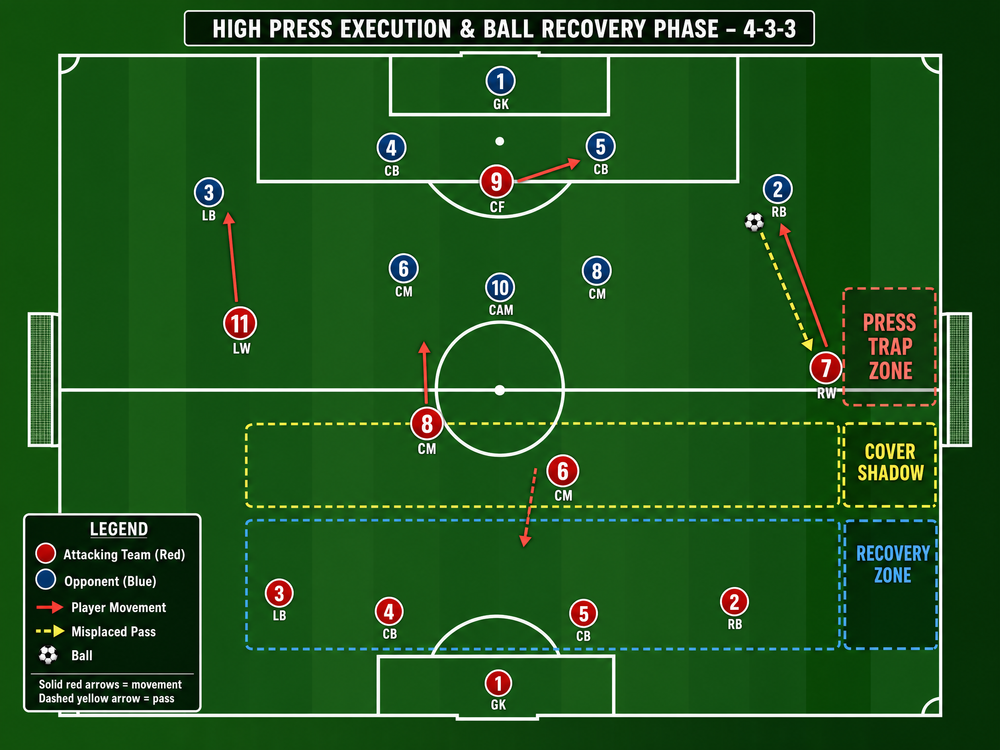
Pitch Area: Full pitch (100-110m x 64-75m) for match realism, or use a condensed 70m x 50m area for higher intensity repetitions.
Players: 11v11 or a focused 8v8 (Front 3 + Mid 3 + 2 CBs vs GK + Back 4 + Mid 3).
Equipment: Full-size goals, bibs (two distinct colours), supply of footballs in the goals, and flat markers to designate the 'Press Trigger Zone' and 'Press Trap Zone'.
Starting Positions:
- Attacking Team (Pressing): Set up in a 4-3-3. The CF (9) is central, ready to engage the CBs. The LW (11) and RW (7) are positioned slightly narrower than usual, ready to jump on the opposing full-backs or split the difference between the CB and FB.
- Defending Team (In Possession): Set up to play out from the back. GK with the ball, CBs split wide to the edges of the penalty area, FBs pushing high and wide.
3. Step-by-Step Instructions
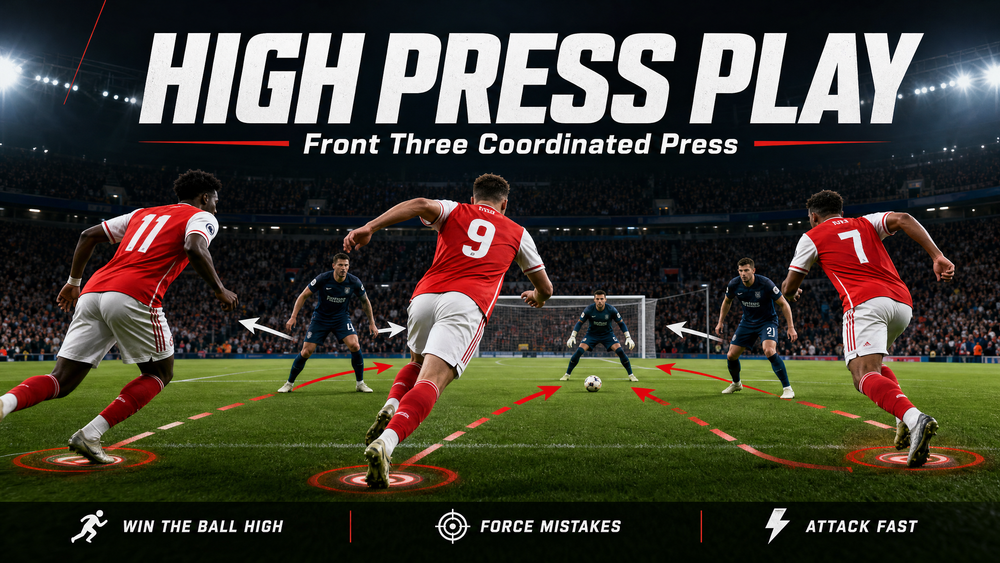
Phase 1: The Trigger
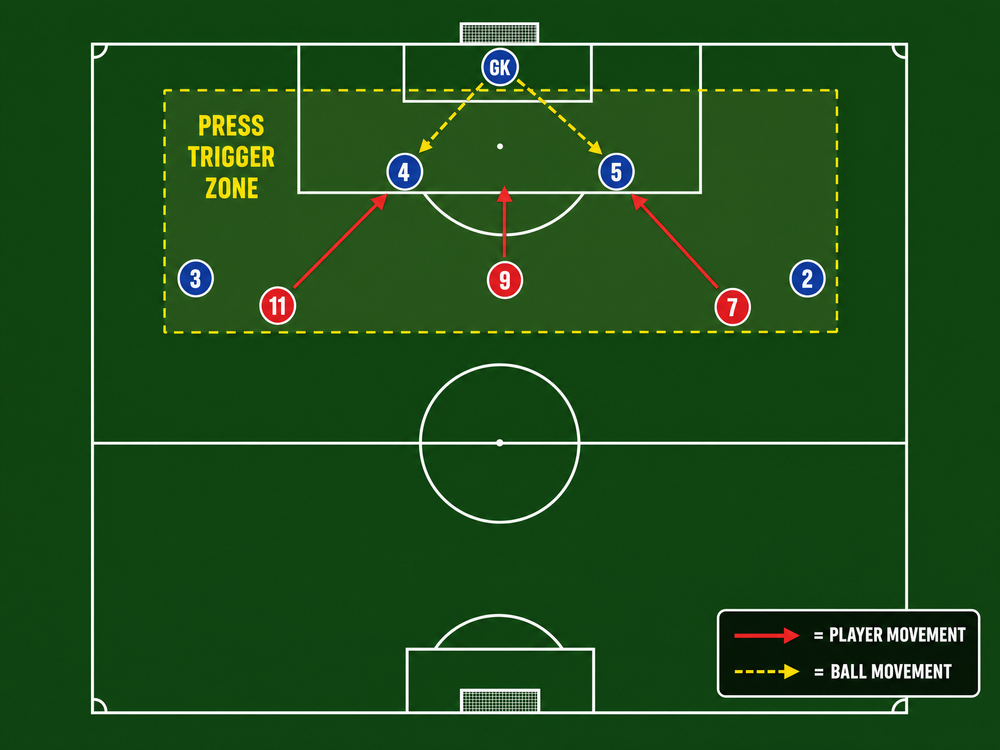
- Identify the Trigger: The press is initiated when a specific trigger occurs. Common triggers include a slow pass from the GK to a CB, a poor first touch by a defender, or a pass played backwards.
- The CF Initiates: As the ball travels from the GK to the CB (e.g., the right CB), the CF (9) begins the press. The CF must run with an arched run, cutting off the passing lane back to the GK or across to the other CB, forcing the play down one side of the pitch.
- Wingers Narrow In: Simultaneously, the winger on the ball side (LW 11) anticipates the pass to the full-back and positions themselves to intercept or immediately press upon reception. The opposite winger (RW 7) tucks inside to cover the central area and mark the pivot/defensive midfielder.
Phase 2: The Trap
4. Springing the Trap: If the CB plays the ball out wide to the full-back, the trap is sprung. The ball-side winger (LW 11) sprints to press the full-back aggressively, showing them down the line and preventing them from turning inside.
5. Midfield Support: The central midfielders must step up aggressively. The attacking midfielder or ball-side CM (8) steps onto the opponent's nearest midfield option. The defensive midfielder (6) pushes up to cover the space behind and intercept any rushed clearances.
Phase 3: Recovery and Transition
6. Winning the Ball: The intense, localized pressure forces a mistake—a heavy touch, a panicked pass out of play, or a direct interception.
7. Immediate Attack: Upon winning the ball, the team must transition to attack instantly. The front three should look for quick combinations to penetrate the penalty area before the opponent can reorganize. If a direct attack isn't possible, secure possession and recycle the ball.
4. Key Coaching Points
- Curved Runs (Cover Shadows): Attackers must not run in straight lines. They must use curved runs to press the ball carrier while simultaneously blocking the passing lane to other options (putting them in a 'cover shadow').
- Compactness: The entire team must move as a unit. If the front three press but the midfield and defense drop deep, enormous gaps will appear for the opponent to exploit. The distance between the strikers and the center-backs should ideally be no more than 35-40 meters.
- Aggression and Intent: The press must be executed with 100% commitment. A half-hearted press is worse than no press at all, as it merely tires the attackers and easily bypassed.
- Communication: Players must communicate constantly. The CF usually dictates the initial trigger, but players behind must call out who they are marking and when to step up.
- Reaction to Failure: If the press is broken, players must instantly transition into a recovery run, dropping into a compact defensive block rather than continuing to chase lost causes.
5. Common Mistakes
- Pressing Alone: One player sprinting to press while the rest of the team stays back. This makes it incredibly easy for the opponent to pass around the isolated player.
- Straight-Line Pressing: Running directly at the ball carrier without cutting off passing angles, allowing the defender to simply pass the ball past the pressing player.
- Lack of Midfield Support: The front three do their job, but the midfielders fail to step up and mark the opponent's midfield options, leaving an easy out-ball.
- Poor Timing: Starting the press too early (before the trigger) allows the opponent to adjust, or too late (after the player has control and options), making the press ineffective.
6. Variations & Progressions
- Progression 1: Add a Time Limit: Once the pressing team wins the ball, they have exactly 6 seconds to generate a shot on goal. This encourages rapid attacking transitions.
- Progression 2: Overload the Build-up: Give the team building from the back an extra player (e.g., an extra midfielder) to make it harder for the pressing team to cover all options, demanding higher tactical intelligence and physical effort.
- Variation: Mid-Block Trap: Instead of pressing the GK, allow the CBs to have the ball and only trigger the aggressive press when the ball is played into the midfield or wide areas. This is useful against teams very comfortable playing out from the back.
7. Age Adaptations
- Under 8 - Under 10: Focus on the basic concept of "hunting in packs." Keep it simple: when the other team has the ball near their goal, we all try to win it back quickly. Don't worry too much about complex cover shadows.
- Under 12 - Under 14: Introduce triggers (e.g., a bad touch) and the concept of cutting off the most dangerous pass. Start working on the team moving together to stay compact.
- Under 16 - Open: Full tactical implementation. Demand precise curved runs, intense physical exertion, perfect coordination between the lines, and rapid transitions upon winning the ball.
