

Football
Mastering Penalty Box Movement: The Triple-Threat Crossing Play
Learn how to orchestrate unmarkable penalty box movement using coordinated three-zone runs to maximize your team's scoring output from wide crosses.
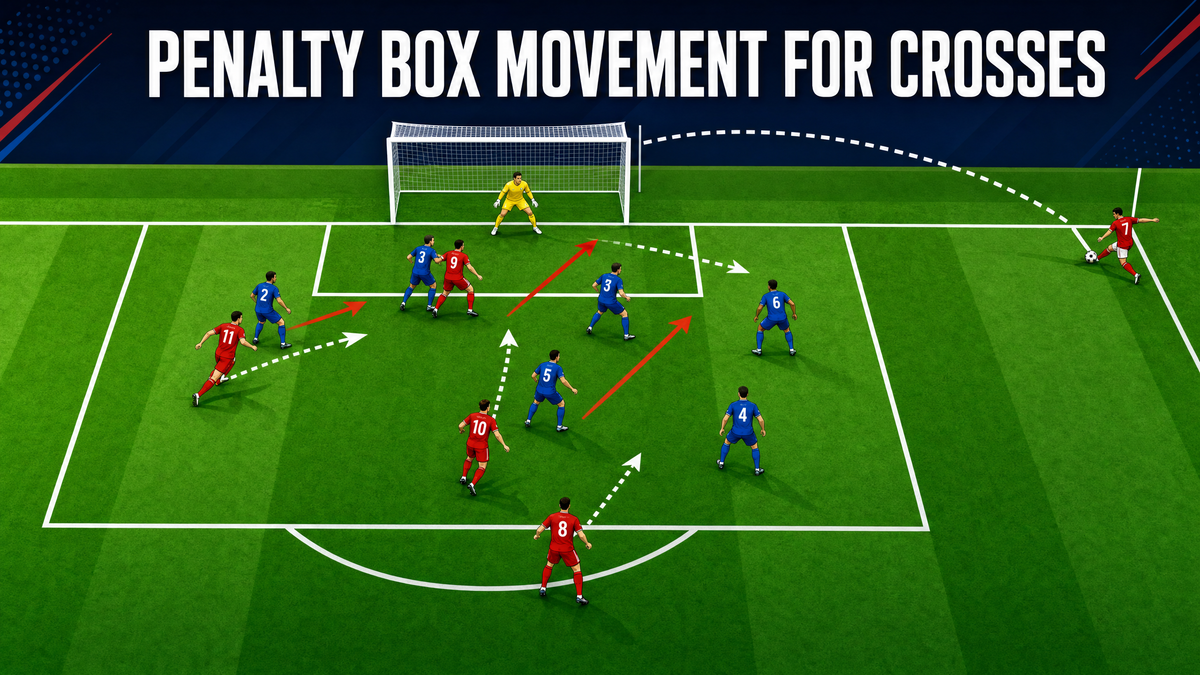
What you need
1 full-size goal, 10-12 footballs, Cones (for marking zones), Training bibs (2 colors)
1. Overview
Crosses from wide areas are a staple of attacking football, but a great delivery is worthless without intelligent, coordinated movement inside the penalty box. The "Triple-Threat Crossing Play" is designed to overwhelm opposition defenses by attacking three critical scoring zones simultaneously: the near post, the penalty spot, and the far post.
This set play achieves success by forcing defenders into impossible decision-making scenarios. When executed with the correct timing and spacing, it creates defensive chaos, pulls center-backs out of position, and guarantees that at least one attacker will have a high-percentage goal-scoring opportunity. It is highly effective against both zonal and man-marking defensive structures.
2. Setup
Pitch Area: Final third of a standard football pitch (approx. 40m x 70m active area).
Players Required: Minimum 6 attackers (Winger, Striker, Attacking Midfielder, Opposite Winger, Central Midfielder, Defensive Midfielder) and a full defensive unit (Goalkeeper + Back Four).
Equipment:
- 1 full-size goal
- 10-12 footballs placed wide left
- Cones to mark starting positions and the three key scoring zones
- Training bibs (2 colors)
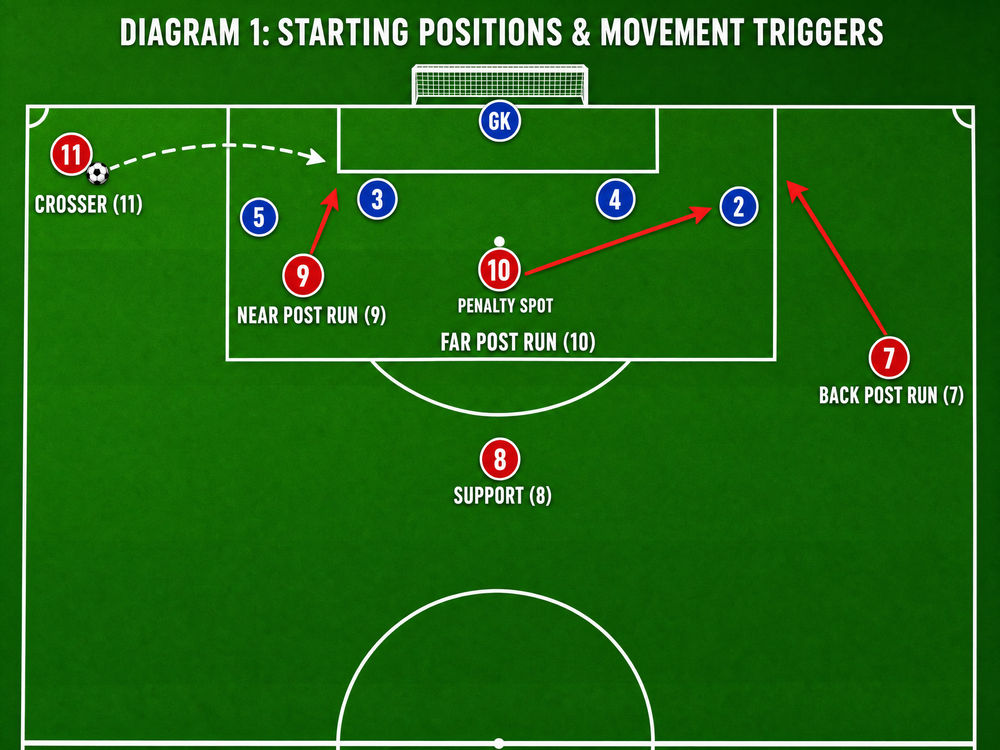
Initial Positioning:
- Player 11 (Left Winger): Wide left, on the ball, ready to deliver the cross.
- Player 9 (Centre Forward): Positioned centrally, roughly 15-18 meters from goal, acting as the primary focal point.
- Player 10 (Attacking Midfielder): Sitting deeper, around 20-25 meters out, slightly offset from the striker.
- Player 7 (Right Winger): Holding width on the opposite flank, level with the edge of the penalty area.
- Player 8 (Central Midfielder): Positioned at the top of the "D" (penalty arc) to sweep up second balls.
3. Step-by-Step Instructions
Step 1: The Trigger
The play is triggered when Player 11 (the wide player) takes a heavy touch out of their feet to set up the cross, or when they look up to assess the box. This visual cue initiates all movement simultaneously.
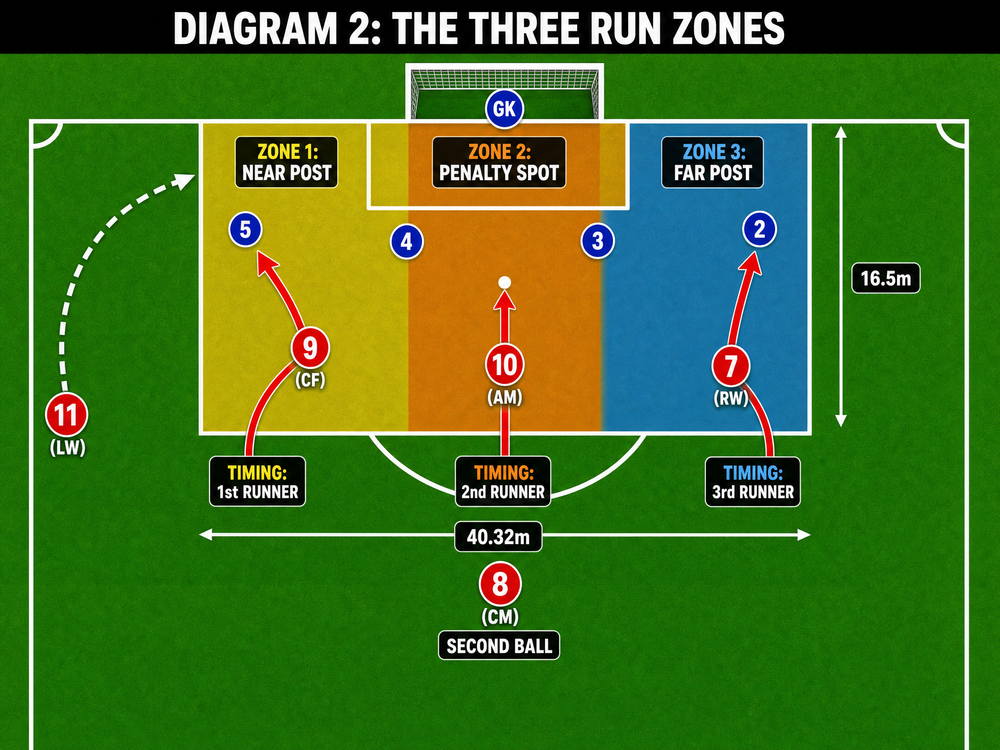
Step 2: The Near-Post Dart (1st Runner)
Player 9 immediately sprints diagonally toward the near post (Zone 1), aiming to arrive at the corner of the 6-yard box just as the ball is delivered. This run must be aggressive and explosive to drag the near-side center-back with them.
Step 3: The Penalty Spot Arrival (2nd Runner)
Player 10 delays their run slightly, then drives straight toward the penalty spot (Zone 2). By arriving a fraction of a second after Player 9 has cleared the space, Player 10 attacks the gap left by the retreating center-backs.
Step 4: The Blind-Side Ghost (3rd Runner)
Player 7 makes a late, looping run toward the back post (Zone 3). Their goal is to stay on the blind side of the opposing full-back, arriving just outside the 6-yard box to capitalize on any overhit crosses or flick-ons.
Step 5: The Second-Ball Net
Player 8 pushes up to the edge of the penalty area, anticipating defensive clearances. Their role is not to score directly from the cross, but to sustain the attack by winning the "second ball" and recycling possession or taking a shot from distance.
4. Key Coaching Points
- Timing Over Speed: The runs must be staggered. If all three players arrive in the box at the exact same time, they become easy to mark. The near-post run must happen first, followed immediately by the penalty spot and far-post runs.
- Attack the Space, Not the Ball: Players should focus on arriving in their designated zones (Near Post, Penalty Spot, Far Post) rather than chasing the trajectory of the ball. Trust the crosser to deliver into the zone.
- Aggressive Decoys: Even if a player knows they aren't the primary target, they must make their run at 100% intensity. A lazy near-post run won't move the defender, ruining the space for the player behind them.
- The "Net" is Crucial: Emphasize the importance of Player 8 at the edge of the box. Statistically, more goals are scored from second-phase play (rebounding or cleared crosses) than from the initial header.
5. Common Mistakes
- Static Starting Positions: Attackers standing still in the box before the cross is delivered. Movement must start from deeper positions to generate momentum.
- Running in Straight Lines: Attackers running straight toward the goal line instead of making diagonal, crossing runs that confuse defenders and force them to hand off marking responsibilities.
- Crowding the Same Zone: Two attackers ending up in the same 5-meter radius, making it easy for one defender to clear the danger.
- Crossing Too Early/Late: The wide player delivering the ball before the runners have established their routes, or waiting too long and allowing the defense to set up.
6. Variations & Progressions
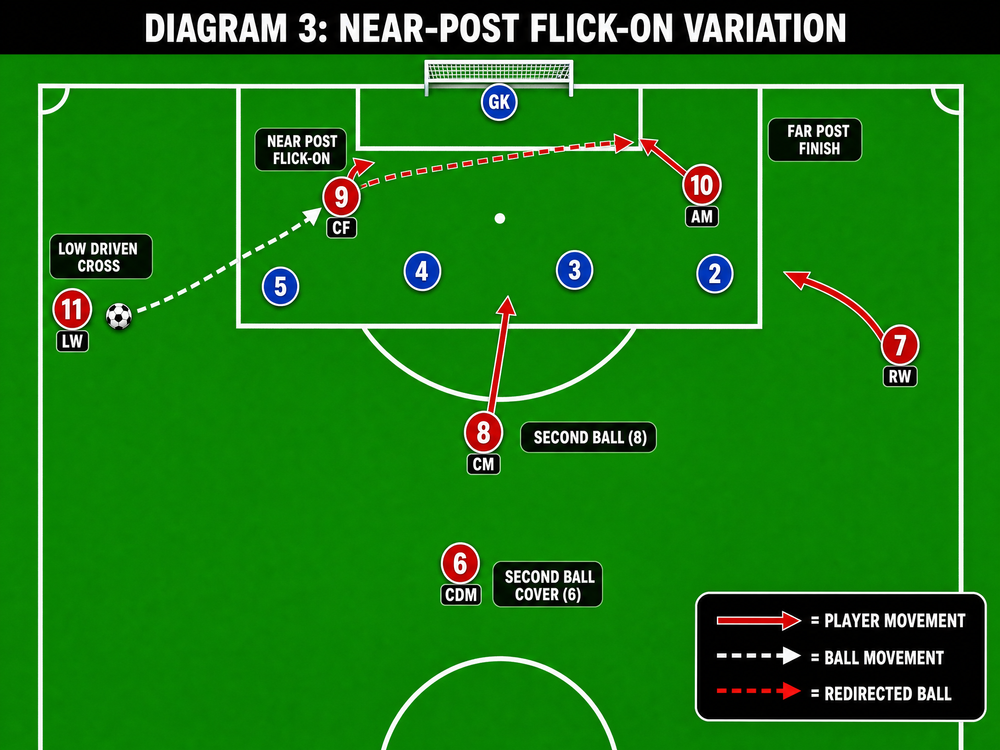
Variation 1: The Near-Post Flick-On
Instead of trying to score, Player 9 makes a darting run to the near post specifically to flick the ball backward across the face of the goal. Player 10 and Player 7 adjust their runs to attack the space behind the flick-on.
Variation 2: The Cut-Back
If the defense drops too deep to protect the 6-yard box, the crosser fakes the deep delivery and instead plays a firm, low pass cut back to Player 8 or Player 10 arriving late at the top of the penalty area.
Progression: Add Active Defenders
Start the drill unopposed to groove the movement patterns. Progress to adding passive defenders (shadowing), and finally introduce full-contact, live defending where the defense is actively trying to clear the ball.
7. Age Adaptations
- Under 8 - Under 10: Focus simply on getting one player to the near post and one to the far post. Keep the terminology simple ("Front Door" and "Back Door"). Use a smaller pitch area.
- Under 12 - Under 14: Introduce the concept of the "second ball" player at the edge of the box. Begin working on the timing of the runs so players aren't waiting under the ball.
- Under 16 - Open: Implement the full three-zone system with complex crossing variations (driven, lofted, cut-backs). Demand high-intensity, game-realistic speed and aggressive decoy running.
