

Football
Rapid-Fire Reflexes: The Multi-Angle Shot-Stopping Circuit
Develop your goalkeeper's reaction speed, positioning, and recovery with this high-intensity multi-angle shot-stopping drill.
What you need
1 Full-size goal, 8-10 Footballs, 4 Cones or markers, 1 Rebound board (optional)
1. Overview
This high-intensity shot-stopping circuit is designed to push goalkeepers to their limits by simulating chaotic, multi-angle game scenarios. It focuses on developing explosive reaction speed, precise footwork for repositioning, and the mental resilience required to make consecutive saves under pressure. Use this drill during the main technical phase of your session when goalkeepers are fully warmed up but not yet fatigued.
2. Setup
Equipment Needed:
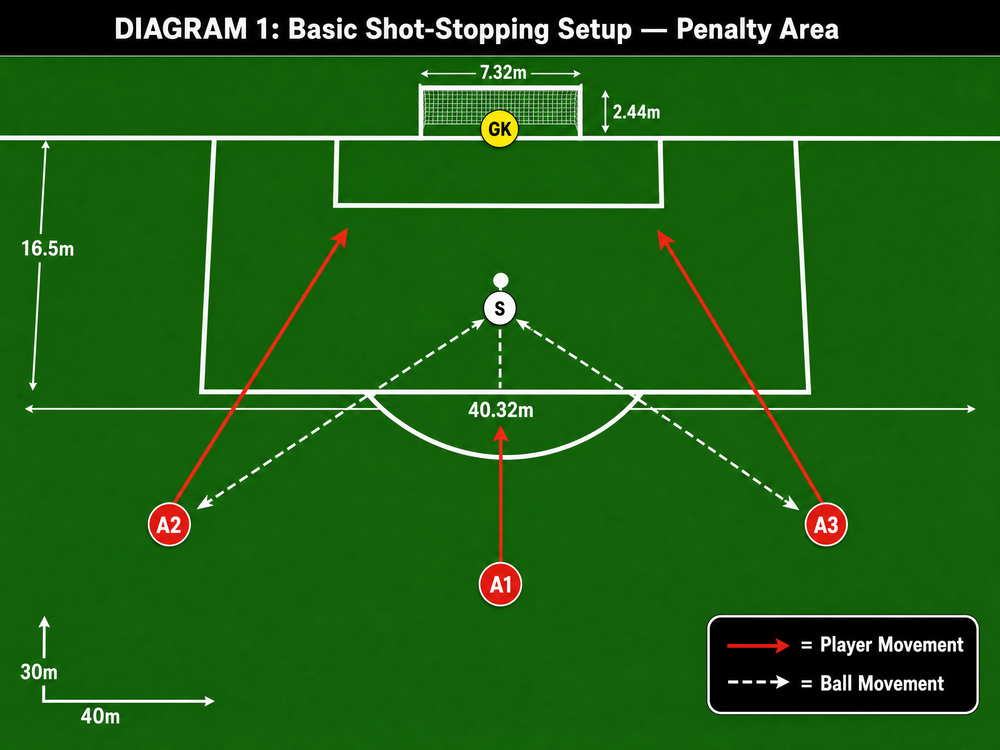
- 1 Full-size goal (7.32m x 2.44m)
- 8-10 Footballs
- 4 Cones or markers
- 1 Rebound board (optional)
Pitch Setup & Player Positions:
- Set up within the standard penalty area (16.5m deep x 40.32m wide).
- Goalkeeper (GK): Starts on the goal-line, central to the goal.
- Server (S): Positioned near the penalty spot (11m from goal) with a supply of footballs.
- Attackers (A1, A2, A3): Positioned in a semicircle just outside the penalty area. A1 is central, A2 is offset to the left, and A3 is offset to the right.
3. Step-by-Step Instructions
- Initial Position: The Goalkeeper (GK) starts in a set position on the goal-line, knees slightly bent, weight on the balls of their feet, hands forward and ready.
- First Shot (Central): The Server (S) plays a firm pass to the central Attacker (A1). A1 takes one touch to control and immediately strikes a shot on goal. The GK must react and attempt the save.
- Rapid Recovery: Immediately after the first shot (whether saved, scored, or parried), the GK must recover to their feet as quickly as possible and adjust their positioning for the next angle.
- Second Shot (Angle): As soon as the GK is recovering, the Server (S) plays a pass to either Attacker A2 or A3. The receiving attacker takes a quick touch and shoots. The GK must quickly set their feet and dive to make the second save.
- The Third Phase (Chaos): After the second shot, the Server (S) immediately strikes a volley or half-volley directly at the goal from the penalty spot. This forces a pure reaction save from the GK who may still be recovering from the previous dive.
- Rotation: After the sequence of three shots, rotate the attackers. The GK rests while a second goalkeeper steps in, or rests for 30-45 seconds before repeating the circuit.
4. Key Coaching Points
- The "Set" Position: Emphasize that the goalkeeper must be perfectly still and balanced ("set") right before the striker makes contact with the ball. Moving while the ball is struck severely limits reaction time.
- Explosive Recovery: The speed of getting back to the feet after a dive is crucial. Teach the "kick-stand" recovery method, using the momentum of the lower leg to push back up rather than relying solely on upper body strength.
- Angle Play: As the ball moves from A1 to A2 or A3, the goalkeeper must adjust their position along the arc to narrow the angle. Ensure they are moving their feet quickly rather than just reaching.
- Handling vs. Deflecting: Encourage clean handling on the first shot if possible, but prioritize safe deflection (pushing the ball wide and away from the danger zone) if the shot is too powerful to hold.
- Mental Resilience: This drill is designed to be difficult. Goalkeepers will concede goals. Coach them to instantly forget the previous shot and focus entirely on the next one.
5. Common Mistakes
- Cheating the Angle: Goalkeepers anticipating the pass to A2 or A3 and moving before the first shot is taken. This leaves them vulnerable to the central strike.
- Poor Rebound Control: Parrying the ball back into the central "danger zone" rather than pushing it wide, giving attackers an easy tap-in.
- Diving Backwards: Collapsing backwards towards the goal-line rather than attacking the ball forward. This reduces the surface area blocking the goal and increases the chance of the ball squirming through.
- Slow Footwork: Crossing the legs or taking too many small steps when repositioning, which delays the set position for the next shot.
6. Variations & Progressions
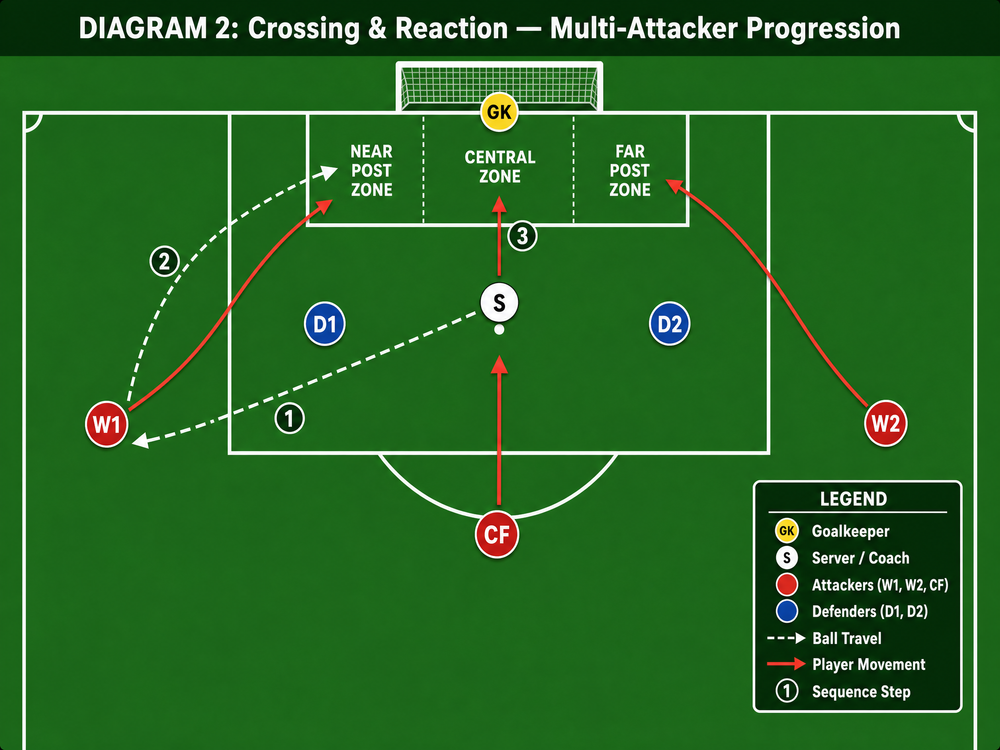
- The Rebounder: Place a rebound board next to the Server. Instead of the third shot coming directly from the Server, they smash the ball off the board, creating an unpredictable deflection for the final save.
- Live Rebounds: Allow the Attackers (A1, A2, A3) to follow in for rebounds after any shot is parried. This forces the goalkeeper to secure the ball quickly or make a secondary block save.
- Visual Obstruction: Place two mannequins or passive defenders in the penalty area to obscure the goalkeeper's line of sight, forcing them to react later to the shots.
7. Age Adaptations
- Under 8 - Under 10: Reduce the distances. Have the servers roll or throw the ball rather than kicking it hard. Focus purely on the basic technique of diving safely and getting back up.
- Under 12 - Under 14: Introduce the full sequence but keep the pace manageable. Focus heavily on the correct footwork for repositioning between shots.
- Under 16 - Open: Run the drill at match speed. The passes from the Server should be rapid, and the shots should be struck with maximum power. Introduce the live rebound progression to increase the pressure.
