

Basketball
The Half-Court Trap Press: Creating Chaos and Turnovers
Master the half-court trap press to disrupt the opponent's offense, force turnovers, and create easy transition scoring opportunities.
What you need
Basketballs, Colored scrimmage vests (pinnies), Cones (for marking trap zones)
1. Overview
The Half-Court Trap Press is an aggressive defensive strategy designed to surprise the offense just as they cross the half-court line. By immediately double-teaming the ball-handler in the high-pressure "trap zone" (the corners formed by the half-court line and the sidelines), the defense aims to force turnovers, rushed passes, or 10-second violations.
This play is highly effective when your team needs to shift momentum, mount a comeback, or disrupt a point guard who lacks elite ball-handling skills under pressure. It forces the offense out of their comfort zone and disrupts their set plays before they can even initiate them.
2. Setup
Court Dimensions: Standard FIBA court (28m x 15m).
Equipment Needed: Basketballs, colored scrimmage vests (pinnies) to differentiate offense and defense, and cones to mark the "Trap Zones" during initial practice.
Player Positions (Defense):
- D1 (Point Guard / Primary On-Ball Defender): Picks up the ball-handler near the half-court line.
- D2 (Shooting Guard / Trapper): Positioned on the wing, ready to sprint and close the trap.
- D3 (Small Forward / Interceptor): Positioned near the top of the key, reading the eyes of the ball-handler to jump passing lanes.
- D4 (Power Forward / Rotator): Positioned at the weak-side elbow, ready to rotate to the middle or deep.
- D5 (Center / Rim Protector): Anchors the defense in the paint, protecting the basket against deep passes.
3. Step-by-Step Instructions
Step 1: The Setup and Funnel
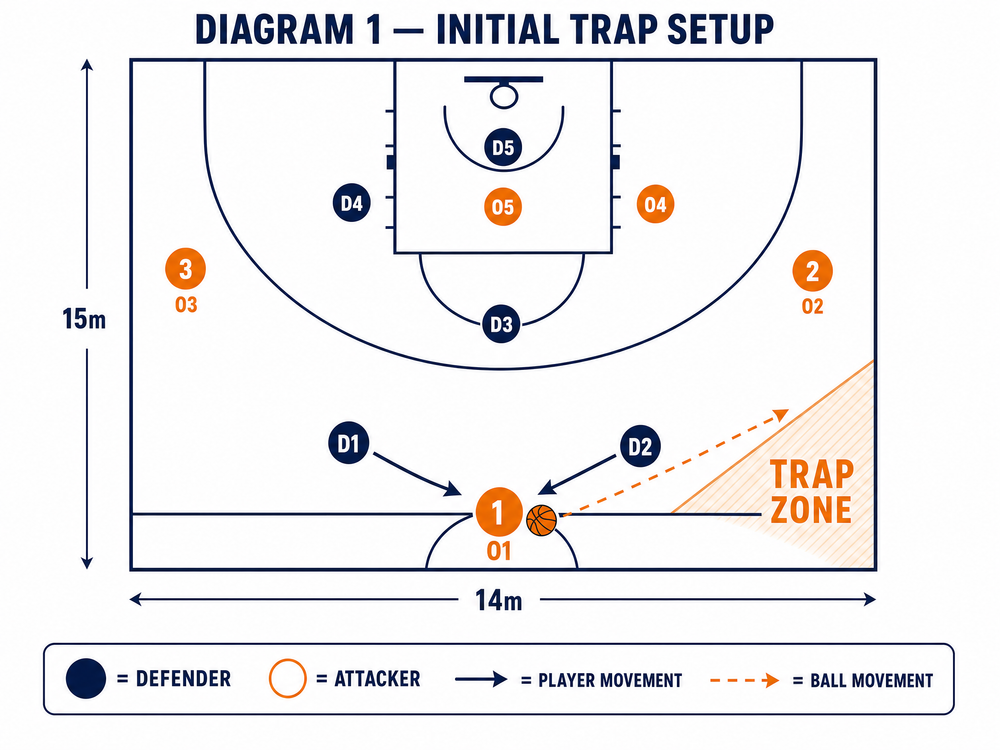
As the opposing point guard (O1) brings the ball up the court, D1 applies moderate pressure. The goal here is not to steal the ball immediately, but to dictate the ball-handler's path. D1 must force O1 toward one of the sidelines as they approach the half-court line. D2 waits patiently on the strong-side wing, anticipating the trap.
Step 2: Springing the Trap
The moment O1 crosses the half-court line and enters the "Trap Zone" (the area bounded by the half-court line and the sideline), the trap is activated. D1 cuts off the forward path, and D2 sprints aggressively to close the trap from the side. They must establish foot-to-foot contact, forming a "V" shape that prevents O1 from splitting the defenders.
Step 3: Denying the Outlet Passes
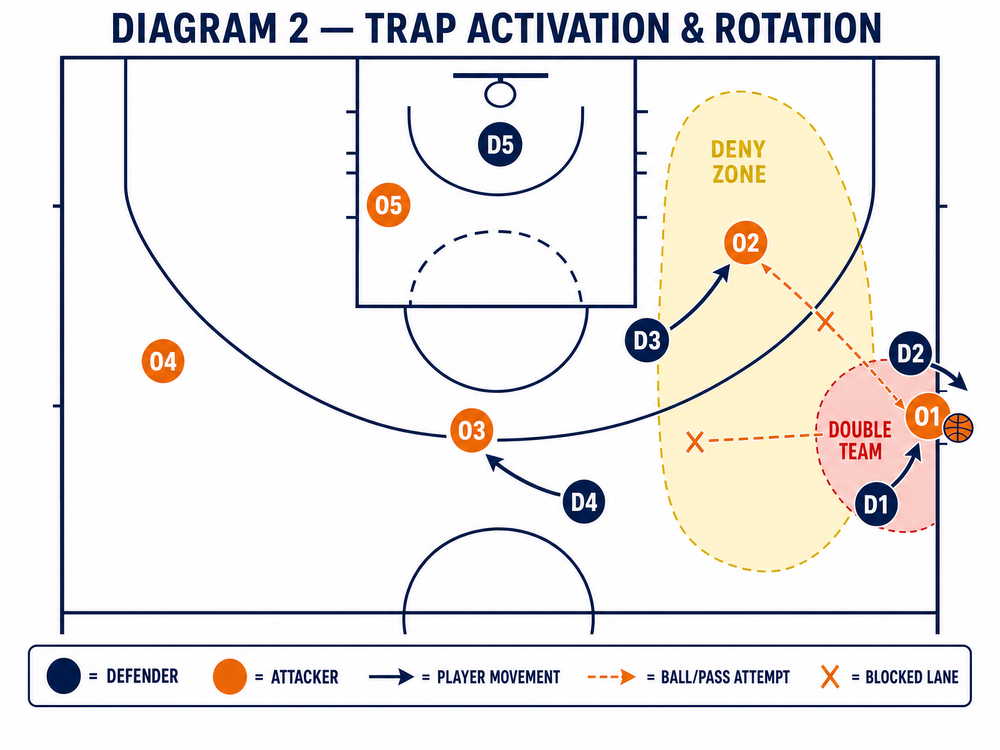
As the trap is set, the remaining defenders must instantly rotate to deny the most likely escape routes.
- D3 sprints to the strong-side passing lane, fully denying the pass to the nearest wing (O2).
- D4 rotates from the weak side to the middle of the floor (top of the key area), reading the play and preparing to intercept cross-court lob passes.
- D5 remains in the paint, communicating loudly and ensuring no offensive player slips behind the defense for an easy layup.
Step 4: Forcing the Turnover
The trappers (D1 and D2) must trace the ball with active, high hands. They should not reach in for a steal, which often results in a foul. Instead, they must smother the ball-handler, forcing a panic pass (often a lob) that D3 or D4 can easily intercept, or forcing a 10-second backcourt violation, or a step out of bounds.
Step 5: Recovery and Reset
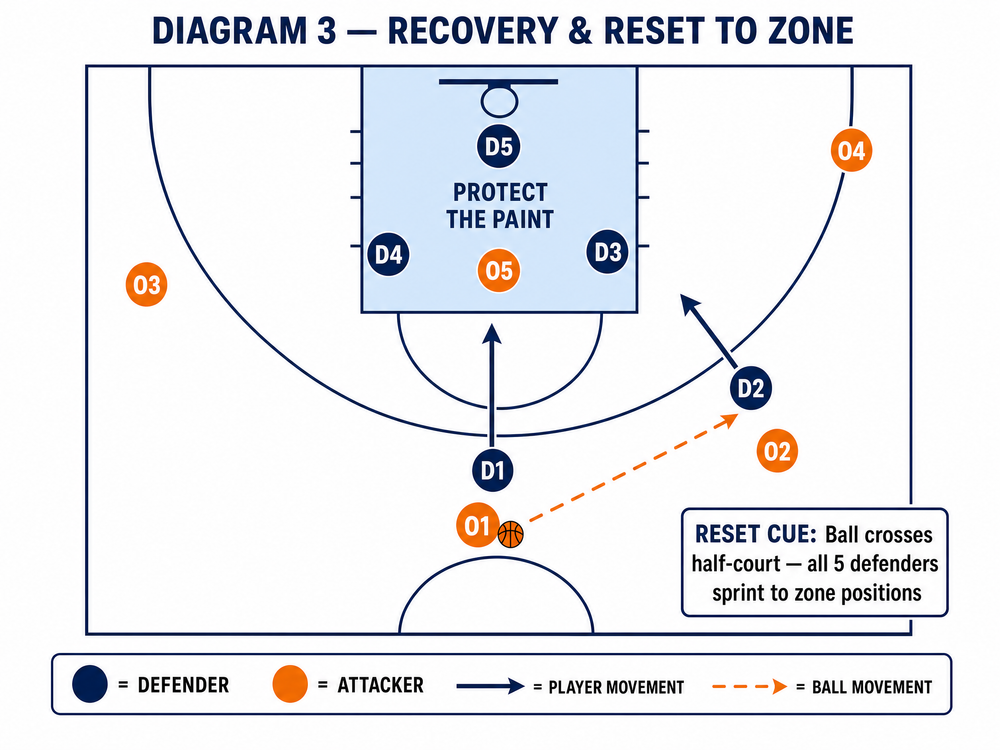
If the offense successfully passes out of the trap, the defense must immediately sprint back and reset into their half-court defensive scheme (e.g., a 2-3 zone or man-to-man). Communication is critical here. D1 and D2 must sprint back to the level of the ball, while D5 ensures the paint remains protected during the scramble.
4. Key Coaching Points
- Trap with the Lower Body: Trappers must use their feet to cut off escape angles, establishing foot-to-foot contact to prevent the ball-handler from "splitting" the trap.
- High Hands, No Reaching: Trappers must keep their hands high to mirror the ball and block passing lanes. Reaching in for steals usually results in cheap fouls and breaks the trap.
- Use the Sideline and Half-Court Line: These lines act as extra defenders. Trap the ball-handler tightly into these corners so they cannot retreat (backcourt violation) or step out of bounds.
- Anticipate, Don't React: The interceptors (D3 and D4) must read the ball-handler's eyes and shoulders to anticipate the pass before it is thrown.
- Sprint on Recovery: If the trap is beaten, the defensive possession is not over. All five players must sprint back to the paint to prevent an easy transition basket.
5. Common Mistakes
- Trapping Too Early: If D2 sprints to trap before O1 has committed to the sideline or crossed half-court, O1 can easily retreat or pass out of the pressure.
- Leaving a Gap: If D1 and D2 do not lock their feet together, a skilled ball-handler will split the defenders and create a 5-on-3 advantage.
- Fouling in the Trap: Reaching down to slap at the ball bails out the offense. The goal is to force a bad pass, not to strip the ball directly.
- Ball Watching by Interceptors: D3 and D4 getting caught staring at the trap instead of denying their assigned offensive players.
6. Variations & Progressions
- The "Run and Jump" Variation: Instead of a set trap, D2 sprints at the ball-handler unexpectedly from the blind side just as they cross half-court, while D1 drops back to intercept the immediate pass.
- Trap on the Pick and Roll: Apply the same trapping principles when the offense attempts a high ball screen near the half-court line.
- Progression 1 (4-on-4): Run the drill without the centers (D5 and O5) to create more space and force the trappers and interceptors to cover more ground.
7. Age Adaptations
- Under 10s / Under 12s: Focus purely on man-to-man defense. Complex trapping schemes are generally not recommended for this age group as they hinder fundamental defensive development.
- Under 14s: Introduce the basic mechanics of trapping (foot-to-foot, high hands) in half-court drills, but use the full trap sparingly in games.
- Under 16s and Open: Full implementation. Players should have the athletic ability and basketball IQ to execute the rotations and read passing lanes effectively.
