

Football
High-Tempo One-Touch Passing Combinations & Third-Man Runs
Develop your team's ability to play fast, precise one-touch football while incorporating third-man runs to break defensive lines.
What you need
10-15 Training Cones, 4+ Footballs, Training Bibs
1. Overview
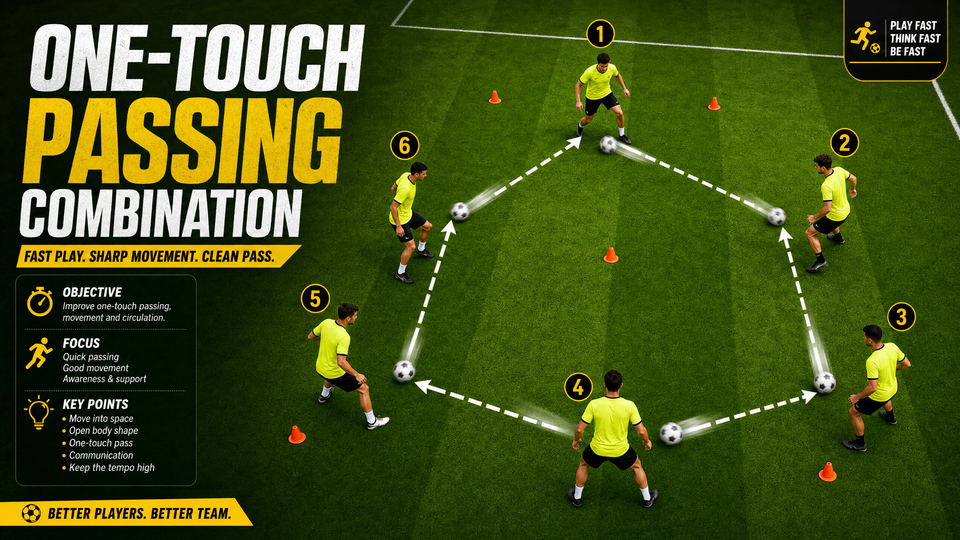
In modern football, the ability to move the ball quickly in tight spaces is paramount. This drill focuses on developing high-tempo, one-touch passing combinations, emphasising body shape, weight of pass, and the timing of third-man runs. It is designed to simulate the rapid ball circulation required to disorganise a compact defensive block. By integrating positional rotations and progressive passing sequences, players will learn to anticipate the next action before receiving the ball, improving both their technical execution and tactical awareness.
2. Setup
Equipment Needed:
- 10-15 Training Cones (mix of colours preferred)
- Minimum of 4 Footballs (kept near the starting position to maintain flow)
- Training Bibs (for the progression phases)
Pitch Dimensions & Setup:
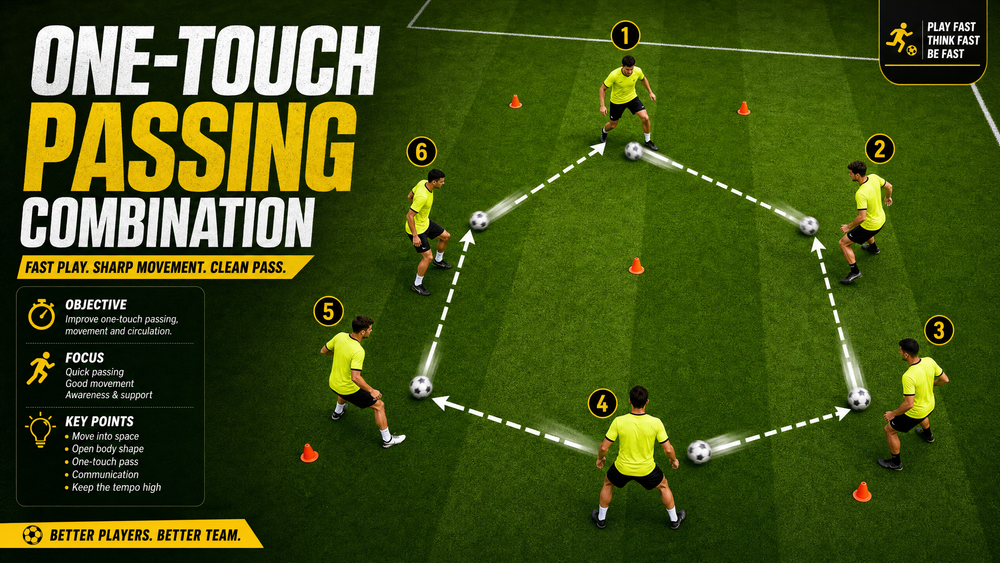
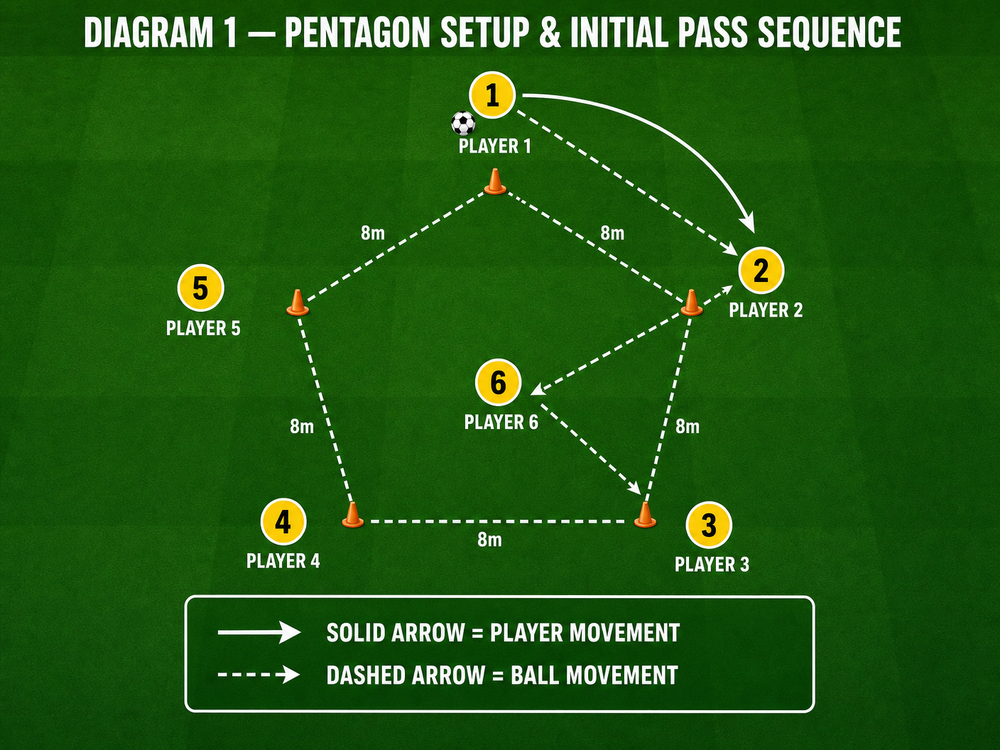
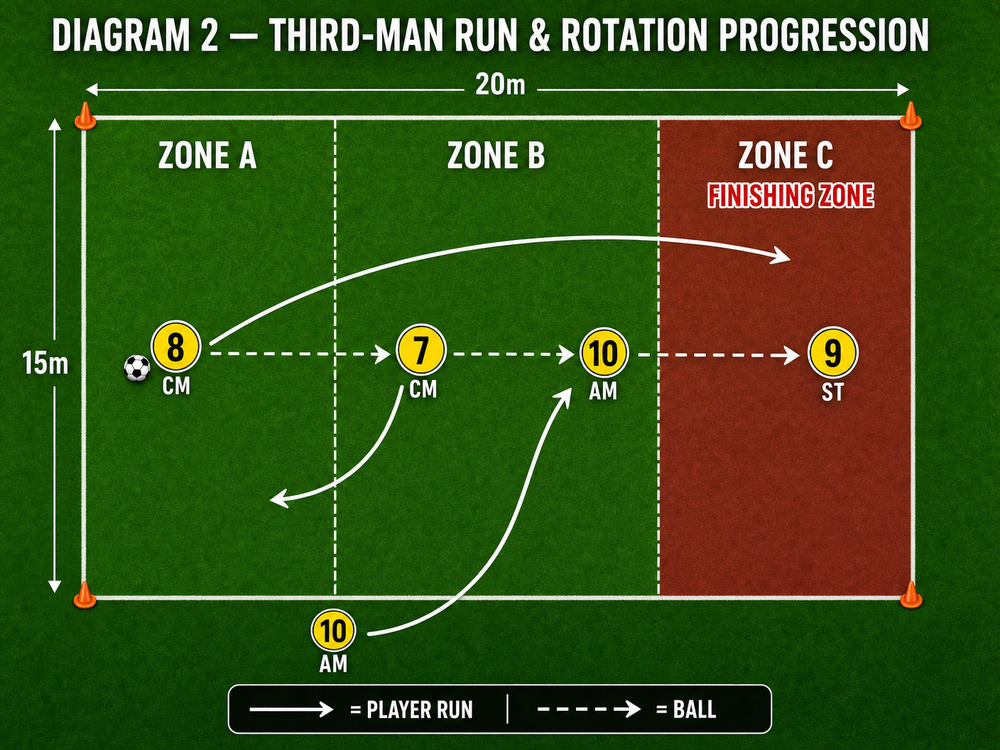
Set up a primary passing circuit using a pentagon shape, with each cone placed exactly 8 metres apart. This tight distance forces quick decision-making and precise technique. For the progression, set up a 20m x 15m rectangular grid divided into three zones (Zone A, Zone B, and Zone C).
Player Positions:
For the initial phase, position 5 players on the outside cones of the pentagon and 1 player operating centrally as the pivot or link player.
3. Step-by-Step Instructions
Phase 1: The Pentagon Circuit
- Starting the Drill: Player 1 starts with the ball at the top of the pentagon.
- The First Pass: Player 1 plays a firm pass to Player 2 on their right.
- The Central Link: Player 2 immediately plays a one-touch pass into Player 6, who is positioned in the centre of the pentagon.
- The Lay-off: Player 6 receives on the half-turn and plays a one-touch lay-off to Player 3.
- The Rotation: After passing, Player 1 follows their pass to take Player 2's position. Player 2 moves to the centre to replace Player 6, and Player 6 moves out to take Player 3's starting position.
- Continuity: The sequence continues around the pentagon, ensuring high tempo and continuous movement.
Phase 2: Third-Man Run Progression
- Grid Setup: Move to the 20m x 15m rectangular grid.
- The Trigger: Player 8 (Central Midfielder in Zone A) plays a firm pass into the feet of Player 7 (Central Midfielder in Zone B).
- The Lay-off: Player 7 sets the ball back with one touch to Player 10 (Attacking Midfielder), who is arriving from deep.
- The Penetrating Pass: Player 10 plays a first-time through-ball into Zone C (The Finishing Zone) for Player 9 (Striker) making a diagonal run.
- The Movement: As the ball is played to Player 7, Player 8 immediately makes an overlapping run to support the attack, while Player 7 drops to balance the midfield in Zone A.
Phase 3: Advanced Rondo with Pressing
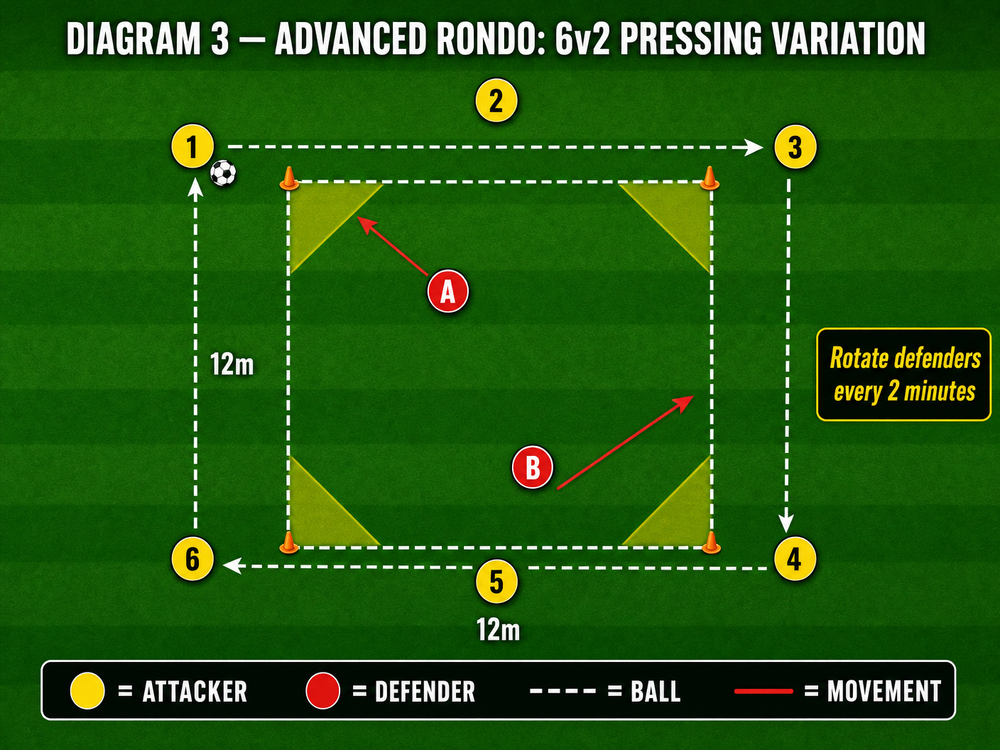
- The Grid: Set up a 12m x 12m square.
- The Setup: 6 attackers on the outside, 2 defenders on the inside (6v2).
- The Objective: Attackers must maintain possession using a maximum of two touches, but one-touch is highly encouraged.
- The Press: Defenders must press aggressively to win the ball or force a mistake. If they win it, they transition out, and the player who lost possession (and the player who passed to them) become the new defenders.
- Rotation: Rotate the starting defenders every 2 minutes to maintain high pressing intensity.
4. Key Coaching Points
- Weight and Accuracy of Pass: Passes must be punched into the receiver's preferred foot with enough pace to allow for a one-touch action, but not so hard that it cannot be controlled.
- Body Shape: Players must receive the ball with an open body shape, allowing them to see both the ball and their next target. They should be on their toes, ready to move.
- Timing of Movement: Runs should be triggered by the passer's body language and eye contact. Arrive as the ball arrives, not before.
- Communication: Verbal calls (e.g., "Time!", "Man on!", "Set!") and non-verbal cues (pointing to feet or space) are crucial for fast combination play.
- Scanning: Players must check their shoulders before receiving the ball to build a mental picture of their surroundings.
5. Common Mistakes
- Waiting for the Ball: Players remaining static on their cones rather than moving to meet the pass or creating an angle.
- Poor Weight of Pass: Bouncing or under-hit passes that disrupt the rhythm and allow defenders to intercept.
- Closed Body Shape: Receiving facing the passer, which limits options and slows down the play.
- Lack of Focus: Mental lapses leading to sloppy touches; the drill requires high concentration to maintain the tempo.
6. Variations & Progressions
- Opposite Direction: Reverse the flow of the drill (anti-clockwise) to work on the weaker foot.
- Two Balls: Introduce a second ball into the pentagon circuit to dramatically increase cognitive load and spatial awareness.
- Adding Defenders: Transition from unopposed passing to opposed scenarios by adding passive, then active, defenders to apply pressure.
7. Age Adaptations
- Under 8s - Under 10s: Increase the distances slightly (10-12m) to give players more time. Allow two touches initially to build confidence before demanding one-touch play.
- Under 12s - Under 14s: Enforce strict one-touch rules on the lay-offs. Introduce passive defenders to apply light pressure.
- Under 16s - Open Age: Shrink the grid size to 5-6m to demand elite technical execution. Introduce full pressure and complex rotational patterns.
