Horns Flare: Baseline Out-of-Bounds Buzzer Beater
A high-percentage baseline out-of-bounds (BLOB) play designed to get your best shooter a clean look from the corner with less than 3 seconds remaining.
Equipment Needed
1. Overview
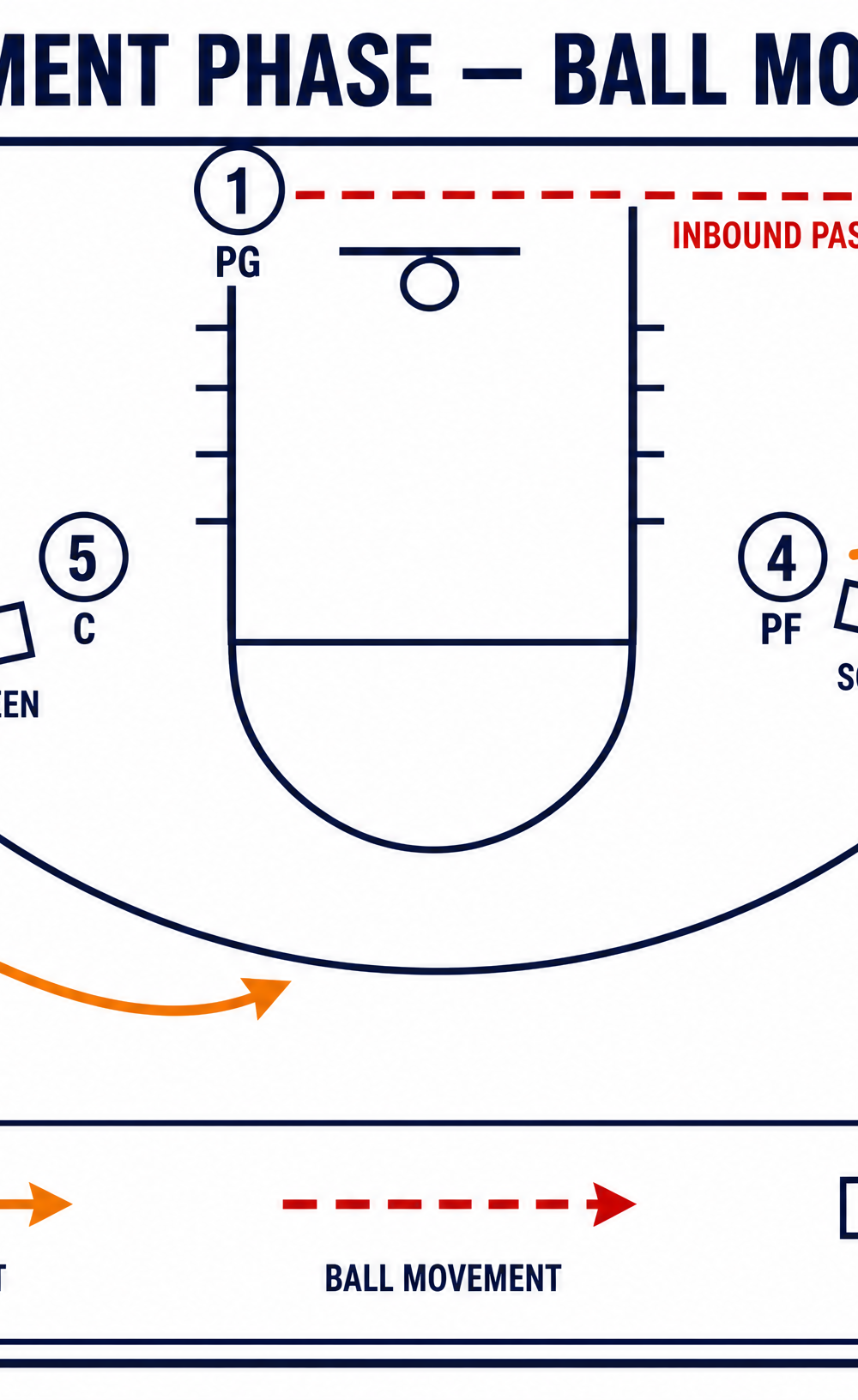
The Horns Flare is a quick-hitting Baseline Out-of-Bounds (BLOB) set designed specifically for end-of-game or end-of-quarter situations where you have between 1.5 and 3.0 seconds left on the clock. This play utilizes a deceptive initial setup that looks like a standard Horns alignment, but quickly transitions into a double-screening action to free up your best shooter for a corner three-pointer. It is highly effective against man-to-man defense, particularly when the opposing team is aggressively switching or denying the inbound pass.
2. Setup
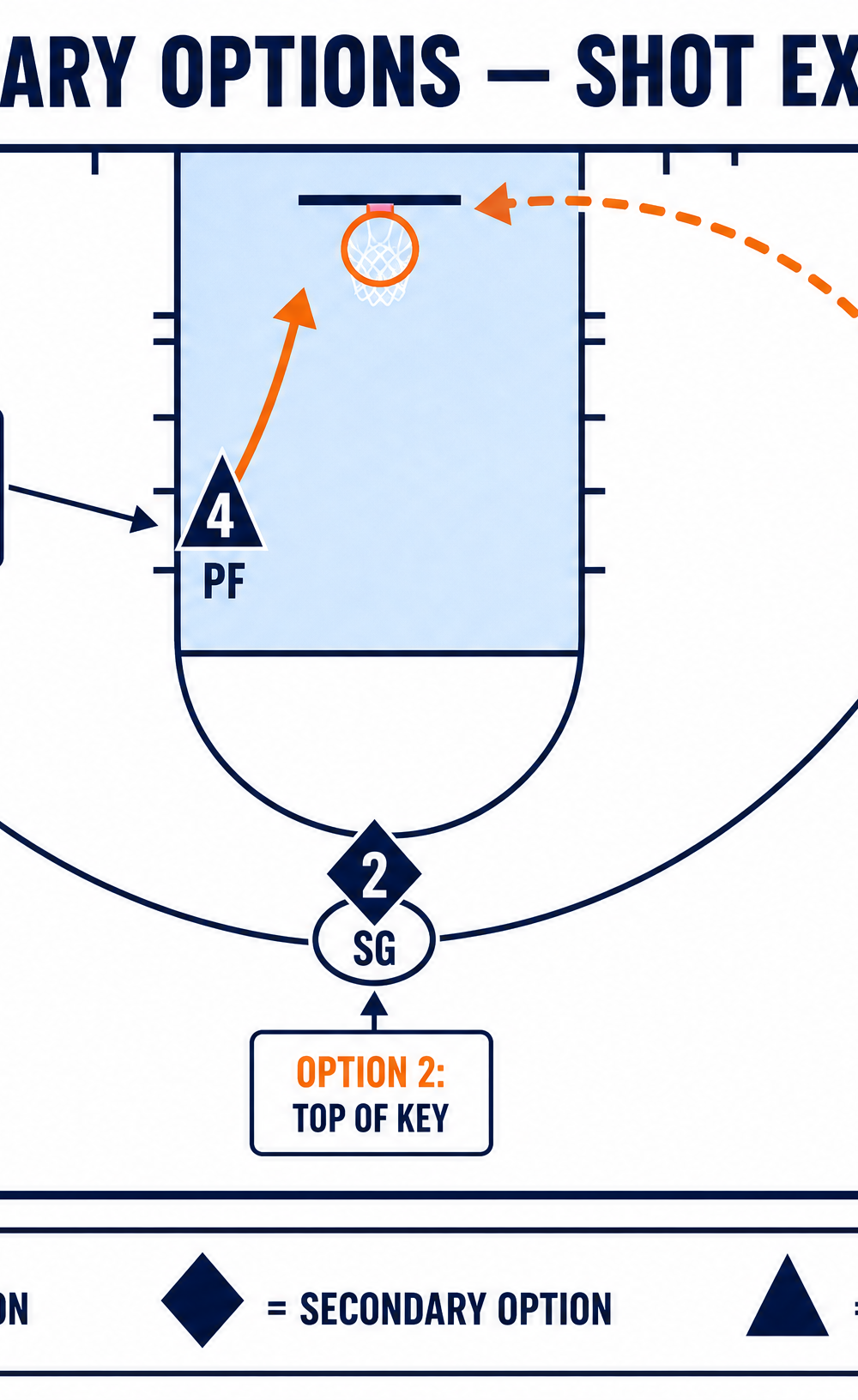
- Equipment Needed: 1 Basketball, full court (28m x 15m FIBA dimensions), minimum 5 players.
- Court Setup: Baseline out-of-bounds underneath your own basket.
- Player Positions:
- Player 1 (PG): The inbounder. Needs to be a smart passer with excellent timing and vision.
- Player 2 (SG): Decoy cutter. Positioned on the left wing near the three-point line.
- Player 3 (SF): Primary shooter. Positioned on the right wing near the three-point line.
- Player 4 (PF): Screener/Secondary option. Positioned at the left elbow of the free-throw line.
- Player 5 (C): Screener. Positioned at the right elbow of the free-throw line.
3. Step-by-Step Instructions
- The Trigger: The play begins when the referee hands the ball to Player 1 (PG) on the baseline.
- The Decoy Cut: Immediately upon Player 1 receiving the ball, Player 2 (SG) makes a hard, aggressive curl cut around a screen set by Player 5 (C) at the right elbow. Player 2 sprints toward the top of the key. This action is designed to draw the defense's attention away from the primary action and potentially open up a quick catch-and-shoot opportunity at the top of the arc if their defender trails.
- The Primary Action (The Flare): As Player 2 is clearing the area, Player 4 (PF) sets a hard back screen on Player 3's (SF) defender.
- The Cut: Player 3 (SF) uses the screen from Player 4 to execute a sharp flare cut toward the deep right corner.
- The Pass: Player 1 (PG) reads the defense. If the flare cut is successful, Player 1 delivers a crisp, on-target pass to Player 3 in the right corner.
- The Shot: Player 3 catches the ball in rhythm, turns, and shoots the corner three-pointer before the buzzer sounds.
4. Secondary Options
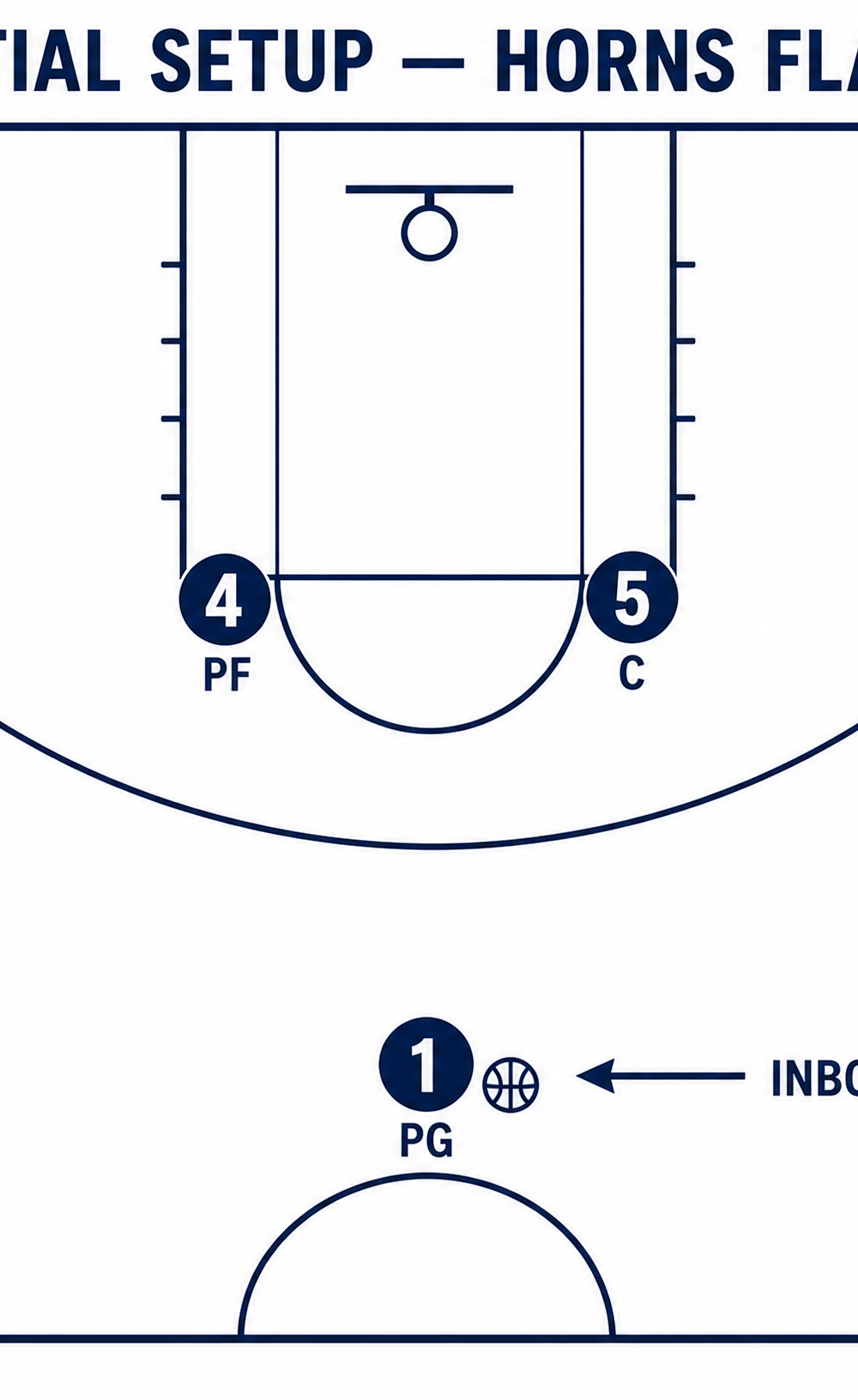
If the primary option (Player 3 in the corner) is heavily contested or denied, the play has built-in secondary reads:
- Option 2 (Top of Key): If Player 2's defender gets caught on the initial screen by Player 5, Player 2 may be open at the top of the key for a quick catch-and-shoot.
- Option 3 (Roll to Basket): After setting the back screen for Player 3, Player 4 (PF) should immediately slip the screen and roll hard to the basket. If the defense switches out onto Player 3, Player 4 will often have a clear path to the rim for a quick layup or dunk.
5. Key Coaching Points
- Timing is Everything: The screens must be set at the exact right moment. If Player 4 sets the screen too early, the defense will recover. If too late, the pass will be intercepted.
- Sell the Decoy: Player 2 must sprint hard and call for the ball on the initial curl cut. The more convincing the decoy, the more the defense will shift, opening up the flare screen.
- Screening Angle: Player 4 must set a wide, solid base on the back screen. The angle should force the defender to go under the screen, giving Player 3 the necessary separation for the shot.
- Pass Placement: Player 1 must deliver the pass exactly where Player 3 is going to be, not where they are. The pass should be thrown to the outside shoulder, leading the shooter directly into their shooting motion.
- Footwork: Player 3 must have their feet prepared to shoot before catching the ball. In a buzzer-beater scenario, there is no time to gather; it must be a fluid catch-and-shoot motion.
6. Common Mistakes
- Weak Screens: Setting "ghost screens" where the screener avoids contact. The screens must be solid to create separation.
- Telegraphing the Pass: Player 1 staring down Player 3 the entire time. Player 1 needs to look at the decoy cut first to manipulate the defense.
- Fading on the Shot: Player 3 catching the ball and fading out of bounds. The shooter must catch and go straight up with their momentum carrying them slightly forward, not backward.
7. Variations & Progressions
- The "Slip" Variation: If the defense anticipates the flare screen and tries to jump it, have Player 4 fake the screen and immediately slip to the basket for a quick layup.
- The "Elevator" Progression: Instead of a single back screen, have Player 4 and Player 5 set an "elevator doors" screen for Player 3 at the top of the key, closing the gap right after Player 3 runs through.
8. Age Adaptations
- Under 12s: Focus on the basic mechanics of setting a screen and making a clean pass. The play can be simplified by removing the decoy cut and just focusing on the single flare screen.
- Under 14s/16s: Emphasize the timing of the cuts and the importance of reading the defense. Introduce the secondary options (the slip to the basket).
- Open/Advanced: Execute the play at full game speed with aggressive defensive pressure. Focus on the nuances of pass placement and footwork on the catch-and-shoot.