

Football
Immediate Counter-Pressing: The 6-Second Rule to Regain Possession
Teach your team how to react instantly upon losing the ball, using coordinated pressure to win it back high up the pitch and launch immediate counter-attacks.
What you need
1 full-size goal, 3 mini goals, Bibs (2 colours), Footballs, Cones
1. Overview
Counter-pressing (Gegenpressing) is the immediate attempt to win the ball back right after losing possession, rather than dropping back into a defensive shape. This set play focuses on the crucial 6-second window immediately following a turnover in the midfield or attacking third.
When executed correctly, counter-pressing serves two vital purposes: it prevents the opponent from launching a counter-attack while they are disorganised, and it creates high-quality goal-scoring opportunities by winning the ball close to the opponent's goal against an unsettled defence.
This resource breaks down the triggers, structural requirements, and exact movements needed to implement an aggressive and effective counter-pressing system in your team.
2. Setup
Pitch Area: Half-pitch or full pitch depending on numbers (standard 105m x 68m dimensions).
Players Required: 14-20 players (can be run as an 8v6, 10v8, or full 11v11).
Equipment:
- 1 full-size goal and 2-3 mini goals (or target zones).
- Bibs in 2 contrasting colours.
- Plenty of footballs positioned around the pitch to keep intensity high.
- Cones to mark out the "Pressing Zone" (typically the middle third or attacking third).
Starting Positions:
The attacking team (Red) starts in possession in a 4-3-3 or 4-2-3-1 shape. The defending team (Dark) starts in a compact block. The coach serves the ball to the Red team to begin the sequence.
3. Step-by-Step Instructions
Phase 1: The Trigger (Immediate Reaction)
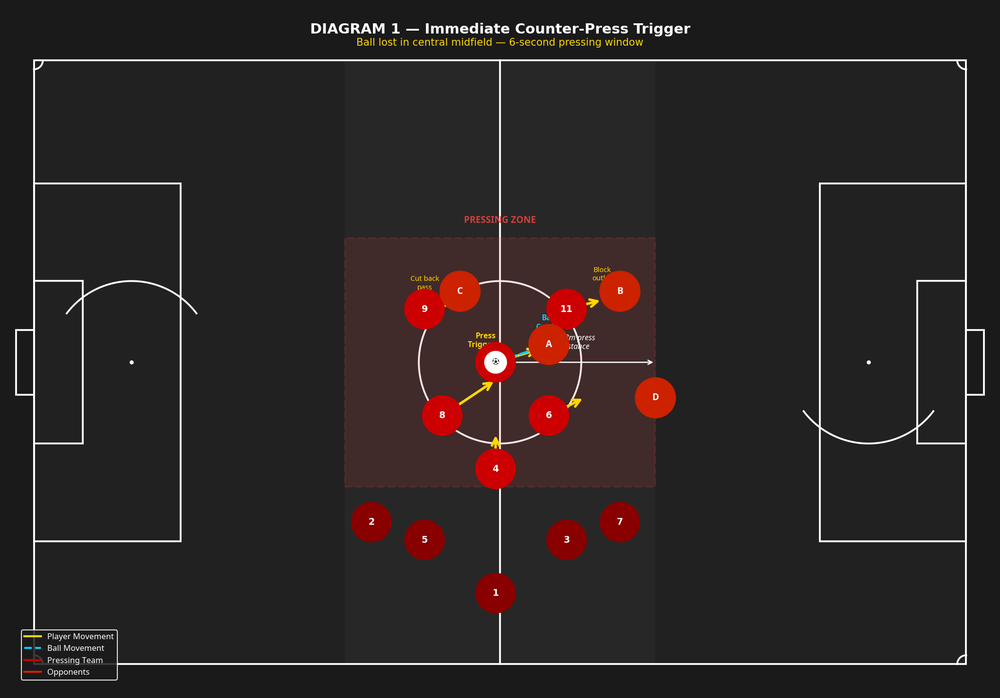
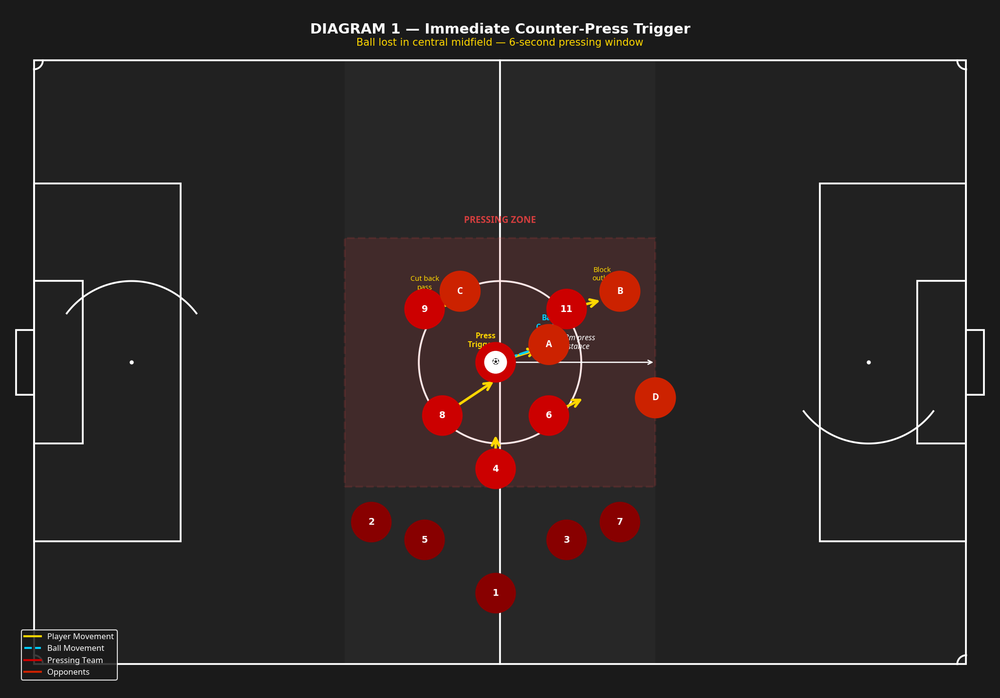
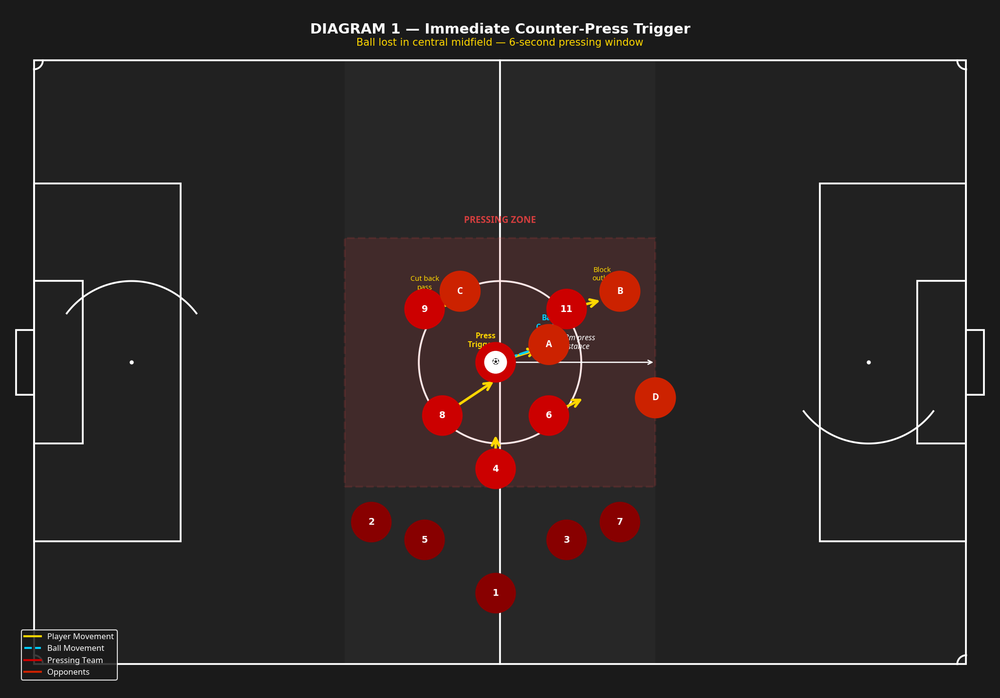
- The Turnover: The sequence begins the moment the Red team loses possession in the central midfield zone.
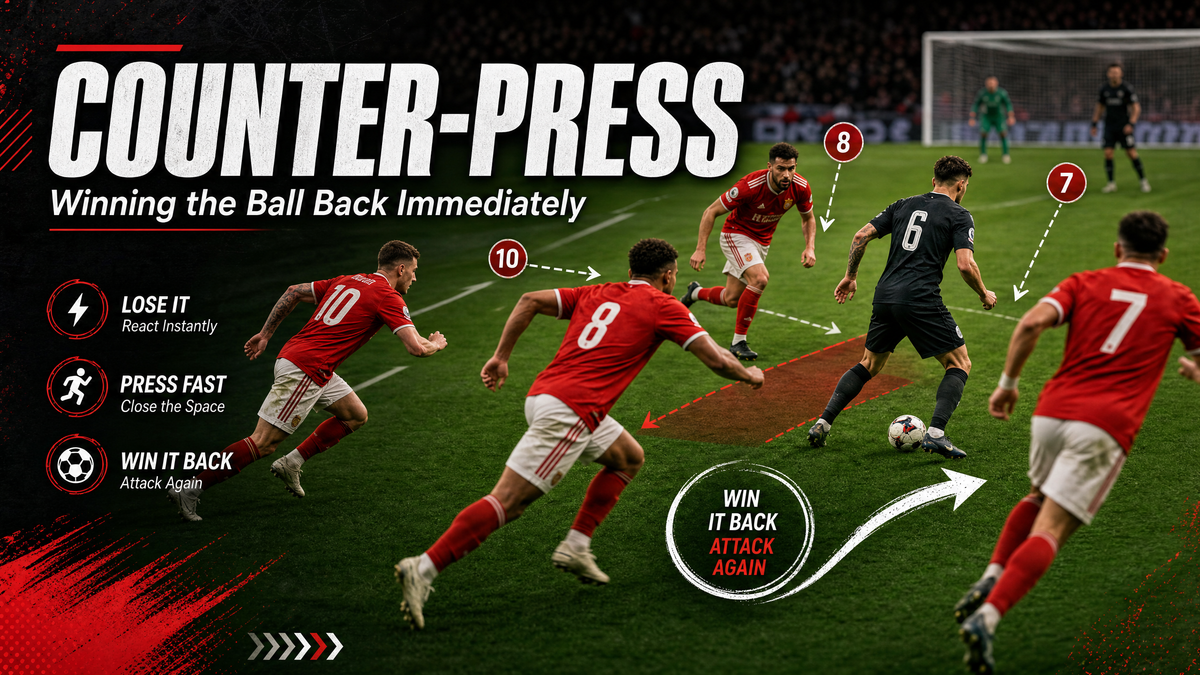
- The First Presser: The player closest to the ball (in this case, the #10) must react instantly. They have zero seconds to think—their job is to sprint at the ball carrier and apply maximum pressure.
- Cutting Passing Lanes: Simultaneously, the surrounding players (#9 and #11) must sprint to cut off the immediate passing options (the back pass and the wide outlet).
- The Second Wave: The midfield players (#8 and #6) step up to apply secondary pressure and cover the shadows of the first pressers.
Phase 2: Structure and Cover Shadows
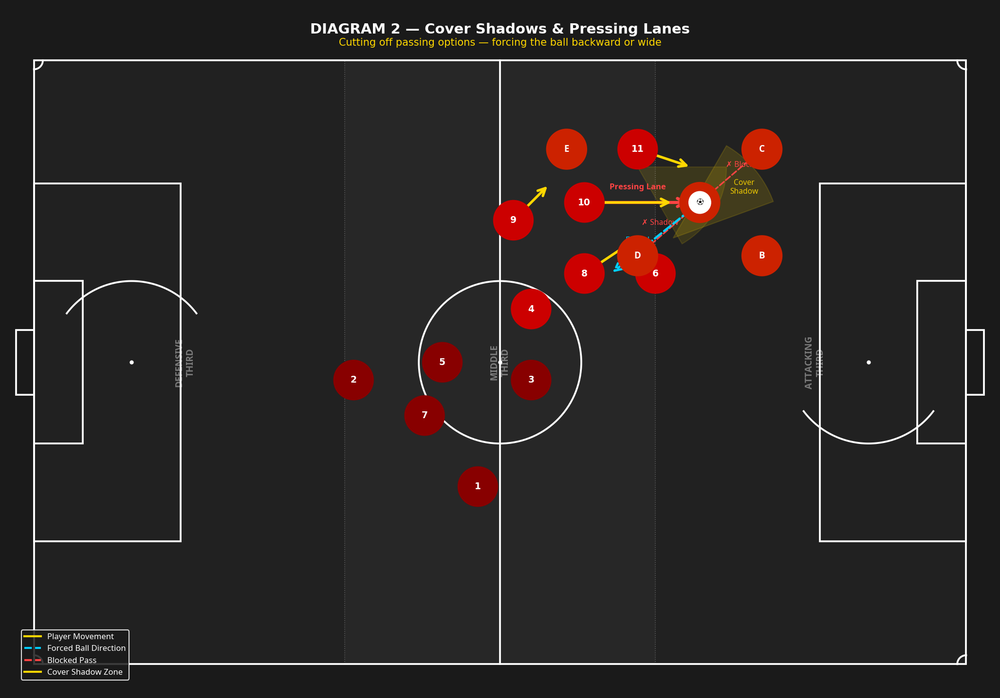
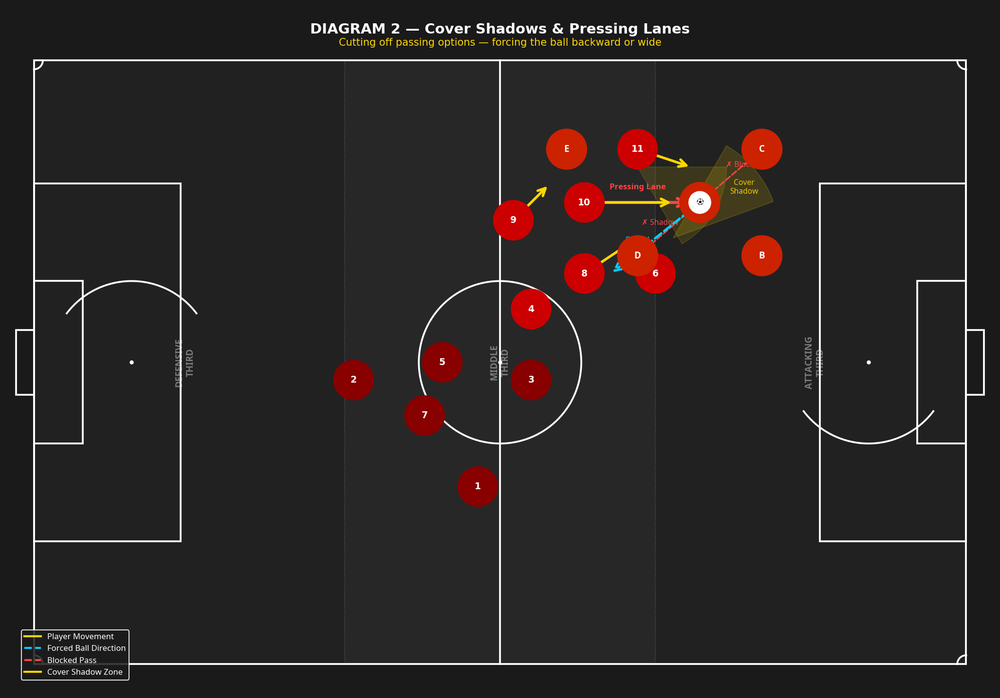
- Forcing the Play: The goal of the initial press is not always to win the ball outright, but to force the ball carrier into a mistake or a predictable pass (usually backward or wide).
- Cover Shadows: Players must use their "cover shadow"—positioning their body between the ball and the opponent's passing option—to effectively mark players without being touch-tight.
- The Pressing Lane: The team creates a "pressing lane" or trap, funneling the opponent into a congested area where multiple defenders can collapse on the ball.
- Compactness: The entire team, including the defensive line (#2, #3, #4, #5, #7), must step up aggressively to compress the space. If the defense drops deep, the counter-press will fail as gaps will appear between the lines.
Phase 3: The Regain and Transition
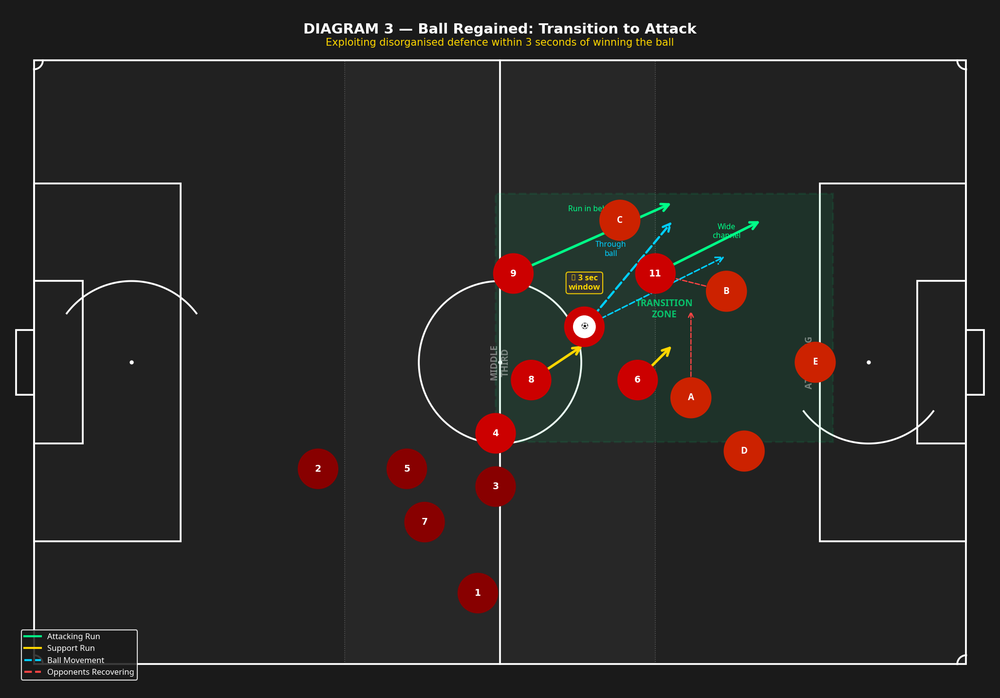
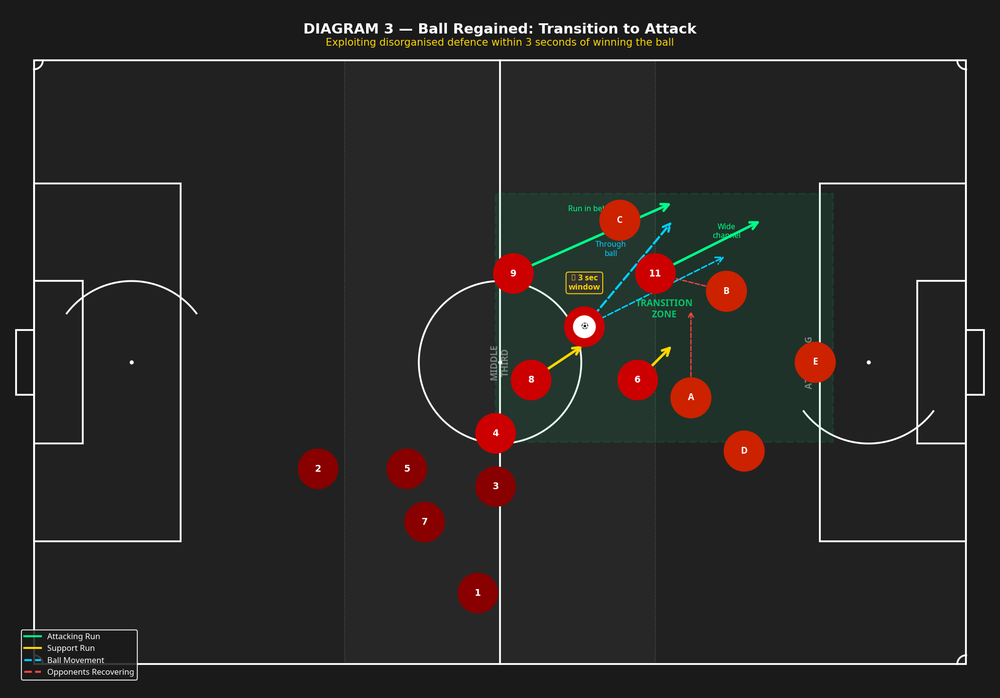
- Winning the Ball: Once the ball is regained (ideally within the 6-second window), the team must immediately transition back into attack.
- Exploiting Disorganisation: The opponent will be expansive and out of position, having just transitioned to attack themselves. This is the moment to strike.
- Forward Runs: The moment possession is secured, forwards (#9, #11) must make aggressive, penetrating runs in behind the unorganised defensive line.
- The First Pass: The player who wins the ball (#10) should look for a forward pass immediately. If a forward pass isn't available, they should secure possession with a safe pass to a supporting player (#8 or #6) to reset the attack.
4. Key Coaching Points
- Mental Switch: The transition from attack to defense must be instantaneous. Players must develop a "hunt the ball" mentality the second possession is lost.
- Aggression vs. Control: The first presser must arrive with intensity but under control, forcing the player one way rather than diving in and being easily beaten.
- Collective Movement: A counter-press only works if the entire team moves together. If one player presses and the rest drop off, the press will be easily bypassed.
- Compactness: The distance between the forward line and the defensive line must remain tight (around 25-30 meters) to suffocate the space.
- The 6-Second Rule: If the ball isn't won back or the opponent isn't forced backward within 6 seconds, the team must immediately drop back into their organised defensive shape.
5. Common Mistakes
- Delayed Reaction: Players pausing to complain about losing the ball instead of immediately reacting to win it back.
- Pressing Alone: One player sprinting to press while the rest of the team retreats, leaving the presser isolated and easily bypassed.
- Poor Body Shape: Pressing head-on without forcing the ball carrier in a specific direction, allowing them to easily pass around the pressure.
- Defense Dropping Deep: The defensive line dropping off instinctively when the ball is lost, creating massive gaps in midfield for the opponent to exploit.
6. Variations & Progressions
- Progression 1 (Overload): Start with a numerical advantage for the pressing team (e.g., 8v6) to build confidence and success, then progress to even numbers (8v8).
- Progression 2 (Time Limit): Introduce a strict 6-second countdown out loud. If the pressing team wins it back within 6 seconds, they get 2 points for a goal.
- Variation 1 (Target Zones): Instead of mini-goals, place target players in specific zones. The defending team must pass to these targets to escape the press, forcing the pressing team to cut off specific lanes.
7. Age Adaptations
- Under 10 - Under 12: Focus purely on the immediate reaction to losing the ball. Encourage the closest 2-3 players to "swarm" the ball carrier like bees. Don't worry too much about complex cover shadows or structural compactness.
- Under 14 - Under 16: Introduce the concept of cover shadows and forcing play in one direction. Begin demanding that the defensive line steps up to maintain compactness.
- Open/Senior: Full implementation of structural counter-pressing, including specific pressing triggers, coordinated traps, and the strict 6-second rule before dropping into a block.
