

Rugby
Mastering Body Height: The Dominant Tackle Drill
A comprehensive drill designed to correct upright tackling habits by teaching players to drop their hips and dominate the collision safely.

What you need
8-10 cones, 4-5 rugby balls, Tackle shields (optional)
1. Overview
The Body Height & Dominant Tackle Drill is designed to build foundational tackling habits, specifically focusing on lowering the center of gravity prior to contact. By emphasizing body height—getting the hips below the shoulders—defenders can generate maximum power from the ground up while maintaining safety. This drill is highly effective for correcting upright tackling habits and is best utilized during the skill-development phase of a session, before progressing to live, full-contact scenarios.
2. Setup
Equipment Needed:
- 8-10 cones for marking boundaries and zones
- 4-5 rugby balls (one for each attacking group)
- Tackle shields or hit shields (optional for early progressions)
Pitch Setup:
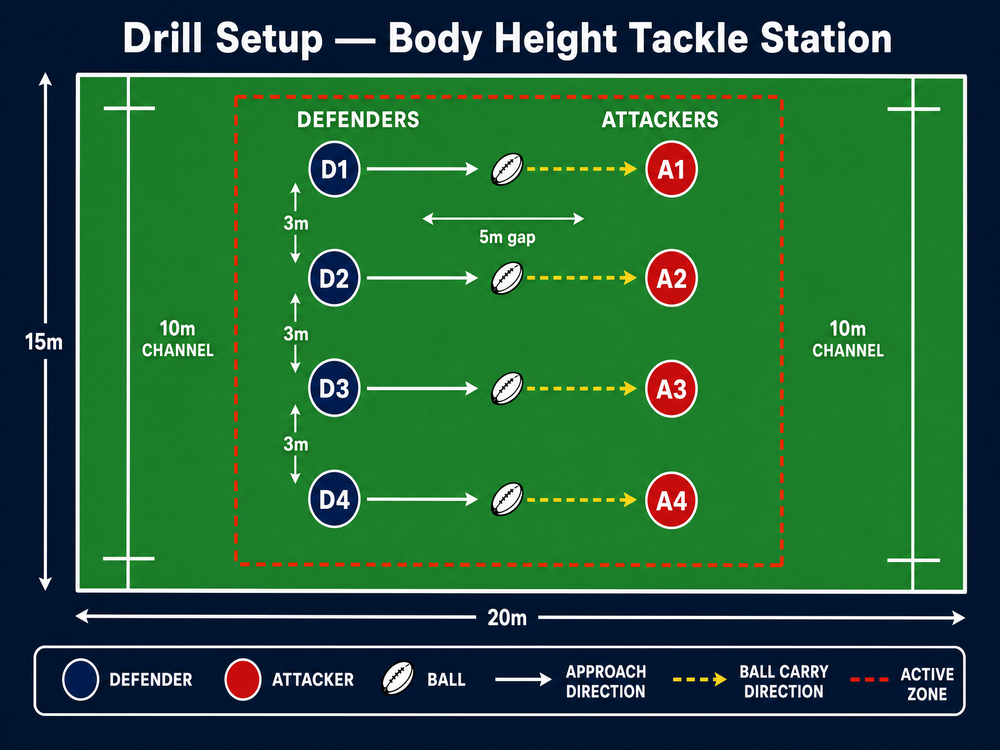
- Mark out a 20m x 15m grid on a standard 100m x 70m pitch.
- Set up a 10m channel down the middle for the primary activity.
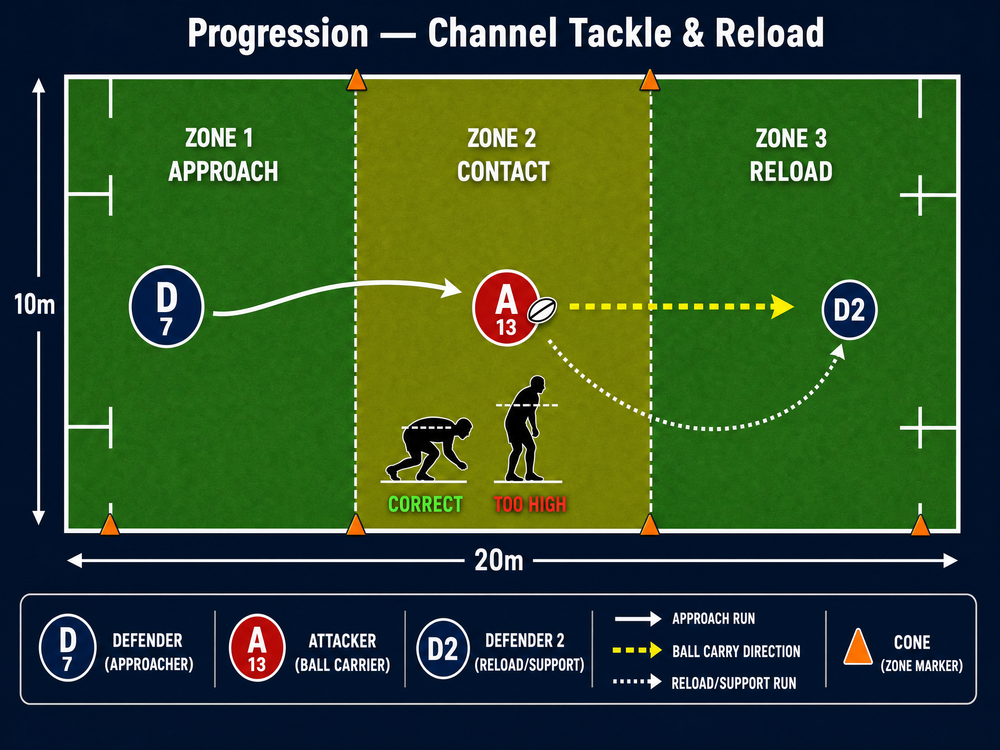
- Mark three distinct zones: a 5m Approach Zone, a 5m Contact Zone, and a 5m Reload Zone.
Player Positions:
- Divide players into pairs (one Attacker, one Defender).
- Position Defenders (D1-D4) in a vertical line on the left side of the grid, spaced 3m apart.
- Position Attackers (A1-A4) in a vertical line on the right side, facing their corresponding defender across a 5m gap.

3. Step-by-Step Instructions
- Initial Alignment: The Defender and Attacker start 5m apart, facing each other. The Attacker holds the ball in two hands.
- The Approach: On the coach's whistle, the Defender advances toward the Attacker, closing the space quickly but maintaining balance.
- Sinking the Hips: At 2m away from the Attacker, the Defender must aggressively drop their body height, ensuring their hips are below their shoulders and their eyes are looking at the target (the Attacker's core/thighs).
- Foot Placement: The Defender steps in close, placing their lead foot (the 'power foot') directly next to the Attacker's lead foot.
- The Contact: The Defender makes shoulder contact on the Attacker's thighs, wrapping both arms tightly around the legs (the 'ring of steel').
- The Drive: Using leg drive, the Defender pushes through the contact, taking the Attacker to the ground safely.
- The Reload: Once the tackle is complete, the Defender immediately bounces back to their feet, demonstrating a quick reload into a defensive ready position.
4. Key Coaching Points
- Eyes on the Target: Always look at what you are hitting. "See what you hit" prevents head injuries and ensures accuracy.
- Hips Below Shoulders: This is the non-negotiable rule of tackling. A low center of gravity provides stability and power.
- Foot in the Hoop: The lead foot must step close to the ball carrier to close the distance and establish a strong base.
- Cheek to Cheek: The tackler's cheek should be tight against the ball carrier's thigh/glute to ensure the head is in a safe position behind the runner.
- Wrap and Squeeze: A strong, tight arm wrap prevents offloads and secures the tackle.
5. Common Mistakes
- Dipping Too Late: Waiting until the moment of impact to drop body height, resulting in an upright tackle and loss of power.
- Reaching: Lunging with the arms instead of moving the feet close to the ball carrier, leading to weak arm tackles.
- Head in Front: Placing the head across the ball carrier's body rather than safely behind, drastically increasing the risk of head/neck injury.
- Stopping Feet on Contact: Failing to drive the legs through the tackle, allowing the ball carrier to dictate the collision.
6. Variations & Progressions
Progression 1: Channel Tackle & Reload
Introduce movement. The Attacker jogs down a 10m channel. The Defender approaches from the side, makes a profile tackle focusing on body height, and immediately reloads to defend a second supporting runner.
Progression 2: Defensive Line Integration
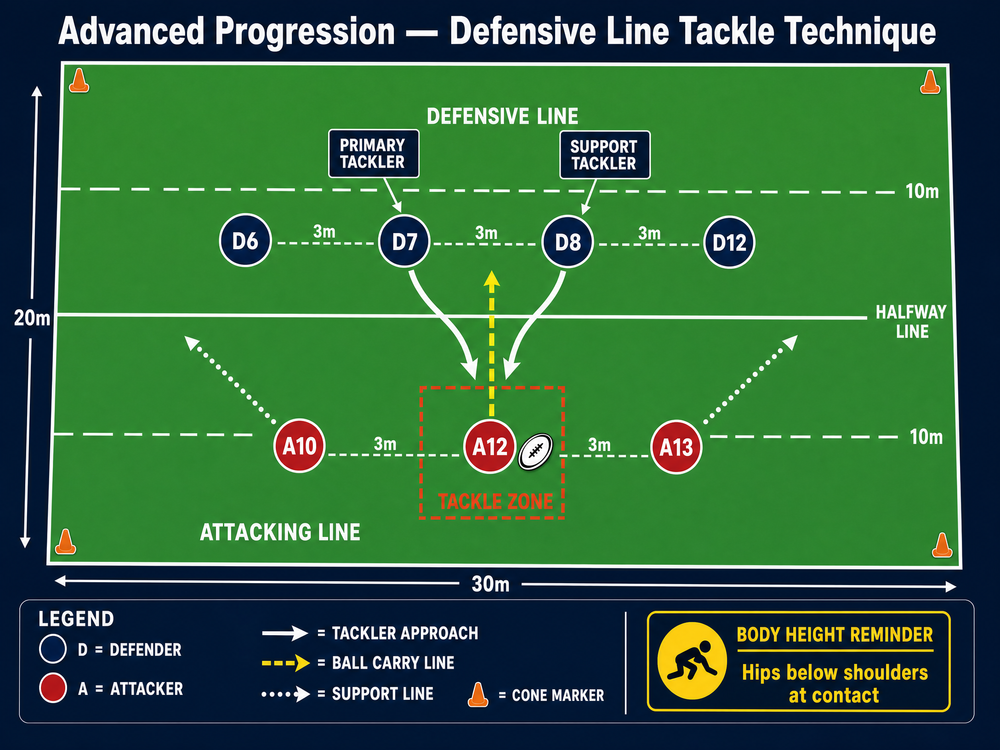
Move to a 30m x 20m grid. Set a defensive line of 4 players against 3 attackers. Practice line speed and two-man tackles, where the primary tackler goes low (hips below shoulders) and the support tackler targets the ball to prevent the offload.
7. Age Adaptations
- Under 8s - Under 10s: Focus entirely on the "Cheek to Cheek" and "Ring of Steel" concepts from a static kneeling or walking pace. Use tackle bags instead of live players to build confidence.
- Under 12s - Under 14s: Introduce the 5m approach and focus heavily on the transition from running to sinking the hips. Emphasize safe head placement.
- Under 16s - Open Grade: Run the drill at full game speed. Incorporate the reload phase and secondary support runners to simulate live match intensity.
