

Netball
Mastering the Dodge and Lead: A Comprehensive Netball Drill
Learn how to teach explosive dodging and sharp leading to help your players consistently lose their defenders and create strong passing options.

What you need
2-3 netballs, Bibs (two contrasting colours), Throwdown markers/cones (optional)
1. Overview
The ability to effectively lose a defender and create a clear passing option is a fundamental skill in netball. The 'Dodge and Lead' drill is designed to develop explosive change of direction, sharp acceleration, and precise timing. This drill transitions players from basic, uncontested movements to dynamic, game-like scenarios where they must read the defender and the ball carrier. It is an essential component of any attacking training session, ensuring your team can reliably bring the ball down the court and into the shooting circle.
2. Setup

To run this drill effectively, you will need the following equipment and court setup:
- Equipment: 2-3 netballs, bibs (two contrasting colours for attackers and defenders), and optionally, flat throwdown markers or cones to indicate starting positions.
- Court Setup: The drill utilizes the full width of the court (15.25m) and initially focuses on the centre third, before progressing to utilize the full length (30.5m).
- Player Positions: You will need a minimum of 6 players to run the base drill effectively. Assign players to specific positions (e.g., C, WA, GA, GD, WD) to make the practice game-specific.
3. Step-by-Step Instructions
Phase 1: The Basic Dodge & Lead
This initial phase focuses on the mechanics of the dodge and the timing of the lead without full defensive pressure.

- Position the Centre (C) with the ball at the centre circle.
- Place the Wing Attack (WA) on the transverse line, with a Wing Defence (WD) applying passive pressure (shadowing).
- On the whistle, the WA drives hard towards the sideline for 2-3 steps. This is the 'dodge'.
- The WA must plant their outside foot firmly and push off explosively, changing direction sharply back towards the centre corridor.
- As the WA makes this decisive change of direction, the C delivers a strong, flat pass into the space the WA is leading into.
- The WA receives the ball on the run, lands cleanly (preferably on their outside foot), and pivots to face down the court.
- Reset and repeat, ensuring players practice dodging both left and right.
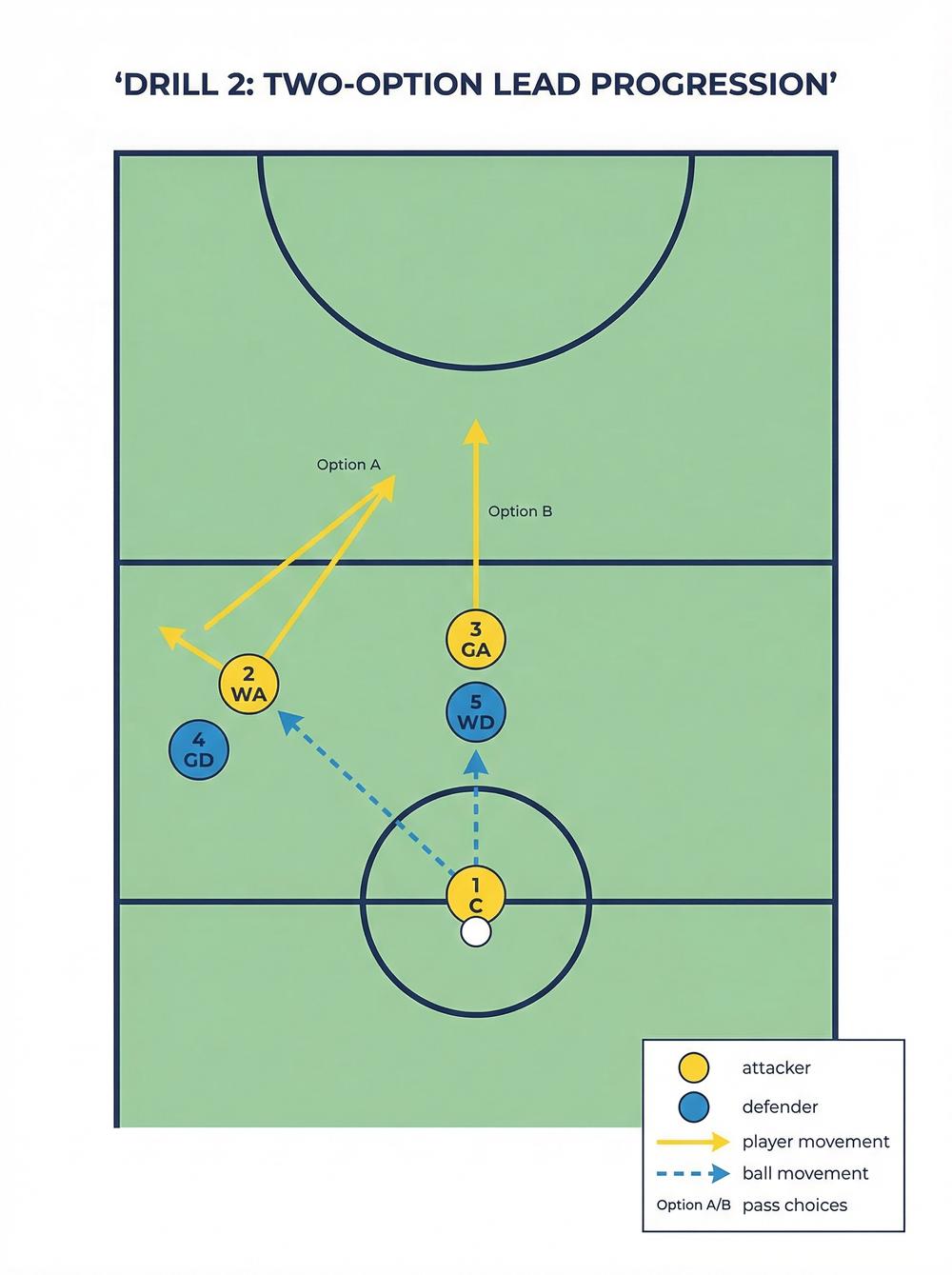
Phase 2: Two-Option Lead Progression
Once the basic movement is mastered, introduce decision-making for the ball carrier and simultaneous movement from multiple attackers.

- Maintain the setup from Phase 1, but add a Goal Attack (GA) starting near the top of the goal circle, marked by a Goal Defence (GD).
- The C starts with the ball at the centre circle.
- On the whistle, both the WA and GA initiate their movements simultaneously.
- The WA performs a dodge and lead as practiced in Phase 1.
- The GA performs a straight, hard lead towards the C, or a dodge and lead into the pocket.
- The C must read the movements, identify which attacker has successfully lost their defender, and deliver an accurate pass to the best option (Option A or Option B).
- The receiving player lands, pivots, and the drill resets.
Phase 3: Full-Court Chain Lead
This final phase integrates the dodge and lead into a continuous, full-court transition, simulating a match scenario from a defensive turnover or baseline throw-in.
- Set up attackers and defenders across the full length of the court (GK, GD, C, WA, GA).
- The drill begins with the Goal Keeper (GK) in the defensive goal circle.
- The Goal Defence (GD) performs a dodge and lead to receive the first pass from the GK.
- As the GD receives the ball, the Centre (C) must time their dodge and lead to receive the next pass in the centre third.
- This chain continues, with the WA and then the GA each performing a dodge and lead to receive the ball progressively down the court.
- The focus is on timing: each player must wait for the player behind them to secure the ball before initiating their final explosive lead.
4. Key Coaching Points
- Explosive Push-Off: The dodge must be convincing. Players need to drop their centre of gravity, plant their outside foot hard, and push off explosively in the new direction.
- Eyes on the Ball: Attackers must get their head around quickly after the dodge to locate the ball carrier and present a clear target with their hands.
- Strong, Flat Passes: The ball carrier must deliver the ball out in front of the leading player, into the space they are moving towards, not where they currently are.
- Timing is Everything: Attackers must not lead too early. They should initiate their final explosive movement just as the ball carrier is ready to release the pass.
- Clean Landing: Emphasize landing on the outside foot (the foot closest to the sideline) to naturally open the hips and shoulders down the court for the next pass.
5. Common Mistakes
- Rounding the Dodge: Players often curve their run instead of making a sharp, angled change of direction. This allows the defender to easily stay with them.
- Leading Too Early: Initiating the lead before the ball carrier is looking or ready to pass results in the attacker running out of space or holding their position, making them easy to intercept.
- Passing to the Player, Not the Space: Ball carriers often pass directly at the attacker, forcing them to break their stride, rather than passing into the space ahead of them.
- Weak First Step: If the initial drive (the dodge) lacks intensity, the defender will not commit, making the subsequent lead ineffective.
6. Variations & Progressions
- Add Defensive Pressure: Progress from passive shadowing to full, contested one-on-one defence. Require the attacker to work harder to get free.
- Introduce a 'Dummy' Pass: Encourage the ball carrier to use a fake pass to shift the defender before delivering the ball to the leading attacker.
- Restrict Court Space: Use cones to narrow the playing channel, forcing attackers to be more precise with their angles and timing.
7. Age Adaptations
- Under 8 / Under 10: Focus heavily on the basic footwork of the dodge (plant and push). Use static passing initially, then introduce slow movement. Keep the distance between players short.
- Under 12 / Under 14: Introduce the timing aspect—waiting for the ball carrier to look before leading. Begin incorporating passive defence to encourage sharp changes of direction.
- Under 16 / Open: Run the drill at high intensity with full defensive pressure. Focus on the full-court chain progression and complex decision-making for the ball carrier under fatigue.
